

Mario 101: Part Eight
Yes, I’ve decided to give Mario 101 an extra life: fifteen more bits that you maybe didn’t know about the Super Mario series and which might make you think a little differently about these games.

On the whole, the original project ended up being fairly successful. I wanted something that could include bits that I didn’t think merited their own post as well as stuff that could point readers back towards what I’ve already written. Not only did it do that, but even more importantly, people seem to be engaging with it. And thanks in part to my thread on Bluesky, Mario 101 has continued to attract new readers long beyond the shelf life of a typical post on this site.
I know I mentioned this toward the end of the original project, but having 101 items was always an arbitrary goal. In the last section especially, I fudged it with extra bits, and even then a whole lot of ideas ended up on the cutting room floor. Now it’s been long enough that I feel like I can go back and reconstitute these into something new. Your mileage may vary, I guess. Unlike the previous parts, this one will jump around instead of following a given timeline or focusing on a specific game. However, I feel like that won’t be much of a problem if you’re someone who made it through the first seven parts of this already.

102. The Super Mario series began in Japan, but it’s been informed by the west more than you might think.
Of everything I’m including in part eight, this is probably the only grand, series-sweeping idea. And I have to thank Patrick and Mark from Nintendo Cartridge Society, because this is something I hadn’t put together myself until we were talking about Mario 101 for the episode they did about it. Those of us outside Japan who enjoy these games probably think of them as being Japanese, and that’s certainly true, but a lot of the Super Mario canon — especially things established early on — actually came about as a result of a back and forth between Japan and the U.S.
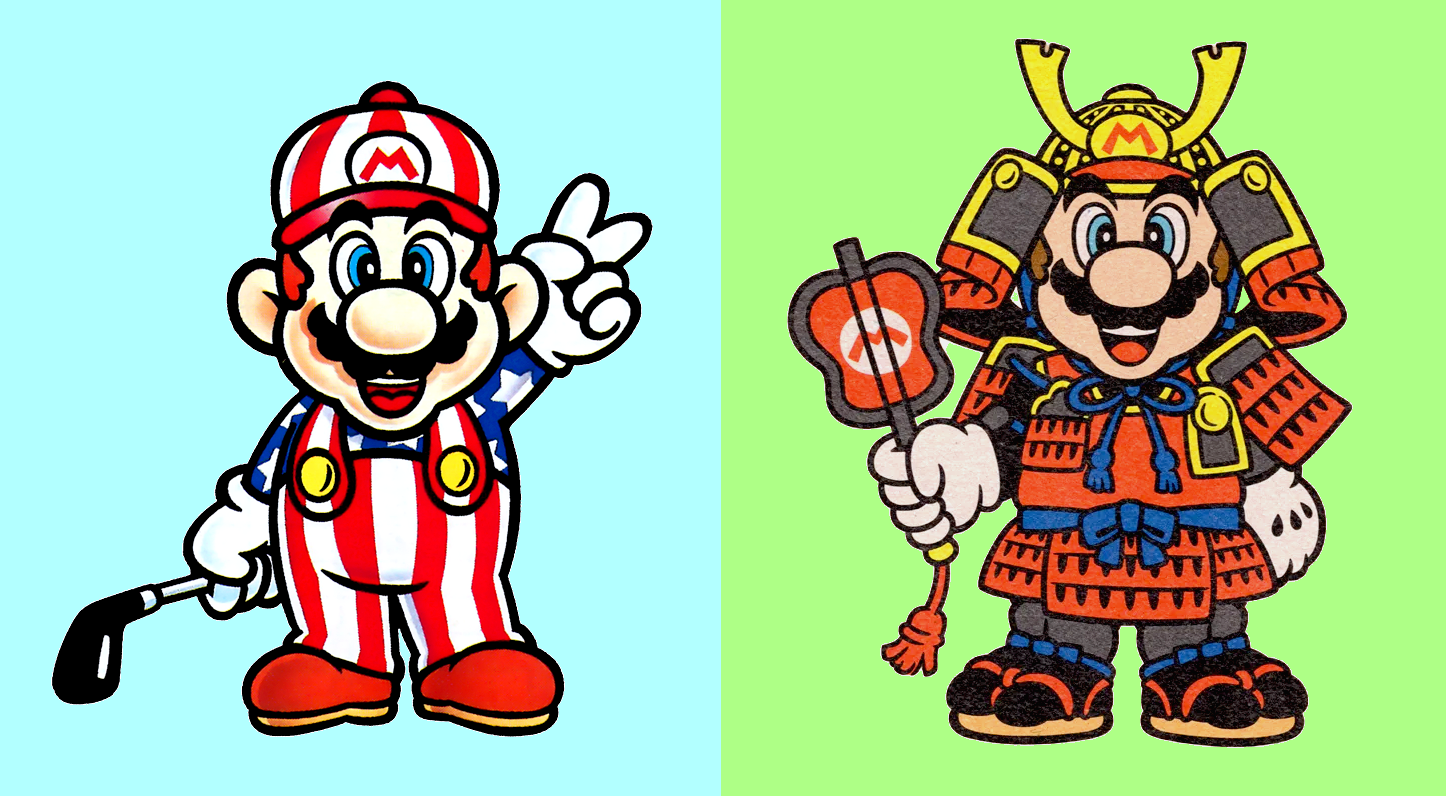
Those of us who began in the 8-bit or 16-bit era, for example, probably remember when Nintendo decreed that the west would no longer know the princess of the Mushroom Kingdom as Toadstool but instead as Peach, the name she’d had in Japan since her introduction in 1985. At the time, this seemed like the Japanese interpretation was the “correct” one, and it was overwriting how English-speakers had come to know the princess for an entire decade. The real story is more complicated, of course, but in presuming that the American perspective mattered less, I wasn’t accounting for how much Nintendo of America employees shaped the series. Most notably, it was in Washington state, not Kyoto, where Mario got his name, and the fact that it happened there is actually a great potential solution to the problem I pose in the very first Mario 101 item: Perhaps Shigeru Miyamoto has so many variations on the story about Mario Segale because he, not being in the room at the time, only ever heard of the actual events second-hand.
Other characters whose official, canonical names originated outside Japan include Pauline, the Koopalings, as well as Diddy and Dixie and the rest of the Donkey Kong Country crew, to say nothing of the fact that Peach’s renaming did not bring about a similar renaming of Bowser, who still uses his western name outside Japan despite the fact that we don’t know where it comes from. And in the earliest days of work on Super Mario Bros., Bowser was called Boss Creeper even though the turtle enemies in Mario Bros. were only called Shellcreepers outside Japan, because even back then, Nintendo of Japan was deferring to naming conventions in the west. And then, of course, there are the western-created entities that come up again and again when discussing the origin of Mario and his games: Popeye, King Kong, Alice in Wonderland (debatably but also come on, Shiggy) and, you know, broad stereotypes of Italians. All of these were selected by Nintendo’s Japanese employees to become part of the fabric of these series, and that’s important because it shows that the western influence doesn’t need to come as a result from western creatives.
So yes, Mario was born in Japan, but much of his identity was shaped elsewhere. In fact, I wouldn’t say he belongs to any one real-life landmass, because it was in the action of criss-crossing the Pacific that he became what he is today.
103. And then there’s Spike — in the west and in Japan.
We’ve even got a fairly recent example of the western naming convention overriding the original Japanese one. In 2023, Wrecking Crew antagonist Foreman Spike lost his Japanese name in favor of standardizing his western one in all territories. Essentially, it was a reverse Princess Toadstool. To be fair, his Japanese name was problematic, and the character’s inclusion in The Super Mario Bros. Movie likely forced Nintendo’s hand in dropping it. The original name was ブラッキー or Burakkī, which would seem to be a Japanese rendering of “Blackie.”
I assume that name is in reference to the color of his beard, which is black in character art but appeared blue in pixel form in the NES Wrecking Crew. In Wrecking Crew ’98 did he donned some darker duds, seemingly in an effort to make it clearer why he was named Blackie, but the likely unintended result was that became a gay leather daddy.
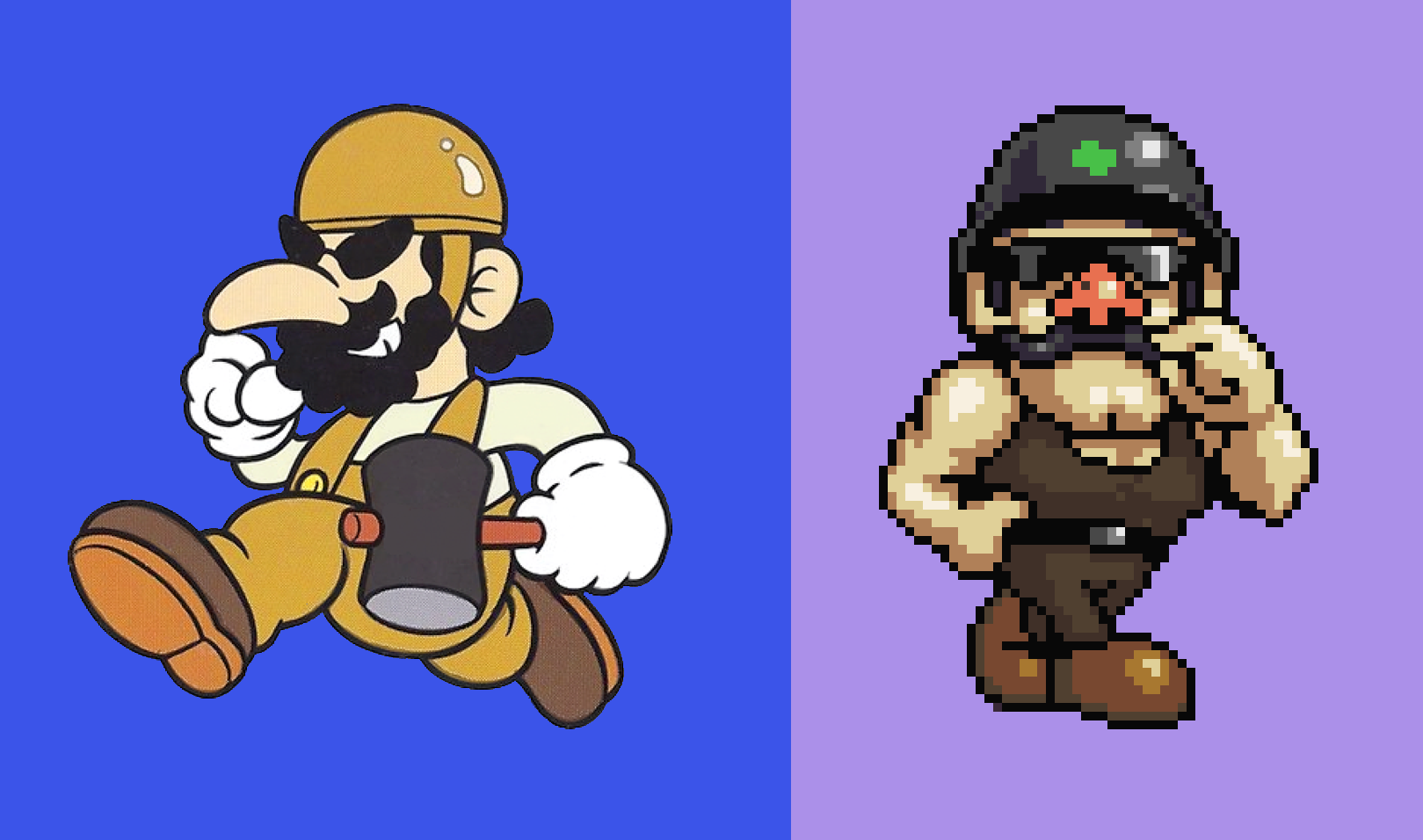
The official Nintendo tweet announcing the name change did not explain why his original name was dropped, but most of us who pay attention to such things presumed it had to do with the original name sounding like a racial epithet. However, the Pokémon Umbreon had and continues to have the same Japanese name. Some concluded that Nintendo may have wanted to eliminate confusion with these two characters they own, but that may be disproven by the next item in this series.
Before we get there, one quick note.
For reasons that are obvious if you know a thing about me, Foreman Spike is one of my favorite Super Mario C-listers, and I was bummed not to give him his own item in the original Mario 101 post. BTW, if you’re similarly pro-Spike, you may be interested to know that there’s ample evidence that Spike is a sort of proto-Wario — a fact complicated by his continued existence in a franchise that also features Wario.
104. But there’s also the other Spike.
English-speakers tend to refer to the Wrecking Crew character as Foreman Spike, hence the Super Mario Wiki page, but when Nintendo posted the announcement in Japanese about the character’s new name, he was just called him スパイク or Supaiku, no workplace title mentioned. This may have caused confusion, because the Super Mario series already had a character named Spike. First appearing in Super Mario Bros. 3, the other Spike is a generic Koopa enemy that coughs up spiked balls as an attack. And while this Spike was for years relegated to generic enemy status, he’s been getting playable roles in more recent years.
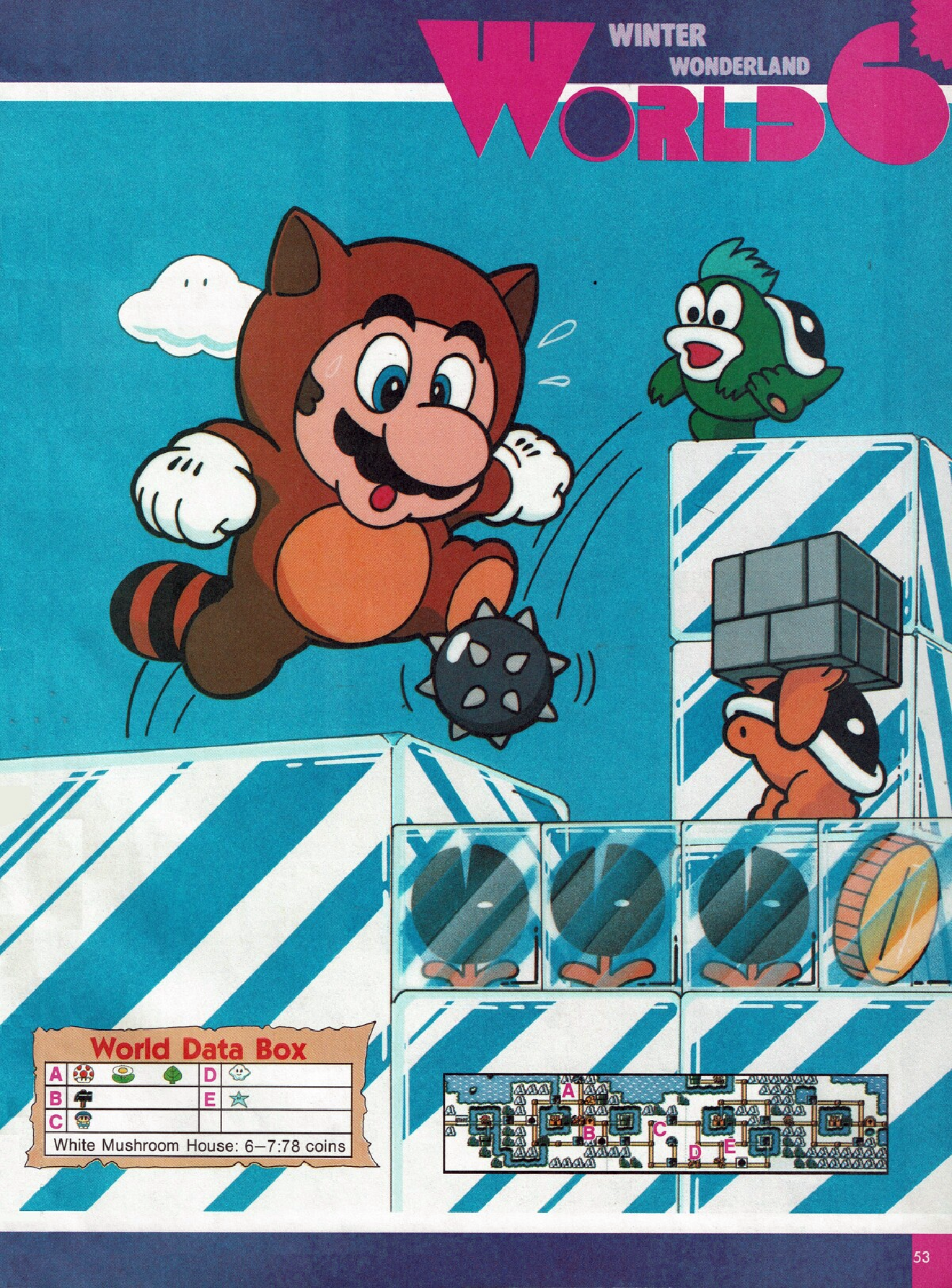
In fact, Spike is playable in Mario Kart World. If you told me that the Mario Kart game released after The Super Mario Bros. Movie was going to feature Spike as a playable character, I would have assumed it was buff, gruff Foreman Spike. It’s not. It’s this little guy. And it’s amusing to me that Foreman Spike’s name change does nothing to clear up any confusion about this enemy’s name.
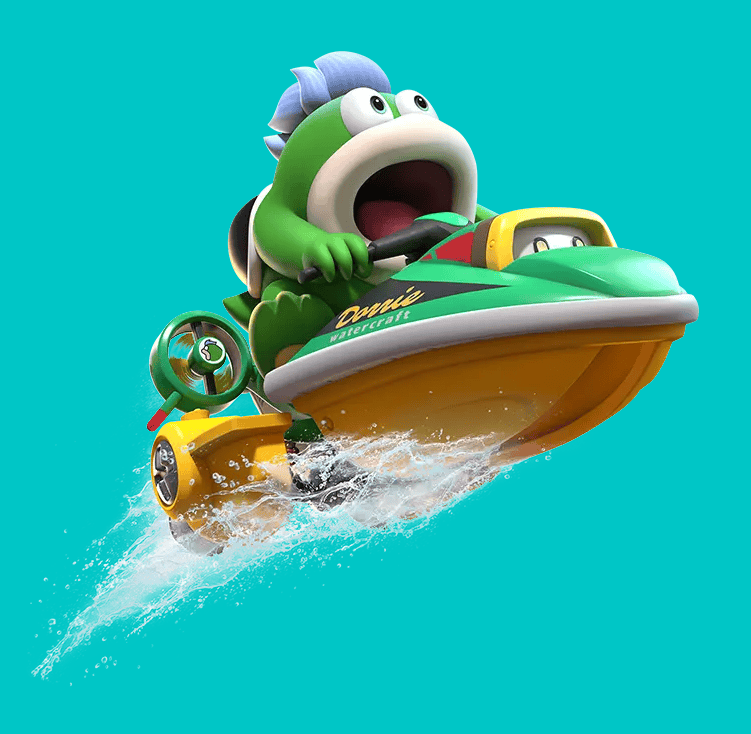
In Japanese, Spike is ガボン or Gabon, possibly from がぶがぶ or gabugabu, the Japanese onomatopoeia for guzzling or gobbling. Many Super Mario enemies have different names in the west, of course, but for whatever reason this name change makes it especially difficult to know when you’re encountering some variation of Spike in other games. Yoshi’s Island, for example, features him in a single stage, but the localized English version calls him Mace Penguin, perhaps because of his resemblance to Bumpty, who looks a lot more like a penguin because he is one.
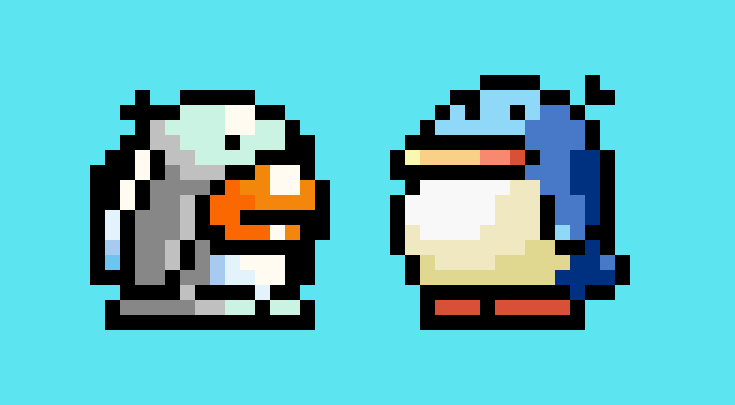
Left: Spike. Not a penguin. Right: Bumpty. A penguin.
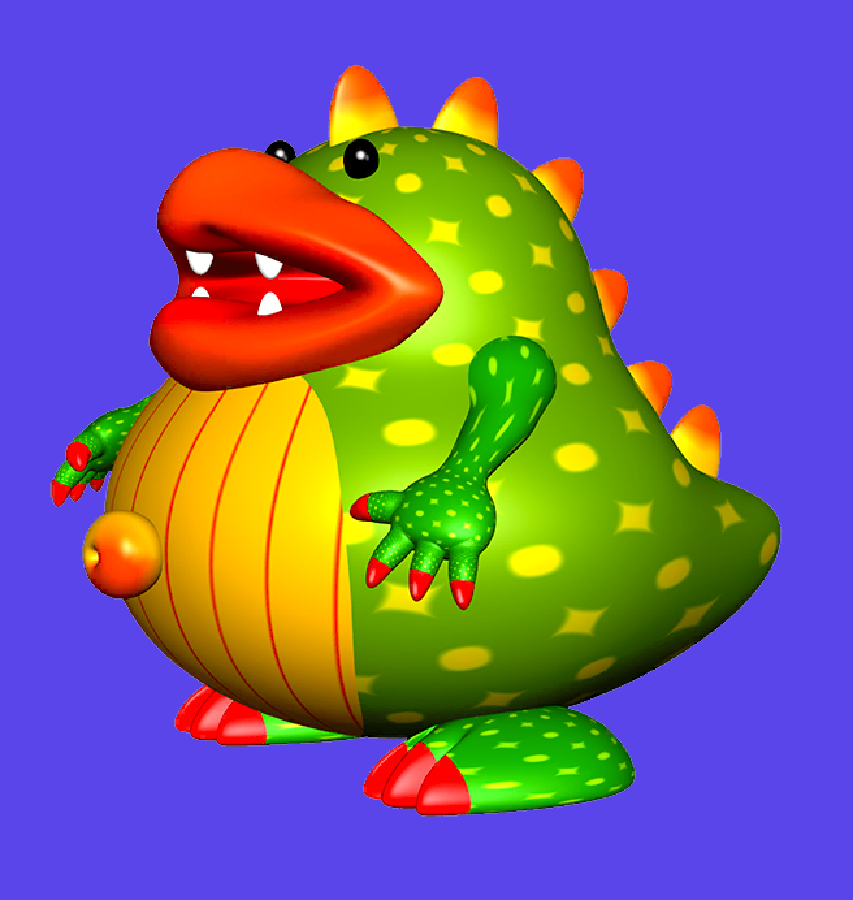
Yoshi’s Story features Spike looking somewhat different than he did in Super Mario Bros. 3 and then further confuses the matter by keeping the Japanese name, possibly because yet another enemy was given the name Spike. And then Don Bongo, a boss character who sports distended lips and a belly button, is meant to be a cross between a supersized Spike and a Blargg. Don Bongo’s Japanese name, ドンババ or Don Baba, makes it somewhat more clear, at least, that he has some Blargg heritage; according to the Super Mario Wiki, the second part of his name would seem to be a nod to Blargg’s Japanese name, ウンババ or Unbaba. There’s actually no part of his name that would seem to reflect Spike’s Japanese name, but you can’t deny that the basic body shape seems based on Spike.
This gets a lot weirder in Yoshi and the Mysterious Book, released earlier this year. Among the creatures featured in the game is a towering, mountain-sized creature named Thudd in English and ヤマズシン or Yamazushin in Japanese — yama (山) meaning “mountain” and zushin (ズシン) representing the noise of something heavy hitting the ground. This does connect with the Yoshi’s Story boss, as the don in his name was probably the Japanese don (どん), also meaning more or less “thud.” What’s more, this latest and biggest variation on the Spike enemy actually acts more like the original than the Yoshi’s Story variation does. Thudd swallows Yoshi whole and then spits him out at a high speed, propelling Yoshi to parts of a level he can’t otherwise, but Thudd is also specializing in projectiles the way the original, spiked ball-spitting Spikes did in Super Mario Bros. 3.
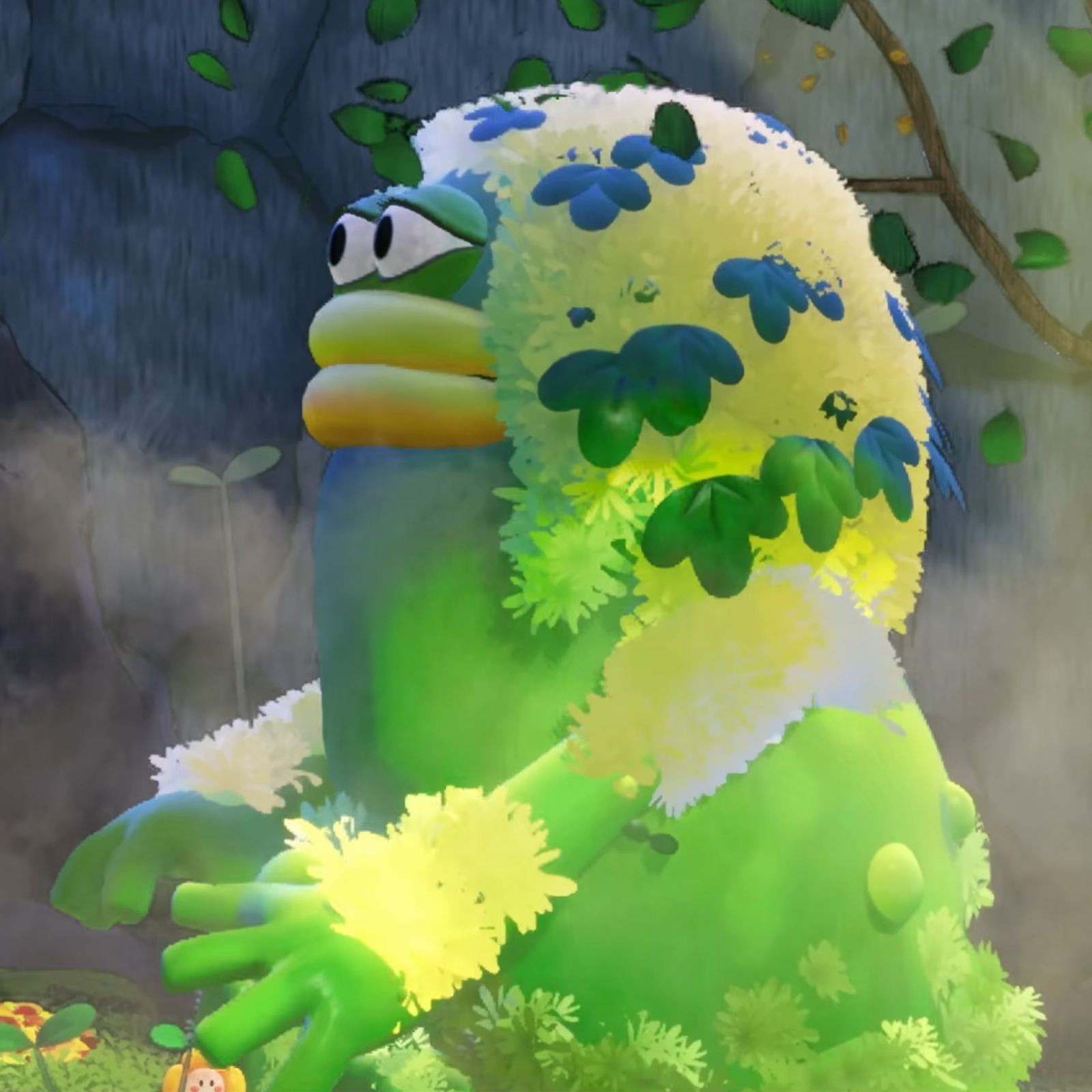
Again, he’s almost not recognizable as a member of the same enemy family, because Yoshi and the Mysterious Book pushes him to the extreme aesthetically while also bringing him back to basics mechanically.
(If I may, a brief plug for Yoshi and the Mysterious Book. Don’t sleep on it. It’s great, and it’s my favorite Yoshi game since Yoshi’s Island.)
< Support this site: on Patreon! • on Kofi! >
105. Blargg = Nep-Unit, colors notwithstanding.
So yeah, with a series that lasts this long, enemy characters can sometimes grow and change a lot. Take Blargg, the dinosaur-looking monster in Super Mario World who surges up from lava in an effort to take a bite out of Mario. In one sense, this original design lives on in the form of dragon bosses such as the Czar Dragon in Super Mario RPG and Hooktail in Paper Mario: The Thousand-Year Door. In fact, the latter’s Japanese name reflects this: ゴンババ or Gonbaba, with the first syllable presumably coming from the last in dragon. She’s a dragon version of a Blargg, basically.
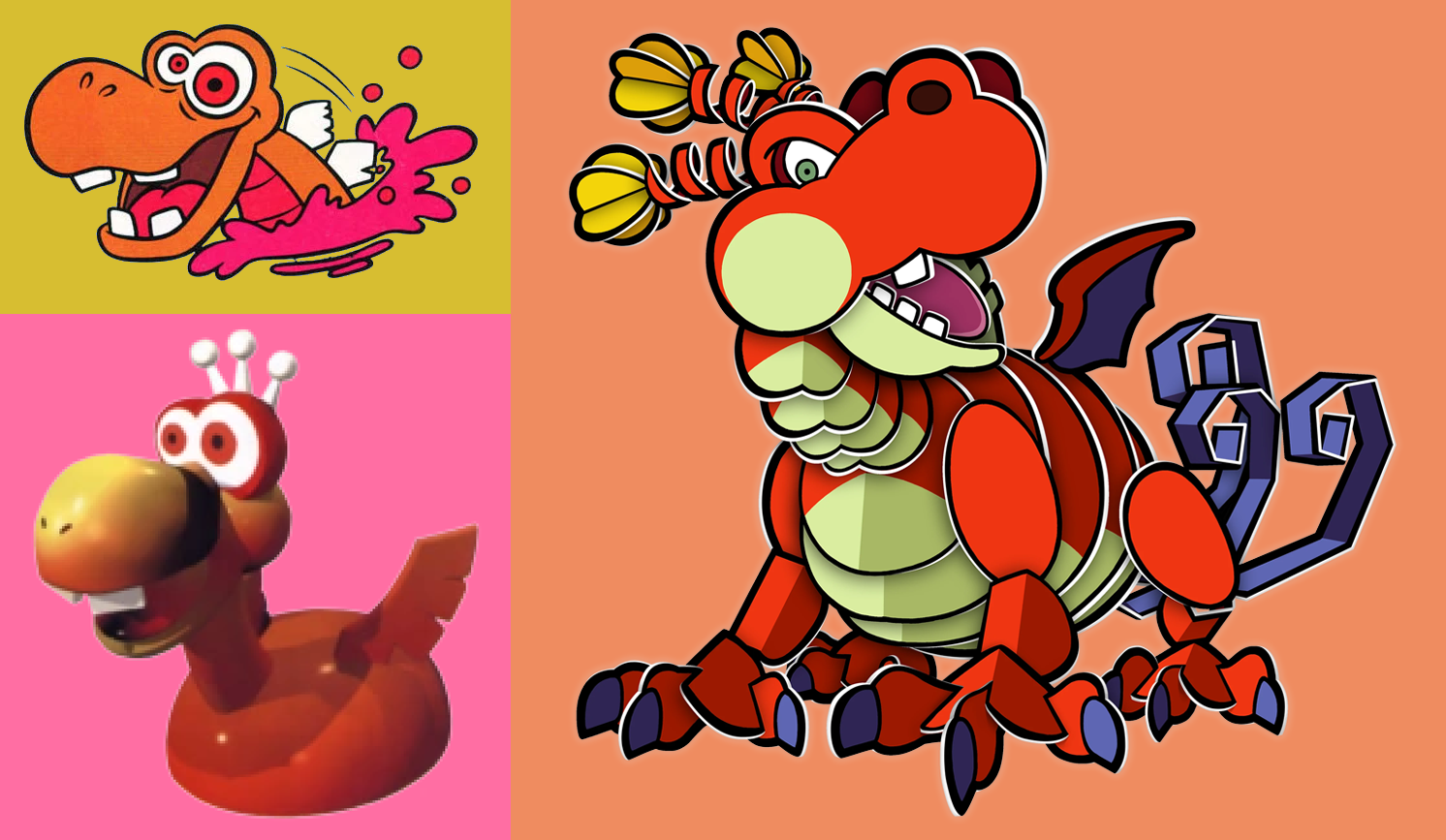
Clockwise from top-left: Blargg, Hooktail and the Czar Dragon.
When this enemy returns for Yoshi’s Island, however, it looks so different that the localization team decided to just treat it as a wholly separate creature. It’s nonetheless famous in the west, however, because it appears on the box art.
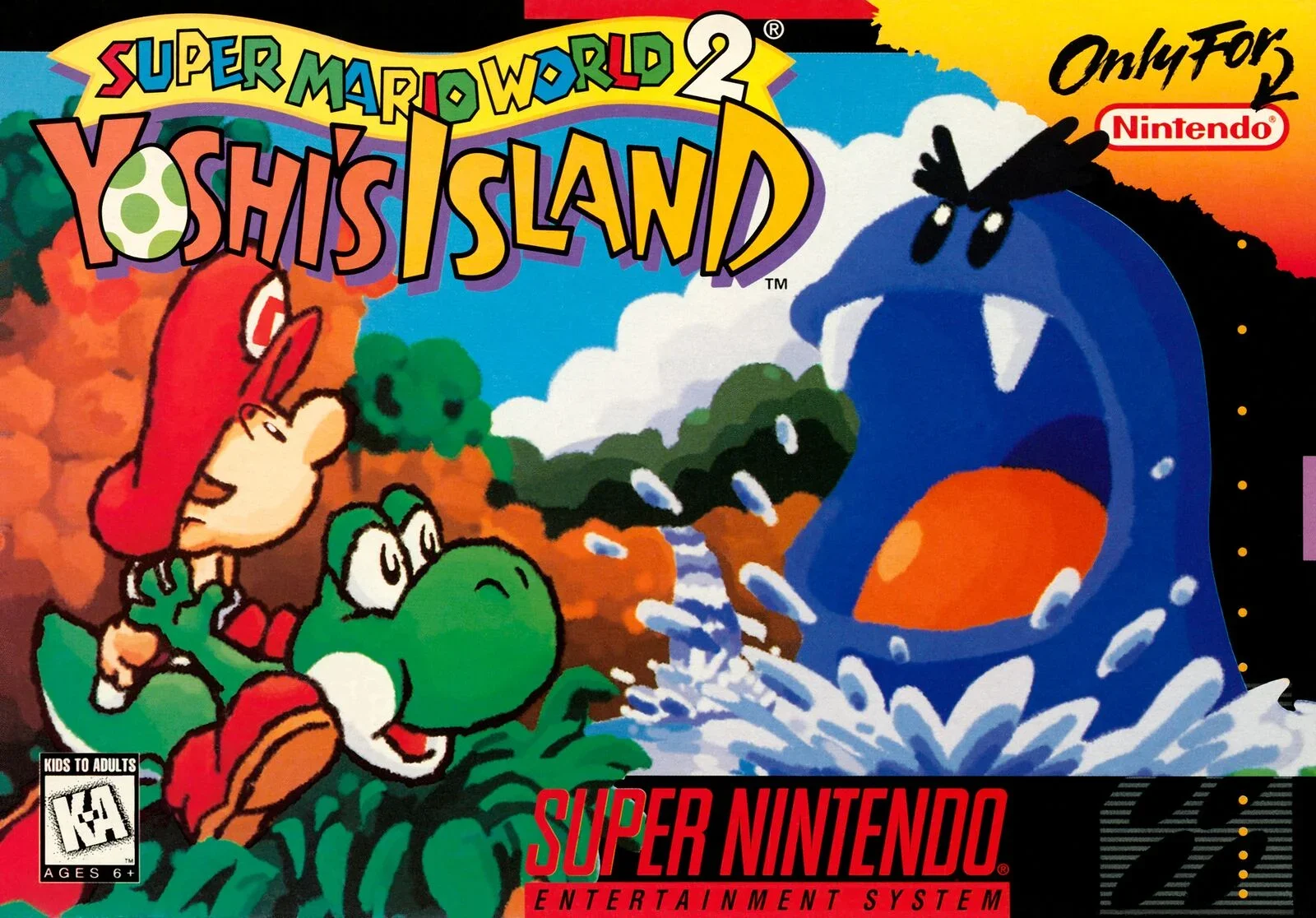
Yes, Nep-Enut, the blue water beast doesn’t look much like any kind of dinosaur. The only connection to the Super Mario World version is that this one lies in wait until you get close and then emerges from a body of liquid — in this game water, but lava in the previous game. Both Nep-Enut and Blargg have the same Japanese name, ウンババ or Unbaba, and because it’s featured in the title of level 3-3 — in English “Nep-Enut’s Domain” but in Japanese “Blargg’s Home Jungle” — Japanese players have more of a chance to realize that this big blue thing is actually the same as the smaller, dinosaur-shaped red thing in Super Mario World. Yoshi’s Island also features a red version of Nep-Enut that acts identically — called Gargantua Blargg in English and ビッグウンババ or Biggu Unbaba in Japanese.
The connection is made clearer in Yoshi’s Story, where the more blob-shaped version of Blargg appears again, this time retaining the original name, even though it has shed basically all its dino qualities. It’s basically a full-time squishy weirdo now. I should point out that the translucent creature appearing in Yoshi’s Island and, later, Super Smash Bros. as well is also apparently a Blargg relation. I know this guy from Masahiro Sakurai highlighting his presence on the Smash Bros. Dojo website, where he dubbed him “the whimsical support ghost.”
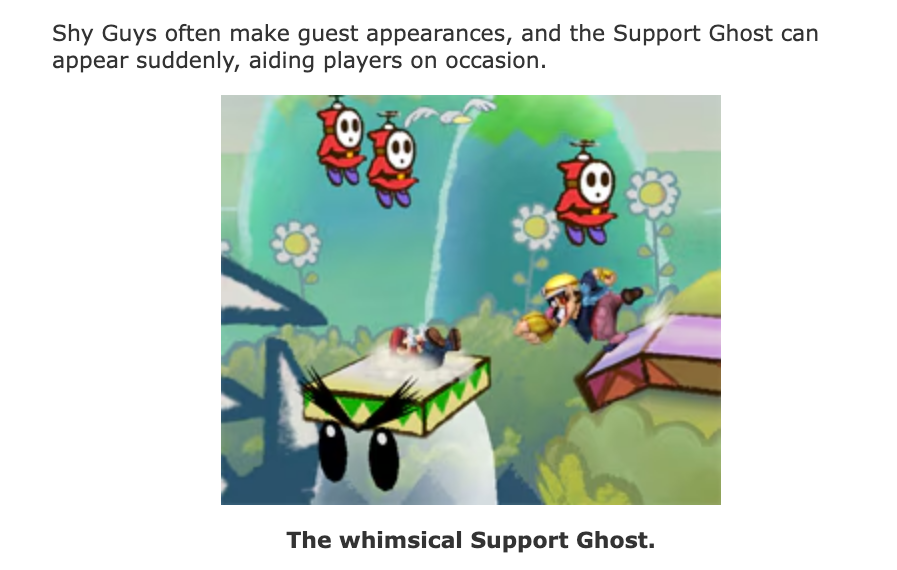
For reasons I don’t understand, the official name for this entity in the west is Blarggwich. The Japanese name is a lot more sensible: ウンババリフト or Unbaba Rifuto — essentially Blargg Lift.
Nep-Enut’s name, of course, is a lazy anagram of Neptune, but you knew that.
106. We’ve never met Mrs. Bowser, but we have technically met his female counterpart already.
Back in a Koopaling-focused item, I mentioned the only official word on Bowser’s baby mama. It’s a 2012 interview in which Shigeru Miyamoto makes the following statement: “Our current story is that the seven Koopalings are not Bowser’s children. Bowser’s only child is Bowser Jr., and we do not know who the mother is.” Is that not… chilling? It just makes me feel like the female turtle-dragon with whom Bowser conceived Bowser Jr. has been missing all this time, and maybe she’s going to be the subject of a true crime podcast one day.
I did a post on Mrs. Bowser and how fandom frequently wants to insert a female counterpart for the series big bad. The closest this came to being realized in a game happened during the lead-up to the release of Paper Mario: The Thousand-Year Door. People saw screenshots of Flurrie, one of the companions Mario has in the game, and assumed she was the ghost of Bowser’s dead wife because she looks like a combo of Wendy and Ludwig, who at the time were still canonically Bowser’s offspring.

Obviously, that did not end up being the case, though how much better would Thousand-Year Door be if you had the ghost of Bowser’s dead wife in the party? However, Super Mario Odyssey did introduce a female version of Bowser, in a sense, in Madame Broode, the leader of the evil rabbit clan planning Bowser’s wedding to Peach. In regards to the structure of her face especially, she looks just like Bowser in the way that Edna Turnblad looks like John Travolta. And then below the face, it’s as if Bowser is padding to add in some curves he doesn’t naturally have. Madame Broode even sports her own version of Bowser’s spiked bracelets, just in gold because she’s a classy lady and also she wants to coordinate with her pet, Chain Chompikins.

Madame Broode even has her own version of the Koopalings in the Broodals, although I’m fairly certain she’s not meant to be their mother so much as their boss — but then again, by the time Super Mario Odyssey released in 2017, the Koopalings were also officially Bowser’s hired hands and no longer his kids.
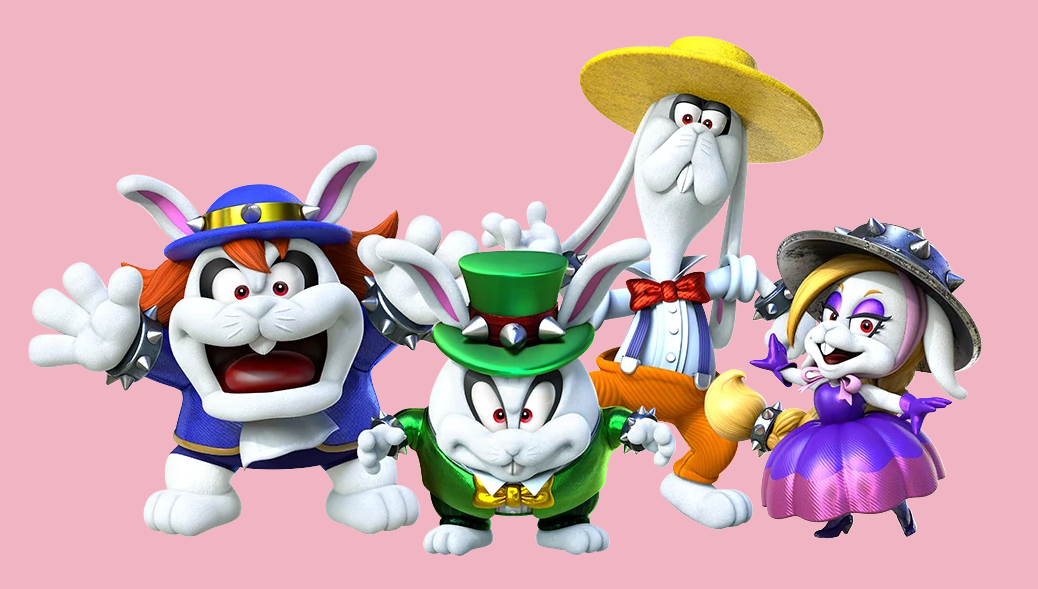
Left to right: Spewart, Topper, Rango and Hariet. While the latter three look fairly original in their designs, Spewart has the Koopa family facial structure, making him look a little like Morton, Roy or Ludwig. He also has that hair… Hmm…
When it comes to adding characters to spinoffs, Nintendo historically has preferred ones that look more or less familiar, so I was surprised when Madame Broode and her underlings did not turn up in any game released after Super Mario Odyssey. In my head, Broode looked enough like Bowser that she’d be a lock for, say, the heavyweight class in a new Mario Kart game, but no such luck so far. But then again, Odyssey featured more than a few new characters with cool designs that have yet to re-appear.
107. Boom Boom : Toad :: Pom Pom : Toadette?
Throughout the project, I have mentioned how many recurring Super Mario characters may not always be specific, unique individuals. Toad, Yoshi, Birdo and Kamek all have this issue, but an interesting complication of this phenomenon is that “spinoff” versions of these characters tend to be treated differently. For example, as far as we’ve seen in the games, there is only one Toadette; it’s not that all female Toads are all Toadettes, if that makes sense. Along similar lines, it’s not always clear if you’re dealing with *the* Kamek or an identical, generic Magikoopa, as in Japanese, both are カメック or Kamekku, and there is not a differentiation the way there is in English-speaking territories. That’s not the case for female variations, of which there have been two: Kammy in the Paper Mario games and Kamella in Super Mario Galaxy. (Curiously, the latter is just ボスカメック or Bosu Kamekku in Japanese, with no specific mention of gender, even though she is clearly designed to scan as female.)
This would seem to also be the case for Boom Boom, the recurring boss character who debuted in Super Mario Bros. 3, and his female counterpart, Pom Pom, who debuted in Super Mario 3D Land. Because Boom Boom is usually fought one-on-one, à la one of the Koopalings, it would seem like he is supposed to be a specific, recurring boss, but then again he shows up in multiples in Mario Kart World, so perhaps he is actually generic they, existing in plural like Goombas and Koopa Troopas.
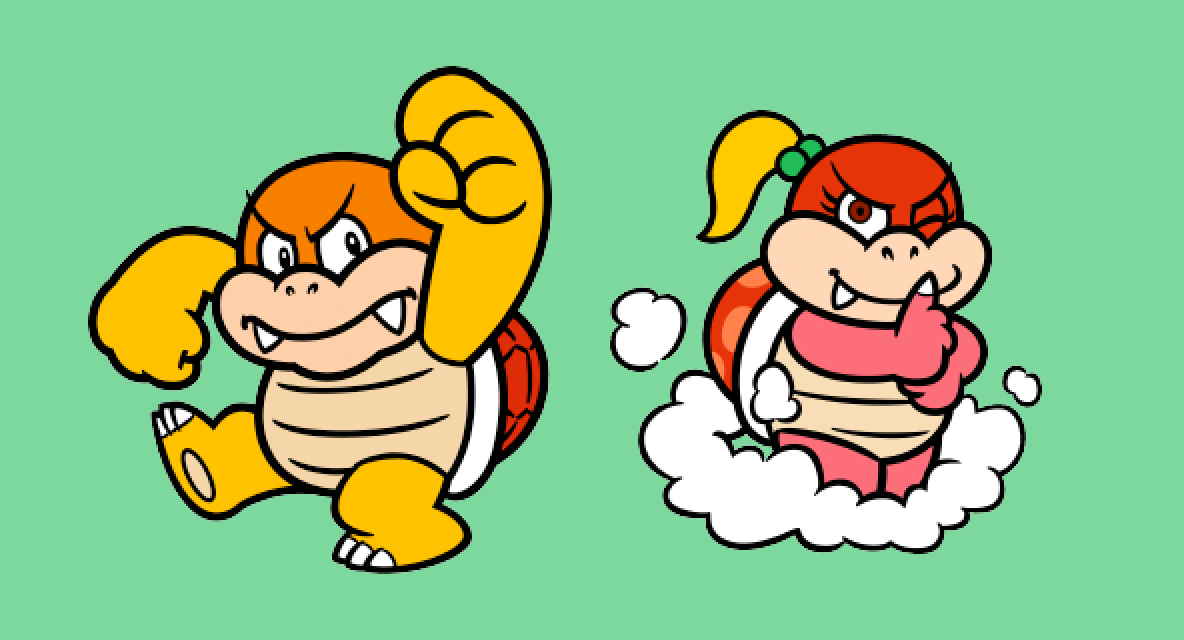
Pom Pom does not exist in multiples, at least as far as we’ve seen in the games. And that’s mostly how official Nintendo texts treat her. Both the Japanese and North American websites for Super Mario 3D Land, for example, seem to treat Boom Boom and Pom Pom both as singular characters.
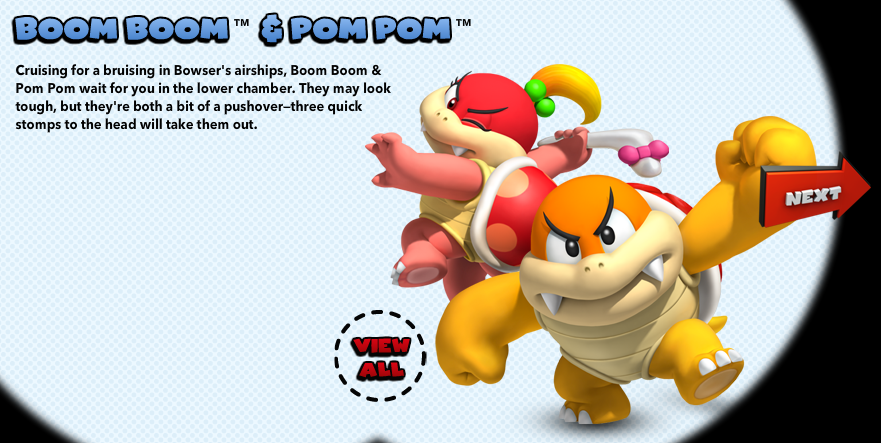
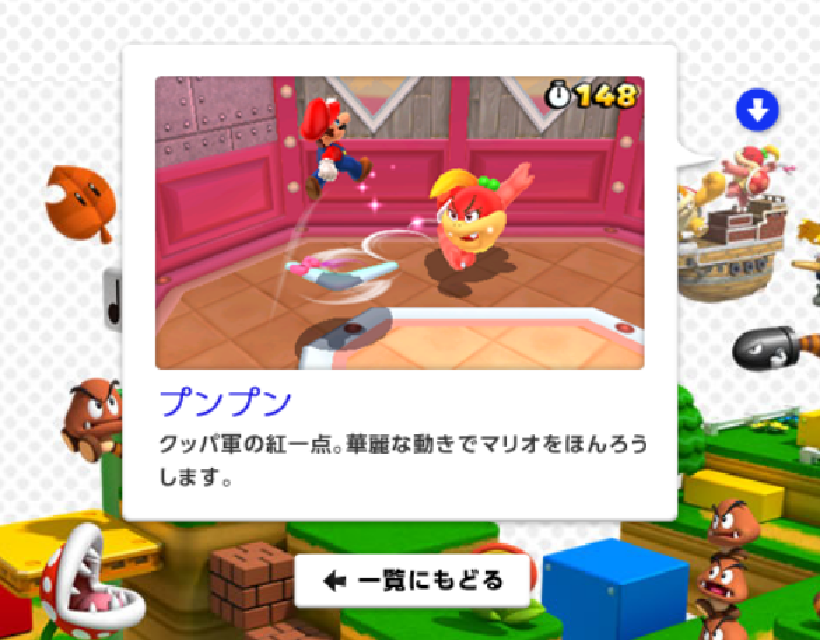
Translation: “The only female member of Bowser’s army, she outmaneuvers Mario with graceful movements.”
However, the Super Mario Wiki has its own section dedicated to Pom Pom’s identity issues, and it points that the name of the Mario Maker 2 stage “Target: A Single Pom Pom” would seem to imply that the character exists not as a specific individual, hence why it’s necessary to specify that she is single in this context. And if that’s not the type of exacting pedantry that we come to dedicated wikis for, I don’t know what is.
I’ll also add that Pom Pom’s English name is a triumph of localization. It sounds like Boom Boom’s name while also naming a decorative embellishment that does, in fact, suggest femininity. Better yet: Her Japanese name, プンプン or Punpun, can mean both “angrily” and “strong-smelling.”
108. Toadette may only be play-acting as Peachette.
In 2019, Nintendo complicated our understanding of Toads and Toadette with New Super Mario Bros. U Deluxe. A remake of a 2012 game that featured Mario, Luigi and blue and yellow Toads, this one not only added Toadette to the roster of playable characters but also gave her the Super Crown, a special item that turned her into Peachette, a hybrid of herself and Princess Peach.
It was characteristically Nintendo to drop something like this without any explanation for what it meant for the Super Mario universe, if it meant anything at all. But more than a few longtime fans of the series wondered if the Toadette-to-Peachette transformation might solve the mystery of why a humanoid, non-mushroom person such as Peach should be the reigning monarch in the Mushroom Kingdom. Could the Super Crown mean that Peach herself is an ascended Toadette? Or, to use the parlance that appears throughout this part, a Boss Toad?

Of course! Not at all! Maybe! It’s Nintendo so we’ll probably never know, and it might not even be something Nintendo considered in implementing Peachette in New Super Mario Bros. U Deluxe. More than anything else, the Super Crown was a way to make Toadette play differently from the regular blue and yellow Toads. It also allowed a very Peach-like facsimile to be playable in a Super Mario platformer that had already cast Peach as the damsel needing to be rescued at the end of the game. I would imagine that discussion of this new feature ended right there, and it’s quite likely that we didn’t ever get the story aspects to Peachette because none were ever discussed.
… Except there is one strange thing that indicates that someone at some point actually did think about the implications of Peachette vs. Toadette vs. Peach.
Peachette sounds just like Peach because she basically is her, more or less. In New Super Mario Bros. U Deluxe, she was voiced by Samantha Kelly, who at the time was the official voice of Peach in addition to Toad and Toadette. Occasionally, however, you will hear Peachette’s very Peach-like voice give way to her “natural” Toadette voice when she gets especially excited — at which point she will clear her throat and revert back to her Peach voice.
I really don’t know what to make of this. Perhaps it’s something that Samantha Kelly came up with on her own, because she could so easily switch between characters. Perhaps it’s something that came from the top, to underscore a bigger connection between Peach, Peachette and Toadette. But the fact that it’s there at all leaves room for us to speculate.
108½. The Bowsette trend filled a void but also missed the point.
(Yes, I am still doing these half-number items, I guess, but in this case, I’m just doing it because this one is very short and also it will come back up in a future post.)
Let me remind you, friends, of the magical day in 2019 when the internet took news of Peachette and the Super Crown and decided to imagine a rich ecosystem of Princess Peach lookalikes that resulted if other characters used this item. The most famous, for obvious reasons, was Bowsette, a combination of Bowser and Peach.
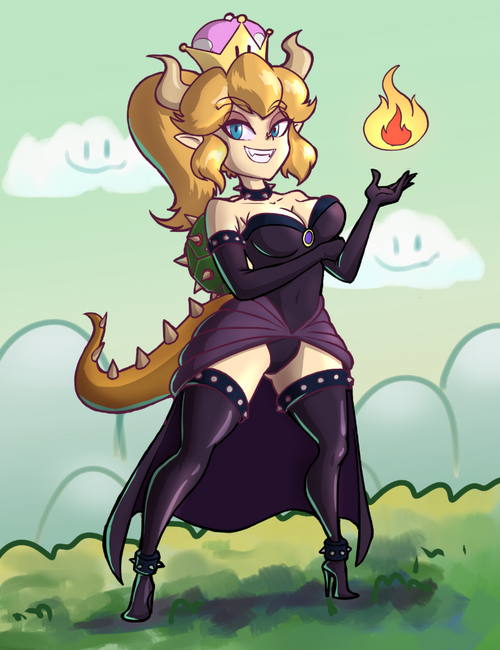
She’s still famous today, and despite the considerable handicap of not being a canonical Super Mario character, Bowsette has her own Wikipedia page when many “real” characters don’t. I can think of a few reasons why internet culture latched onto her. For one thing, she allowed people to style Peach in ways that were a little more risque than anything Nintendo was willing to do, and horny goes a long way, especially online. For another thing, the series might seem to lack an obvious candidate for “evil Peach,” even if that role has been filled a few different ways over the years, perhaps most notably by Captain Syrup in the Wario Land games — and yes, I should get around to writing that piece one day.
The thing about Bowsette that interested me, a guy who’s obsessed with names and their origins, is that Bowsette and every other Peachette variant — Luigette, Chain Chompette, Midbusette, Sepirothette, Reggie Fils-Aimette — took the wrong part from Peachette’s name. If she’s a combo of Peach and Toadette, then the -ette suffix should represent Toadette and not anything that looks like Peach. But I Peaser and Bowch are far less catchy names than Bowsette, which at least gets the point across that we’re dealing with a feminized version of Bowser. For what it’s worth, the Japanese manifestation of this meme skirts the issue altogether; over there, Bowsette is クッパ姫 or Kuppa-hime — basically Princess Koopa.
109. The Goomba King is hiding in Paper Mario: The Thousand-Year Door.
Way back in item no. 17, I discussed how the original name for Bowser, Boss Creeper, stemmed from the Shellcreepers, the proto-Koopa Troopas from Mario Bros. This naming convention stuck around even if the name Boss Creeper did not. For example, Petey Piranha is ボスパックン or Bosu Pakkun in Japan, and other “elevated” versions of generic enemies abound, including King Bob-Omb and King Boo. There is a Goomba version that is a bit of an oddball in a few different ways: The Goomba King, who originally debuted in Paper Mario.
He’s a relatively minor boss in this game, but he later shows up in Super Mario 64 DS and Mario Kart DS, making him one of the few characters introduced in the one of the RPG spinoffs who then makes an appearance in a mainline game. In both of these appearances, his name is localized in the English version as Goomboss, but the Japanese name is the same: クリキング or Kuri Kingu, making it clear that he’s the king of the Kuribō, as the Goomba is known Japan. What’s more, he is drawn more or less identically; the flat version that debuted in Paper Mario is realized in three dimensions for Super Mario 64 DS and Mario Kart DS, just with bigger eyebrows.
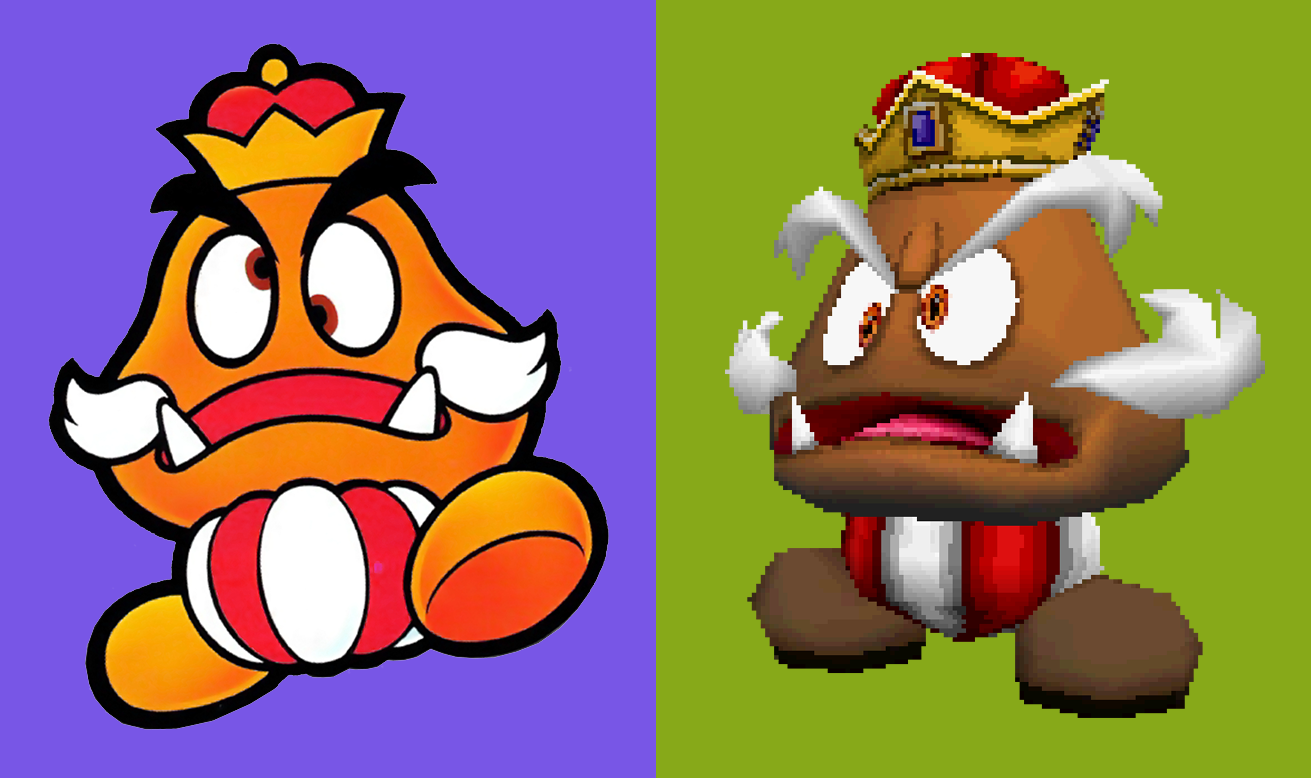
Goomba King is actually given his most interesting role yet in Paper Mario: The Thousand-Year Door, but it’s harder to recognize him in the English localization of that game. One of the running jokes in Thousand-Year Door is that while Mario is on his quest, Luigi is on one of his own, running parallel to the main plot of the game, even collecting his own partners to mirror the ones Mario teams up with. You only run into Luigi when his quest for the seven pieces of the Marvellous Compass crosses paths with the main game’s, and you get fragments of his story, which involves rescuing Princess Eclair of Waffle Kingdom from a villain known as the Chestnut King.
If you will recall item no. 32, the Goomba is, in fact, supposed to be a mushroom but nonetheless got the name Kuribō, more or less “chestnut guy,” because someone on the original Super Mario Bros. team mistook the sprite for a chestnut instead of a shiitake mushroom. The chestnut association has stuck ever since, and therefore we have the Goomba King’s Japanese name, クリキング or Kuri Kingu. I assume that whoever did the game’s localization saw that name in the text — disconnected from any Goomba imagery because in this game he’s only mentioned, never seen — and logically translated it as Chestnut King instead of Goomba King. But all signs point to this unseen character being the latest manifestation of Goomba King, having been given the most to do yet in a game that just happens to be unfolding offscreen.
< Support this site: on Patreon! • on Kofi! >
110: There’s a very obvious Legend of Zelda crossover hiding in Super Mario Galaxy.
Speaking of “king” and “boss” versions of regular enemies, there’s one in both Super Mario Galaxy games that’s slightly harder to recognize as a member of this club in the English versions. The lava-dwelling King Kaliente is specifically the king of the various octopus monsters introduced in this series. All of these are octo-versions of existing enemies. The Octoomba is based on the Goomba, supported by its Japanese name, タコボー or Takobō, from 蛸 or tako, “octopus,” plus Kuribō. The pink Octoguy is actually based on the Shy Guy, and the Japanese name reflects this: タコヘイ or Takohei, from the Japanese word for “octopus” plus the Japanese name for the Shy Guy, ヘイホー or Heihō.
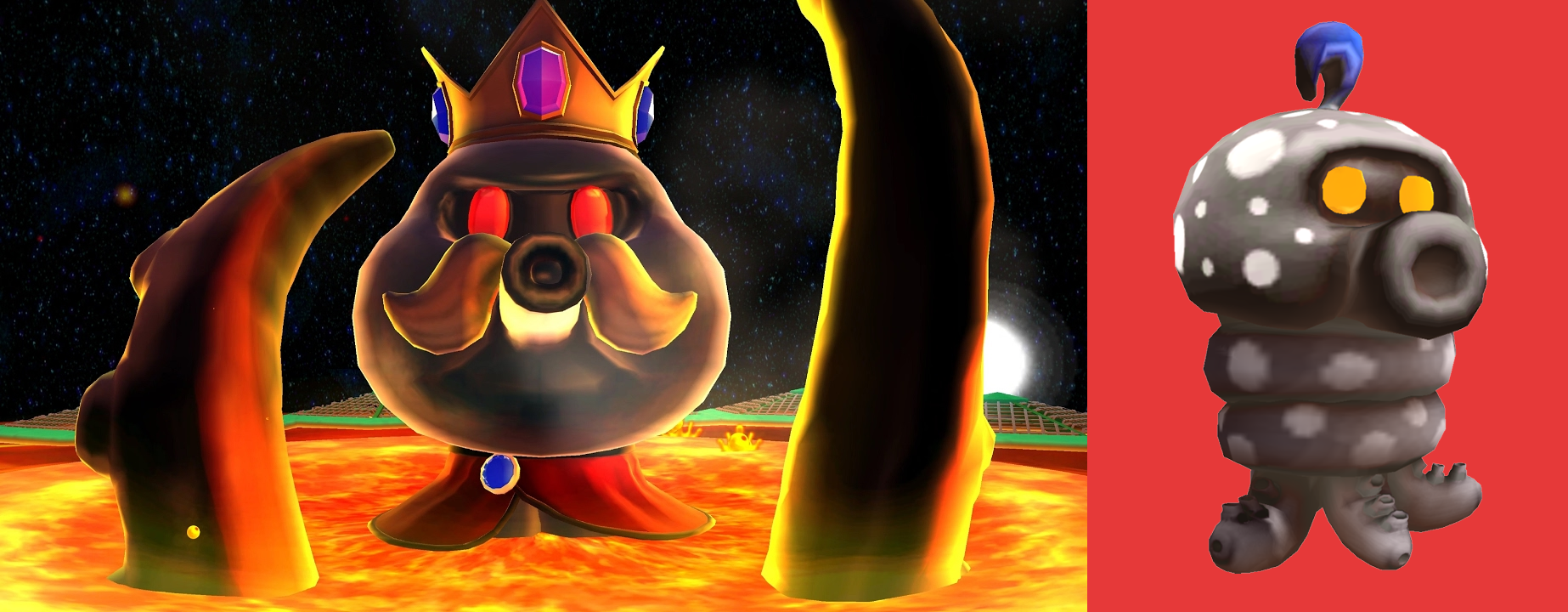
The most notable of the octo army, however, is the Rocto, whose English name obscures the origin even more than the Japanese one does. In Japanese, it’s オタロック or Otarokku, which does not use the Japanese tako at all and that instead would seem to be a play not on any Super Mario mainstay but on the octopus enemy from the Legend of Zelda series, the Octorok. For whatever reason, this connection had never occurred to me back when the Galaxy games came out, even though it’s fairly obvious. The Rocto is an octopus monster that attacks by firing projectiles, and that’s just not something octopuses are known for doing outside the Zelda games. And King Kaliente’s Japanese name is オタキング or Ota Kingu, with Ota presumably being a truncation of Otarokku, implying that the boss is a big version of the Rocto specifically.
By the way, the Japanese name of the Octorok is オクタロック or Okutarokku, presumably octo- and rock rendered in katakana.
111. Super Mario Advance tried to retrofit some existing characters into the “Boss Creeper” mold.
The most notable difference between Super Mario Advance and the Super Mario All-Stars version of Super Mario Bros. 2 is, of course, the ceaseless chatter of Mario and friends. However, there’s a minor modification leading into certain boss battles that implies the boss in question is an elevated version of a generic Super Mario enemy. For example, when you fight Clawgrip, the world five boss, you initially encounter a Sidestepper from Mario Bros. The action pauses and you see Wart’s bubbles drift onscreen and transform him from a small crab to a big honkin’ crab.
One interpretation is that you’re seeing in real time the kind of transformation that happened only offscreen with other boss characters in other games. According to this Supper Mario Broth post, other boss battles were meant to have this style of introduction as well, but they were mostly scrapped before the final version of Super Mario Advance. For example, Tryclyde began as a single-headed, teal-colored Cobrat before transforming into a three-headed version. (In Doki Doki Panic and the original version of Super Mario Bros. 2, Tryclyde was the same color red as Cobrat but was recolored teal beginning with Super Mario All-Stars.)
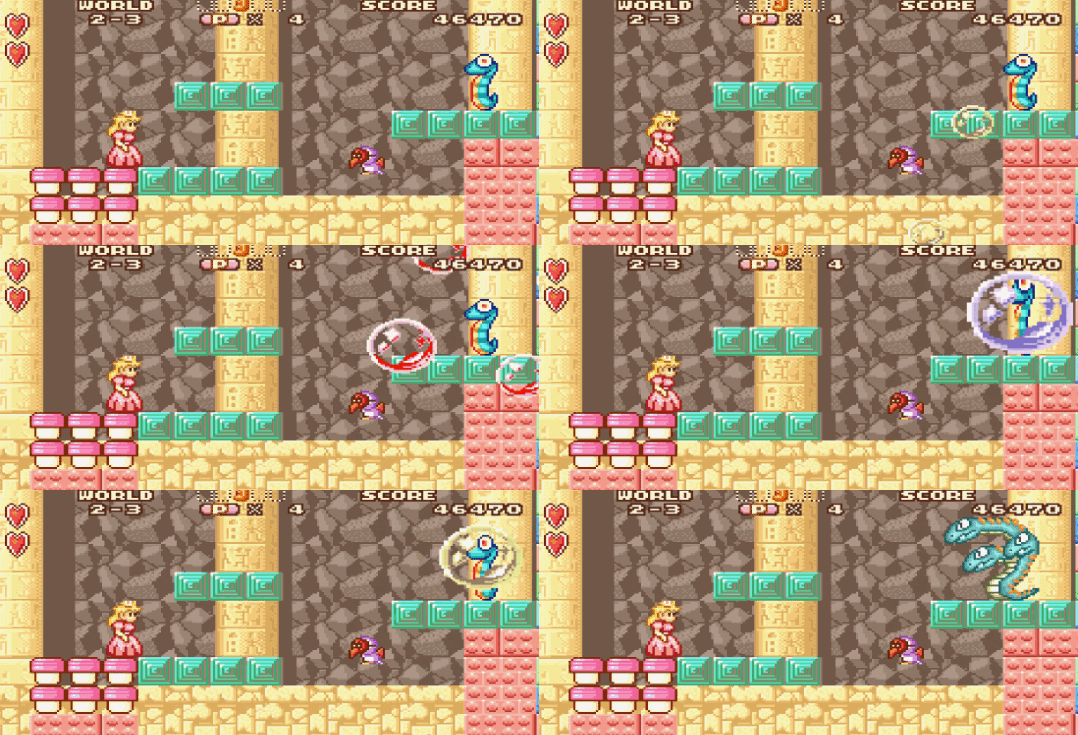
Similarly, Mouser actually got a unique mouse sprite created for his transformation sequence, apparently based on the Pocupo enemy, only to have it left on the cutting room floor.
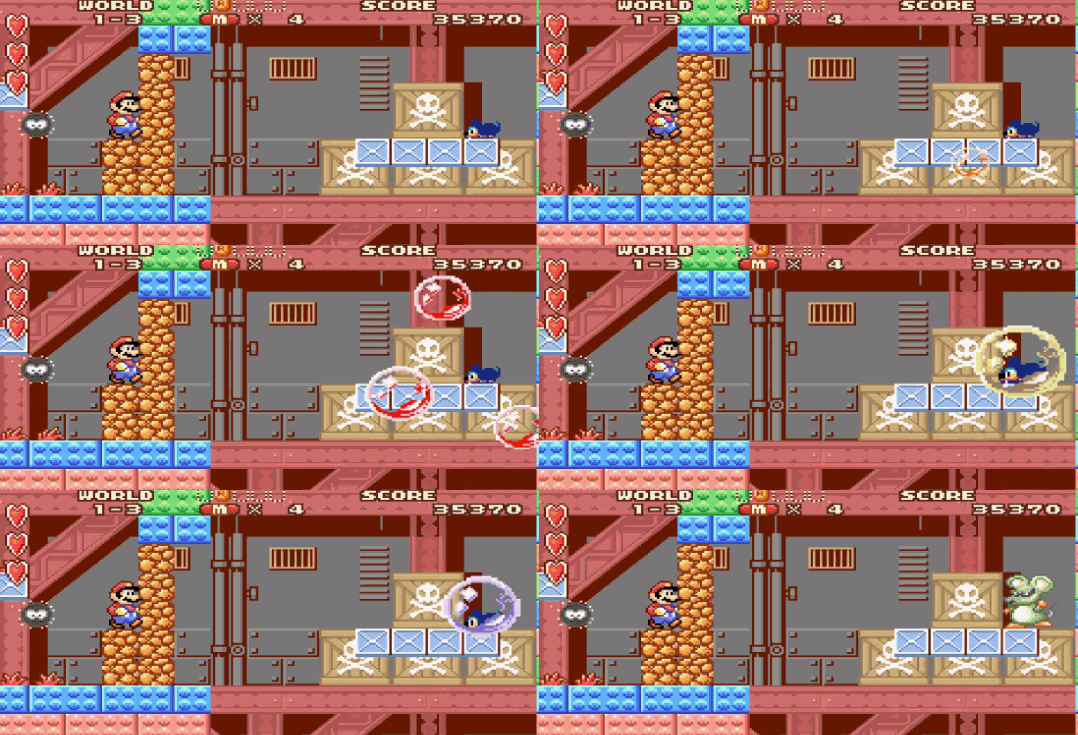
BTW, I’m pretty sure the LEGO-like blocks that appear in these boss areas, which started with the Super Mario All-Stars version, are a reference to N&B Blocks, Nintendo’s attempt at a very LEGO-like interlocking brick toy, which the company started selling in 1968.
For what it’s worth, Fry Guy’s special boss intro did make it to the final version of the game, but rather than focusing on a minor version of him, it focuses on his mask. That’s not necessarily inappropriate, given how masks are a central theme in Super Mario Bros. 2, but it’s odd that the game overlooks that mini-Fry Guys already exist in the game; they’re what Fry Guy devolves into after you hit him enough times.
No special intro exists for Robirdo, the giant, robot version of Birdo who serves as the boss of world three in Super Mario Advance. She’s actually never appeared in a game since, which is a travesty, if you ask me.
Giant mechanical version of Birdo, you will live on in our hearts.
111½. Mouser may not necessarily be related to the Little Mouser enemies, names notwithstanding.
If you’re someone who knows too much about the Super Mario games, you might be wondering why a new sprite was created for Mouser’s transformation sequence instead of using one of the Little Mousers from Yoshi’s Island. I’m guessing it’s because they’re unrelated mouse-like enemies that only seem related because of their English names.
In Japan, Little Mousers are チューさん or Chū-san, with chū being the onomatopoetic representation of the squeak of a mouse. Little Mouser is essentially “Mister Squeak” in Japanese. Mouser’s Japanese name, meanwhile is ドンチュルゲ or Don Churuge. The second syllable is still probably based on chū, but there’s a lot more going on here. The Super Mario Wiki posits that while Don could be from the Spanish don, an honorific title that implies you’re the guy in charge, it also might be from どん or don, “bang” or “thud” or other such loud, sudden noises, like I mentioned in item no 104. In any case, what they’ve got in common is that they’re both mice, hence that one syllable, but they otherwise might not be intended to be greater and lesser versions of the same enemy in the way I’ve been discussing otherwise.
112: Shy Guys are foot soldiers, etymologically speaking.
Can you believe I devoted nearly an entire part of Mario 101 to the enemies of Super Mario Bros. but skipped over the Shy Guy entirely? No wonder they lack confidence.
I think it’s pretty well known that in Japan the Shy Guy is known as ヘイホー or Heihō because they’re fond of saying their own name, in the style of Yoshi and Pokémon. The Mario Kart 8 track Shy Guy Falls, for example, is full of the little guys going to work mining crystals, and in all versions of the game, they do so while saying their Japanese name. Because this track puts them to work in mines specifically, I think it’s meant to be a tip of the hat to the Disney version of Snow White and the dwarves’ iconic work song, “Heigh Ho,” which sounds a lot like the Shy Guy’s name. However, I don’t think this is the origin of the Shy Guy’s original name. According to Super Mario Wiki, ヘイホー or Heihō is probably an anagram of 歩兵 or hohei, “foot soldier” or “infantryman.” And that checks out, because the horseless soldiers are the lowest-ranking and Shy Guys are truly the grunts of Wart’s army in SMB2 — and more or less equivalent with Goombas and Koopa Troopas in every subsequent game,
113. Not all fireballs are Podoboos. In fact, most of them aren’t.
In the original Mario 101 post, part three covered *almost* every enemy in Super Mario Bros. I skipped over the Podoboo, just because covering its history would mean getting into a pedantic level of video game trivia that would end up stretching longer than any reader has patience for. Of course, that’s basically what I ended up doing with the history of the Cheep-Cheep, so here we go anyway.
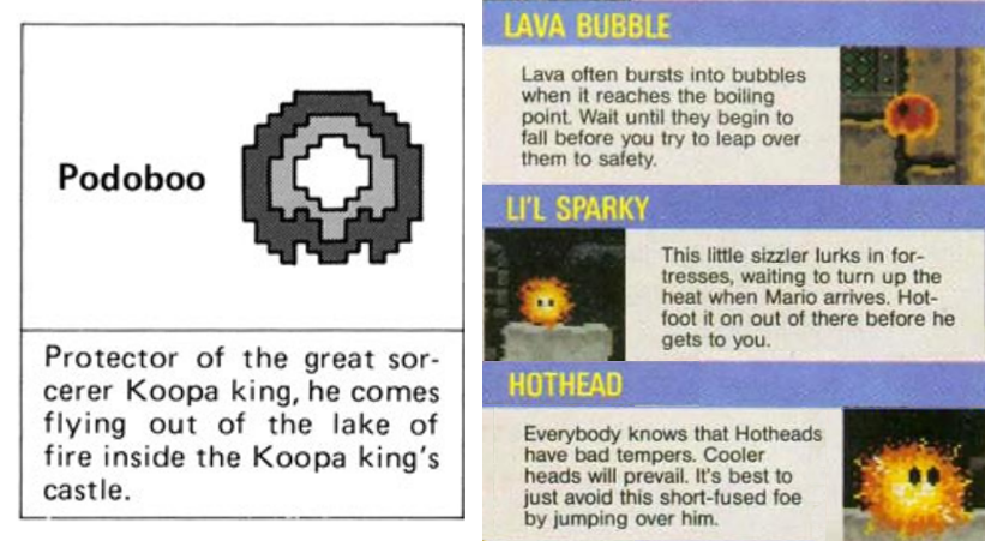
The manual for the original Super Mario Bros. identifies the fireballs that leap out of lava pits as Podoboos. This localized name is one of the few for which I can make an educated guess about where it comes from, and it’s the French dish name pot-au-feu, literally “pot on the fire.” In Japan, however, this creature (obstacle?) was originally バブル or Baburu, literally “bubble,” which would seem to link it with the similarly named creature in the Legend of Zelda games, sometimes known as Anti-Fairy. I’m not sure if this is another intra-franchise reference, however, because although the Zelda version sometimes looks more like a fireball, it’s usually more of a flaming skull. And aside from being more or less impossible to kill, as both usually are, they don’t act all that similarly.
The version in Super Mario World appears to have evolved somewhat — it has eyes, and it can also ricochet around a room without diving back into lava — and because they’re identified in English materials as Lava Bubbles, they may seem like they’re a different entity altogether. It would appear that they’re not, however. Because while later games would sometimes give them eyes (sometimes not) and mostly refer to them as Lava Bubbles (but sometimes Podoboos), the fact that all versions are grouped together in the menus for the Mario Maker games would seem to indicate that Nintendo considers them one and the same, for the most part. As near as I can tell, the final time that Nintendo referred to them as Podoboos was in New Super Mario Bros. back in 2006.
Podoboo or Lava Bubble or whatever you call it, it’s not to be confused with the other fireball enemy, first introduced in Super Mario World, although even that is a little unclear. This one exists in large and small versions that go by unrelated names in the west. The little guy is Li’l Sparky. The big guy is Hothead. Regardless of their size, they act identically, roving around the perimeter of a platform, surface or room, forcing Mario to get out of the way each time they pass by.
In Japan, they’re named in a way that makes it clearer that they’re related. The smaller version is ケセラン or Keseran, while the larger is パサラン or Pasaran. Their names add up to Keseran Pasaran, a white puffball from Japanese folklore that allegedly brings good luck. (The jury is out on whether they’re creatures or just, like, things, I guess.) And I guess these Super Mario enemies also look fuzzy, technically, even if they’re meant to be buzzing balls of red-hot electricity that are certainly not meant to be cuddled or caressed and which almost certainly do not bring good luck. The one exception would be Watt, one of the party members in Paper Mario. She’s meant to be a baby Li’l Sparky, so I guess one that is especially little?
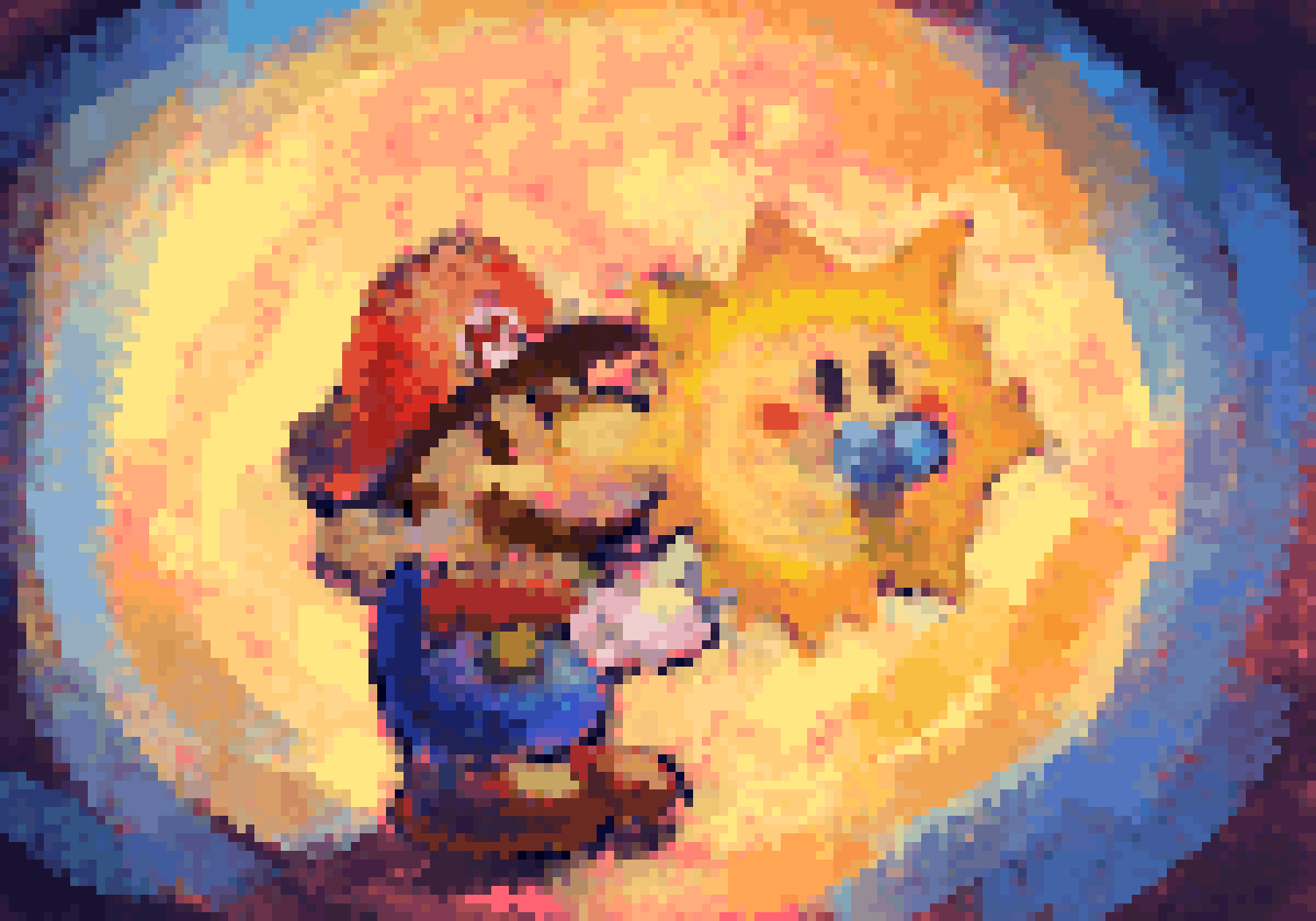
Baby fireballs are the cutest!
Oddly, the various versions of this enemy behave almost identically to the Spark enemy in Super Mario Bros. 2. I don’t think that the Super Mario World Spark is meant to be any version of the Super Mario Bros. 2 Spark, however, even if Pokey, Ninji and Pidgit all come back for Super Mario World after sitting out Super Mario Bros. 3. The Super Mario Bros. 2 version looks very different, electricity theming aside, and we don’t know what its Japanese name is because it’s inexplicably missing from the enemy section of the manuals for Doki Doki Panic or Super Mario USA both. As a result, its only Japanese name is just a rendering of its English name in katakana: スパック or Supakku.

Contrary to what I stated in one of my first posts, about the enemies of Super Mario Bros. 2, this Spark does show up again. There’s an enemy in the Mario vs. Donkey Kong series that’s known as Magnet Spark in the English and スパーキー or Supākī, “Sparky,” in Japanese whose design seems to specifically echo the Super Mario Bros. 2 version. However, it’s also considered a variation of yet another enemy called Spark that appears in the first Mario vs. Donkey Kong game and that looks completely different.
It’s pointed out on the Super Mario Wiki that there’s a rare enemy in Yoshi’s Island that only appears in a secret room in the fortress of Burt the Bashful. Called Piro Dangles — which BTW is a name I’d never heard until researching this item — these look like a cross between the Super Mario World fireball enemies and Fry Guy from Super Mario Bros. 2. In Japanese, it’s just スパーク or Supāku.
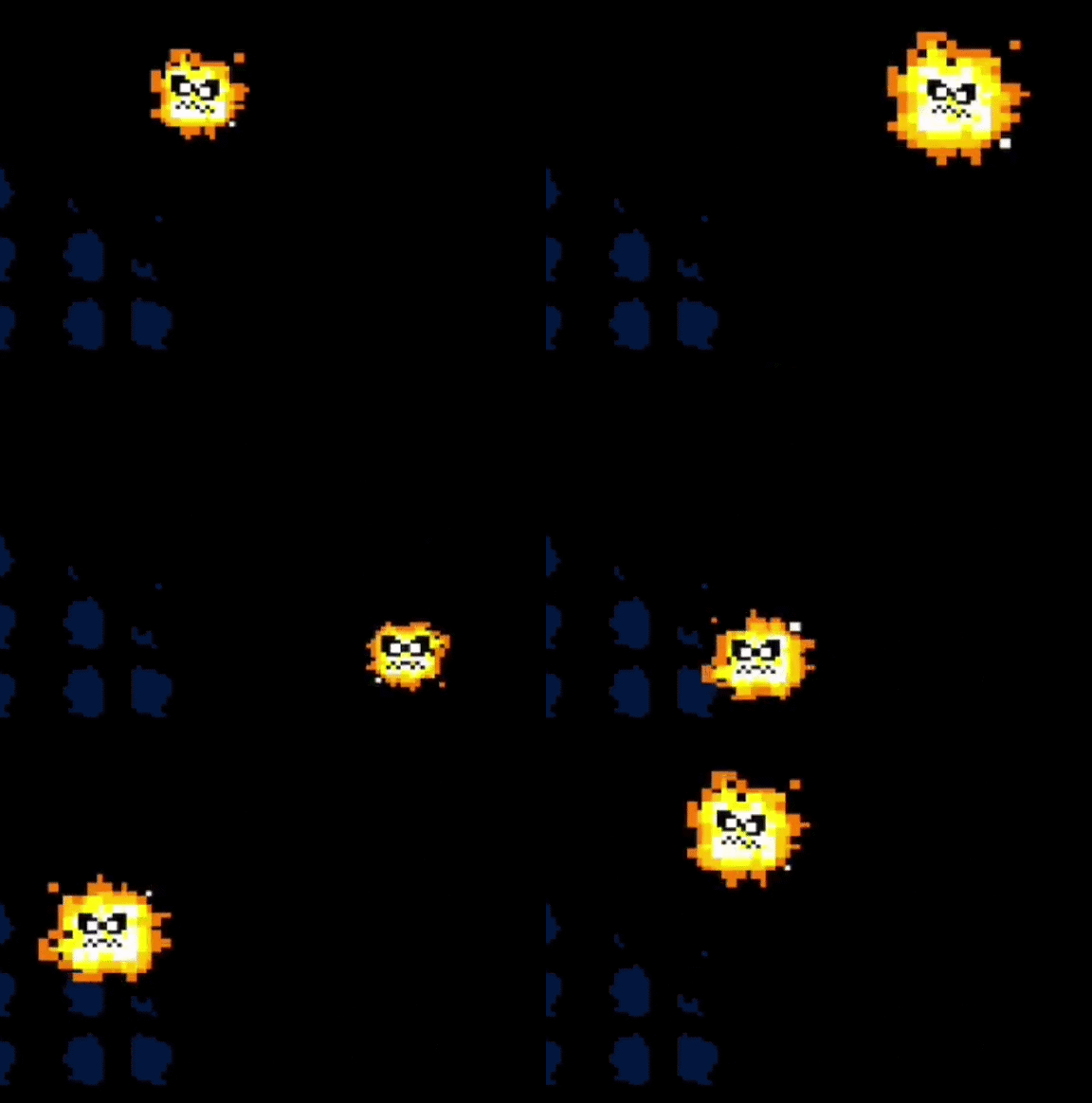
Of course, balls of fire and electricity are among the oldest enemies ever to appear in a game in this series. The original arcade version of Donkey Kong has fireballs and fires both, while Donkey Kong Jr. has Sparks, but I’m not sure any of the later versions discussed in this item are meant to be riffs on them, seniority notwithstanding. BTW, the Donkey Kong fireball is apparently called おじゃまむし or Ojama Mushi, “Trouble Bug” in Japan, and if you can explain this, please do so at once.
And so ends this burning, round journey. The one remaining Super Mario Bros. enemy yet to be detailed would be the Hammer Brother, who will just have to wait until part nine for his moment in the spotlight. It will be weird and philosophical.
114. The swimming physics in Super Mario Bros. were lifted from Balloon Fight.
So much of this project has been identifying when Nintendo has lifted an idea from some external source, but as the many Zelda references have demonstrated, it’s no less interesting when Nintendo borrows from itself. This one seems especially notable to me just because compared to other franchises, 1985’s Balloon Fight doesn’t get a whole lot of love. But it’s actually responsible for a mechanic that would become a mainstay of the entire Super Mario series.
As I explain in my post counting down the earliest Nintendo crossovers, there is a 2006 Iwata Asks promoting New Super Mario Bros. explains that the way Mario swims in the original Super Mario Bros. comes directly from the way the controllable character in Balloon Fight flaps through the air.
Satoru Iwata: [Super Mario Bros.] takes place on land, sea and air, with underground sections as well. Had you decided right from the start that it should be a large character that negotiated this terrain?
Shigeru Miyamoto: We had broadly decided on this approach. A large character that would run around on the ground.
Iwata: And swim in the sea.
Miyamoto: In terms of the game's structure, the swimming part is Balloon Fight.
Iwata: You're right. That's exactly what it is.
Miyamoto: With Balloon Fight launching previously, that system of controls had been tried and tested. For the sky, we had the image of Sun Wukong from Monkey King jumping between clouds.
This is not the only interaction Balloon Fight has had with Super Mario and its various spinoffs. For example, the WarioWare series has more recently introduced a new weirdo to Wario’s entrepreneurial gang: Lulu, a little girl who stands apart from the other little girls Wario has amassed because she’s meant to be an homage to Balloon Fight — specifically to Alice, the heroine from the 1991 Game Boy sequel to Balloon Fight, Balloon Kid.
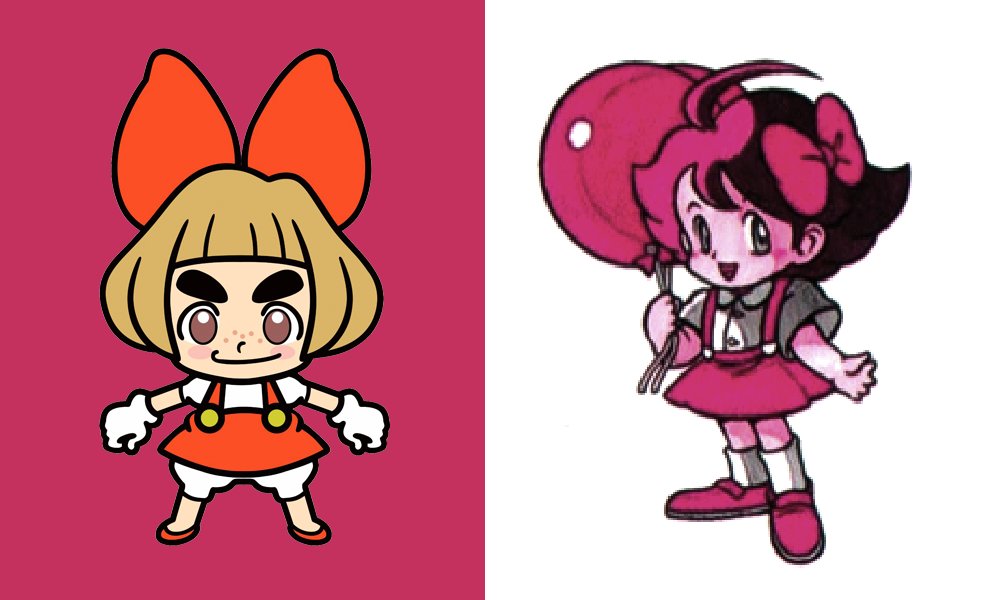
And that’s not all. Weirdly enough, the Game & Watch version of Balloon Fight, released in 1988, adds in a rather perplexing reference in the form of a sort of boss character who occasionally shows up to harass you. He looks like an iguana in a wrestling singlet and his name, for some reason, is Oiram Repus — “Super Mario” backwards.
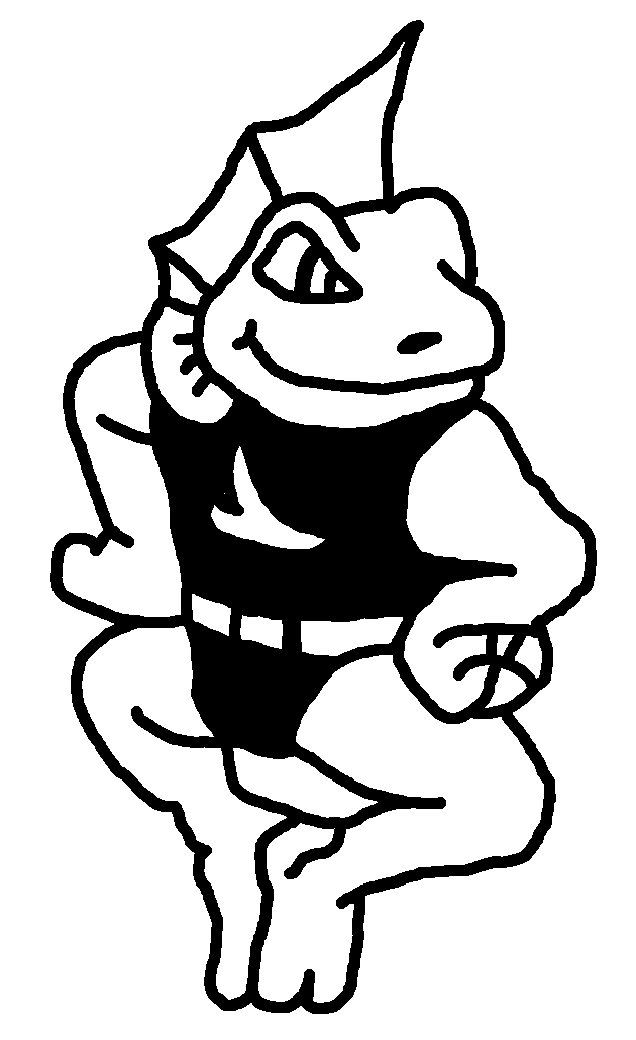
If you can think of a reason why this should be, please tell me.
115. The Mushroom King does not exist, but everyone wants to give Peach a dad nonetheless.
Perhaps it’s not surprising, exactly, that we tend to cling to information imparted in the early instruction manuals. Often, these documents were the only sources that could explain why any game was the way it was. And what they told us remained part of the perceived canon long after we figured out that a lot of what’s in these booklets was basically ad-libbed, their writers not counting on the fact that anyone would still be talking about it decades later.
A prime example of this would be the background story provided in the original Super Mario Bros. manual, which identifies our princess as the daughter of the mysterious Mushroom King.
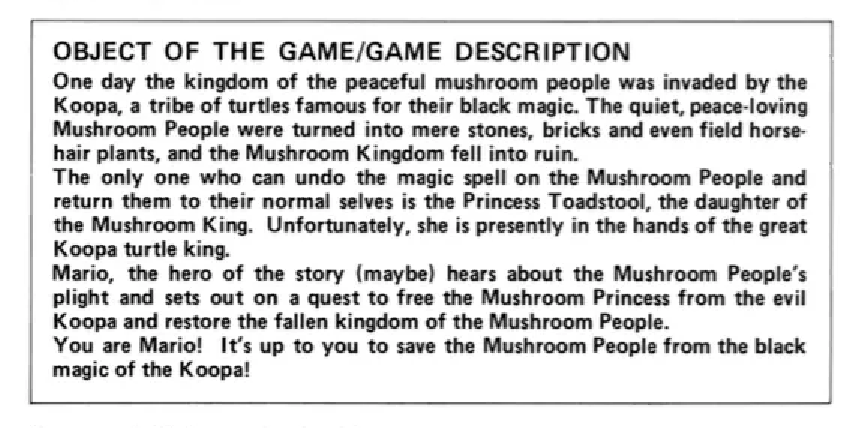
In case you’re wondering, no, the Japanese original says no such thing. And the Legends of Localization guide to differences between these two documents is a must-read in case this kind of thing is up your alley.
I’m guessing that grammatical pedantry might have inspired this character’s creation. Although the title attained a special air in western culture, a princess is the daughter of a monarch. If this one were the sole ruler in charge of the Mushroom Kingdom, shouldn’t she be the queen? Regardless of the motivation, Peach’s dad is a character hovering in the fringes of the Super Mario series throughout the NES years. Most notably, Valiant’s Super Mario comic series had a Mushroom King character who was a doddering old man who needed his daughter’s help to keep the Mushroom Kingdom in order. He’s drawn as humanoid but with a crown that suggests the Toad cap — visually, a sort of missing link between the royal family and the people they rule over.
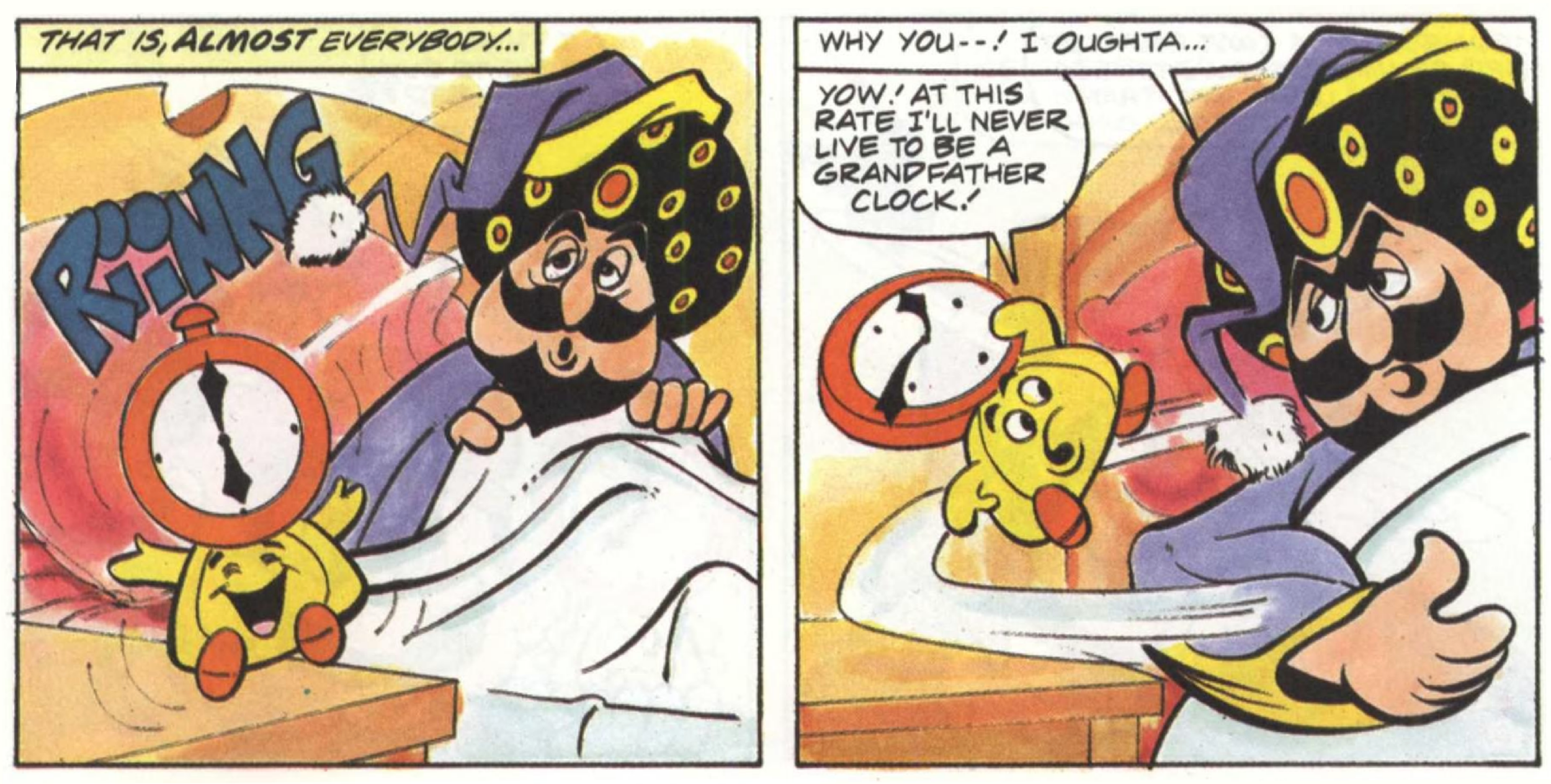
This selection from the Valiant series pairs the Mushroom King with Stop Watch, detailed in item no. 24 as another classic Super Mario character who totally exists and who is beloved by fans of the series.
The live-action Super Mario Bros. movie would also insert a sort of Mushroom King. Played by Lance Henricksen in what amounts to a cameo, he’s the true ruler of the film’s setting, Dinohattan, but he’s been devolved by Koopa into a sprawling, sentient fungus. It’s actually one of the reasons I think the Samantha Mathis character in this movie is not actually supposed to be Daisy but is actually Princess Toadstool borrowing Daisy’s name because the name Peach had not yet come stateside. This king being fungified is the one way the movie attempts to reconcile the princess’s mushroom associations, which the movie largely ignores in favor of, you know, dinosaur stuff. Honestly, his character pretty much only exists to do this one thing, but it’s notable that two different western adaptations of the Super Mario mythos give the princess a father who does not exist in the games at all.
However, the Mushroom King would be willed into existence separately in Japan as well. The strategy guide How to Win at Super Mario Bros., released in Japan in 1985 and in the U.S. in translated form in 1987, shows Peach in the company of her father before Bowser takes over.
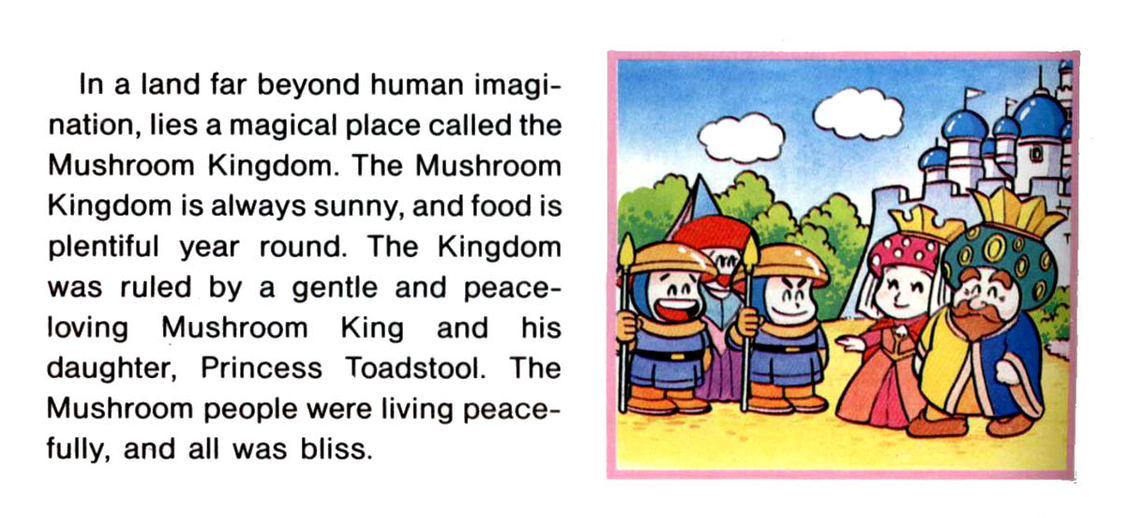
BTW, that’s meant to be Peach walking with the king, not the Mushroom Queen. See “A Parade of Peach Prototypes” for more on all the alternate versions of the princess that existed before her look got standardized for The Lost Levels.
And in a sense, the games would also incorporate the idea of an old man in charge, even if doing so further complicates Mushroom Kingdom politics. Super Mario Bros. 3 introduces seven kings of the larger Mushroom World, in fact, who are kicked off their respective thrones by the Koopalings and who are transformed by that Koopa black magic we keep hearing about. The seven kings are extremely minor characters, however — only the king of the third kingdom has official art, and even then only in his kappa form — and they were forgotten by the franchise more or less immediately.
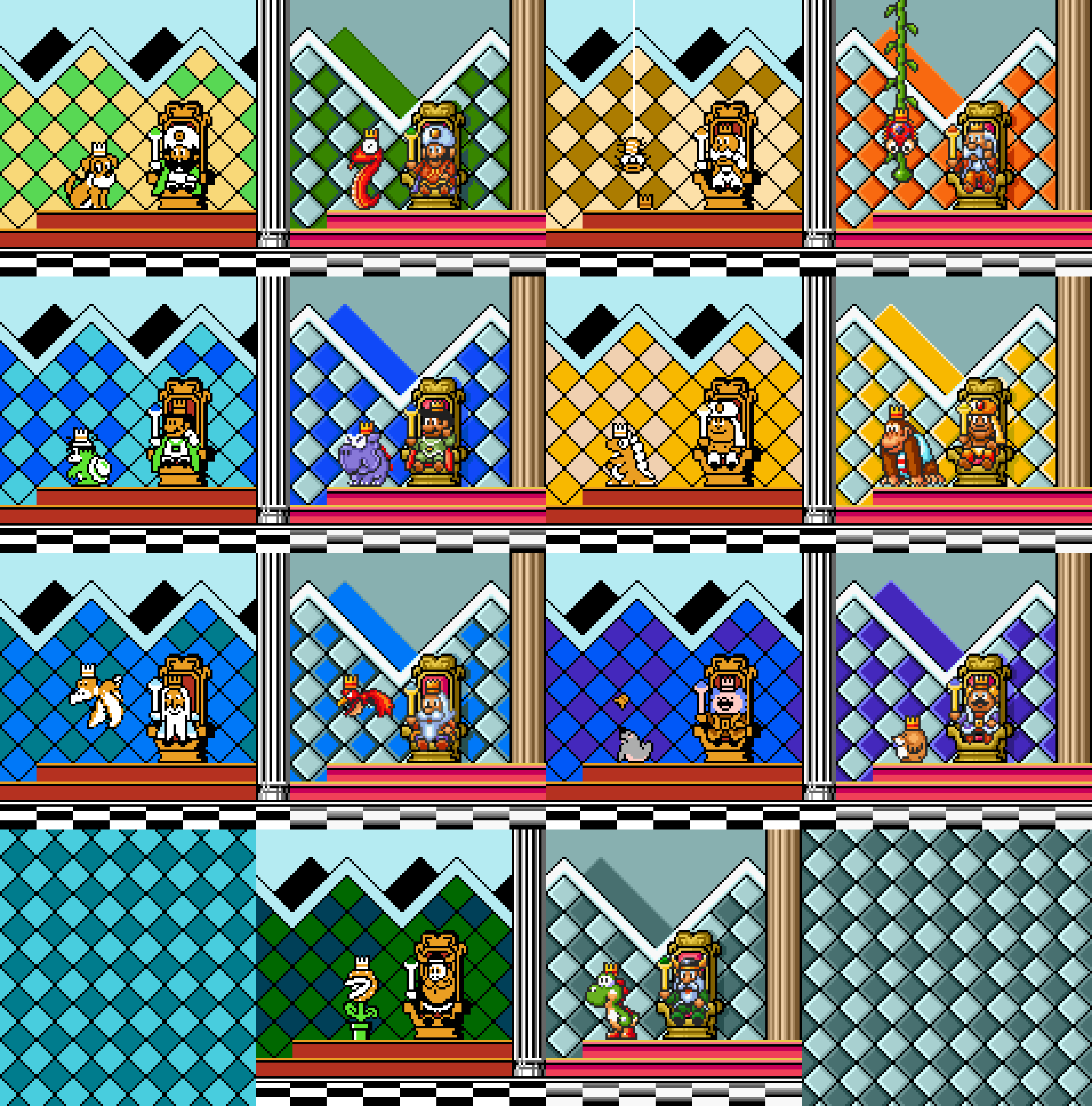
Left to right, top to bottom, in order: the original NES and SNES Super Mario All-Stars versions of the kings of Grass Land, Desert Land, Sea Side, Giant Land, Sky Land and the Pipe Maze.
These seven kings basically show up and prove that yes, kings do exist but not in a way that explains why a princess is in charge of the Mushroom Kingdom. The Valiant Comics version of the Mushroom King looks like a member of the same club as these guys, and in all honestly, his design was probably inspired by theirs, just a little more mushroomy. But there is no Mushroom King in the games, there probably won’t ever be, and Nintendo seems perfectly happy not explaining why Peach is the ruler of a kingdom that does not and seemingly has not ever had a king.
I’ll end with this: For reasons I cannot explain, one of the many versions of the script for the Super Mario Bros. movie referred to the Mushroom King character as King Bowser. And weirdly enough, this ended up being preserved in the novelization of the movie by Todd Strasser.
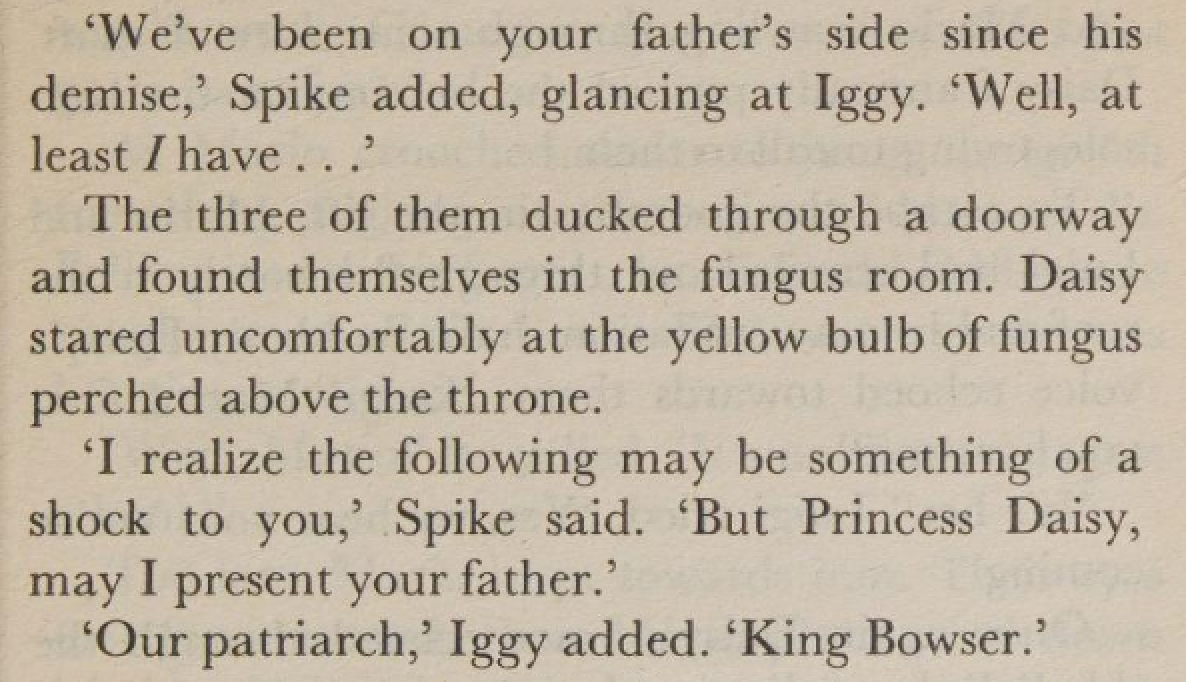
I cannot even begin to contemplate what this means for the realm of Dinohattan.
116. The background trees in Super Mario Bros. apparently are the legendary field horsehair plants.
Given that the English instruction manual completely made up Peach’s dad, you might expect that another odd bit in that backstory also came about in this fashion. But no, the infamous field horsehair plants are actually present in the original Japanese version, more or less. In Japanese, these mysterious flora are identified as つくし or tsukushi, which refers to the edible part of the plant that in Japan is called スギナ or sugina but whose scientific name genus is Equisetum — literally Latin for “horse hair,” with equus meaning “horse” and seta meaning “hair” but more in the sense of “bristle.”
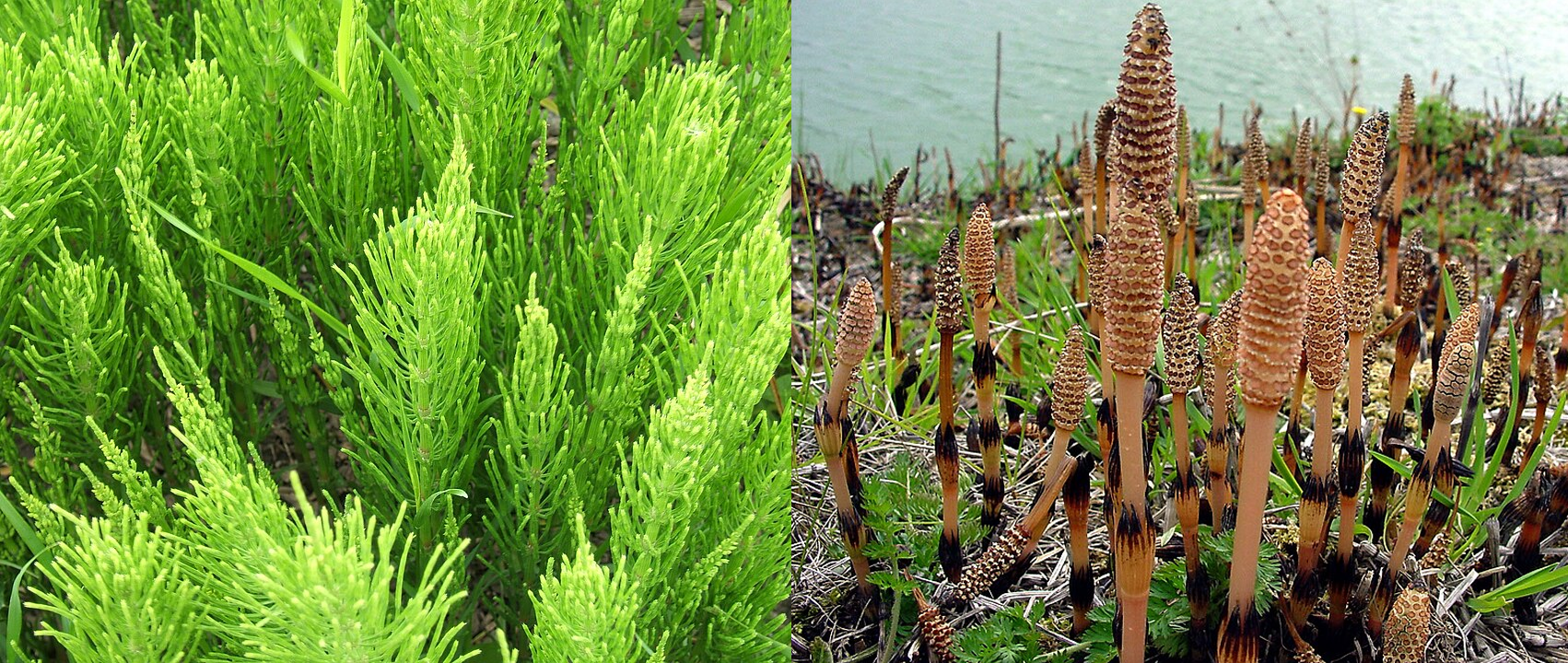
Left: The green, leafy branches of Equisetum arvense. Right: The edible shoots. Both via the species’ Wikipedia page.
Allegedly they get their name because they look like a horse’s tail. I don’t particularly see it? And I guess Japanese people back in the day didn’t either, because none of the Japanese names for this plant have anything to do with horses. It’s debated, but tsukushi probably comes from 付く子 or tsukuko, "attached child" because of the way its stalks grow from the “mother” plant. And sugina seems to come from 杉の菜 or sugi no na, literally “cedar vegetable,” because it’s edible and looks like a small version of the Japanese cedar. Either Japanese name tends to be translated into English as “horsetail,” however.
I don’t know why the official story limits the list of transformations to “stones, bricks, and field horsehair plants,” because only one of these three shows up in the game itself in any kind of meaningful way. (And don’t forget that the manual clarifies that no, you’re not killing innocent Toads by smashing bricks.) Clearly, horsetails are more familiar to Japanese players because they’re a food item there. I’d imagine they stand out more if you are, like me, from a culture that doesn’t eat them. Perhaps as a result, there’s been an effort on the part of English-speaking gamers to figure out if this is a reference to something present in or otherwise important to Super Mario Bros. And that Legends of Localization page comparing the English and Japanese versions is probably the most prominent online source of information to guess that this might be a reference to the trees that appear in the stage backgrounds.
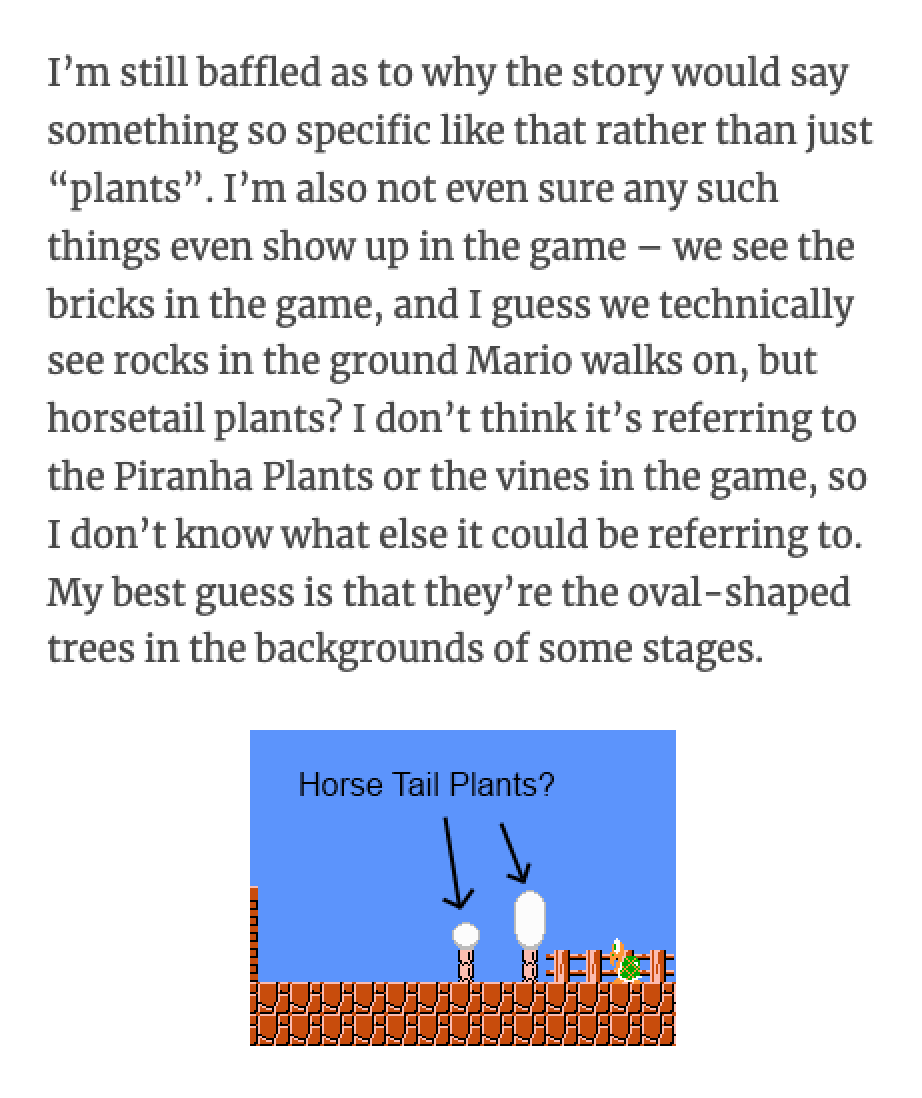
Personally, I always thought this read was incorrect. For one thing, the background trees don’t really look like what horsetails look like in real life, even allowing for the difficulty of rendering something in pixels. In my head, at least, a much more likely explanation for the things in the background that look like trees is that they’re actually just trees — especially because the default version of them is green, which is, you know, tree color.
I would appear to be wrong, however — at least according to the guide How to Win at Super Mario Bros. The English version does, in fact, identify the white version of the background trees as horsehair plants. I assume they’d say the same for the green ones too.
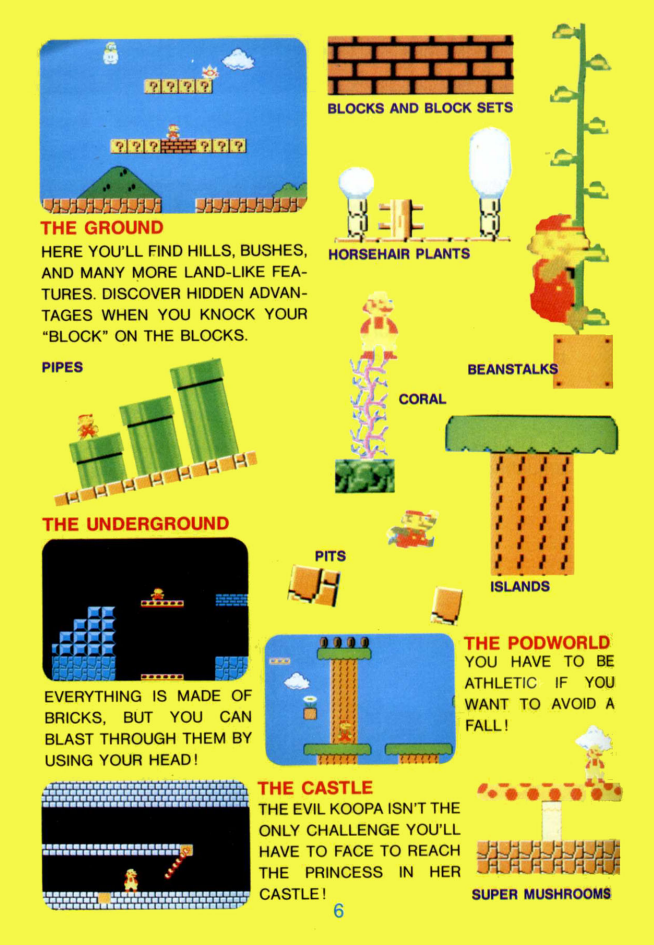
Initially, I assumed that the people who translated this document made the same guess that Clyde Mandelin did: more or less, “Welp, they have to be something and this is the thing that seems closest, so let’s go with that.” After all, the same page identifies the tree-like platforms that appear in the “whoops, no ground” stages as islands when they’re clearly meant to be trees.
Maybe someone who works for Nintendo is just really bad at identifying trees?
I could not find a PDF of the Japanese version of the guide online, but I did happen to find this video of someone flipping through theirs, and the resolution is just high enough to make out that the trees in this version are labeled as つくし. To whoever wrote this copy, the background trees are, in fact, the tsukushi a.k.a. horsetail a.k.a. field horsehair plants.
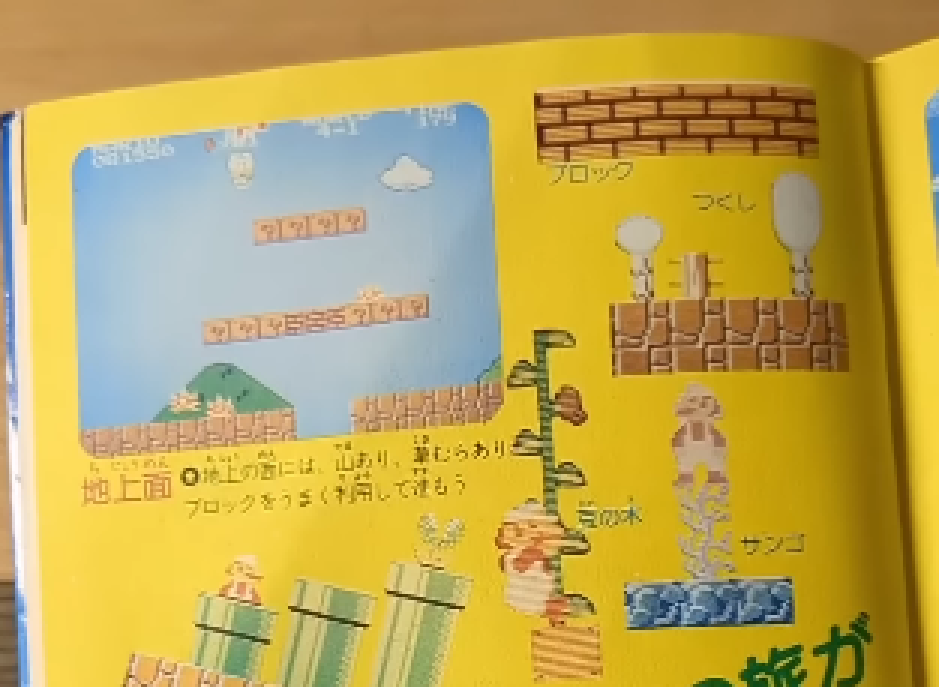
This is not quite a solid confirmation from Nintendo. How to Win at Super Mario Bros. was published by Tokuma Shoten and not Nintendo, utilizing content that had previously been printed in Family Computer Magazine, which Tokuma Shoten owned. That said, the guide was reprinted many times over, becoming the top-selling book in Japan for both 1985 and 1986. I suppose if anything in the guide was so erroneous that Nintendo wanted it changed, someone would have said something, to say nothing of that happening before the English version appeared with a foreword by Howard Phillips, giving the whole thing an air of being heartily endorsed by Nintendo.
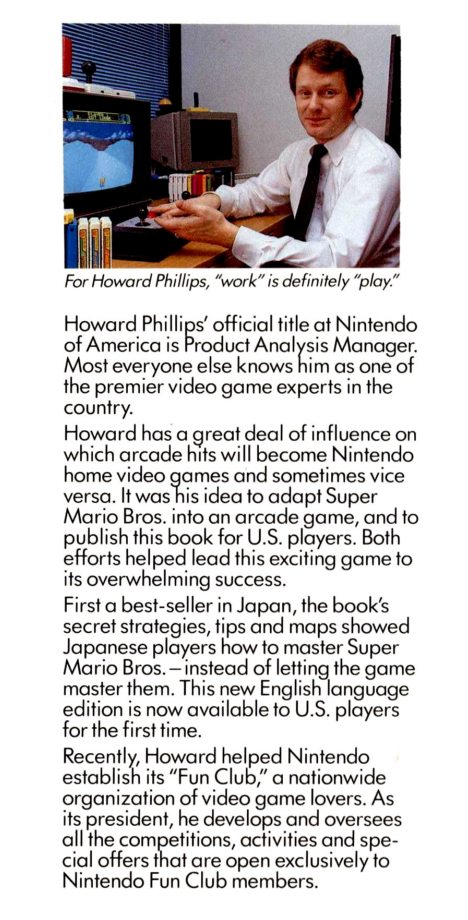
It is possible, I suppose, that the author of the guide also just guessed that the things that look the most like horsetails might actually be them, more or less canonizing the association as a result. Before discovering this information, my take on the original Japanese text was that it was meant to convey the idea that Bowser has transformed the Toads into the kind of common everyday objects you’d pass by without thinking twice about them. The edible spores of the Equisetum genus grow about a foot high, and unless you’re out foraging for them specifically, I think they’re the kind of thing you wouldn’t really notice. And I think this is what the Japanese backstory is getting at, as opposed to pointing out something that is relevant to the game in any real way.
For what it’s worth, horsetails do eventually show up in Paper Mario: The Thousand-Year Door and Super Paper Mario both, looking a lot like they do in real life. In both games, they’re edible items that restore health. And in neither game is any allusion made to the trees appearing in Super Mario Bros. Similar to the Koopa vs. Kappa argument I made in item no. 21, I’m inclined to say that the presence of actual horsetails in the series makes me think this background element was never intended to be anything other than trees, just because these games are so big on self-references and especially callbacks to that original NES outing. But the connection has been made, whether rightly or wrongly, and I suppose it’s going to linger in the periphery of Super Mario fandom as a result.
This eighth part of Mario 101 began with me talking about how many elements in this series became the way they are as a result of communication between east and west. In a way, this item makes the opposite point; there may be a constant give and take, but there are always going to be confusing bits that result from a rift between Japan and every other country that won’t readily recognize its cultural exports. In this case, a stray mention of an edible plant that is a lot more commonplace in Japan created a kind of Cult of the Field Horsehair Plants, with English-speaking players wondering what this reference meant and why it was included in the game’s official story. And while it seems like we have an answer — I am still not 100 percent on this — this matter speaks to the enticing mysteries that result from encountering a culture that’s not yours and then spending years wondering what it could mean.
Which is something I do a lot. Clearly.

And that’s it! Like I said, I’ve got a good idea of items for part nine. I don’t know when I’ll get around to it, but when it happens, it will be weird stuff from the fringes of the Super Mario universe. Who cares about Prince Pine? I do. I really do.
I wanted to link to and thank the various podcasts that have done episodes about Mario 101 since it went live in May. If you’re curious to hear me discuss this project and what possessed me to do it, have a listen to the following episodes.
Nintendo Cartridge Society: Exploring Mario’s Surprising History and Lore
Still Loading: Mario 101
Tokyo Game Life: The Unknown Origins of Mario
The non-Drew episodes are also good! Also, there will be the first of a two-part Retronauts going live on the main feed this week (on Patreon now!) for which I’ve got a special post planned.
I’m grateful for all of these shows giving me a chance to promote something that I think does not suck and which I worked really hard on. If you’re looking to have me as a guest on your show, to talk about Mario 101 or anything else, hit me up!
Navigation:
Part One (1–15): Mario and Luigi origins / Donkey Kong and Mario Bros.
Part Two (16–30): Bowser, Peach and Toad / Super Mario Bros.
Part Three (31–45): The enemies of Super Mario Bros.
Part Four (46–60): Super Mario Bros. miscellany / Super Mario Bros. 2
Part Five: (61-75): Super Mario Bros. 3 and Super Mario World
Part Six (76–90): Yoshi and Donkey Kong (and friends)
Part Seven (91–101): Various beloved supporting characters and also Stanley the Bugman
Part Eight (102–116): A sort of junk drawer including Peach’s dad, Bowser’s wife and the infamous field horsehair plants