
What Is the First Nintendo Crossover?
If you can, imagine a time before Smash Bros. allowed every Nintendo character to meet each other, to say nothing of every character from every Nintendo-friendly video game franchise getting to do the same. The year is 1989, and following the success of Tetris on the Game Boy, a console version followed. Of course, Tetris and similar puzzle games are well-suited for play on a portable system. What could the NES Tetris offer that the handheld version could not?
Well, for one thing, it gave players a vision of their favorite Nintendo characters (plus Pit from Kid Icarus) hanging out in a way we’d never seen before. It’s got a whiff of “Everyone is here,” twenty-eight years before it was used to promote Super Smash Bros. Ultimate.
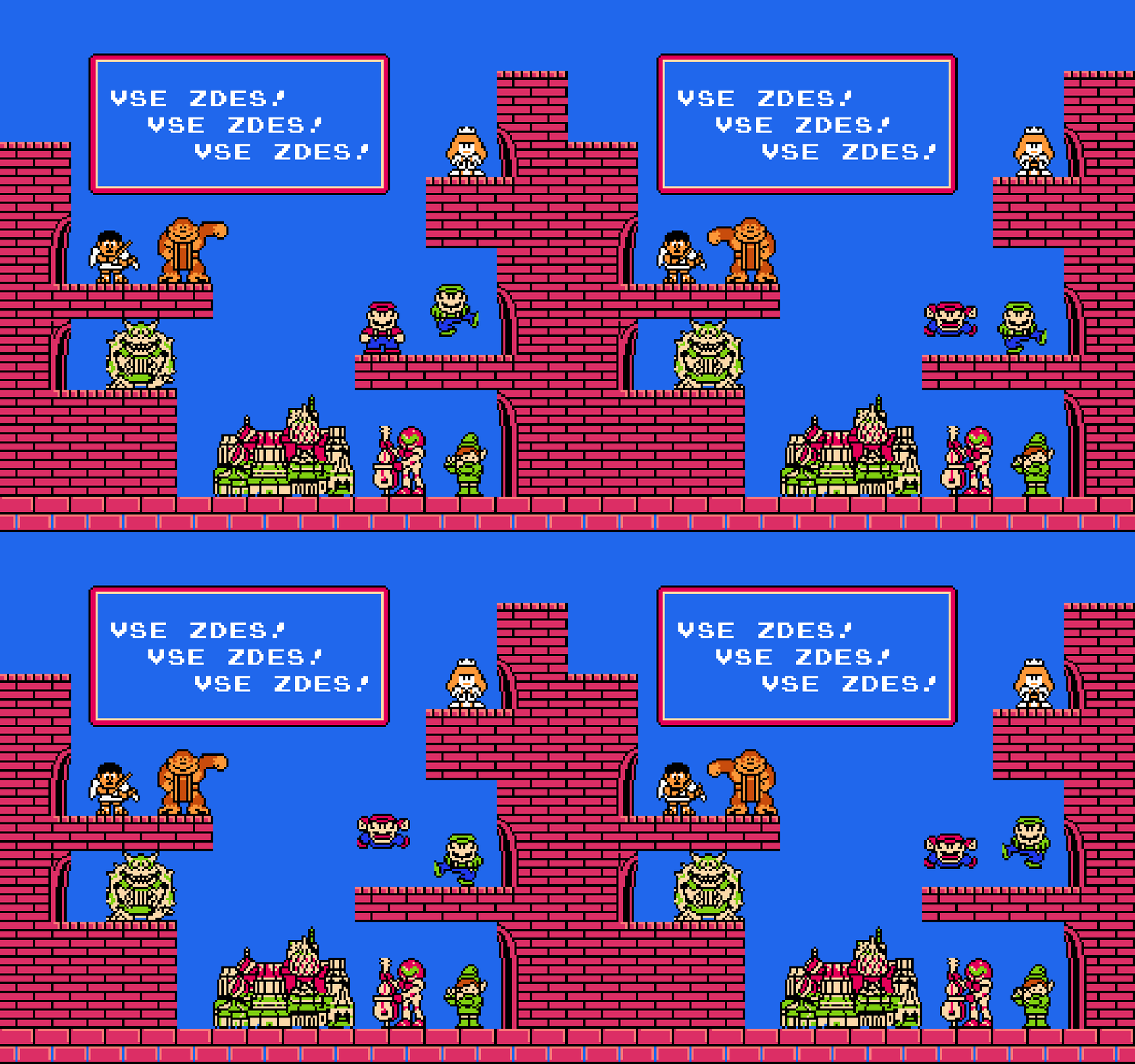
Yes, as you progress through the game’s B mode, you’re rewarded by gradually getting more and more Nintendo mascots doing a hootenanny outside St. Basil’s Cathedral in Moscow. You get Mario and Luigi doing a Russian dance, Link playing his trusty recorder, Samus on a double bass for some reason, toe-tapping Bowser on an accordion, Pit playing the violin, Donkey Kong punching the crap out of a drum and finally a princess politely clapping. (I’m told that it’s Peach and I have no reason to question it, but there’s nothing about the way she’s styled that couldn’t just as easily be Zelda. It really doesn’t look like anyone in particular.) It might sound dumb to say this today, but as a kid, I thought this was very exciting because I’d never seen anything like this before. In my head, at least, the Super Mario stuff stayed over here, and the Legend of Zelda stuff was kept over there, and this was just the way of the pixelated world.
Of course, I was wrong for thinking this, because Nintendo actually had a history of inserting cameos to its other games going back well before the NES Tetris. In fact, the second NES game I ever played, Legend of Zelda, actually had a pretty obvious nod to the first NES game I ever played, Super Mario Bros. I just didn’t realize it for years. It’s the subject of one of the first posts I ever did on this blog, and it made as sensible a starting point as any for this post, in which I will try to find the first instance of Nintendo inserting into a game a reference to one of its other games.
Note: As I do this trip backwards through Nintendo history, some of the in-game references I mention might seem more like cameos, while others might better be classified as crossovers. To me, it’s just a matter of semantics that I don’t find especially interesting. For the purposes of this post, all shoutouts to other Nintendo games or products, big or small, should count.
The Legend of Zelda (February 21, 1986)
Two of the dungeon bosses in Link’s first game are lifted from other Nintendo titles. Manhandla (Testitart in Japanese), the boss of the third dungeon, is meant to be a mutated version of the Piranha Plants from Super Mario Bros. It’s mentioned directly in the Japanese version of the instruction booklet but not the English version.

Translation: “A large Pakkun Flower with limbs in all four directions. It moves faster as the number of limbs decreases. Has a somewhat strong attack power.”
And then Digdogger, the eyeball-looking boss from the fifth dungeon, is actually an overgrown version of the sea urchin-like Unira enemy from Clu Clu Land. Again, it’s hard to spot, and it’s not helped at all that Clu Clu Land was not as popular a game as Super Mario Bros., but the Japanese manual calls out the cameo directly. (If you want to read about how the strange enemy names in Zelda games follow a basic linguistic structure, read this post.)
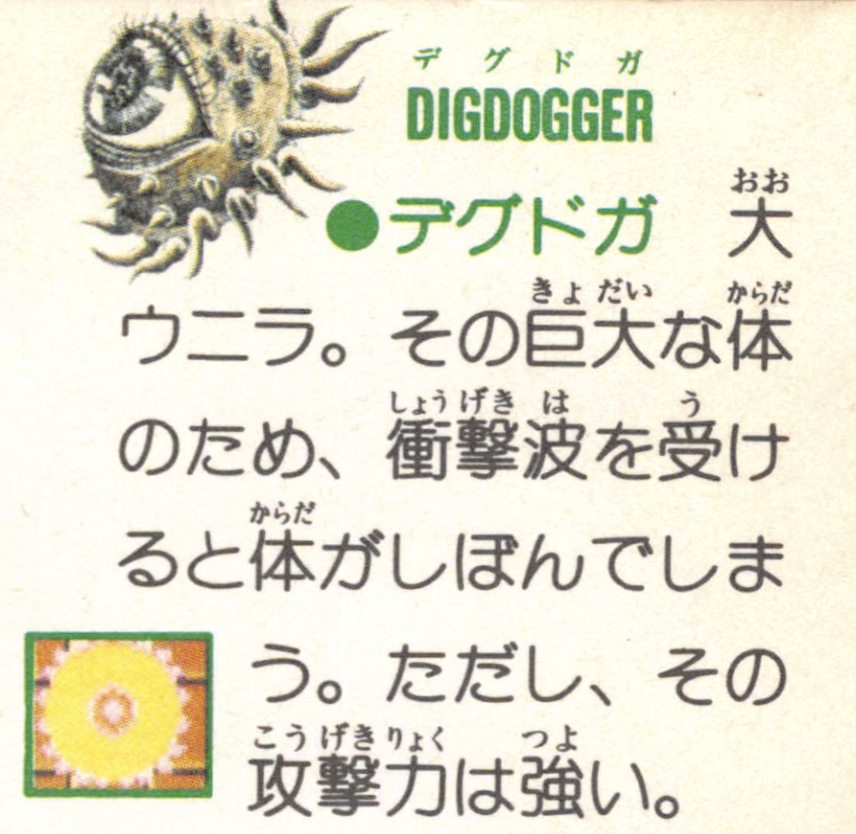
Translation: “A big Unira. Due to its enormous size, its body shrivels when hit by a shockwave. However, it has a strong attack power.”
Speaking of Clu Clu Land — which is a phrase that’s only rarely begun a sentence in the history of human language — it’s perhaps also worth mentioning that the design of Legend of Zelda’s iconic Rupee is identical to the gold ingots appearing in 1984’s Clu Clu Land.
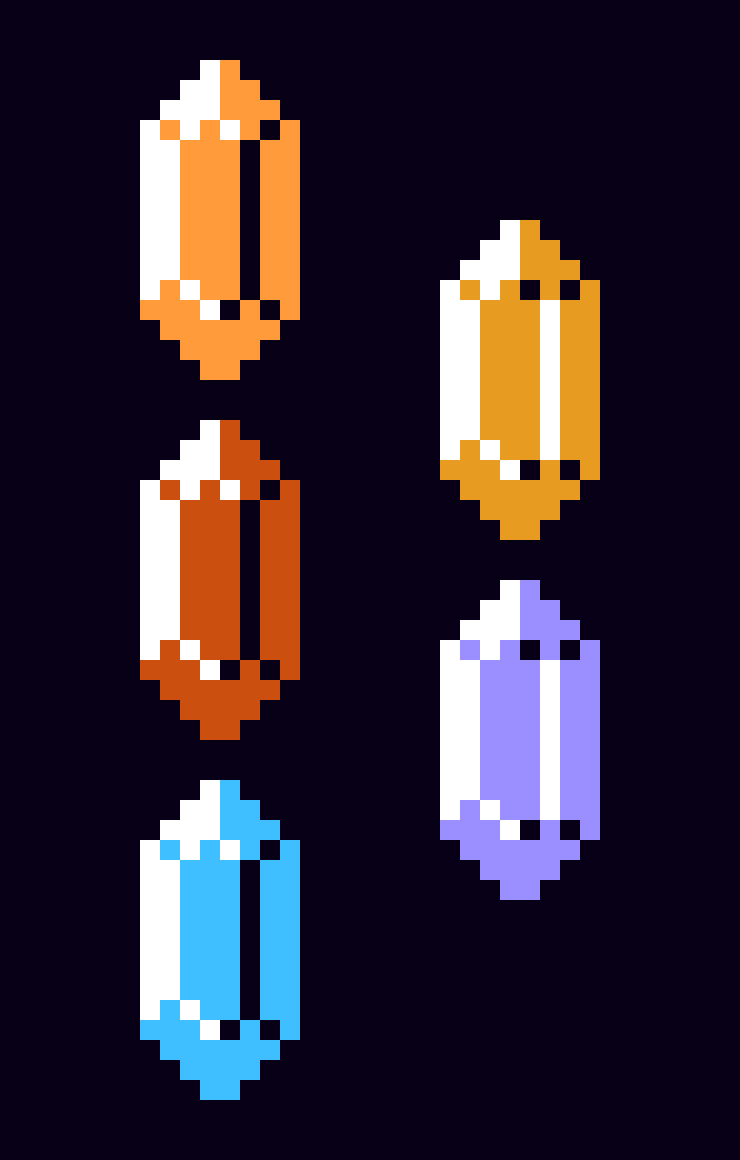
Left: the ones from Clu Clu Land. Right: the ones from Legend of Zelda. Vive la différence.
I don’t think there’s ever been a statement about this from anyone at Nintendo, but even considering how the limitations of the pixel grid might push artists toward similar designs, it does seem like someone opted to just re-use an asset. Legend of Zelda was developed by the R&D4 Team and Clu Clu Land by R&D1, but it doesn’t seem implausible that someone on the latter team saw this design in Clu Clu Land and decided it made visual sense as Zelda’s unit of currency.
Arm Wrestling (November 1985)
I don’t think this arcade game is officially a follow-up to Punch-Out!!, but it was created by the same team that made that series. And that probably explains why it features a hard-to-miss cameo by the Punch-Out!! boxer Bald Bull, just under an assumed identity: Mask X. It’s pretty easy to tell it’s him even before the mask comes off.
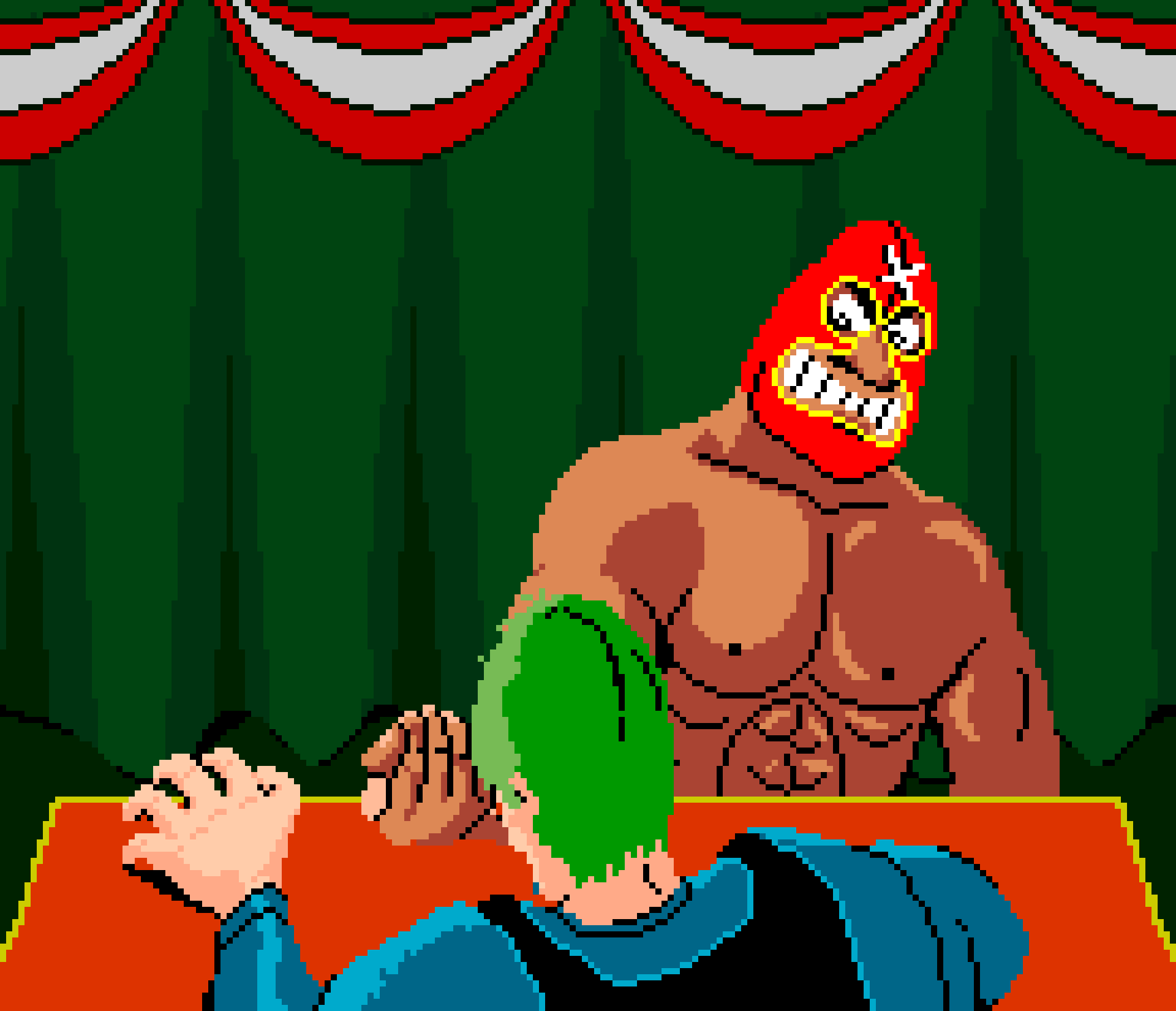
I guess you could call Arm Wrestling a spinoff, though I could also see it being considered an unrelated game that just happens to share the Punch-Out!! art style and the basic theme of physical competition between two characters. Either way, it’s got a character from a different game who’s wearing a disguise in a way that suggests he knows he’s breaking a rule by showing up in a game that’s not technically a Punch-Out!! installment. That’s something.
I’ve seen that some people see Alice, a nerdy science girl who has programmed an ape robot to arm wrestle, as being a kind of antecedent to Penny from WarioWare.
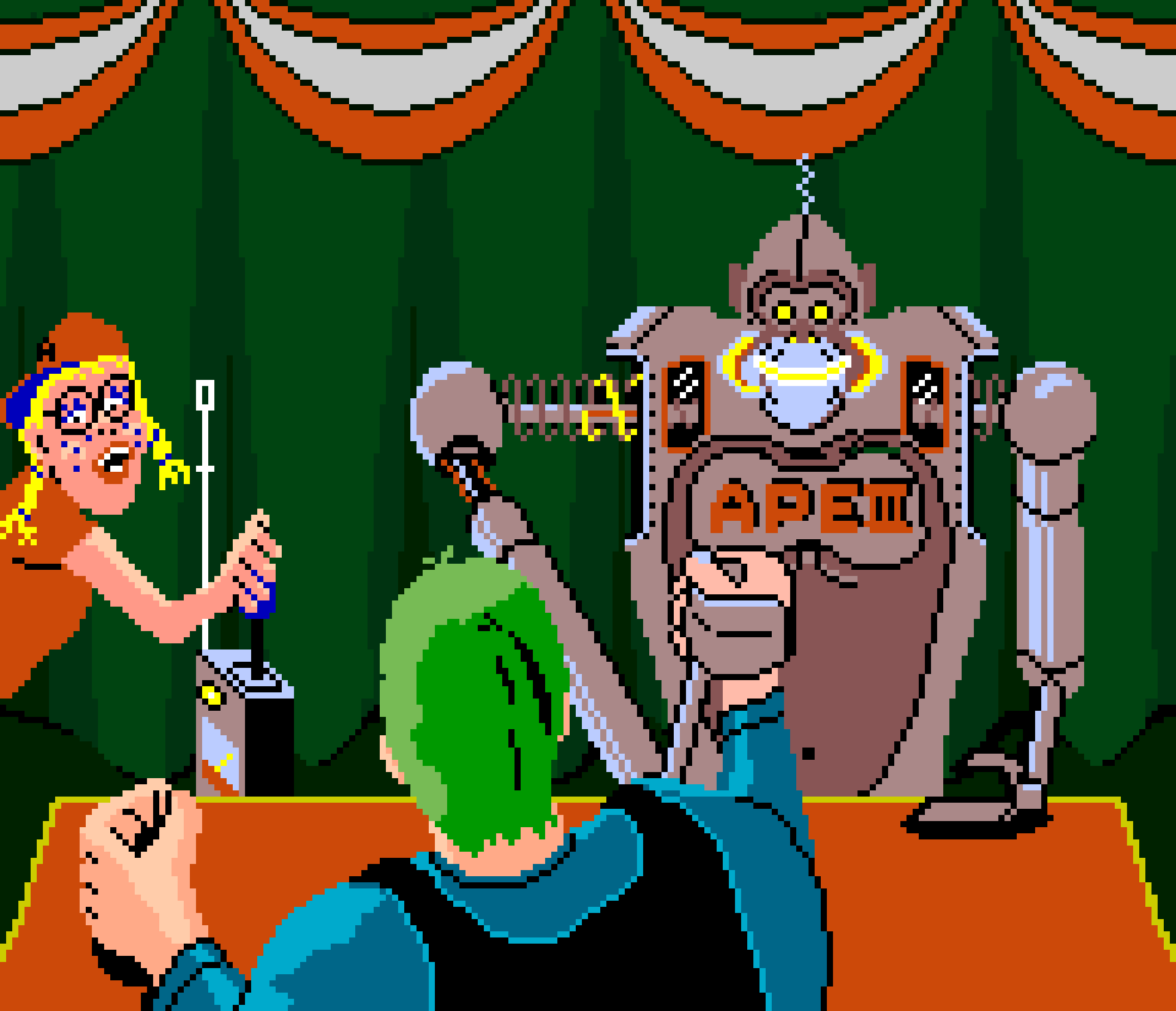
She could also just be another female science whiz wearing glasses, but I guess it’s not impossible, considering how Lulu, another WarioWare regular, is actually an homage to the heroine of Balloon Kid, and that’s almost as deep a cut. Since I’ll probably never have reason to mention Arm Wrestling again, I’ll just put this out here now: Texas Mac for Smash, please.
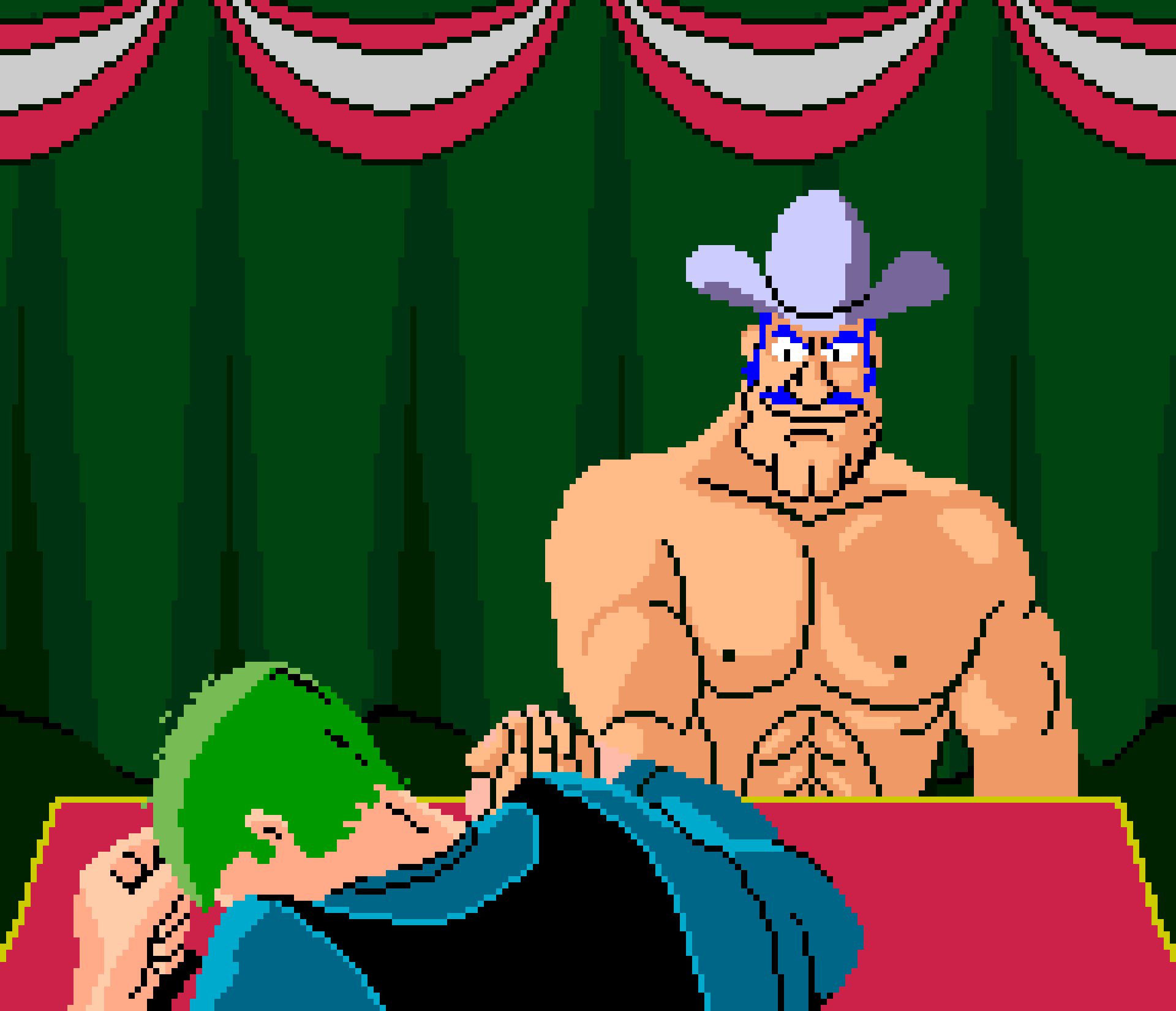
Best pecs in the history of Nintendo and a damn good mustache too. And, BTW, the game literally describes him as a “stud horse.”
Mach Rider (October 18, 1985)
The post-apocalyptic racing title re-uses a name from a 1972 racing car toy released by Nintendo before it pivoted to video games. As explained on the Before Mario blog, this toy doesn’t have much in common with the video game; there’s nothing about it that suggests anything sci-fi or combat-related. Both the toy and the video game seem to be named to convey the idea “vehicle that goes fast,” so it’s not clear if it’s an intentional allusion or merely a result of someone at Nintendo thinking it was a cool name. And while the toy itself was not an original Nintendo creation — it’s a Hasbro toy, Stick Shifters Drag Racers, repackaged for a Japanese market — the name does seem to have arisen at Nintendo.
I should probably mention that Mach Rider’s greatest franchise-spanning legacy is probably how Metroid’s famous “it’s actually a girl” surprise gender reveal arguably began with Mach Rider, and you can read about that in this post.
Super Mario Bros. (September 13, 1985)
Because the game is more or less a sequel to the 1983 arcade game Mario Bros., I don’t think we can count the presence of Mario, Luigi or the Koopa Troopas, the last of which technically debuted in the previous game as Shellcreepers. The Super Mario series’ signature green pipes also debut in Mario Bros, for what it’s worth, and lifts and trampolines look a lot like elements in the original Donkey Kong and Donkey Kong Jr., respectively. I guess you could call that a reference if you really wanted to, but I suspect it results more from reusing existing resources in an effort to be efficient.
It also probably doesn’t count that the swimming physics in this game are a modified version of what existed in Balloon Fight, because that’s less of a cameo than it is the developers looking back on something that had already worked previously. This comes up briefly in a 2006 Iwata Asks promoting New Super Mario Bros.
Satoru Iwata: [Super Mario Bros.] takes place on land, sea and air, with underground sections as well. Had you decided right from the start that it should be a large character that negotiated this terrain?
Shigeru Miyamoto: We had broadly decided on this approach. A large character that would run around on the ground.
Iwata: And swim in the sea.
Miyamoto: In terms of the game's structure, the swimming part is Balloon Fight.
Iwata: You're right. That's exactly what it is.
Miyamoto: With Balloon Fight launching previously, that system of controls had been tried and tested.
I guess the closest thing we have in Super Mario Bros. that came from another game series is the rotating firebars, because per this Iwata Asks they were originally designed for Legend of Zelda, but I realize that’s a stretch.
Ice Climber (January 30, 1985)
The noise that Popo and Nana make when they jump does sound awfully close to the jumping noise in Super Mario Bros., but again, I’m not sure if that’s a cameo so much as this is just the way Nintendo got around to thinking jumps sounded. They’re not identical, which means someone at Nintendo went back and purposefully re-created the Super Mario jump noise.
And the seal enemies that show up in the Japanese version of this game look fairly close to ones in Pinball, but that could be more of a case of “this is how you draw a seal using limited pixels.”
And I didn’t realize until it was brought to my attention in a comment, but a generic enemy in this game would seem to be pulled from one in Donkey Kong Jr.
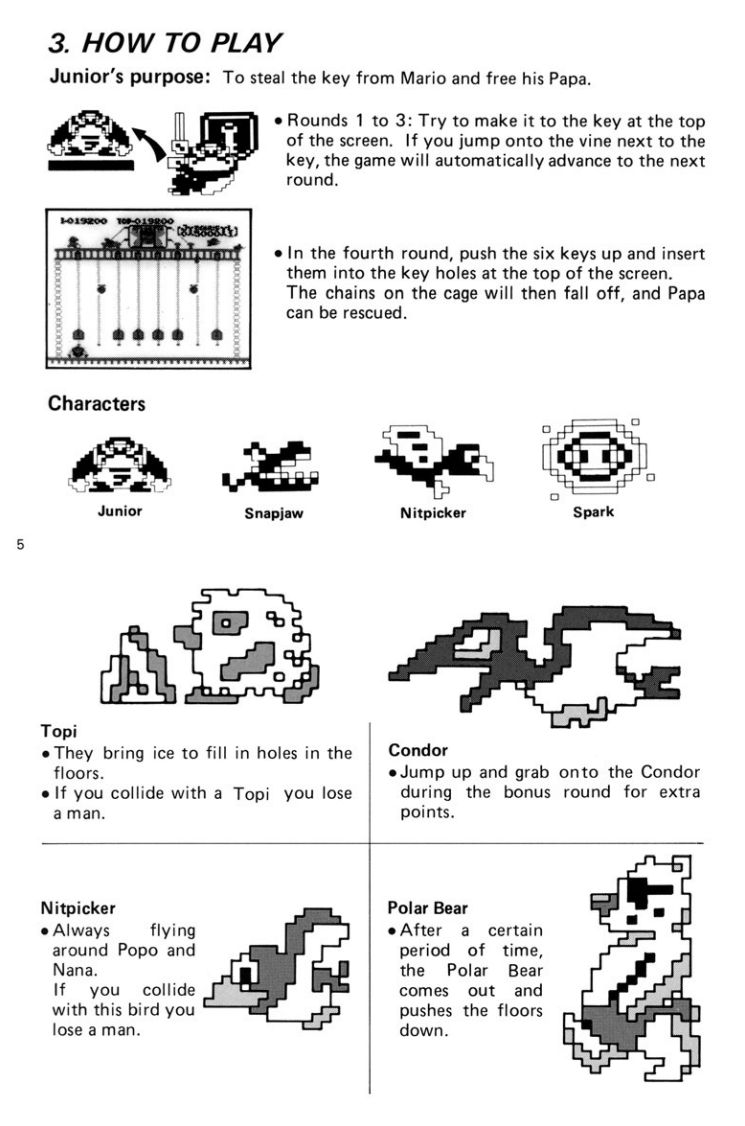
They act different and have different sprites, but both are called Nitpicker (ニットピッカー or Nittopikkā) in the original Japanese version, and some people consider them to be the same character, re-used.
Clu Clu Land (November 22, 1984)
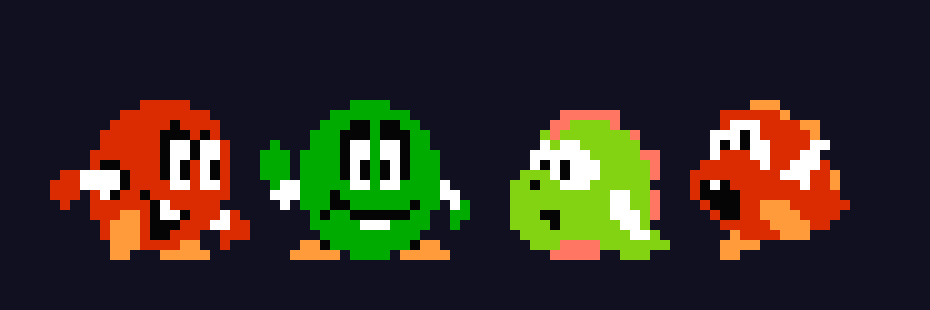
While this game is Bubbles’ big moment in the spotlight, she technically made her debut as a cameo in the North American version of VS. Pinball, released in October 1984. I don’t really know what to make of it other than Nintendo trying to foist Bubbles on a video game-playing public that wasn’t ready for her. Instead of Bubbles, the Japanese version, released July 26, features Achilles, a bird that I will mention later in the Family BASIC entry in this post. I have no idea why this change happened.

You can read more about Bubbles and how she’s not a female character in the original Japanese version of Clu Clu Land in this post.
The noise that Bubbles makes when she bumps into a wall sounds a lot like the Ice Climber jump sound effect — a lot more than they do the Super Mario Bros. jump sound effect. It might actually be the same sound, just slightly more clipped. Since it’s not paired with actually jumping, I would assume it’s more a case of “Here is a noise we already have.”
Perhaps it’s a subtle callback to Mario and Luigi that Bubbles’ default color is red but you get a green version of her if you do two-player mode? But then again, red and green are complimentary colors and they’re used in opposition in a lot of situations that aren’t Super Mario-coded. And I don’t know if this proves or refutes anything, but Devil World does exactly the opposite, with Tamagon being green by default but the player two version being red.
VS. Wrecking Crew (August 1984)
This is a weird one in that the VS. arcade version actually predates the console version of the game that most people would imagine kicked off the series. The game that’s just titled Wrecking Crew actually hit shelves almost a year later, on June 18, 1985. The infamous Foreman Spike is missing from the arcade version, with an inexplicably pink Luigi acting as the antagonist in the game’s one-player mode. Either version of Wrecking Crew would seem to retain a gameplay element that appeared previous in Mario Bros. wherein if you take too long on a given screen a fireball will start bouncing around to raise the level of urgency.
These fireballs look different, however, and more closely resemble the ones Mario and Luigi throw in Super Mario Bros. Apparently Nintendo thought it made sense to use fireballs as the “hurry up” mechanism in games that starred Mario, perhaps because that’s more or less how fireball enemies function in Donkey Kong. That said, this gameplay mechanic wasn’t invented by Nintendo, and per this Bluesky conversation, antecedents include the pterodactyl in Joust (1982), the larger monkey in Kangaroo (1982), the Baiters in Defender (1981), Evil Otto in Berzerk (1980) and maybe even the small saucer in Asteroids (1979).
Other than that, I think I can write off a lot of possible elements of this game as being drawn from the Super Mario series, because it’s a spinoff.
Family BASIC (June 21, 1984)
Not a game so much a peripheral that allowed users to program their own games in the BASIC computer language, it functions a little like an 8-bit forerunner to creative suites such as Mario Paint and Mario Maker. It was only released in Japan, and it came pre-programmed with sprites that often came from existing Nintendo games. Seeing them all next to each other gives a little bit of the “everyone is here” vibe I mentioned earlier, just with the extremely slim pickings of the console’s early days.
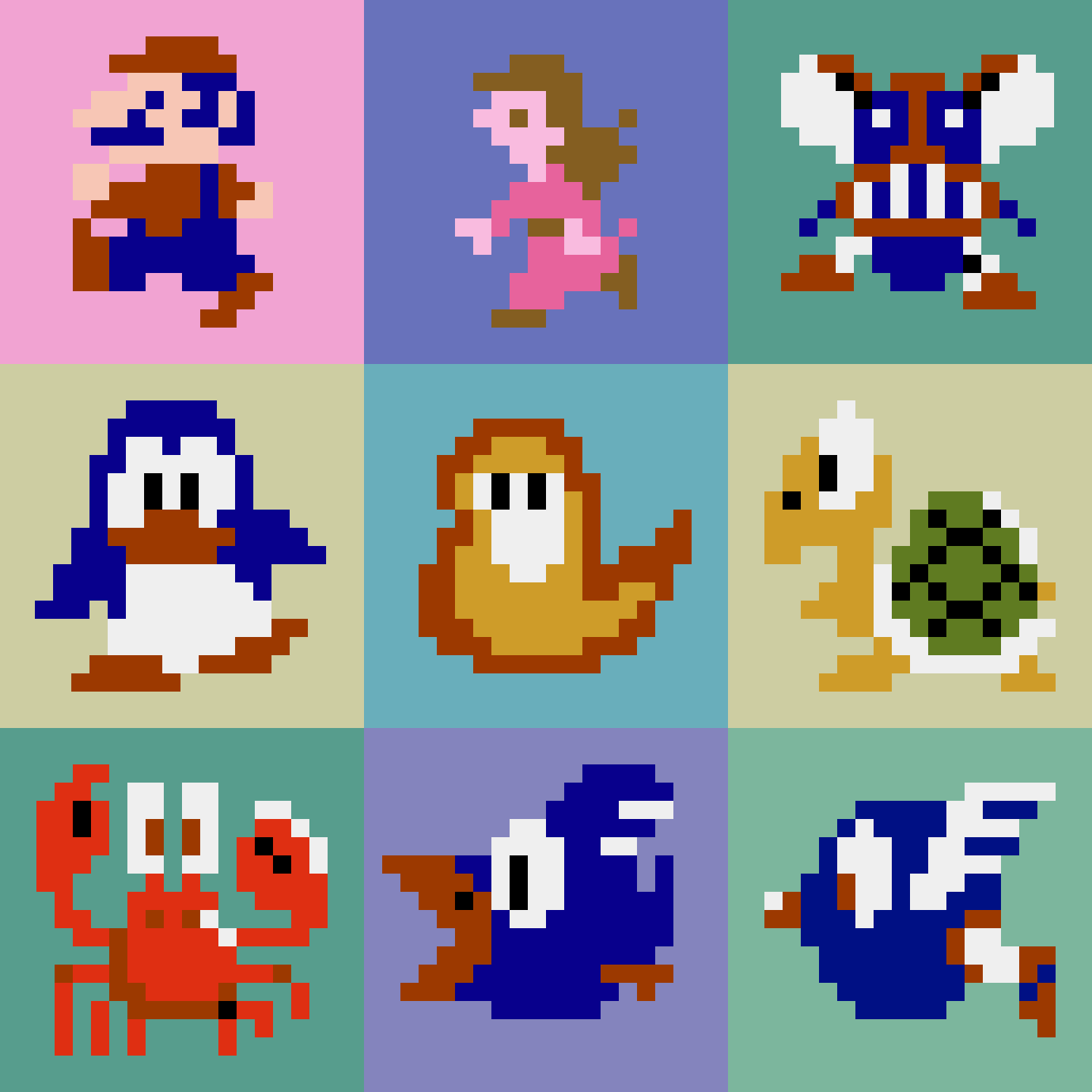
Clockwise from top-left: Mario, Pauline, Fighter Fly from Mario Bros., one of the penguins from Pinball (and he’s apparently named Penpen, but I’m not clear if that’s something specific to this game or if he’s named that in Pinball as well), the roving fireball from Donkey Kong, a Shellcreeper from Mario Bros., a Side Stepper from Mario Bros., the Nitpicker bird enemy from DK Jr., and then a different bird, Achilles, whom I mentioned in the Clu Clu Land entry, although I have to say I have no idea why his name is Achilles or if he’s supposed to be from some other game and I’m just not tracking it. Anyone?
There are also some sprites that don’t seem to come from any specific game.
There’s also a premade game that comes with the third iteration of Family BASIC, and it features Mario and Pauline re-creating a scene from Sheriff.
From one perspective, this is two Donkey Kong characters stepping into the roles played in the original Sheriff arcade game by its hero and heroine, Mr. Jack and Lady. But as I explain in my history of Pauline, there’s a good argument that Pauline basically is the same character as Sheriff’s Lady and that she therefore pre-dates Mario. There’s also an argument that Mr. Jack, with his tough guy sneer reading as mustache in pixel form, works as a kind of proto-Mario, so perhaps both of them originated in Sheriff, but I personally think the evidence is stronger that the Donkey Kong heroine is essentially the same character. It’s complicated.
Hogan’s Alley (June 12, 1984) and Wild Gunman (February 18, 1984)
Just because someone will point this out if I don’t say it, the noise you hear when you pull the trigger on the Zapper makes the same sound effect in these two games as it does in Duck Hunt. I would assume that more than anything else, this is merely a result of Nintendo deciding how they wanted their gun accessory to sound.
All three games were part of the Family Computer Video Shooting Series (光線銃シリーズ). I will discuss the origins of Duck Hunt in its own section, but there’s an interesting bit of Nintendo history regarding Wild Gunman. The game released for the NES and Famicom is basically an adaptation of an FMV arcade game Nintendo released in 1974. Fortunately, this is not a matter I had to research, because Kate Willaert already did the work. Thanks, Kate!
Hogan’s Alley does not revisit a Nintendo property that I know of, but I will take this opportunity to remind you that it’s inspired by and named for the real-life gun training facility that the FBI operates at Quantico — and that, in turn, is named after a comic strip from the 1890s. What a wild way to name a video game.
Golf (May 1, 1984)
Okay, this one is going to be more complicated than you might think.
The playable character in the NES Golf game looks a great deal like Mario and is even referred to as being Mario in some materials. However, the actual game doesn’t make it clear that it’s him. Furthermore, the 2008 Nintendo nostalgia fest Captain Rainbow features this golfer dude as part of its cast of lesser-remembered Nintendo characters, but he’s called Ossan, after a Japanese term referring to a middle aged man.
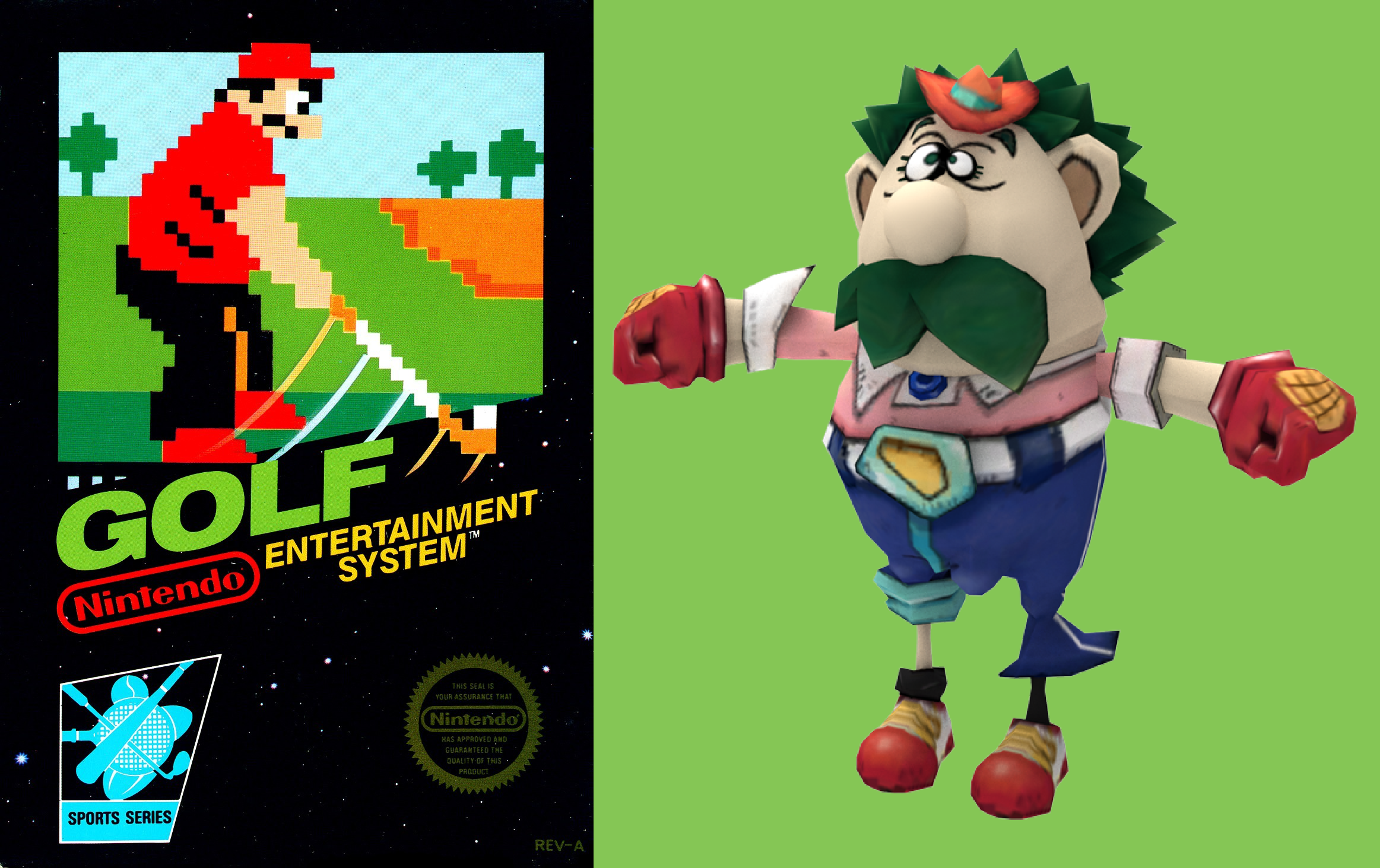
Left: Despite the fact that the default color scheme for the golfer avatar is white and blue, Nintendo marketed the game in the west with the version wearing the alternate color scheme, possibly in an effort to make him look more like Mario. Right: Ossan, as he appears in Captain Rainbow, is clearly not meant to be Mario at all. Let’s just say that Captain Rainbow has its own particular art style.
However, Ossan was also one of the names that Nintendo referred to Mario early on, back when they were considering making him a sort of average Joe who just showed up in every game they made. So maybe it’s Mario being playable in his first sports spinoff or maybe it’s a character who looks a lot like Mario but just isn’t. I guess you get to choose your own adventure.
This is made even more complicated with the release of VS. Ladies Golf that same year. As the title implies, the player avatar in this version is female. And while the default version may not look much like Pauline, there’s an alternate palette that puts her in red, making her look a lot like how Pauline looks today, though notably not how she looked back in the NES era. In fact, as Kate Willaert pointed out, Pauline’s sporty outfit in Mario Tennis Aces looks a lot like the female golfer’s.

There’s a 1985 flyer advertising the Nintendo VS. system, which allowed arcade operators to swap out special versions of Famicom or NES titles from a single arcade cabinet. It features a host of Marios in various costumes suiting the various games available, but the one for VS. Ladies Golf shows a potato-nosed woman who looks more or less like Mario in drag.

But I don’t think that’s what it is. I think this is actually meant to be Pauline again. Back before they really nailed down her look, she was sometimes depicted like a female Mario, nose and all. Check out, for example, this illustration from the manual for Family BASIC.

Because Pauline is the only playable female character in that game, this illustration in the manual can really be no one else other than her. Thus, I do think it’s supposed to be Pauline in VS. Ladies Golf as well, because the original Donkey Kong arcade game was successful enough that she had become Nintendo’s go-to girl and the original player two to Mario’s player one… you know, before Luigi showed up and pushed her to the sidelines.
Again, this is all covered in considerable depth in my big Pauline post, should you be interested.
Duck Hunt (April 21, 1984)
In the same way that Wild Gunman hearkens back to something Nintendo had attempted before, the video game version of Duck Hunt is essentially a new realization of a concept that Nintendo had previously released in 1976: 光線銃ダックハント or Kōsenjū Dakkuhanto (“Light Ray Gun Duck Hunt”). It’s an “electro-mechanical toy” but not a video game, and it’s a marvel to watch it in action. I’ll refer you to the Before Mario entry for details on how it actually worked.
But that’s not all! The video game version of Duck Hunt also had a mode in which you could shoot clay pigeons, and this seems like a nod to the Laser Clay Shooting System (レーザークレー射撃システム), an arcade-style gun shooting simulation that Nintendo sold in 1973. There is also a Before Mario entry about this.
I am not really sure how to classify these or how well they meet the criteria I set for this post. They’re neither crossovers or cameos, really, but they are for sure Nintendo nodding to its own past — just in a way that wasn’t especially apparent to gamers outside Japan. In one sense, Duck Hunt represents Nintendo returning to older ideas and realizing them in a way that technology hadn’t allowed beforehand. That is… something, surely, but I’m not sure what.
Punch-Out!! (February 17, 1984)
The original arcade version of Nintendo’s boxing series features literal background cameos of the company’s biggest stars of the time: Mario, Luigi, Donkey Kong and Donkey Kong Jr. They’re clustered on the left side of the screen, in the audience watching the fight.
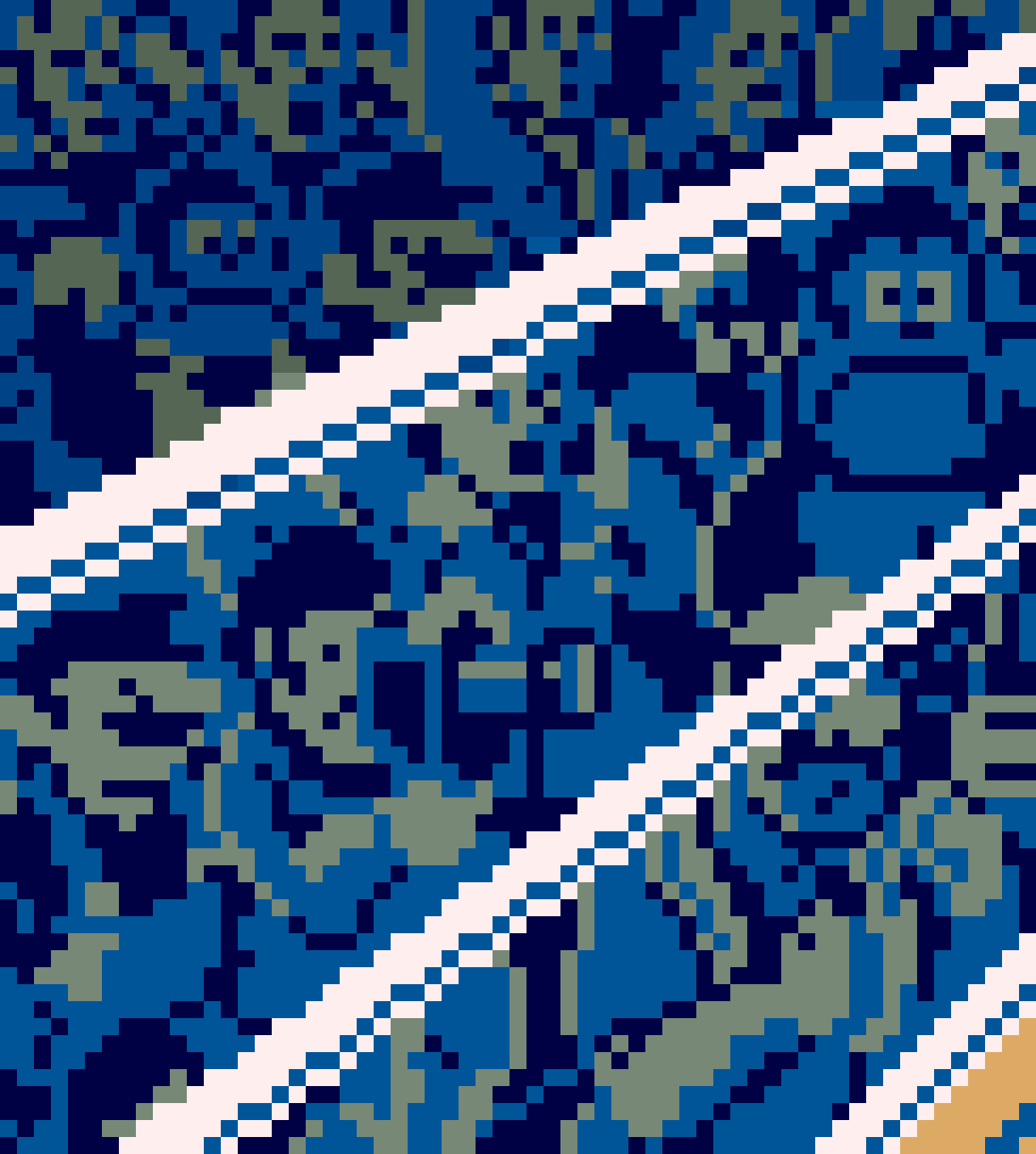
And for what it’s worth, the same background is reused in Super Punch-Out!!, released just months later that same year. What’s more interesting to me, however, is how this series shows the evolution of Nintendo’s concept of how cameos and crossovers should work. The first two installments of Punch-Out!! feature a referee character who starts each fight. By the time the series arrives on consoles, however — Mike Tyson’s Punch-Out!!, first released October 1987 — the role of referee had been handed off to Mario.
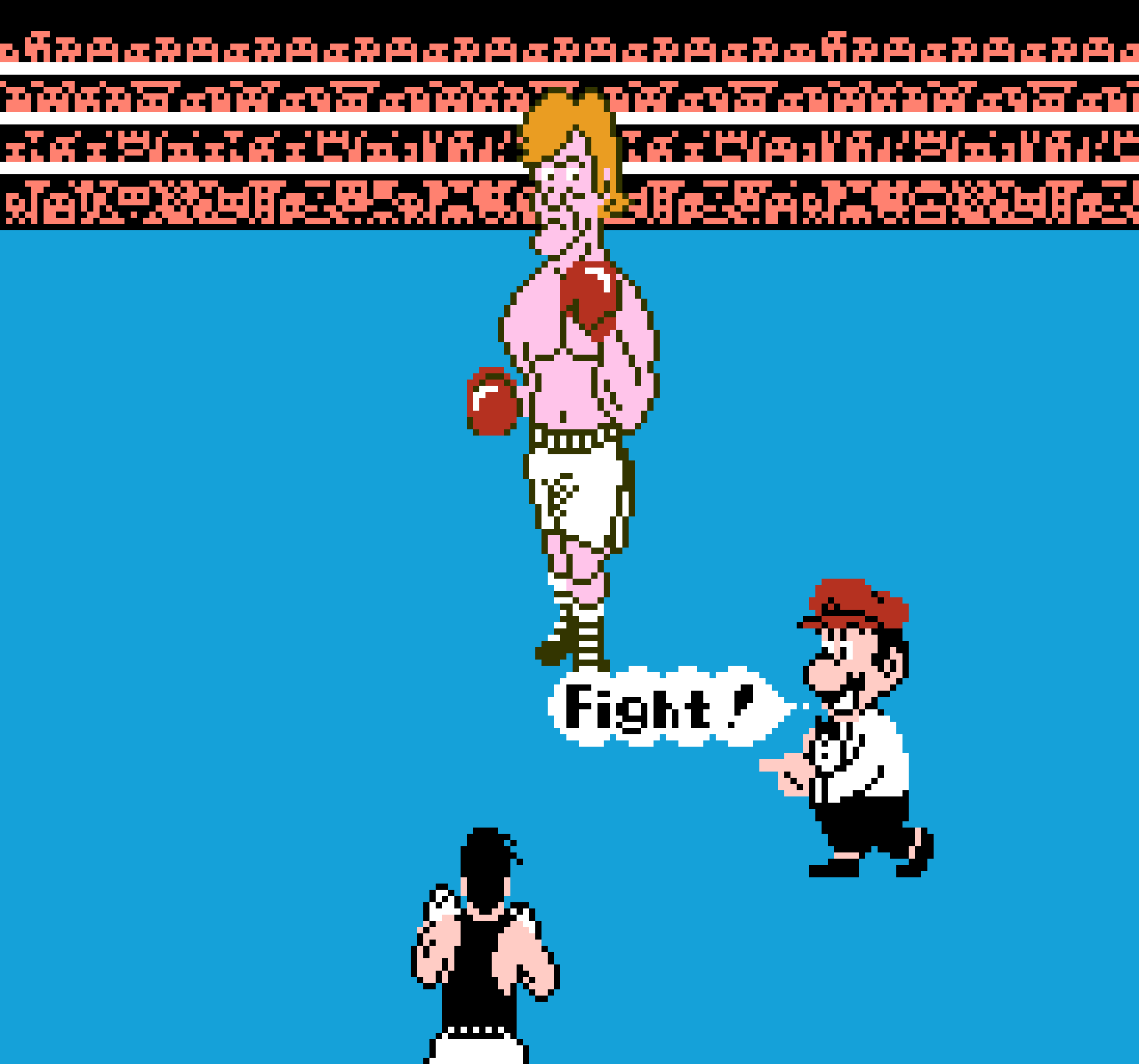
In the time between the first arcade version and the NES version, Mario literally goes from the background to foreground. He’s unmissable.
Pinball (February 2, 1984)
This is Mario’s first appearance in a game that’s not part of his own series. You can view the Donkey Kong series and the Super Mario series as two separate franchises or you can view them as two different phases of the same series. Either way, Pinball doesn’t really seem like it belongs. Regardless, you get to see both Mario and Pauline in a Breakout-esque bonus stage. You even see Pauline walking back and forth, which she hadn’t been allowed to do previously, since she only ran in place in Donkey Kong.
For what it’s worth, she’s more than a little Olive Oyl in the way she walks.
Tennis (January 14, 1984)
It’s funny how it took until 1987 for Mario to play referee in a Punch-Out!! game when he’d already more or less done that in Nintendo’s first Tennis game, where he played the umpire.
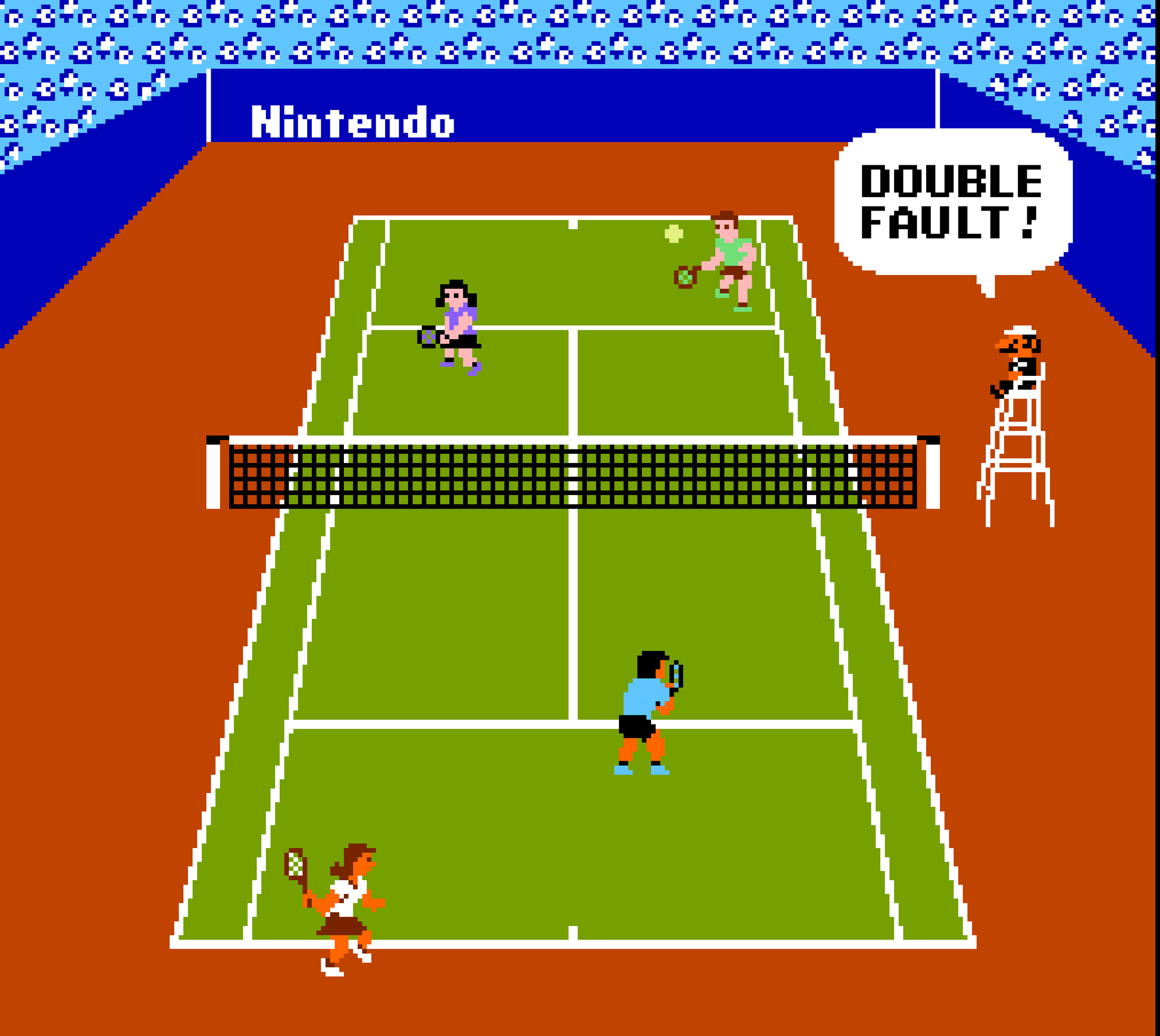
But then again it’s just as surprising that it took eleven more years for Nintendo to realize that Mario himself could be the one playing tennis. Of course, in the Nintendo 64 Mario Tennis, an inexplicable blue version of Mario still managed to be the umpire. Hmm…
Donkey Kong 3 (October 21, 1983)
I have to say that I’m shocked that it took until this point in this list for me to mention Game & Watch. I was sure there’d be an entry that mentioned Game & Watch before Donkey Kong 3 — by which I of course mean *after* Donkey Kong 3, since we’re going in reverse chronological order — but here we are. It’s entirely possible that I am dense and have simply missed some connections between the Game & Watch series and later video games. (Please tell me if I have. I envisioned this post as the kind that I’d update as new information comes to my attention.) But I’m not sure there’s another instance of a Game & Watch game being more closely tied to a later Nintendo video game than Donkey Kong 3 is to Green House.
What’s interesting about Donkey Kong 3 is that while it does owe a certain debt to Green House, which was first released December 6, 1982, they’re different games in a few different ways, and I’d be curious to know who thought it made sense to shoehorn this title into the Donkey Kong series.
If you’ve never seen it in motion, check out this video of Green House’s gameplay.
You’ve got a room full of plants. You’ve got a guy trying to save certain flowers from predatory insects. His only weapon is bug spray. And while some enemies take a single insecticide hit and die, others are only pushed back, requiring strategy and timing to kill them for good. All of that describes Donkey Kong 3 as well, but there are also quite a few differences. The latter works more like a shooter than whatever you’d call Green House. There’s no ladder, and instead you move around the platforms by jumping. And the role of the spiders is essentially played by Donkey Kong as he descends from the ceiling, only leaving once he’s received repeated blasts of bug spray up his butt.
I feel pretty safe calling Donkey Kong 3 a remake of Green House, but it’s a *weird* remake — and it’s an even weirder Donkey Kong sequel. I’d love to hear the people who made this game explain how they came to adapt a Game & Watch title in this way, but as far as I know that conversation has not happened on the record.
The fact that the hero of Donkey Kong 3 is Stanley the Bugman and not Mario does make me think that it should count as a crossover. Sure, Mario was “busy” starring in Mario Bros., which Nintendo released in arcades the previous March, but it’s not like Mario couldn’t just as easily have been the hero of Donkey Kong 3. No, Nintendo decided to stick with the hero of Green House, essentially making this a crossover between this one Game & Watch title and the Donkey Kong series.
But is that what actually happened? If you look at the English instruction manual for Green House, it doesn’t mention Stanley’s name at all. It refers to the player character only as “the Fumigator.”
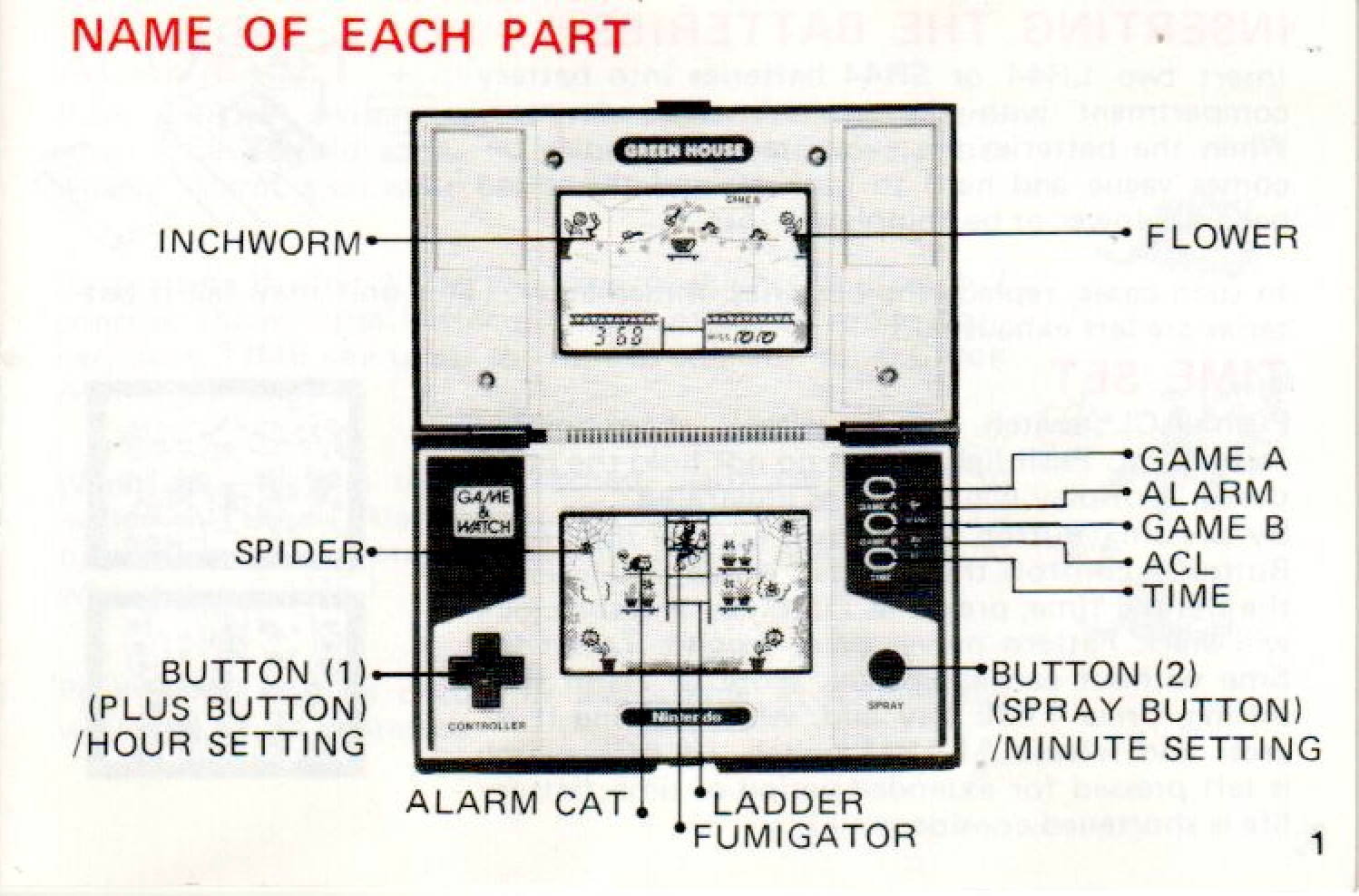
In trying to find where and when the first mention of Stanley’s name showed up, I did find a magazine advertisement allegedly from February 1983 — eight months before Donkey Kong 3’s release — that did refer to the player character in Green House as Stanley.
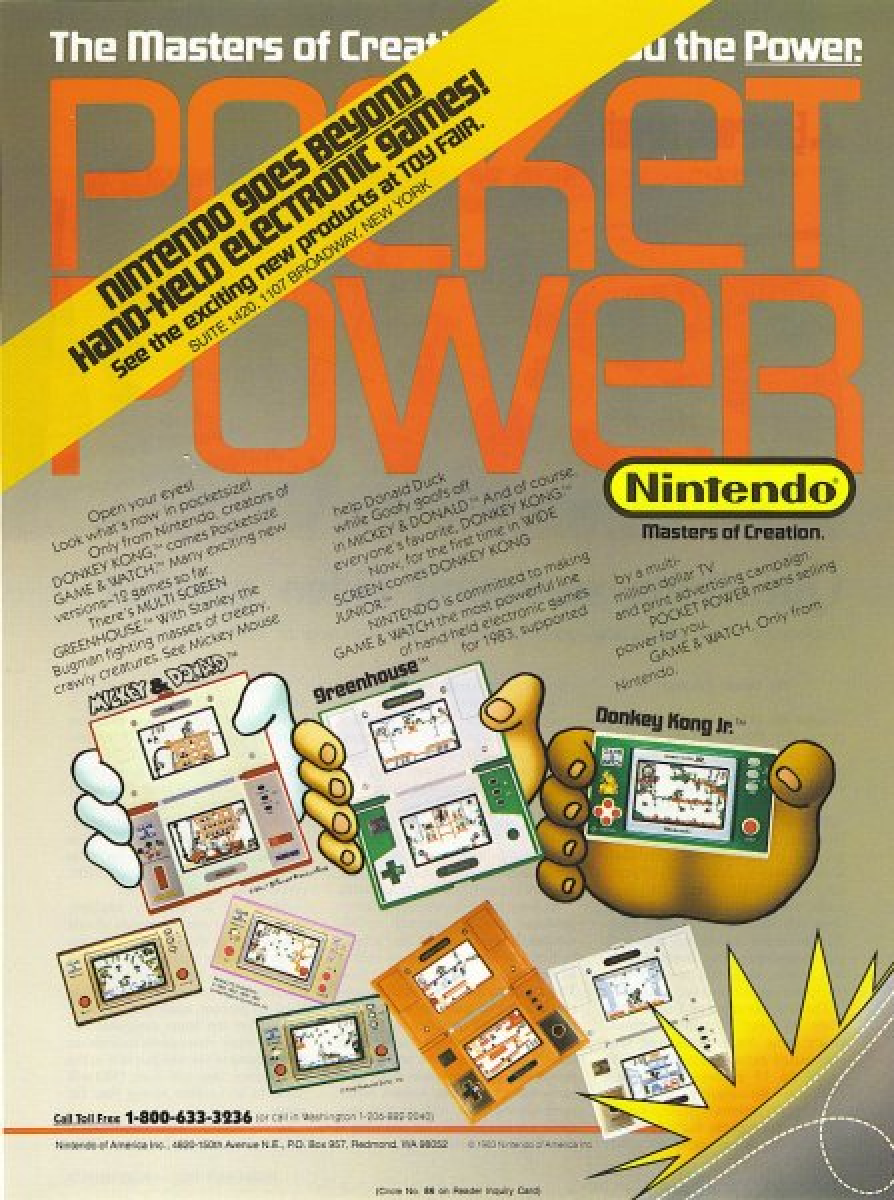
On the other hand, Stanley’s trophy in Smash Bros. Melee lists his first appearance as being Donkey Kong 3 and not Green House, but then again the trophy bios aren’t always 100 percent accurate.
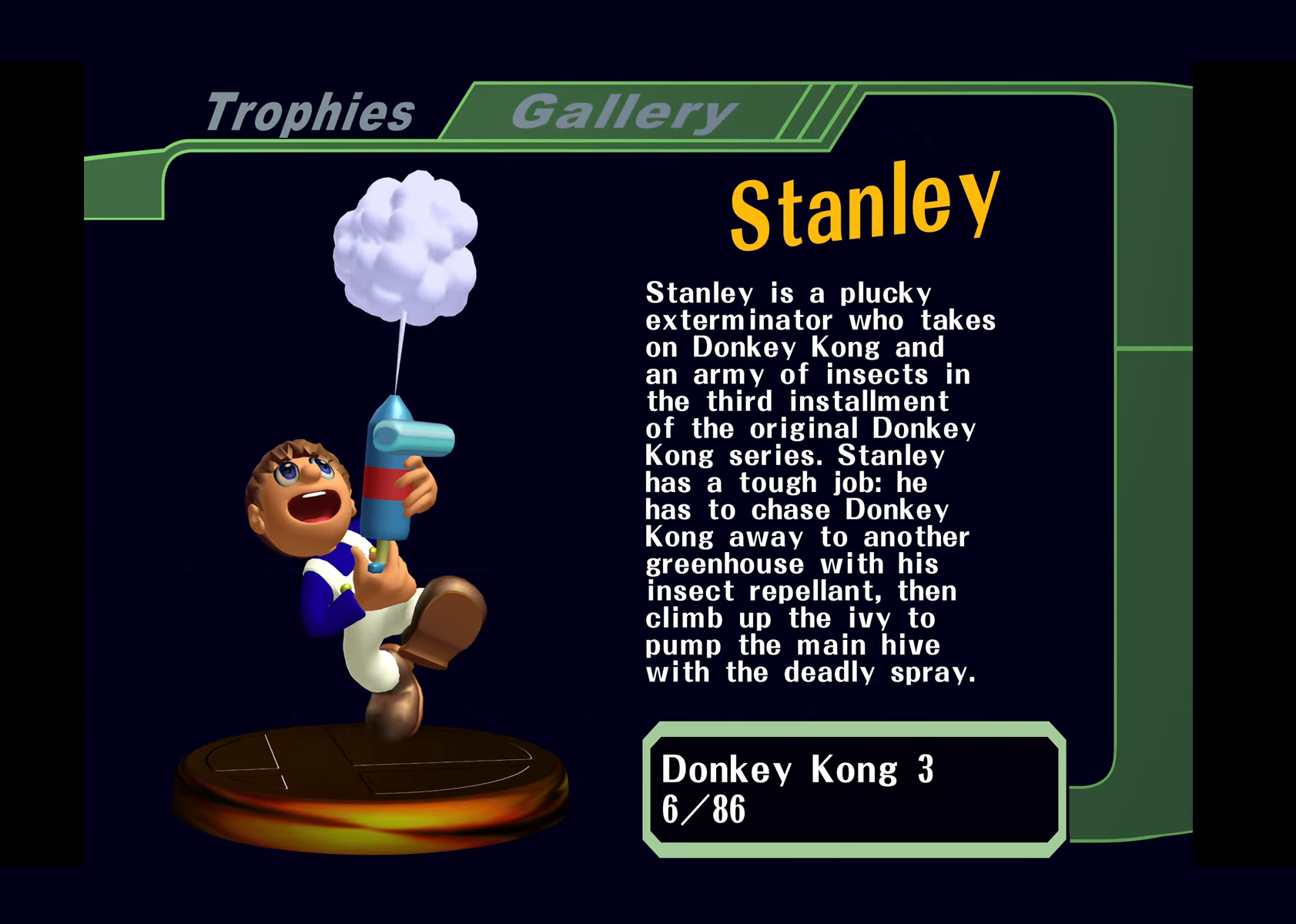
I’m all ears if anyone can find an earlier reference to the Game & Watch character being named Stanley.
Finally, the arcade version of Donkey Kong 3 eventually got sent back to where it came from: as a Game & Watch title of the same name, but even then, it’s a weird adaptation of that game. I have to laugh because it seems like a lot of to-do for a game that is basically a footnote in Donkey Kong’s video game history.
Mario Bros. (June 21, 1983)
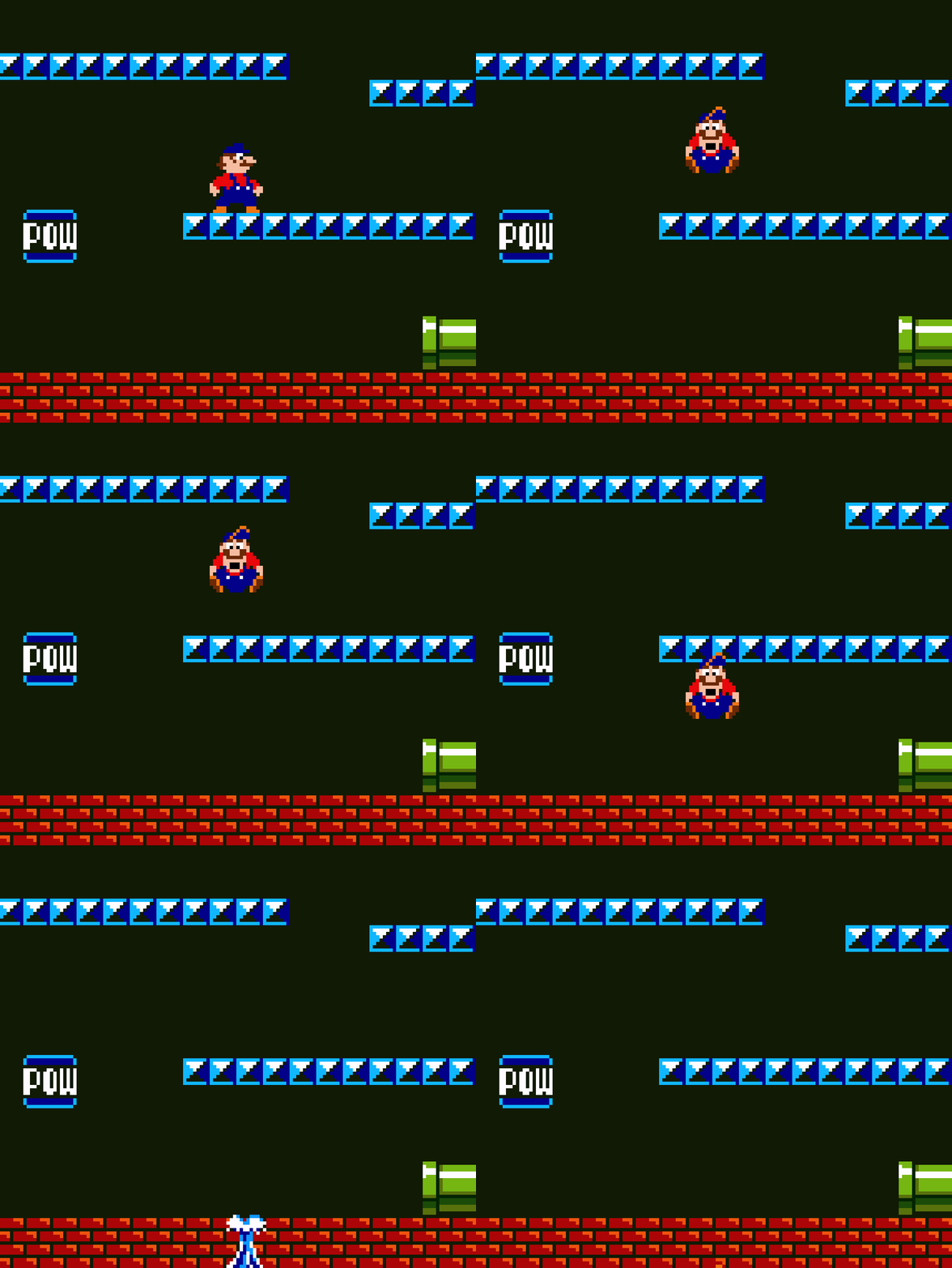
As far as I can tell, the first game to make Mario a title character only cribs from one previous Nintendo game, and it’s a pretty tenuous connection at best. Late last year, I put up a post about the evolution of Mario’s trademark death animation. You know what I’m talking about: facing the screen (and breaking the forth wall) while he melodramatically falls though the floor of whatever platform he was standing on.
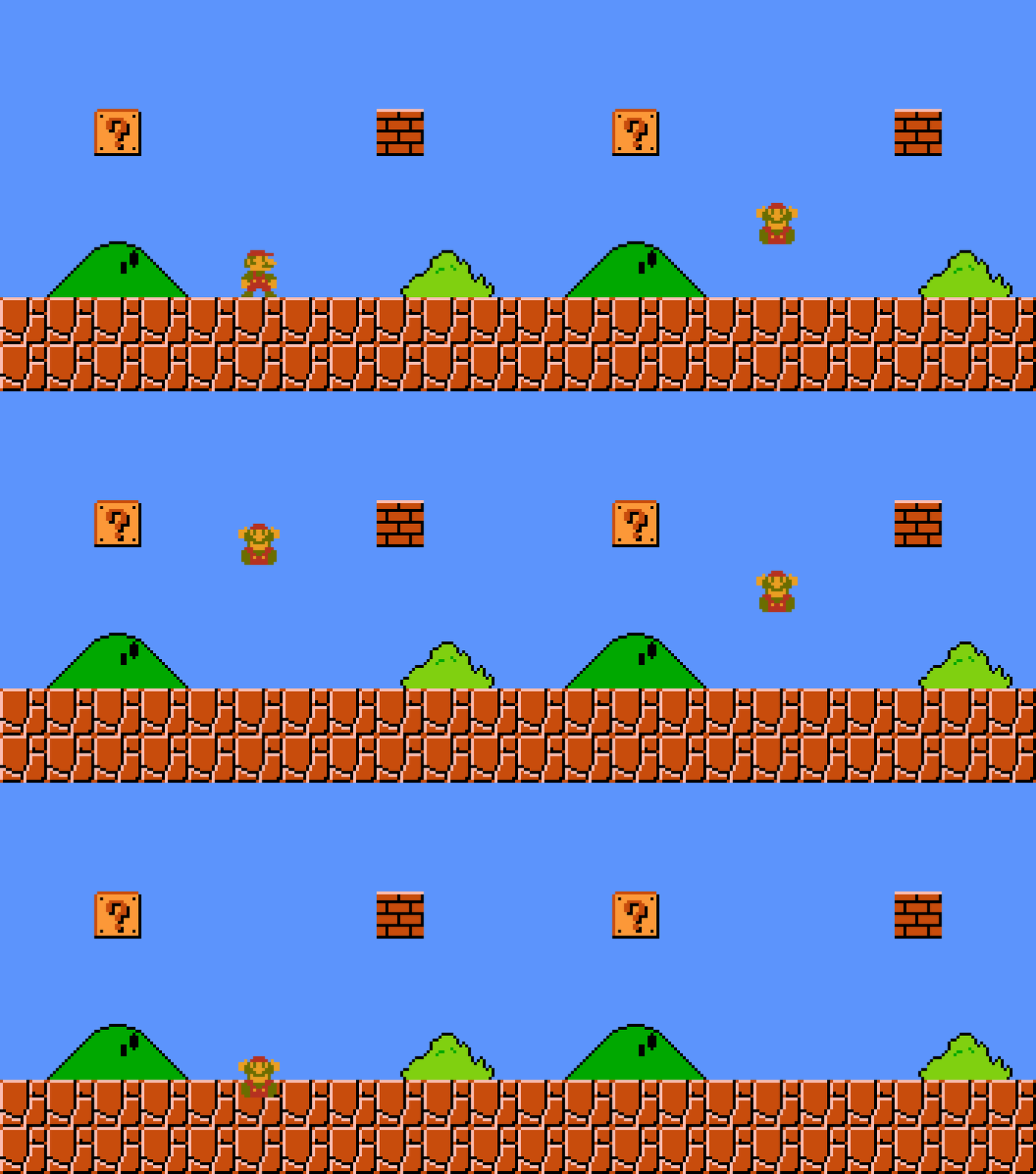
I concluded that Mario more or less ripped it off from Donkey Kong Jr. (the game and the character), as had Milon’s Secret Castle, Hudson’s Adventure Island, Mickey Mousecapade, Little Nemo: The Dream Master and even Sonic the Hedgehog. But by my count, Mario Bros. was the first to steal it.
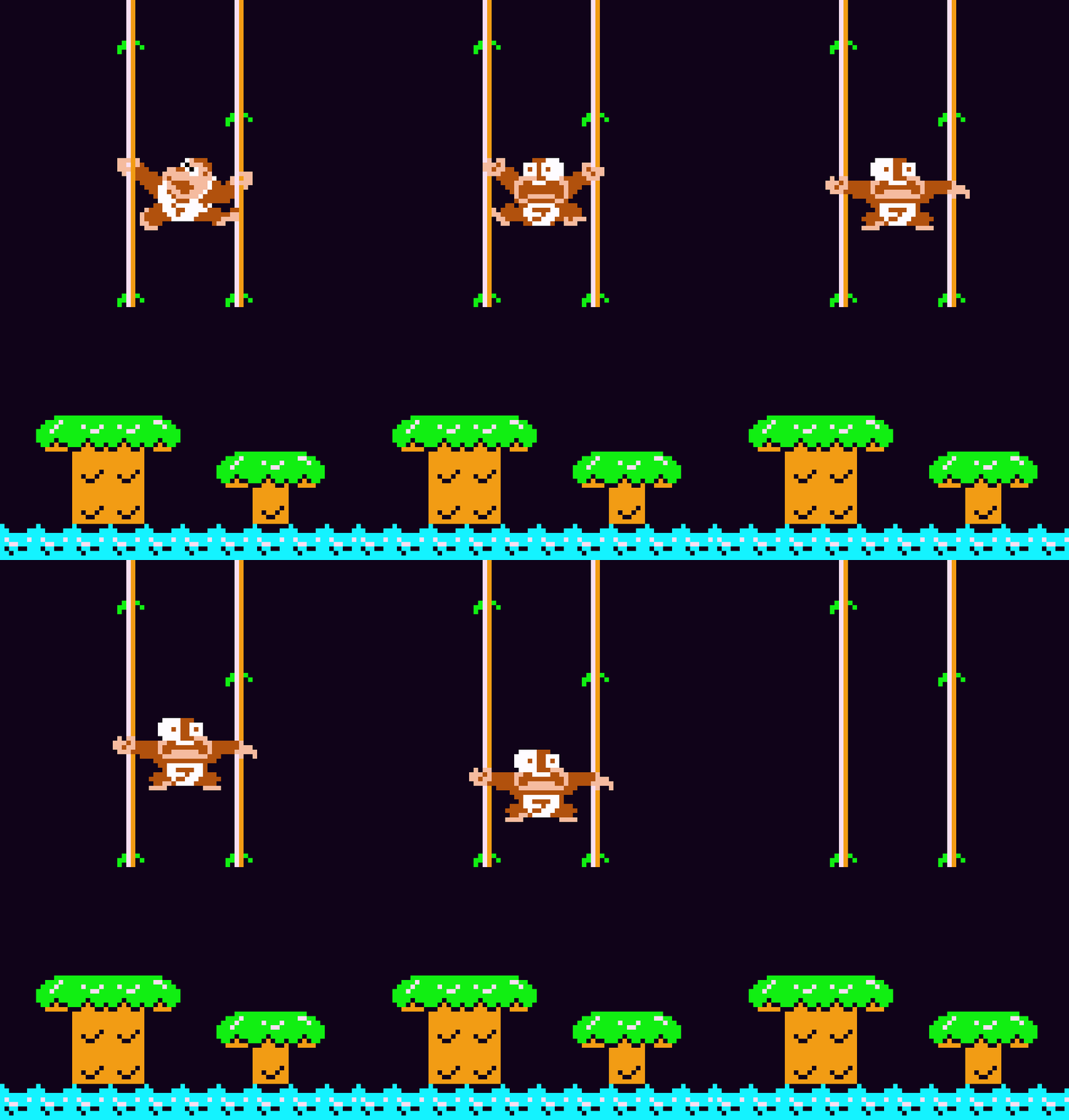
Here’s how Junior dies in his game.
And here’s the very different death animation in the first Donkey Kong, for comparison’s sake.
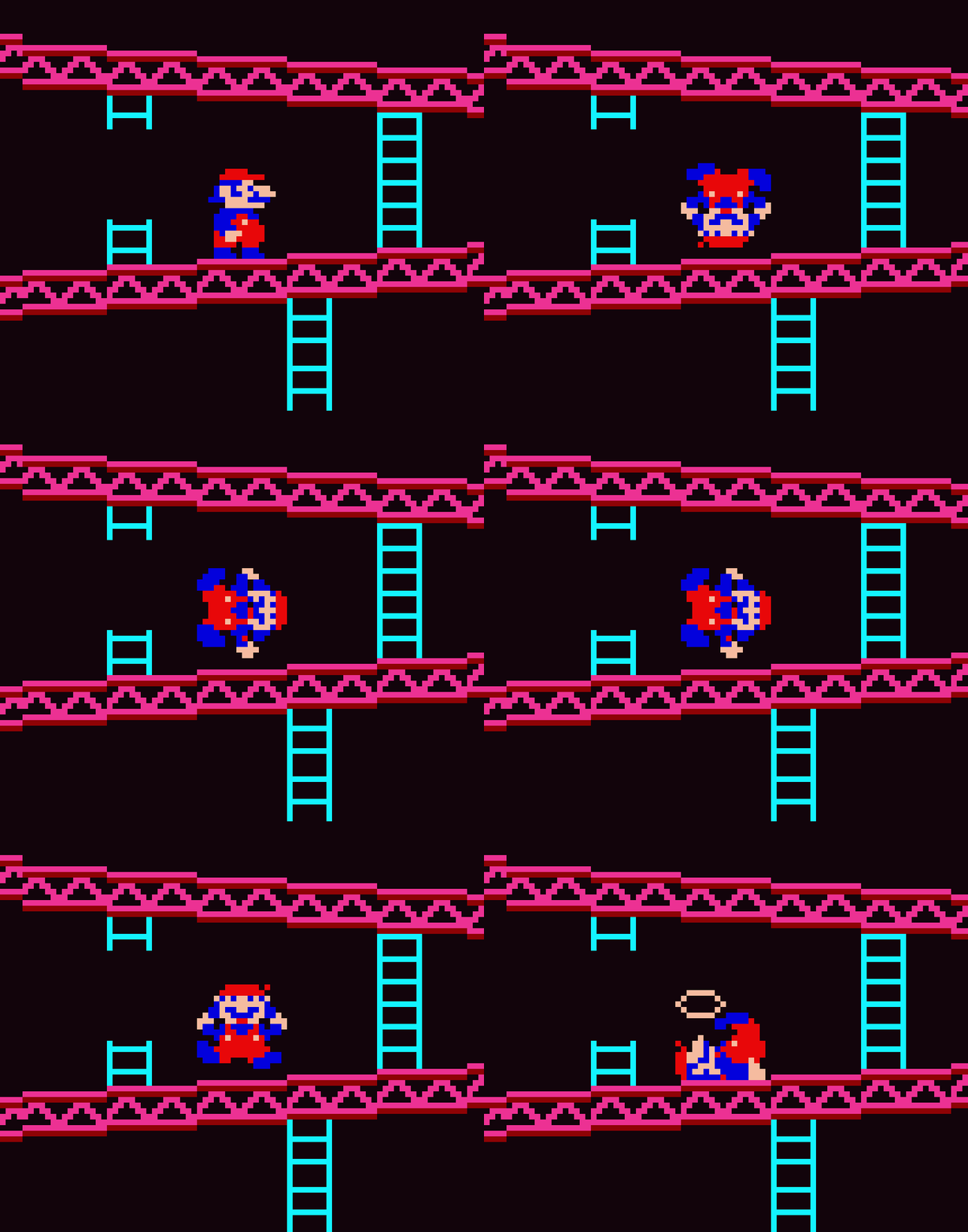
As far as I can tell, Donkey Kong Jr. invented it, but then it became associated with Mario despite the fact that everyone else also copied it.
Donkey Kong Jr. (August 2, 1982)
According to the Super Mario Wiki, the music you hear upon completing the game for the second time in a row is a reworking for the music you hear upon beating the first stage in Sky Skipper.
I know this won’t count, since it’s a reference to the original Donkey Kong, but in researching connections between this game and other games I learned that there’s actually a scene showing that Junior is following the evil Mario by floating along on what is clearly Pauline’s umbrella.
I’d not noticed this before! It’s super cute, and it’s also the first instance of the Mary Poppins-style umbrella flight that Peach still uses in Smash Bros. today.
Popeye (December 1982)
Of course, a failed attempt to create a Popeye arcade game ultimately resulted in Donkey Kong, which helped turn Nintendo into a video game giant. But shortly after Donkey Kong’s release, Nintendo did successfully make that Popeye game. Visually, I don’t see anything in Popeye that was lifted from a previous game. The noise you hear when Popeye collects an item, at the very least, seems very close if not identical to the one heard in Donkey Kong jumps over a barrel.
There is a Game & Watch connection, however. The handheld Popeye game, released August 5, 1981, plays very differently but hinges around the idea of Popeye catching objects thrown by Olive Oyl.
It’s more or less garbage that she’s throwing, and I don’t know why you’d want any of it, but it does parallel a major part of the Popeye arcade game. In each stage of that, Olive Oyl is dropping something that Popeye needs to collect. It’s just that here it’s stuff that more relates to Popeye being in love with her: hearts or musical notes or the like, instead of bottles, cans and tiny pineapples. That’s a pretty standard video game mechanic — ”Collect the things that were scattered for some reason!” — and even Donkey Kong has its own version of it, wherein Mario can snag Pauline’s purse, parasol and hat for extra points.
It’s not quite the scope of this post, but I do have a post “How Popeye Changed Video Games” that explains, among other things, how the concept of a power-up may have originated with Popeye and his trusty can of spinach.
Sky Skipper (July 1981)
And here we have what might be the least remembered, least celebrated and overall least played Nintendo game of the post-Donkey Kong era. I have actually only seen a Sky Skipper cabinet once. I played it to say I’ve done it, and pretty much right away I got why it’s not a game that’s discussed much. Not only is it not a great game, it also lacks that Nintendo feeling, which every other game in this post does — yes, even Donkey Kong 3.
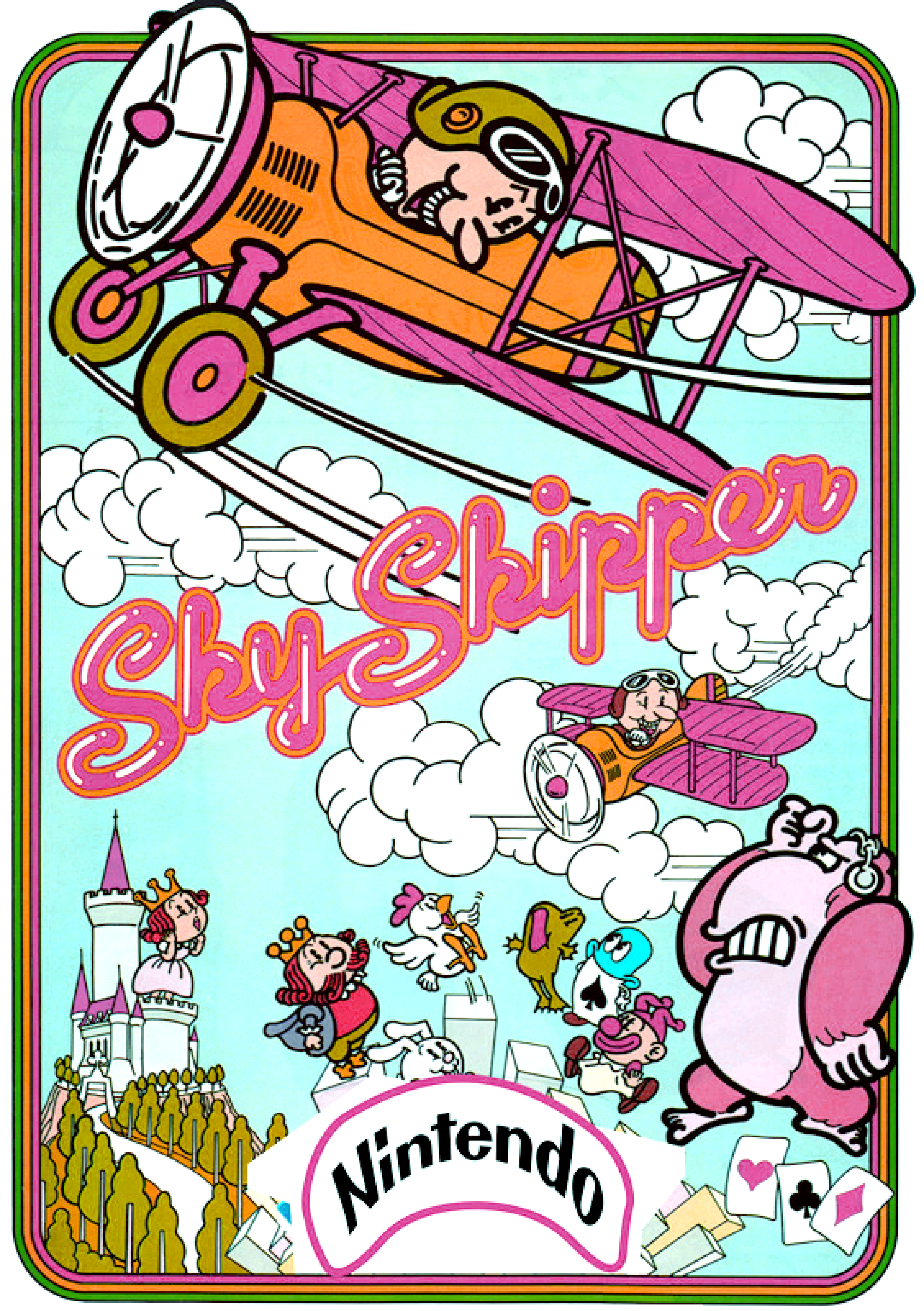
Sky Skipper has you controlling a biplane around an abstracted cityscape as you rescue captive animals and also a royal family from giant gorillas. Because the bad guys are giant gorillas, it might seem like a given that Sky Skipper is riffing on Donkey Kong, but I don’t think that’s the case. For one thing, this game’s gorillas happen to look nothing like Donkey Kong. They don’t even look especially like gorillas. If anything, they remind me a little of the Brothers Bear from Donkey Kong Country 3.
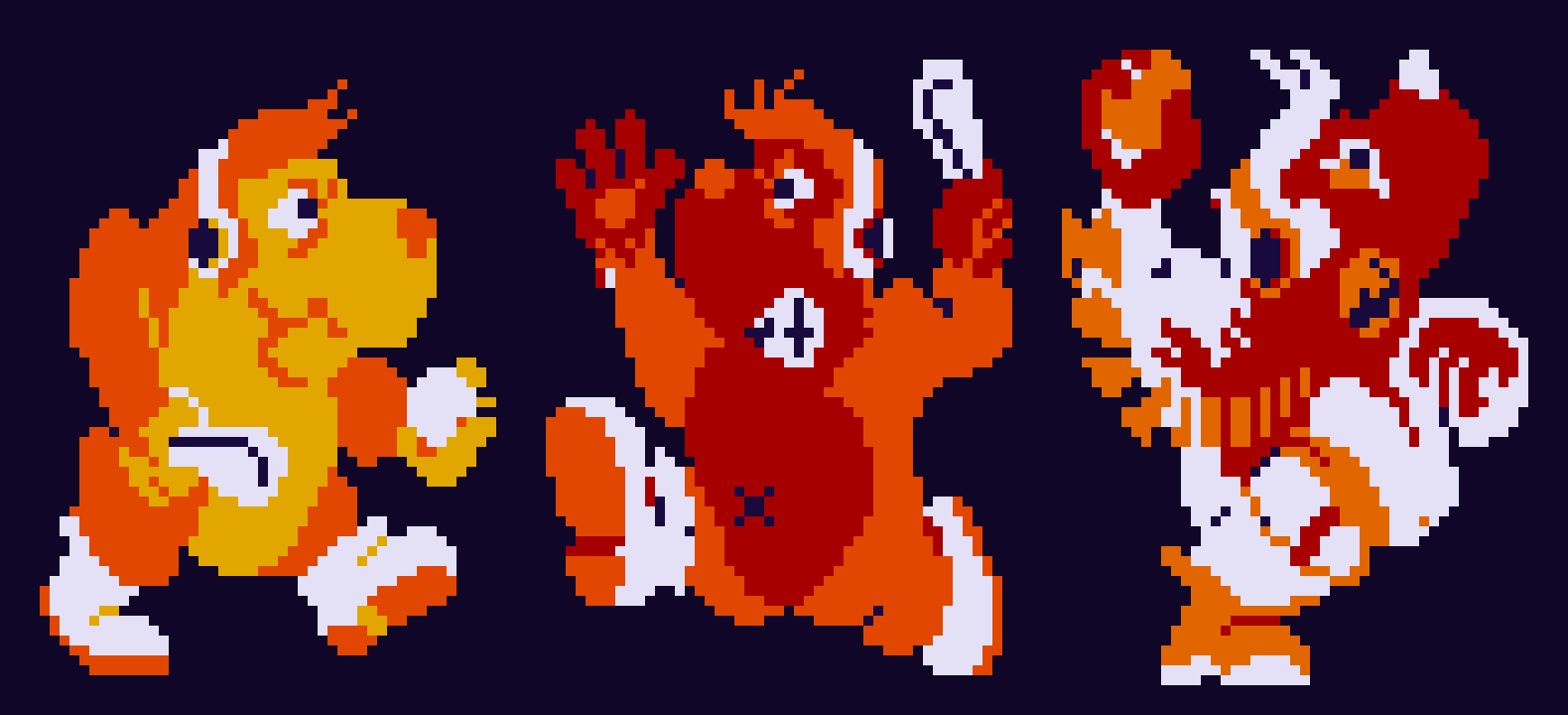
The art makes them look slightly more gorilla-like, I guess.
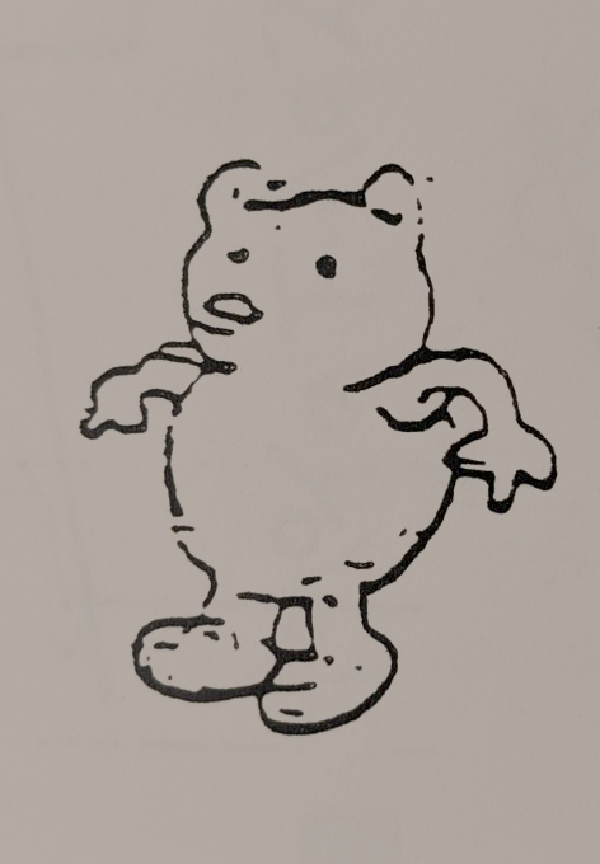
EDIT March 14, 2026: It has come to my attention that during a March 16, 1981, meeting about the game that would become Donkey Kong, Miyamoto drew a doodle of what would could be a gorilla but just as easily could be a bear. Perhaps this is why the Sky Skipper simians look more like bear than gorillas?
Both games were created by Nintendo R&D1, so if they wanted to make Sky Skipper’s gorillas look like Donkey Kong, it would have been possible. After all, there’s ample proof in this post that Nintendo has always been down to reappropriate resources. I actually wonder if Sky Skipper’s gorillas may have been pushed in another visual direction in an effort to diversify this game from Donkey Kong. That would have been possible because the two games would have been in production around the same time, seeing as how both were released in July 1981. In fact, that development period makes it very hard to call Sky Skipper an homage to Donkey Kong at all, since they’re basically twin releases.
So how, then, did Nintendo come to release two different and apparently unrelated games that feature kidnapping gorillas as the villains? I think the answer lies in the argument that Nintendo would present in the King Kong lawsuit by Universal Studios just two years later. Whereas Universal argued that the plot elements of Donkey Kong infringed on the studio’s intellectual property, Nintendo countered that Universal had itself proven that the basic plot to King Kong was public domain in a 1976 lawsuit against RKO Pictures regarding Dino De Laurentiis’s efforts to release a remake. Famously, the judge in the Universal v. Nintendo lawsuit would rule in the latter’s favor, but I think Nintendo’s winning argument speaks to the idea that skyscraper-climbing, damsel-snatching gorillas were just something that existed in pop culture — because of King Kong, but not always directly related to him, if that makes sense.
I mean, months before Donkey Kong hit arcades, the Jorudan-developed, Nichibutsu-published Crazy Climber did, and it more closely approximates a general King Kong vibe than Donkey Kong does. And yes, it does have a giant gorilla, in case you were wondering.
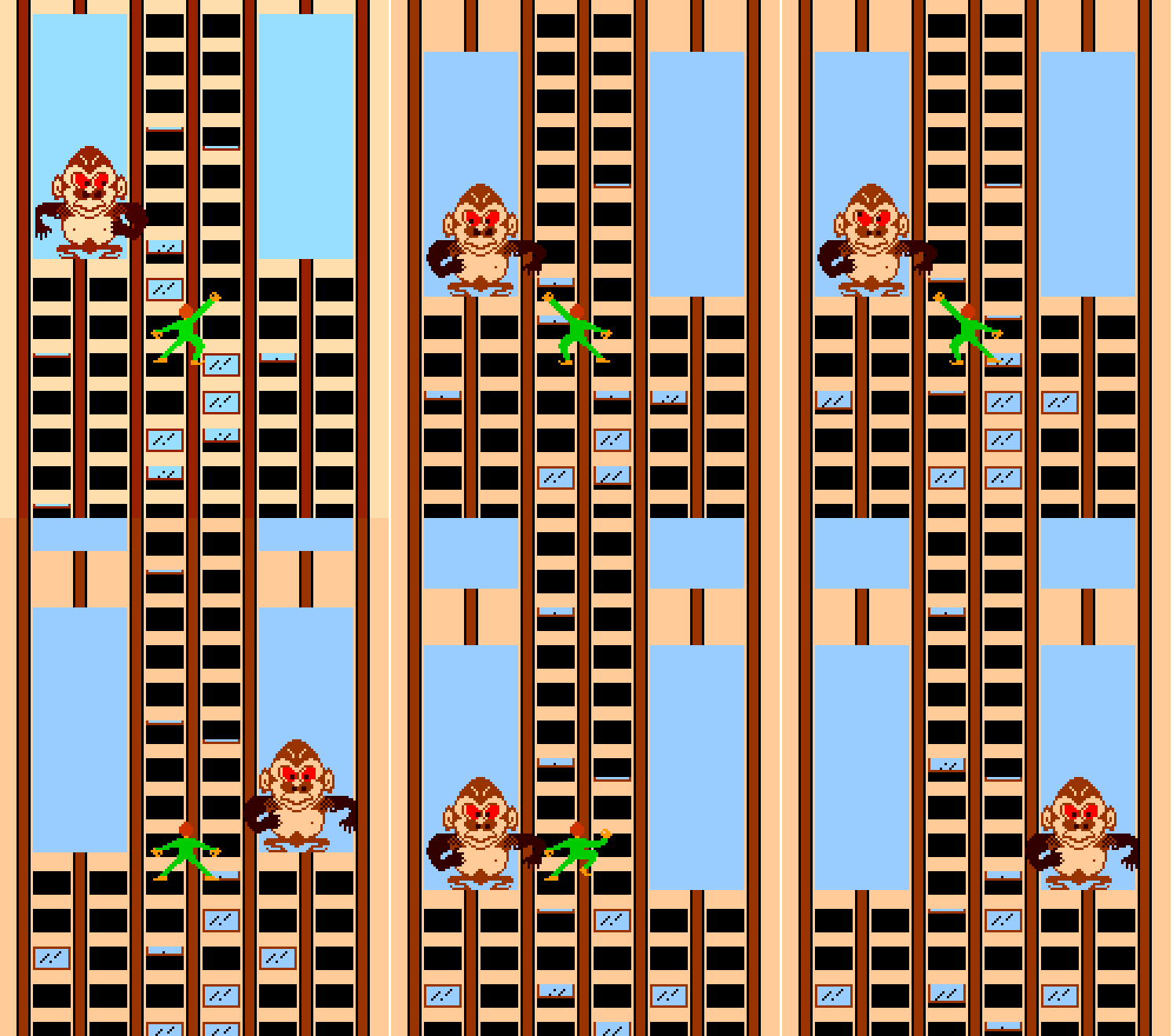
Again, because I don’t have much opportunity to mention Sky Skipper, I’ll point out that the long, strange evolution of what would eventually become Yoshi’s Island at one point starred a weird little guy who looked remarkably like the pilot in Sky Skipper. You can read that post here.


And that’s it — at least for now. You may wonder what the answer is to the question posted in the headline of this post: What is the first Nintendo crossover? But that answer depends on how you define crossover, of course.
If you’re being strict about it and requiring a character from another series to make an appearance in a game that’s not theirs, so to speak, I would say Mario and Pauline showing up in Pinball is a safe answer. Donkey Kong 3 is older, but whether that should count as a crossover depends on whether you think the playable character in the Game & Watch title Green House is actually Stanley the Bugman — and the jury’s still out on that. Personally, I would make the case that the death animation in Mario Bros. (and every subsequent two-dimensional Super Mario game) originated in Donkey Kong Jr., and there’s the branding distance between the Donkey Kong games and what at the time the fledgling Super Mario series to the point where that could be considered something, but you can decide for yourself. And then if you’re counting music, the fact that a Sky Skipper theme plays in Donkey Kong Jr. should count — and that’s all the more remarkable because it’s one of the last times anyone at Nintendo admitted that Sky Skipper existed.
All that said, I should point out that I didn’t find anything that fit my loose crossover/cameo criteria in the following titles:
Wild Gunman (1974)
Sky Hawk (November 1976)
Computer Othello (June 1978)
Space Launcher (November 1979)
Block Fever (November 1978)
Space Fever (February 1979)
Monkey Magic (August 1979)
Sheriff (November 1979)
Space Firebird (October 1980)
Heli Fire (October 1980)
Radar Scope (December 1980)
Donkey Kong (July 9, 1981)
Baseball (December 7, 1983)
Donkey Kong Jr. Math (December 12, 1983)
Balloon Fight (September 1984)
Devil World (October 5, 1984)
Urban Champion (November 14, 1984)
Excitebike (1985)
Soccer (April 9, 1985)
Stack Up (July 26, 1985)
Gyromite (August 13, 1985)
That’s a long list, and I am positive that there are elements that I just missed and that as soon as this post goes live, people will be telling me I’m stupid for not realizing them myself. Like I said earlier, I feel like this list is going to evolve over time. With a little help, it could one day definitively find the first instance of Nintendo referencing itself. Until that happens, I hope you’ve had as much fun rummaging through Nintendo’s catalogue as I have.