

Mario 101: Part Seven

91: Stanley the Bugman might be the least-celebrated hero in the entire Mario series.
I take it back about D.K. Jr. getting screwed, because no one ever got a rawer deal than Stanley, the hapless hero of Donkey Kong 3. After that game, he also vanished from the series save for ports, WarioWare microgames and cameos in Smash Bros. But Stanley’s sad fate is actually worse than just getting the one crack at video game fame and then being banished to the Phantom Zone. Donkey Kong 3 was likely his second appearance, and there’s a bit of evidence that Nintendo was attempting to build him up to be a proper video hero before thinking better of it.
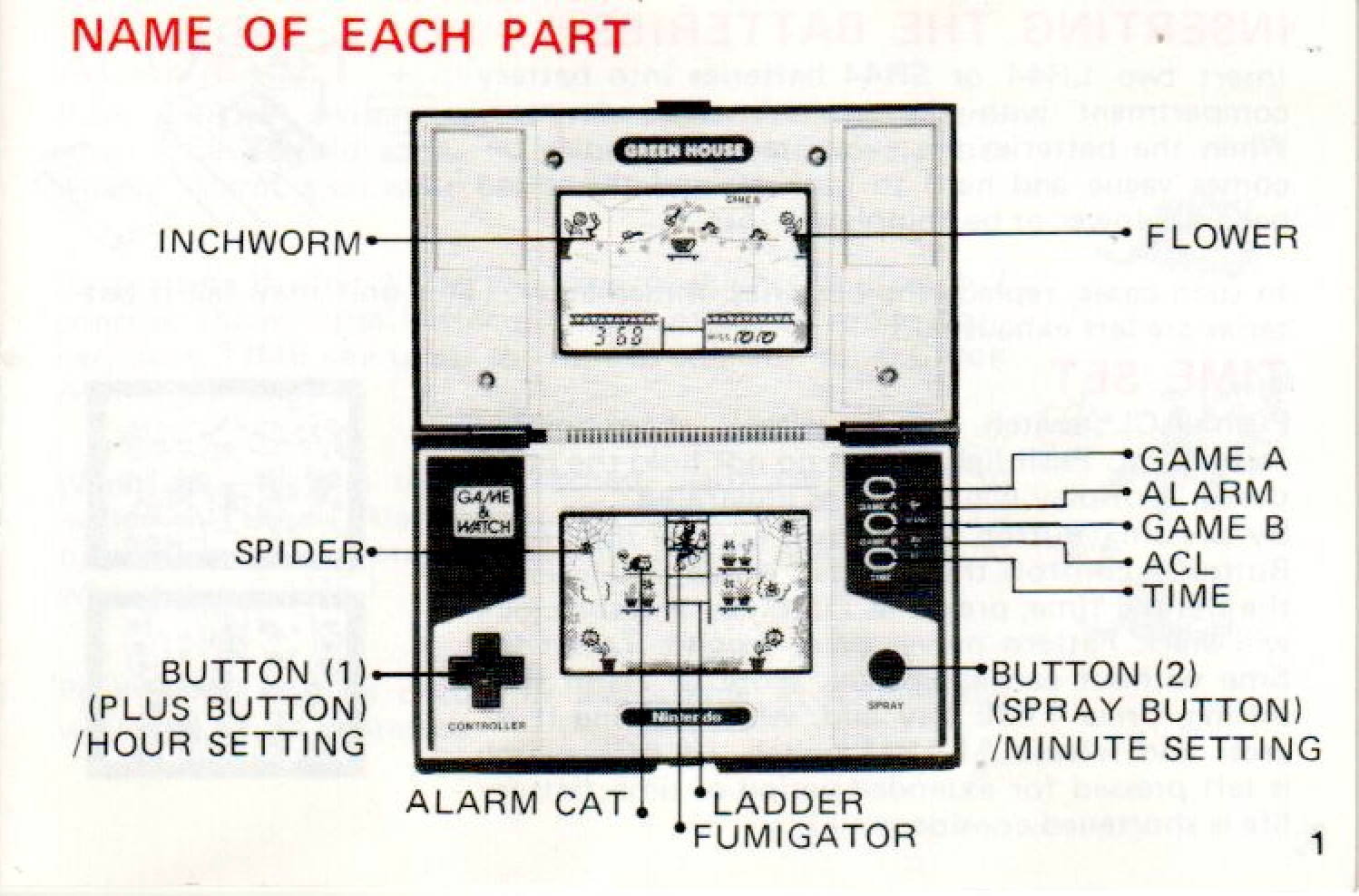
Donkey Kong 3, you see, owes somewhat of a debt to the Game & Watch title Greenhouse, which stars a similarly insecticide-spraying guy attempting to save potted plants from menacing spiders and inchworms. The gameplay is fairly different from Donkey Kong 3, and really the two games are tied together by the setting and the protagonist more than anything else.
In a post about the history of Nintendo crossovers, I expressed some doubt whether the controllable character from Greenhouse actually was meant to be Stanley. Evidence against this being the case includes the manual for Greenhouse, which refers to him only as The Fumigator.
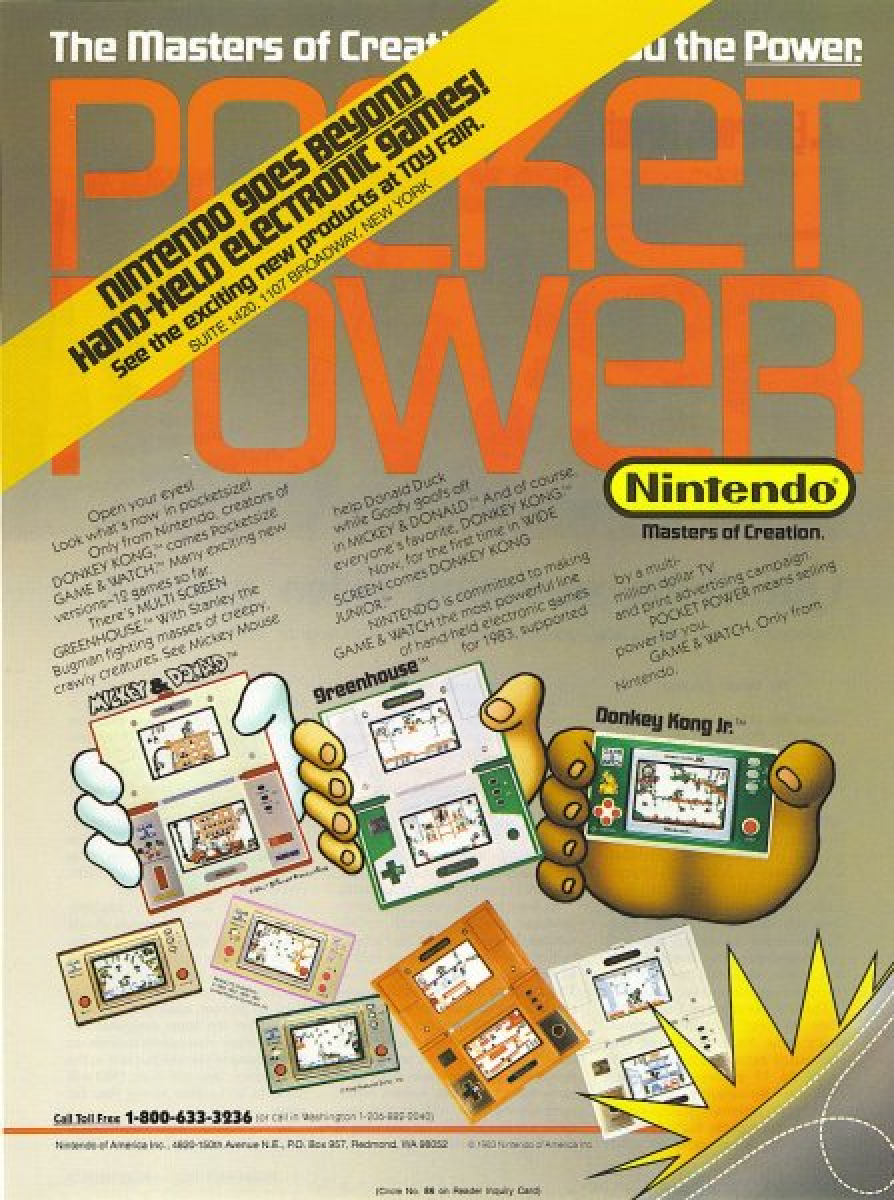
Reapproaching the matter a few weeks later, I now see it as something like Nintendo dragging its heels in giving a proper name to Mario or Pauline. It doesn’t seem like Stanley had a name in either the Japanese or English release of Greenhouse in December 1982, but it did not take long for English-language media to give him one, including this print advertisement dated February 1983. By the time Nintendo was promoting the Japanese release of Donkey Kong 3, in October 1983, Japanese media had adopted the name as well, and this flyer features the katakana rendering of Stanley’s name, the katakana rendering of Stanley’s name, スタンリー or Sutanrī.
It’s almost as if Nintendo had decided to introduce a new hero for this new Donkey Kong game because Mario was too busy promoting Mario Bros,. which released the same year. Whatever the reasoning, it would mark a shift in Nintendo’s attitude toward Mario being a working-class everyman who could show up in multiple games, apparently employed in a variety of professions. There’s not any real reason that Mario could have been the main controllable character in Mario Bros. and Donkey Kong 3 both. It would seem oddly sentimental if Nintendo kept Mario out of Donkey Kong 3 because Greenhouse starred a non-Mario, non-Mr. Game & Watch character, like Stanley had forever dibs on any Nintendo game taking place in a botanical setting. Whatever the case, there does seem to be a brief effort on Nintendo’s part to push Stanley. It’s perhaps notable that this 1984 TV spot for the Game & Watch not only mentions Stanley by name but actually mentions him first — before Mario.
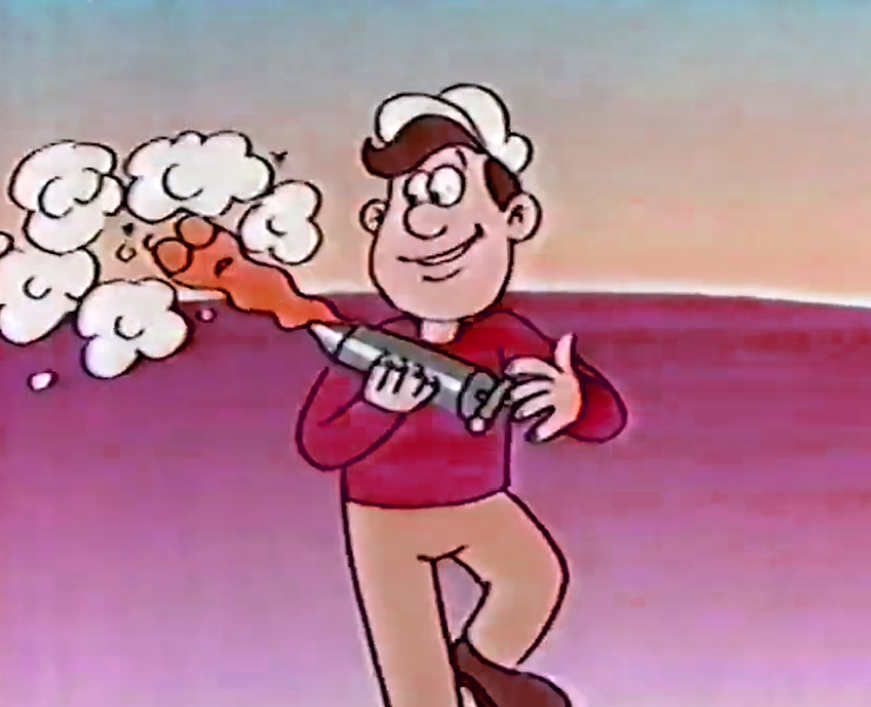
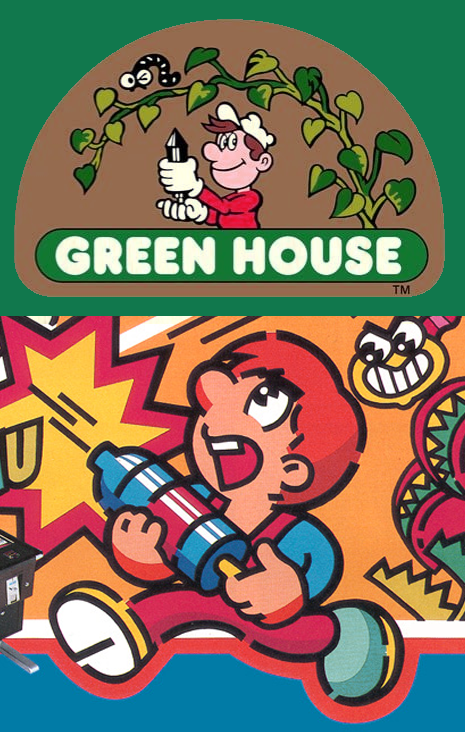
Of course, by then, the arcade version of Stanley had been made over to look more like Mario in some ways — shorter, stouter, and with a rounder nose.
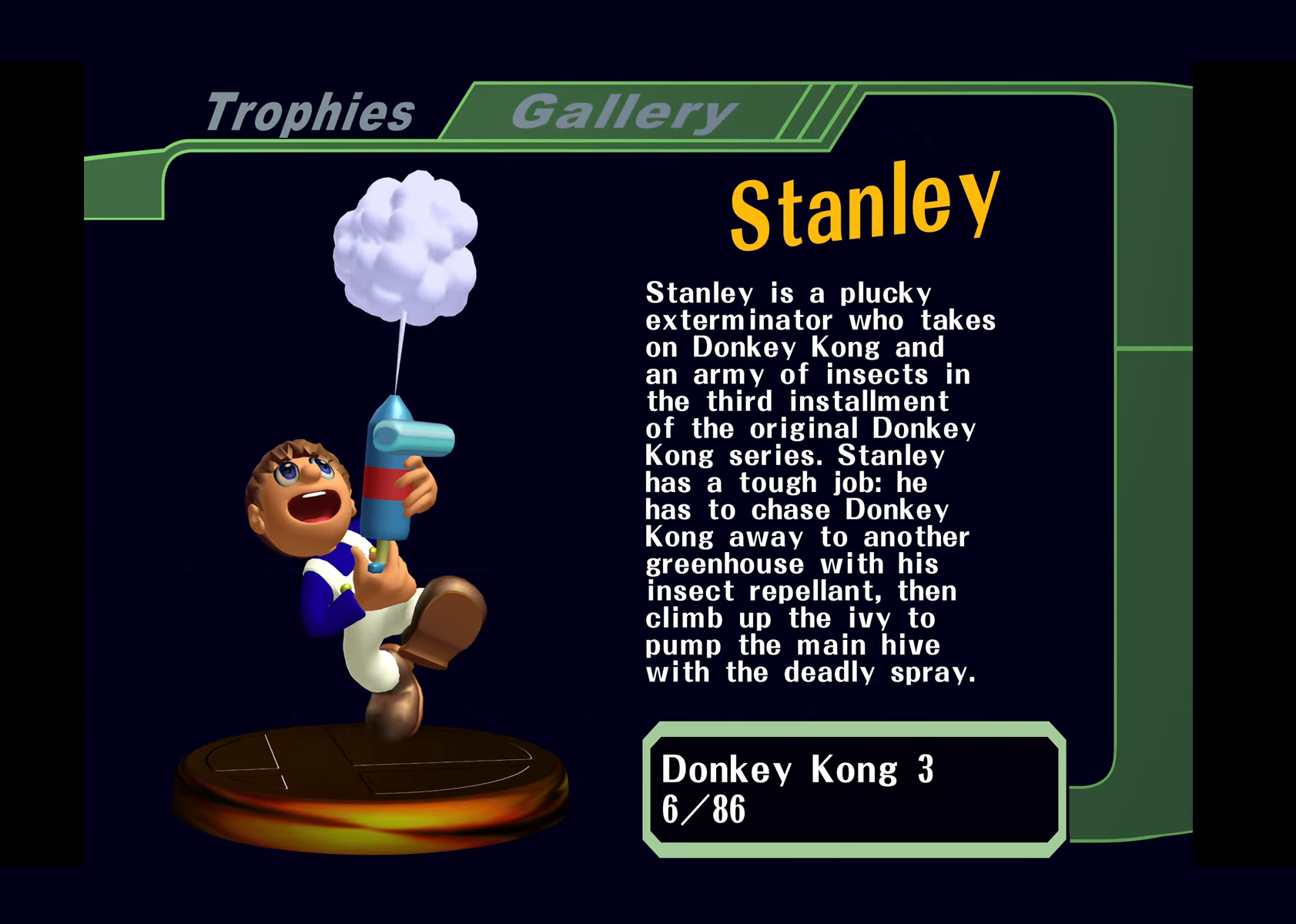
Nintendo’s interest in Stanley proved short-lived, however, as a result of Donkey Kong 3’s lack of success, Mario’s growing popularity or some combination of these two. His last appearance of any real note was as a trophy in Super Smash Bros. Melee that, notably, lists his first and only appearance as Donkey Kong 3, seemingly implying that Greenhouse didn’t count.
What’s more, Mr. Game & Watch uses Stanley’s move as a neutral attack, pumping bug spray at enemies as if it had been he who starred in the original Greenhouse. He didn’t. It was Stanley. And maybe one day after E. Gadd, Foreman Spike, Wart, Captain Syrup, Tatanga, Wanda, Fawful, all seven Sprixie Princesses, Madame Broode and every other forgotten Super Mario character gets promoted to the big leagues, we’ll see him in a new game. At the very least, we’d get Stanley before we’d get Prince Pine… right?
EDIT: After this post went live, it was brought to my attention via Bluesky that Donkey Kong Country: Tropical Freeze features a background homage to Stanley’s greenhouse in the stage Fruity Factory.
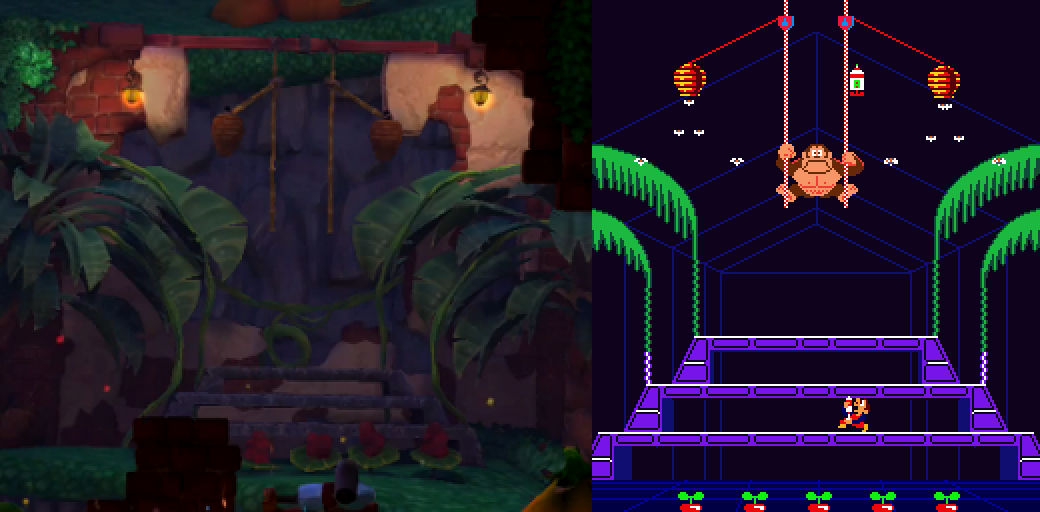
It’s not proof of Stanley’s alivativity, but it’s something.
EDIT: After I recorded an episode of Nintendo Cartridge Society about this project, host Patrick pointed out that Stanley does technically star in an additional Nintendo game, a Game & Watch version of Donkey Kong 3 that’s probably best known today for its inclusion in the final Game & Watch Gallery collection. (For the updated, “modern” mode, Mario takes over as the playable character, naturally.) Released August 1984, the Game & Watch Donkey Kong 3 plays fairly differently from the arcade version, which plays fairly different from original Game & Watch title, meaning that Nintendo sent Stanley on three different insecticide-based adventures before kicking him to the curb. What a ride!
92: Diddy Kong truly did replace D.K. Jr.
It’s not just that Diddy usurped Junior’s role. Quite literally, Diddy evolved out of D.K. Jr. during the development of Donkey Kong Country. According to Boundary Break’s oral history of the game, Nintendo felt the team’s attempt to update D.K. Jr. didn’t look right.
(The below quotes start at 12:15 in this video.)
Gregg Mayles, former Rare creative director: To start with, we took Donkey Kong, and we knew he was going to have a companion. Donkey Kong Jr. was the obvious choice, but we wanted to bring him up to date. But Donkey Kong Jr. was basically this little kind of ape with a nappy on, and we didn’t feel that fit the kind of modern modern remake we wanted to do. So Diddy Kong actually was our proposed redesign of Donkey Kong Jr. But I think for Nintendo that was a step too far. I think we’d gone so far from the original character that they weren’t happy with it being called Donkey Kong Jr. They said, “We like the character, but please don't call it Donkey Kong Jr. Can you come up with a new name for the character?”
Kevin Bayless, character designer: We wanted to incorporate the dynamic with the tail on Diddy, and Donkey Kong Jr. didn’t have a tail. He was an ape, wasn’t he? Not a monkey. And so we detached the two characters and we said, “Well, this isn’t his dad. This is a different guy. He’s from the family, but he’s not his dad.” And so I think that's why we did what we did with Diddy Kong; we made him different. And we expanded the whole universe that way by adding all of the characters that we did in the future games, too. That worked out well. And they’ve still got Donkey Kong Jr. there to play with, which is cool.
You can even see preliminary concept art that shows what is essentially Diddy wearing a modified version of Junior’s logo.
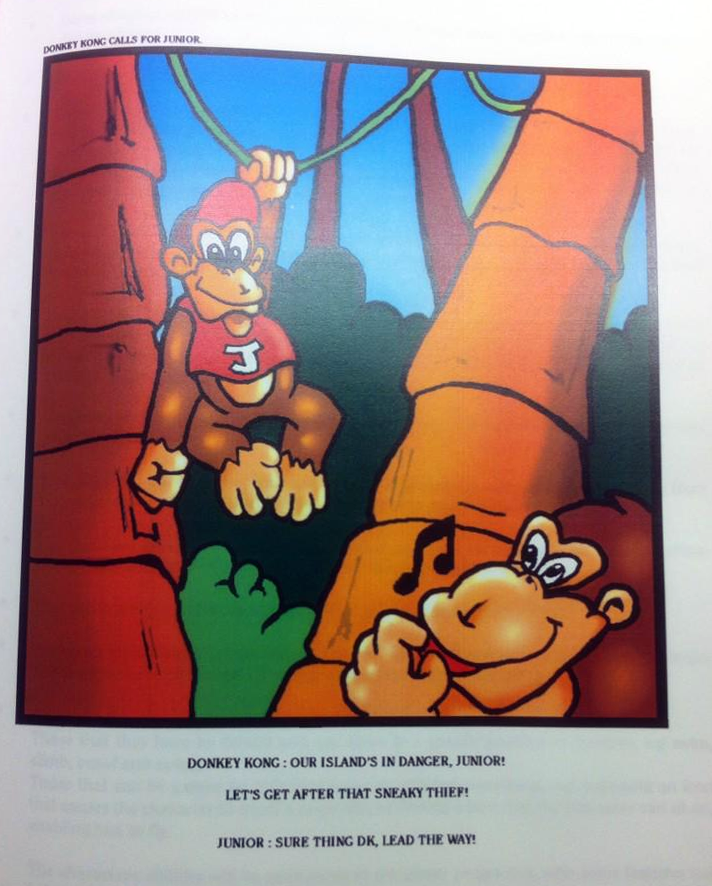
In the roundtable, Mayles goes on to say the new name even tries to preserve the idea of Diddy being the junior version of Donkey Kong, in that diddyis a Britishism meaning “small.” The team’s first choice for this new character’s name was Dinky, but a potential copyright headache squabble with the British company Dinky Toys persuaded them to pick something else. Ironically, Nintendo would assign the the name ディンキーコング or Dinkī Kongu, to Kiddy Kong, introduced in Donkey Kong Country 3.
92½: Diddy was inspired by a certain cereal mascot.
Yes, I’m doing half-numbers now. Toward the end of this project, I decided to err on the side of including more info rather than less. So you’re going to get these little bits thrown into this final section. Aside from making a snappy title, the 101 in Mario 101 is kind of an arbitrary number, after all.
In January 2025, Kevin Bayliss revealed on Twitter that one of the major inspirations for Diddy Kong was Coco, the monkey mascot for the cereal known as Cocoa Krispies in the U.S. and Coco Pops in the United Kingdom. He’s got the ballcap and the logo tee and everything.
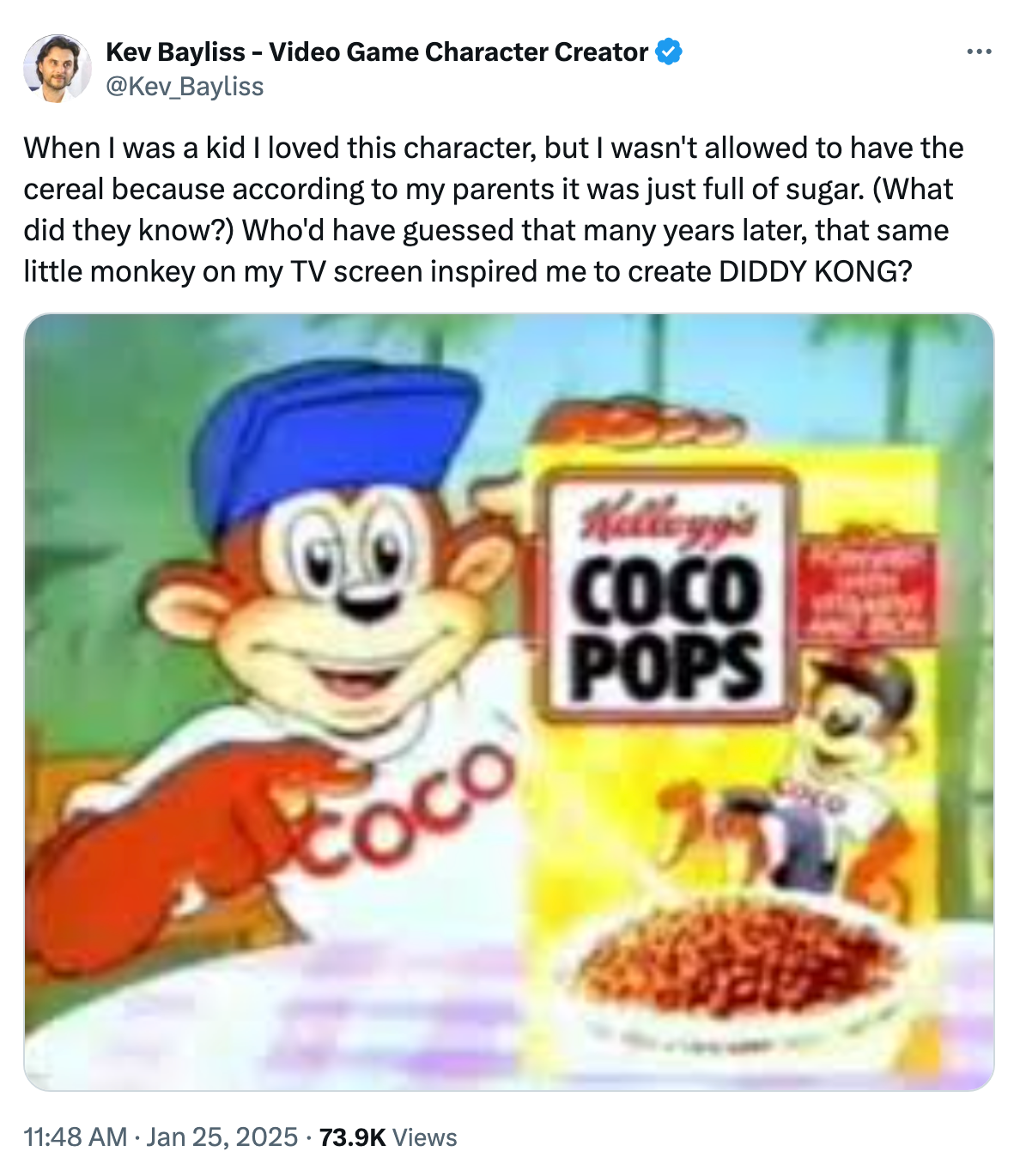
I was shocked to learn this just because the jingle that played in commercials in the 90s has been stuck in my head all these years, and I did not expect this monkey to have any relevance outside of an earworm.
I guess I shouldn’t be surprised that the overseas version of the commercial used the same song.
Now it’s stuck in your head. You’re welcome.
93: Among Dixie Kong’s preliminary names was… Diddy Ann.
Boundary Break’s Donkey Kong Country oral history also mentions that more a few names were batted about when it came to Diddy’s female counterpart in the sequel. The only one revealed, however, comes from Gregg Mayles, and it’s so bad that I actually almost love it: Diddy Ann.
Diddy took us a long time — and Dixie for the second game. I definitely remember her having a piece of paper with a lot of silly names on it. Not all. They weren’t all silly names. Some of them were very serious. But I think Dixie’s original name was Diddy Ann, because we wanted a link
to Diddy, because she was meant to be Diddy’s girlfriend. So we just did the feminine version of Diddy, but over time we didn’t like it and it eventually got changed to Dixie, which probably suited her better.
It’s very Ms. Pac-Man logic, that the female hero has to be derivative of the hero, but I’m glad that they ultimately went a different route for Dixie. That said, I’m somewhat suspicious that it might be intentional that her name sounds like a penis joke. You see, in addition to meaning “small,” diddy can also mean “tit,” and Winky, the frog buddy from the first game, also happens to have a name that can mean “penis.” Considering that the original Donkey Kong Country trilogy was made by a bunch of twentysomething guys, it just seems very believable that they would have snuck these kinds of jokes into a Nintendo title because they thought it was funny. (I also think it is funny.)
94: Daisy wasn’t supposed to be a desert princess.
Introduced in Super Mario Land in 1989, Princess Daisy hails from Sarasaland, which we’ve collectively decided to remember as a desert kingdom. This isn’t accurate to how this area appears in Super Mario Land, but there are a few reasons why we’ve come to this conclusion.
The first area of Super Mario Land, Birabuto Kingdom, is Egyptian-themed, and if you didn’t get past the third stage, you might actually think the rest of the game is full of pyramids and sphinxes as well. It’s not. The second world, Muda Kingdom, takes place near the water and is inspired by the Bermuda Triangle. The third, Easton Kingdom, is full of moai heads in reference to Easter Island. And finally, there’s the Chinese-themed Chai Kingdom. Sarasaland is literally a land of contrasts, though I suppose the unifying theme is an association with the unexplained and aliens, probably because the game’s big bad is Tatanga the Mysterious Spaceman.
When Daisy was reintroduced to the Super Mario series with the Nintendo 64 version, she initially had a darker skin tone than the other human characters, as you might expect from someone coming from a place that gets a lot of sun. From Mario Party 4 on, however, Nintendo made Daisy look like Azalea, a normie human character appearing in various sports spinoffs, basically giving her Azalea’s face, hair and lighter skintone. So much for that.
More recently in Mario Kart World, Daisy was given a castle stage in the middle of Shy Guy Bazaar, a track that originated in Mario Kart 7 as an homage to the pseudo-Arabian theme of Super Mario Bros. 2. This new version of the stage makes it a tribute to Daisy’s heritage instead. The dunes on the outskirts are even populated by the moai-inspired enemies from Super Mario Land, Batadon and Tokotoko, making their first reappearance since their debut.
Sarasaland sounds like it should be a desert kingdom, both because it sounds a bit like Sahara, which is a desert, and さらさら or sarasara, which can mean “dry” or “rustling.”
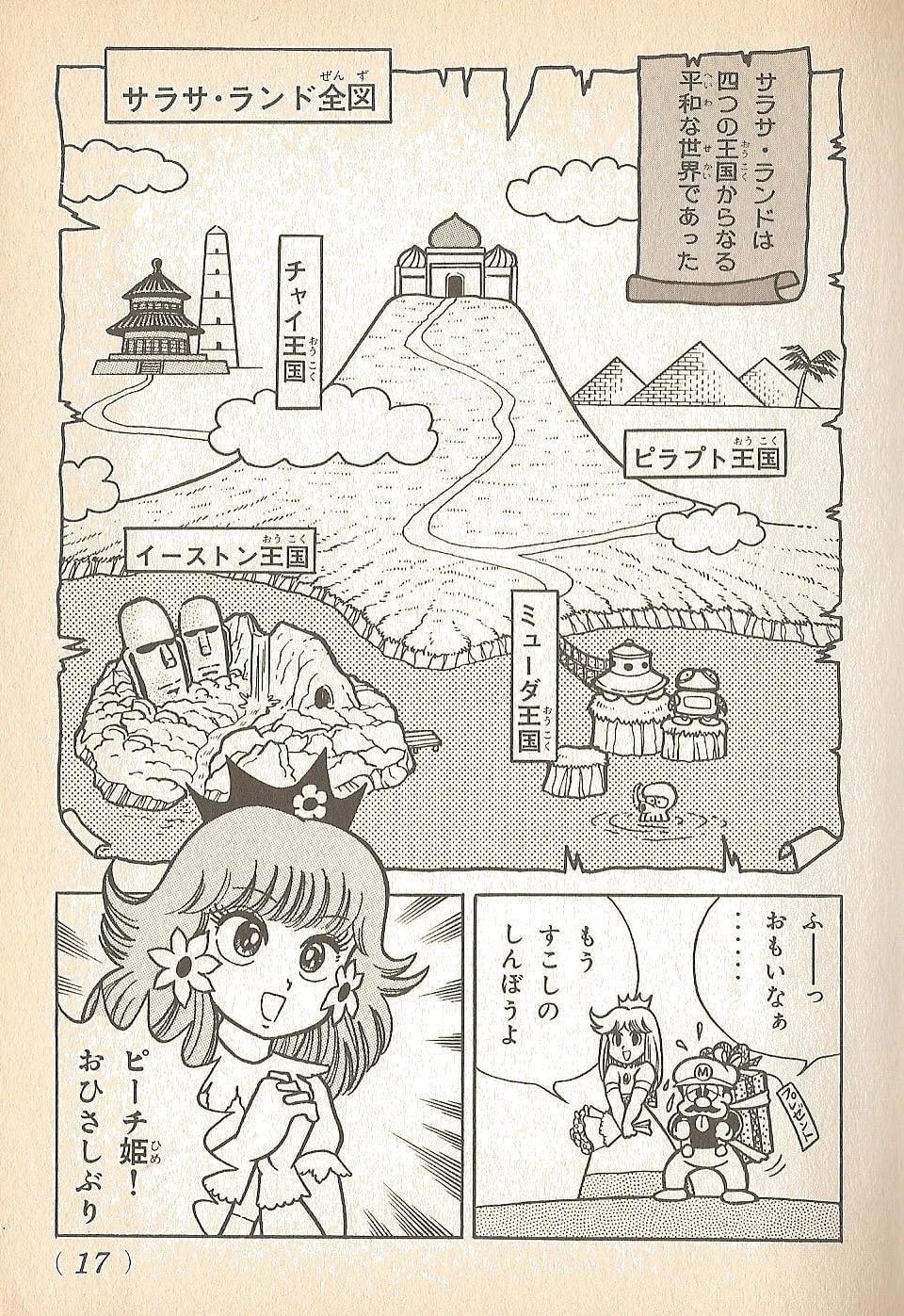
In Japanese, 更紗 or sarasa is a fashion term referring to calico. Named for the Indian city where it originated, Calicut, calico is a textile. When it’s decorated with flower patterns, it’s called chintz. Often, different prints were laid next to each other for contrast in the way you might see on a patchwork quilt. Sarasaland works much the same way, with very different sections — the Egyptian one, the Bermudan one, the Easter Island one and the Chinese one — existing alongside each other even though they don’t seem like they match. And that, friends, is why Sarasaland is not a desert kingdom but a place whose name is signalling to you that it will consist of varied regions that are nonetheless part of the same “cloth,” if you will. And my guess is that Daisy got her name specifically because the design motif most often associated with calico happened to be floral.
94½: The princess in the 1993 Super Mario Bros. movie is not actually Daisy.
Like, yes, the character Samantha Mathis plays is technically named Daisy, but it’s very clear that she’s meant to be this universe’s version of Peach. Then why call her the other princess’s name? Well, it’s the problem I put forth in item no. 27. The princess’s western name at the time was still Toadstool, and this is not a name that works well in many contexts, including the somewhat more realistic setting of the 1993 live-action movie.
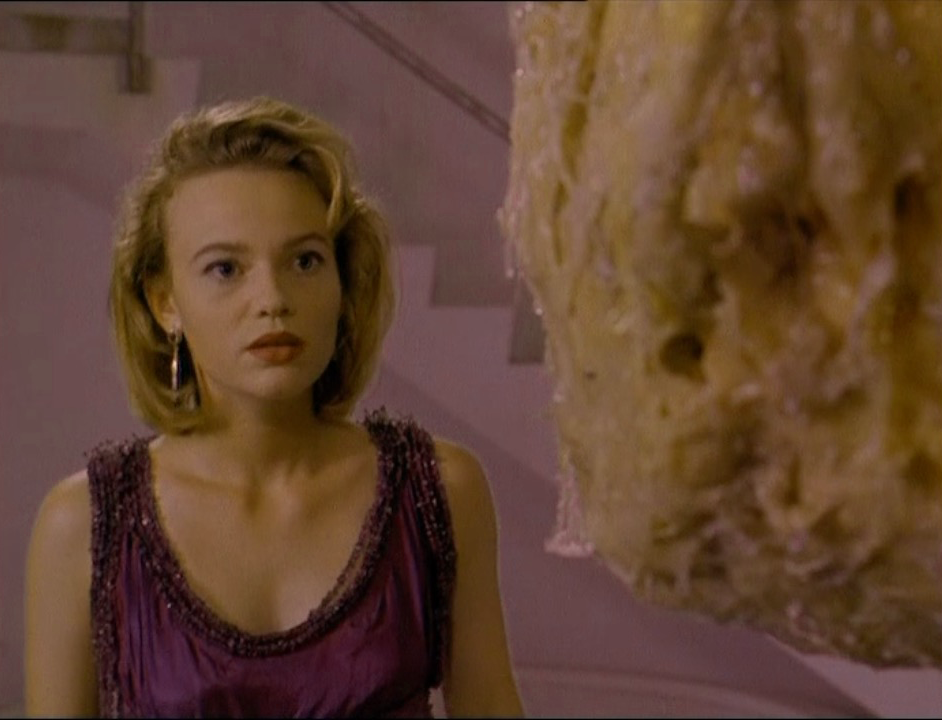
Super Mario Bros. (1993), starring Samantha Mathis as the princess and Lance Henricksen as her father, a gooey scrotum.
The Samantha Mathis character is the daughter of the king that Bowser not only dethroned but de-evolved into a fungus, making her kinda sorta a mushroom princess. She’s blond. She wears pink — or, well, magenta. She gets abducted by the Bowser figure. She is Peach and would have probably been called Peach if her name in the west had been Peach when this movie came out. The only thing she has in common with Daisy is the fact that she’s paired off with Luigi in this movie.
Peach or Daisy, however, it is worth noting that the Japanese subtitle title for the film is 魔界帝国の女神 or Makai Teikoku no Megami, which could be translated as “Goddess of the Demon Empire” or “Goddess of the Underworld.” Either sort of works, I guess, based on the plot, but I think both vastly oversell the scope and tone of the film.
95: Wario’s name is perhaps the most successful pun in all of video games.
The setup for Super Mario Land 2: Six Golden Coins is that Wario, Mario’s new lookalike alterego, seizes power while Mario is off rescuing Princess Daisy in Sarasaland.
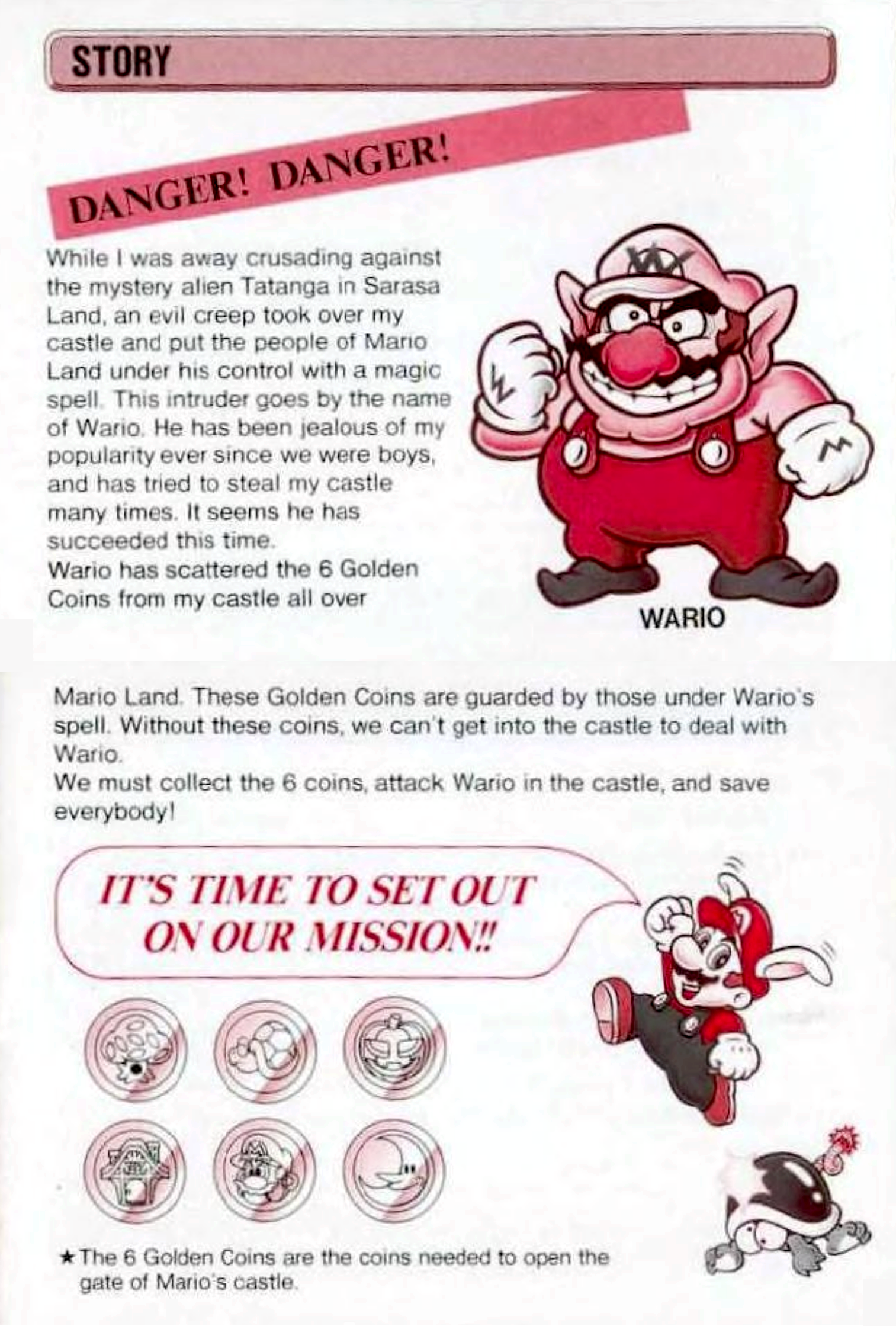
And yes, BTW this is stated in both the Japanese and English versions of the instruction manuals.
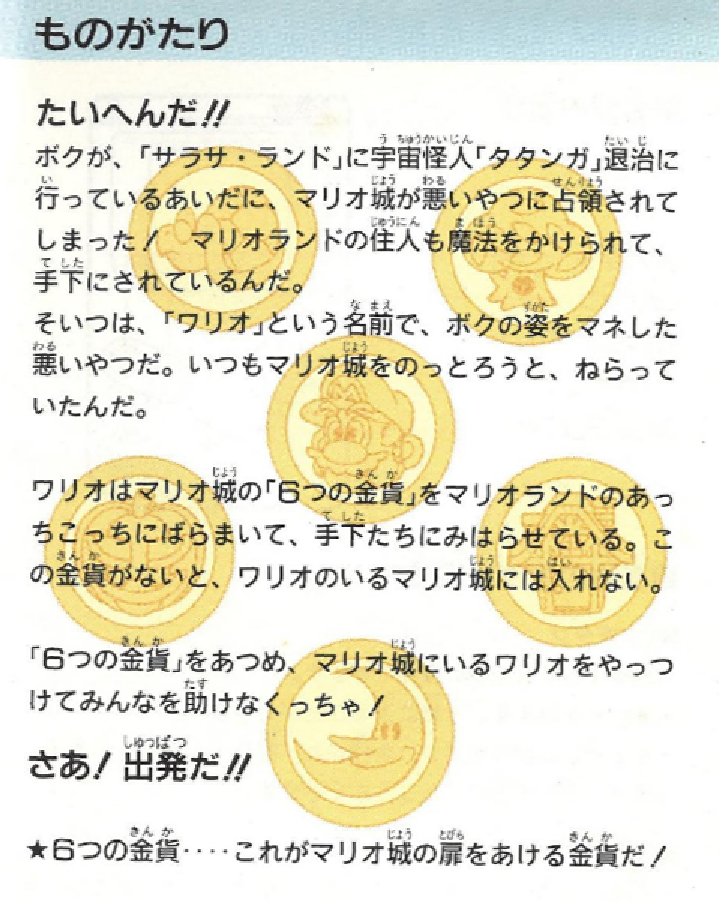
Translation: Oh no! While I was off fighting the space monster Tatanga in Sarasaland, Mario Castle was taken over by a bad guy! He cast a spell on the inhabitants of Mario Land and made them his minions. He goes by Wario, and he’s a no-good guy who’s impersonating me. He’s always had his sights on taking over Mario Castle. Wario scattered the Six Gold Coins of Mario Castle across Mario Land and has his minions guarding them. Without them, I can’t get into Mario Castle where Wario is.
I gotta get the Six Gold Coins, deal with Wario, and free everyone!
Alright, let's go! The Six Gold Coins... we need them to open the gates of Mario Castle!
There’s a lot to unpack from this single-sentence backstory. For one thing, it implies more connective tissue between Super Mario Land and Super Mario Land 2 than there is between any of the NES Super Mario adventures, which more or less don’t acknowledge each other directly. It also just casually drops that Mario owns a castle in a place called Mario Land when we’ve never heard of either before. But the most important thing is that this little backstory is the official introduction of Wario, who’d go on to be a major player in Mario’s adventures from here on out. We don’t know much about him even today. The English version of the Super Mario Land 2 story states that he’s always been jealous of Mario, while the Japanese version says that Wario imitates Mario’s appearance. Either way, he’s a mystery, and we’ve never really been given his supervillain origin story in any official capacity.
Not that we need to, of course, because “Mario but evil” is introduction enough to kick off a decades-long rivalry, I say. And one of the reasons that Wario just instantly made sense in this series is that his name explains everything you need to know about him, whether you’re playing the game in the original Japanese or the localized English version.
At this point, I think it’s fairly well-known among English-speaking players that Wario’s name is a portmanteau of Mario’s name and 悪い or warui, meaning “bad, wicked or evil.” It’s a very clean pun, and I feel like anyone who spoke Japanese would be able to suss out his identity right away. Puns almost never translate to other languages, but in this case, it actually makes sense in English as well. I suppose Wario’s name contains the English word war, which has negative connotations, but I feel like it makes sense in English because the letter “M” happens to be the letter “W” flipped upside-down, and that visually communicates that this new character is Mario but with his most prominent character trait — he’s the good guy — also inverted.
This is obviously something that the creators of Super Mario Land 2 realized, as there’s a small detail in the ending symbolizing that ownership of the castle has been restored back to Mario.
It’s just a clean, effortless form of wordplay that works so well that I wonder why it took until 1992 for the evil Wario to exist. Of course, no one so far in the “Wario family” has been as fortunate. The pun in Waluigi’s name, for example, works much better in Japanese, because warui and the Japanese rendering of Luigi’s name, Ruiji, blend together in a way that just does not happen in English, to say nothing of the inverted “L” on Waluigi’s cap. And the evil Yoshi appearing in Super Mario RPG apparently so missed the mark that the English localization just gave him a new name: Boshi, presumably from “bad Yoshi,” rather than trying to write the Japanese name, ワッシ or Wasshī, as Warshi or or Washi.
I would imagine one of the impediments to there being a Wario twist on Peach is the fact that the name doesn’t sound great in either language no matter how you try to form it. The Japanese version, ワルピーチ or Warupīchi, is just meh. And it came to light that Waluigi creator Fumihide Aoki created a model for this character for Mario Power Tennis that ultimately went unused, English speakers chose to render her name as… Walpeach. Which is just not a winner.
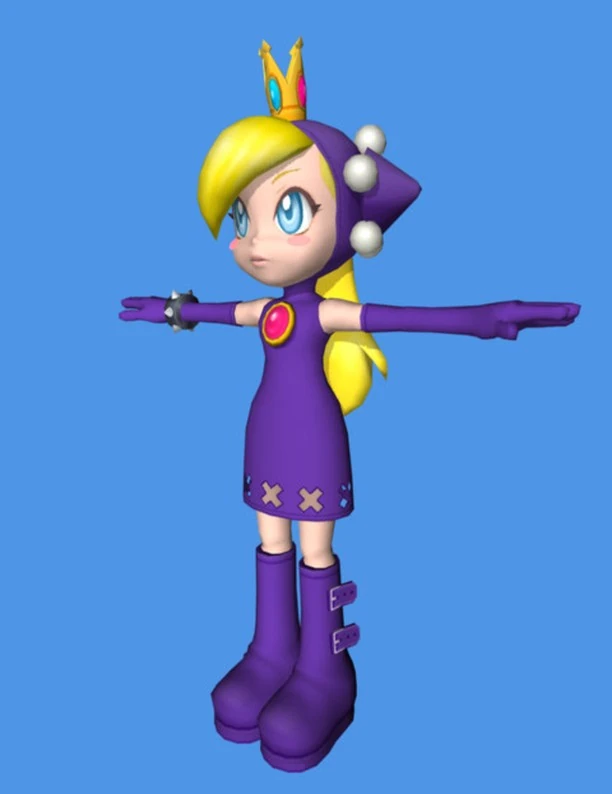
But I guess it sort of makes sense that Wario’s version of Mario’s crew would all be losers, no?
95½: Wario’s greed comes from the subversion of a classic Super Mario mechanic.
It’s easy enough to look at Wario and see how he’s a distorted exaggeration of Mario. While Mario has a prominent mustache; Wario has a comically oversized one. Mario has big ears; Wario’s got these giant elf ones. Mario has a big round nose; Wario has a nose that’s even bigger and also red so it’s all the more noticeable. And as I mention in item no. 14, the fact that Wario is overweight is a tacit acknowledgement that Mario himself is a little on the heavier side. In fact, in a 2018 interview with the French magazine Le Monde, Yoichi Kotabe notes that in finalizing the design of Wario for his debut in Super Mario Land 2, he drew upon Bluto from Popeye and Stromboli, the evil puppeteer from Pinocchio — both men of heft in addition to being ne’er-do-wells.
But being fat is not Wario’s most notable characteristic. No, it’s his greed, as that motivates basically everything he does. Why does he steal Mario’s castle? He’s greedy. Why does he risk life and limb hunting down treasure in the Wario Land spinoff? He’s greedy. Why does he launch his own video game company in WarioWare? Again, it’s all because he’s looking to make a buck. And it’s maybe not occurred to you why this has always been a central trait for him, but I think it’s Nintendo commenting on a mechanic that’s been present ever since Super Mario Bros. — and that’s collecting coins, but again distorted and exaggerated. I mean, there’s a reason the subtitle for Super Mario Land 2 is Six Golden Coins.
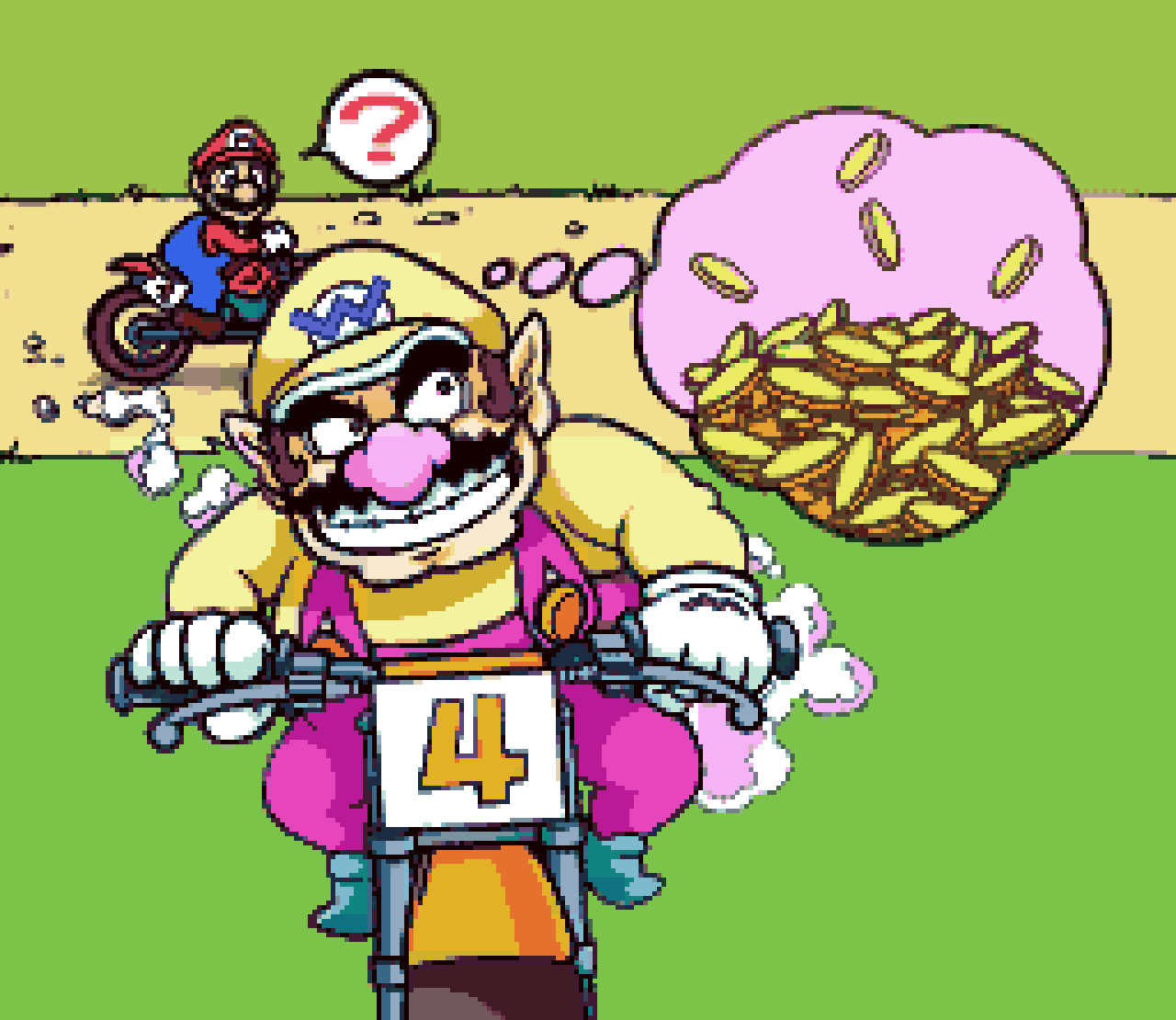
Amassing a certain number of a certain item was such a common thing in video games back in the day that it almost doesn’t seem strange that Mario should be snagging coins as he’s on his journey to rescue the princess. It is strange, however, if you think about it. There’s no in-universe explanation ever given for why Mario has to do this, and you might just assume that Mario happens to like money. Well, along comes Wario, who likes it more, to the point that it’s the foundation on which his entire personality is built. Suddenly Mario’s interest in spare change doesn’t seem so odd, because Wario is literally giving him a run for his money.
On my TV podcast, it comes up a lot that the sitcom Frasier made its title character seem less pretentious by having Niles be an exaggerated version of Frasier. The same thing happened on Buffy the Vampire Slayer with its title character and Cordelia Chase, who existed initially to make Buffy seem less airheaded and superficial. I think Wario serves this purpose in the Super Mario series, in that you don’t notice Mario being a pudgy, money-grubbing Italian stereotype if Wario is standing there next to him.
96: Nintendo seems to think Waluigi is somehow… illegitimate.
Did you know that Waluigi’s inverted “L” on his cap is just a sticker? It’s true. I learned this via Supper Mario Broth in 2020. Not only is it affixed to his cap via adhesive, but it’s actually peeling.
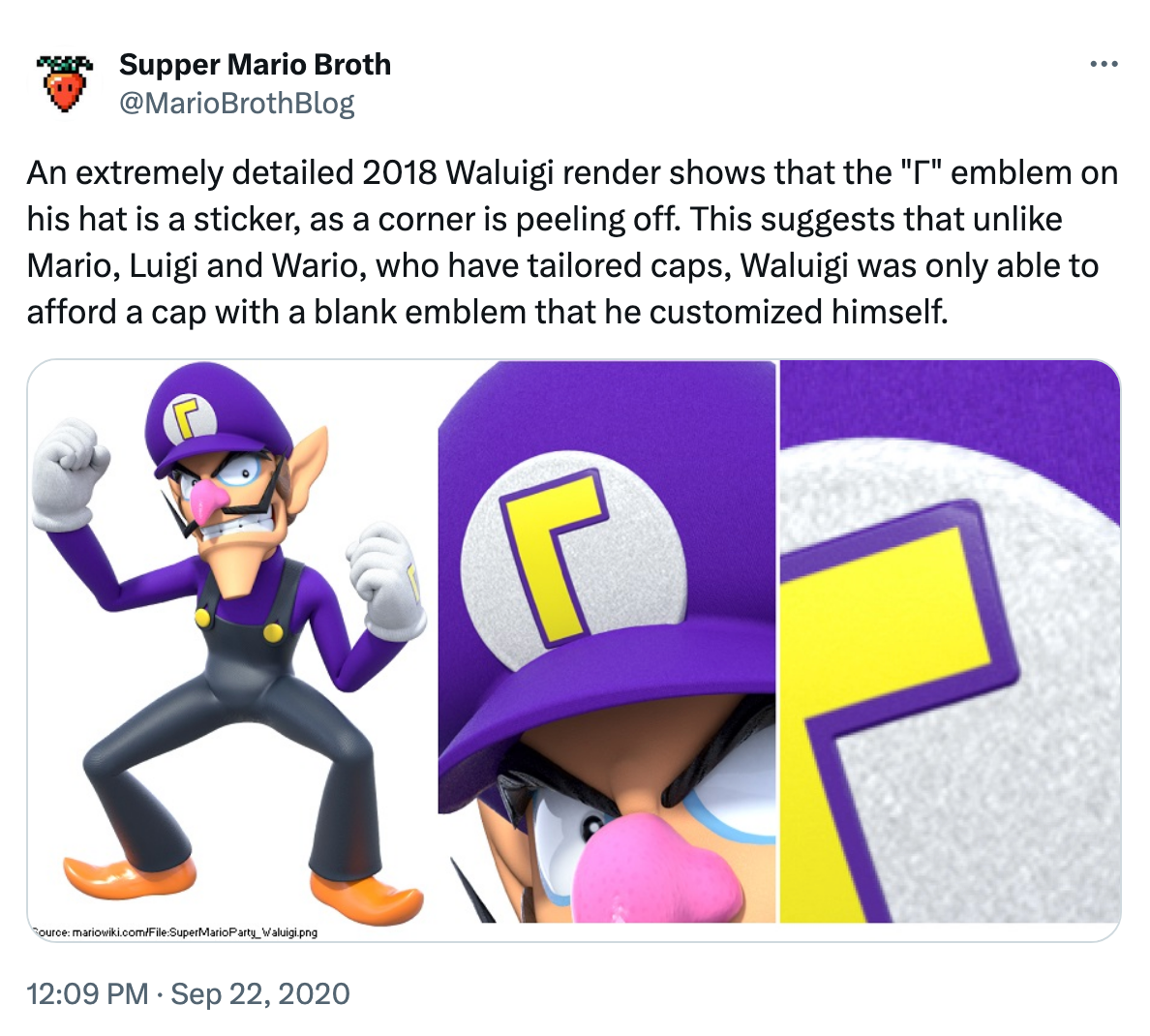
This particular Waluigi art forms from Super Mario Party, and it’s unique to this one character. Mario and Luigi’s hats boast stitching. Wario’s lacks stitching, but it’s not peeling, at the very least. The implication is that Wario is some kind of knockoff of the Mario Bros., and then Waluigi is cobbling together an identity for himself using the cheapest possible materials.
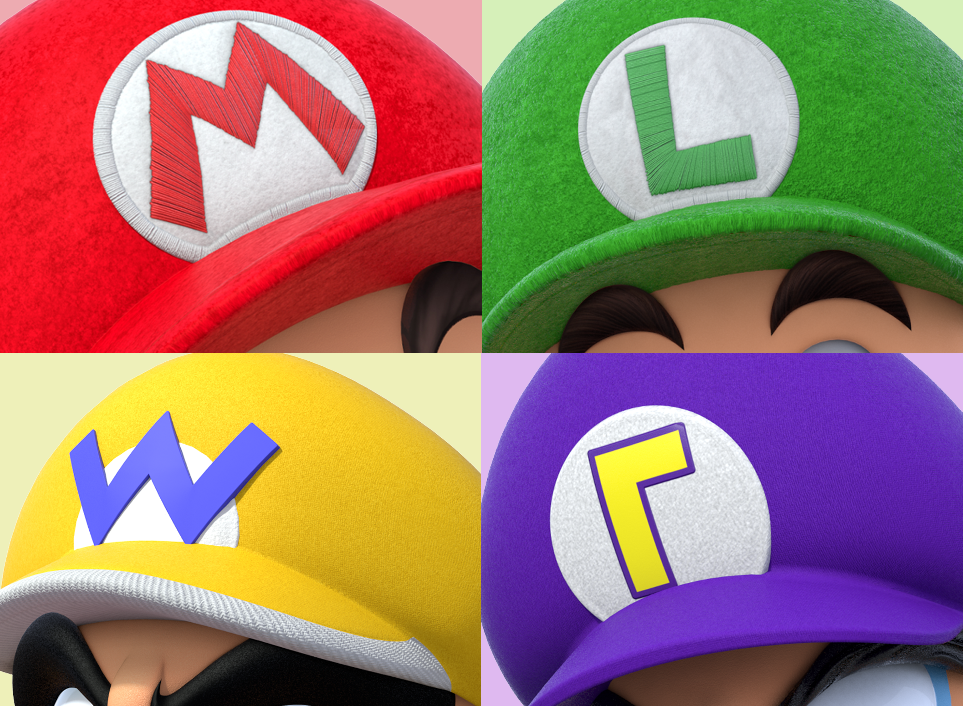
That’s a worthwhile detail on its own, I think, but it also represents a way Nintendo has responded to the accusation that it hates Waluigi. According to his surprisingly loyal fanbase, Nintendo has historically disregarded Waluigi, at least in part because he was invented not by Nintendo proper but by Camelot, a second-party development studio that has developed the Super Mario sports spinoffs starting in the Nintendo 64 era. It’s for this reason that Waluigi has so far been denied a spot in Smash Bros., it’s alleged by the pro-Waluigi faction. The Washington Post even wrote about it following the presentation of Super Smash Bros. Ultimate at the 2018 E3, which revealed that the purple beanpole was once again relegated to Assist Trophy status.
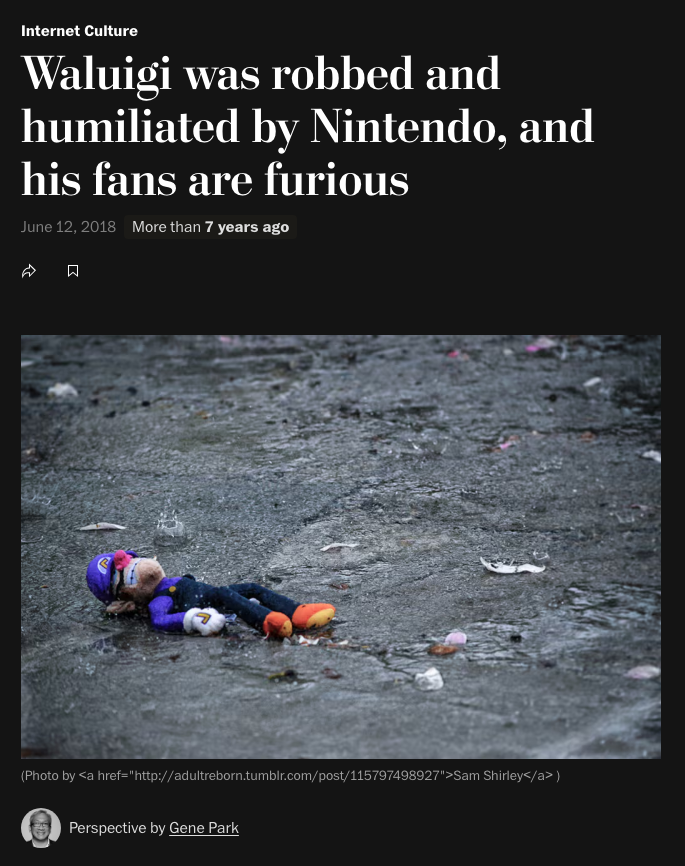
This sentiment has hovered over Waluigi like a little rain cloud for long enough that in 2018, Reggie Fils-Aimé, then-president of Nintendo of America, commented on it during an interview with Vice.
Fils-Aimé: Clearly, Nintendo does not hate Waluigi. Because here I am with him as my main character. I mean look, we’re making every character that’s ever been in a Smash Bros. game available in Super Smash Bros. Ultimate.
Austin Walker, for Vice: But not Waluigi.
Fils-Aimé: [With faux exhaustion] You would think that would be enough to satisfy the fans. But noooooo! The fans have to focus in on one character that isn’t part of the series and to demand their inclusion. So, one of the good things about the way we approach E3 is when it’s all said and done we step back. We look at all of the feedback and share with the devs and certainly Mr. Sakurai will be aware of the groundswell of support that appeared for a Waluigi. And in the end it’s his decision to make. Just like when we were getting ready to launch the Wii U and 3DS version there was this groundswell asking for Reggie to be a playable character in the game. I mean…
Walker: I got that question today from people: “When is Reggie going to be in the game!?”
Fils-Aimé: Nah, no. I’m not a video game character, much as others might disagree.
Walker: What about as an assist trophy? If you were an assist trophy, what would your move be?
Fils-Aimé: No, no.
Walker: Fine. Fine. But actually a real question on this. Which is, you think about Waluigi’s arc — and the Washington Post article kind of says this — when Waluigi first debuted as an extra character, he seemed like, ugh, another B.S. character and now there is this fandom for him. Genuinely! Does it feel good that there was that swing?
Fils-Aimé: Oh absolutely. I mean, look, I love that our fans have a passion for our intellectual property that feels so good. You know, I could remember as a new executive with the company being asked about Kid Icarus, and I’m like, “Kid Icarus? I thought I was the only one who loved you know the Kid Icarus game!” And so it’s humbling, but I’ve got nothing to announce about Waluigi.
Eight years later, it would seem that Nintendo still does not have anything official to announce regarding Waluigi or his legitimacy, but that peeling sticker would seem to be a tacit acknowledgement, at the very least.
97: Mallow’s name is a pun that only works in Japanese.
In the English version of Super Mario RPG, Mallow’s name makes sense because he is white and puffy, like a marshmallow. The fact that he was raised at the Tadpole Pond is just the icing on the cake; his name is Mallow and he was raised in a marsh.
In the original Japanese version of the game, however, Mallow’s name takes on an added dimension that just does not exist in the localization. Mallow’s name is rendered in Japanese as マロ or Maro, which is extremely close to Mario’s name. This is representative of Mallow’s character; he’s introduced as a crybaby who wants to be a hero like Mario but who is falling short of doing it on his own, just like how his name falls short of Mario’s by one syllable. Really, it’s similar to how the first partner encountered in Paper Mario is Goombario, who is another young up-and-comer who wants to be like Mario.
Eventually, Mallow arrives in Nimbus Land, a cloud kingdom up in the sky, where it turns out he’s the missing prince and therefore a member of the cloud species that resides there. In the Japanese version of the game, however, the name of the kingdom is マシュマロの国 or Mashumaro no Kuni — “Marshmallow Kingdom.” This is another way that Mallow is meant to parallel Mario, because the pronunciation of the Japanese name for this land is very close to “Mushroom Kingdom.” In fact, the マッシュルーム or mashurūmu does exist in Japanese as a loanword to refer to the white mushrooms that you get on pizza.
So why did Ted Woolsey change the name of Mallow’s homeland to Nimbus Kingdom? I’m assuming that was done because someone thought it would spoil the plot twist that Mallow is the missing prince is his name were that close to the kingdom’s… even if it’s pretty obvious anyway. Like, you know what a tadpole looks like and Mallow is clearly now one. To be clear, I actually think the localization of Super Mario RPG was really good. It’s just a shame that there wasn’t a way to translate everything that was packed into Mallow’s name into the English version. So it goes.
You can read more about ponderous localization choices in Super Mario RPG in this post.
98: Culex’s name is a rather deep cut of video game lore.
Famously, Super Mario RPG represented the long-awaited team-up of Nintendo and Squaresoft, but just as famously they’d get into a fight shortly thereafter, breaking the hearts of little video game dweebs who felt loyal to both companies. But the most interesting way that Squaresoft’s biggest franchise appeared in Super Mario RPG was the fight with Culex, an original character who nonetheless represented Final Fantasy-ness, even if he didn’t actually come from a Final Fantasy game. You’d be forgiven for thinking so. He’s accompanied in battle by the four elemental crystals that recur throughout that series, and the music that plays during the fight is the boss battle BGM from Final Fantasy IV.
His name is also an allusion to Final Fantasy IV, though a damn near impenetrable one. Culex is a genus of mosquitoes. I was aware of this but could not make sense of it on my own for years. It took a 2023 post from Supper Mario Broth to connect this to Golbez, one of the antagonists of Final Fantasy IV.
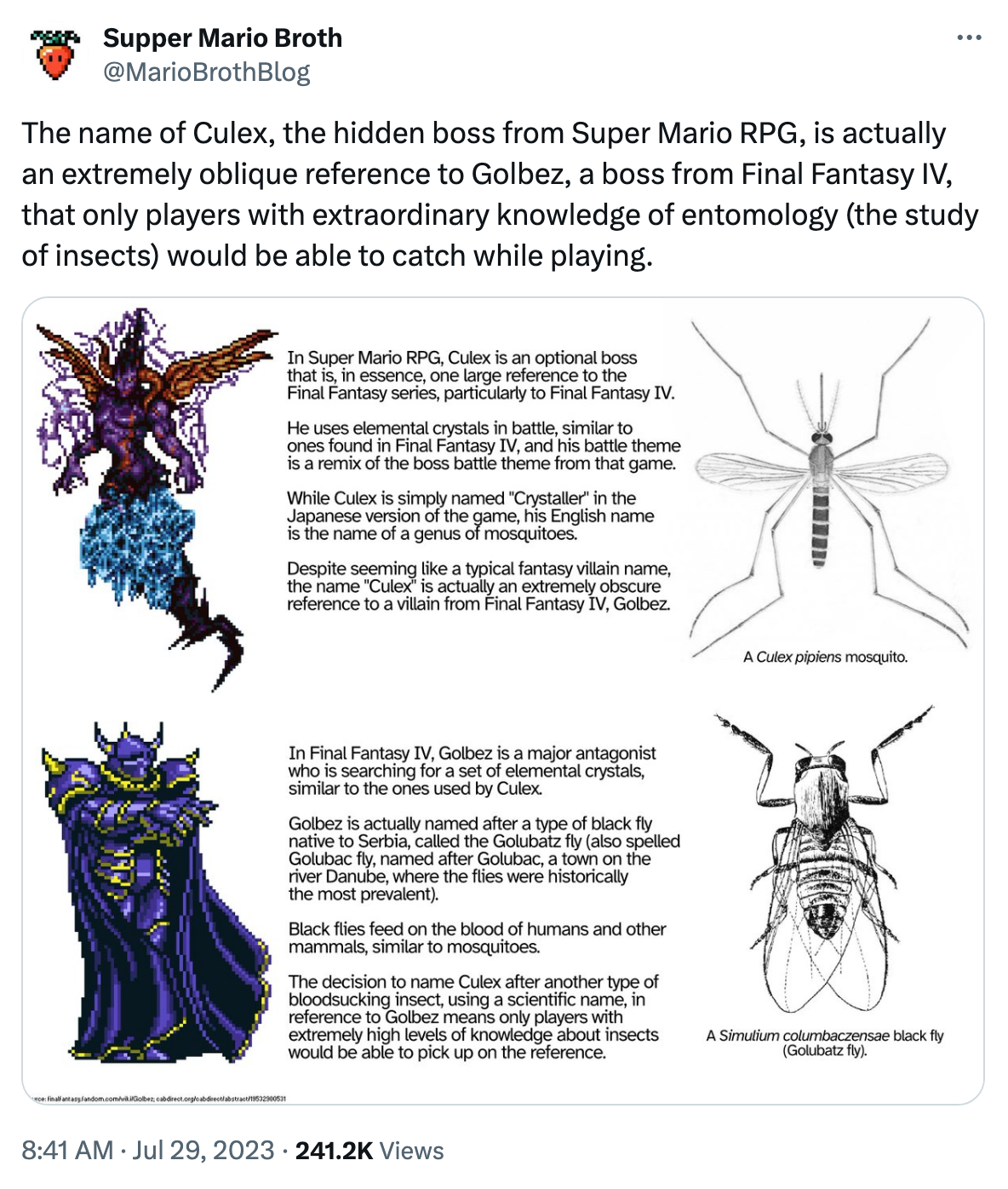
As do many of the villains in FFIV, Golbez gets his name from a 1904 book on demonology — specifically from a legend that says St. George slayed his famous dragon in caves near the Serbian city of Golubac. As the story is told, the decaying body of the dead dragon gave rise to a vicious bloodsucking insect known as the Golubaeser fly. And this demonym is the unlikely origin of Golbez’s name. His Japanese name is ゴルベーザ or Gorubēza, and the English localization of FFIV truncated it to what we know him as today. And while that may seem out of left field, the specifics of this legend are actually referenced in FFIV, if obliquely, via a poem about the hero who saves the world that begins, “One to be born from a dragon / Hoisting the light and the dark.” You’d assume this is referring to Cecil, who is the protagonist of the game, but it’s actually foreshadowing that Golbez — the apparent villain and the one whose name associates him with being born from a dragon — will switch sides and fight alongside the good guys.
(Does the previous paragraph make sense? I fear it doesn’t, because it’s my attempt at a much-condensed version of this story. You can read the full post about this here, if you’re inclined.)

Why yes, this landmass does look like a dragon’s mouth, and why yes, something does arise from here that relates to both Golbez and Cecil.
In the Japanese version of Super Mario RPG, Culex’s name is クリスタラー or Kurisutarā, which Super Mario Wiki posits is probably the English world crystal plus the agent suffix -er. That doesn’t sound great no matter how to try to transcribe it in English, however, and so Ted Woolsey apparently took it upon himself to rechristen Crystaler as Culex, making the character an extremely hard-to-spot nod to Golbez lore in FFIV that is itself extremely hard to spot. But that’s what makes it so satisfying to finally learn years later why the Final Fantasy stand-in in Super Mario RPG takes his name from a mosquito.
In the English versions, Culex introduces himself as a “Dark Knight of Vanda.” According to the Final Fantasy wiki, this is reference to a genus of mosquitoes that is “bred in Vanda orchards,” but I call bullshit on this, both because I’m pretty sure this person meant Vanda orchids but also I can’t find any kind of connection between any orchids and any mosquitoes. I don’t know what Vanda could be, and all I can really make of this line is that is another confirmation that all this is supposed to allude to Golbez, who is also a Dark Knight. (Yes, Cecil is too, until he’s not.) In the Japanese version of the game, Culex merely identifies himself as the “controller of all evil in the world.”
New to the Switch remake of Super Mario RPG is Culex’s homeworld being identified as Last Illusion, and I have to admit it took me longer to get this joke than it should have.
And yes, BTW, I have written extensively about the origin of Final Fantasy names, characters and concepts!
99: Like Rosalina herself, Rosalina’s name is a bit of a mystery.
In Japan, Rosalina’s name is Rosetta (ロゼッタ or Rozetta), which is potentially a reference to an erratic type of orbit that, if traced, makes a flower pattern.

Yes, a rosetta orbit is basically Spirograph art.
I say most likely because I actually am the one who came up with this reading of her name back in 2008. I posted it on my personal blog (now retired), and it’s currently everywhere online — unsourced, natch — but I never said it was a sure thing that this is why she had that name. It was just my best guess as a video game guy who thinks a lot about words.
Anyway!
If my guess was correct, then it’s an association with outer space that I like a great deal, and I don’t know why Nintendo switched her name to Rosalina in English-speaking territories and a lot of other parts of the world as well. By the 2000s, Nintendo seemed keener to standardize names and avoid making another Peach/Toadstool-style split. But that’s exactly what happened by giving her a new name that is flower-related even though she has no association with flowers.
At the very least, Nintendo may have been toying with what to call this new princess-like character until fairly late in the production of Super Mario Galaxy. Per the recollection of Rosalina’s original voice actor, Mercedes Rose, when she auditioned for the character her name wasn’t Rosetta or Rosalina; it was just Rose, and she didn’t become Rosalina until after her recording for Super Mario Galaxy was completed. I would love to hear the logic in deciding that Rosetta just wasn’t the right name for this character but Rosalina somehow was.
99½: Rosalina is a low-key Glinda the Good Witch homage.
As development on Super Mario Galaxy went along, Rosalina was made to look more and more like a sleek, modern twist on the standard Super Mario series princess — and that’s ironic, because she’s not technically a princess at all. Early concept art shows her looking a lot more like Glinda the Good Witch from the 1939, live-action Wizard of Oz, though with a little of the 1986 anime version thrown in as well.
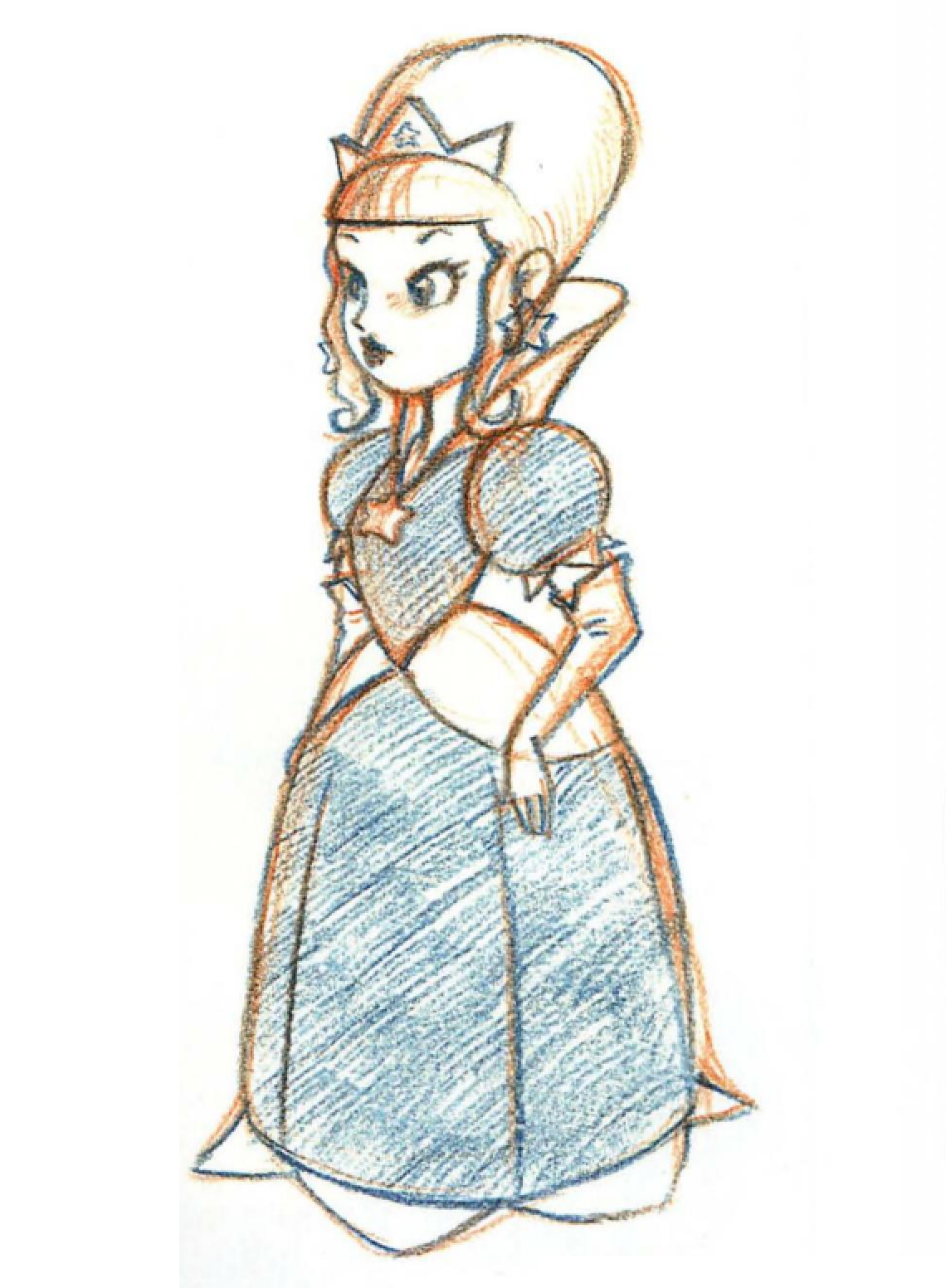
There’s not much of the Glinda version of Rosalina that made it into Super Mario Galaxy save for two obscure references. For one, she does seem to possess some kind of bubble magic that works somewhat like the mode of transportation Glinda got in the 1939 movie and has continued to have in many subsequent adaptations. If Mario tries to take a running leap off the edge of her fortress, he’s surrounded by a bubble that brings him back to safety. And for another, there’s a sort of negative space version of her that shows up as a guide in Super Mario Galaxy 2. In the English version of the game, it’s called the Cosmic Spirit. In Japan, however, it’s known as おたすけウィッチ or Otasuke Uitchi — literally “helper witch.” So she’s a witch, but a good one — just like Glinda, even if she doesn’t dress the part.
I’ve written about this in more depth in this post.
100: Prince Florian is a cautionary tale against presuming that cultural connections are always intentional.
Throughout this list, I’ve attempted to show how the Super Mario games exist in a push-and-pull relationship with greater pop culture. In many cases, things you’d never associate with these games have ended up influencing them — and sometimes in weird and surprising ways. However, coincidences also happen, and especially when you have a franchise that spans decades, different creatives come to the same conclusions separately. And a good example of this is Prince Florian, the caterpillar character introduced in Super Mario Bros. Wonder, who seems like he’s probably a nod to the 1986 Super Mario Bros. anime.
Super Mario Bros. Wonder, involves Mario and friends (and also Nabbit) trekking to nearby Flower Kingdom to meet with Florian, only to find out that Bowser has been up to his trademark mischief in this place as well. This mirrors several elements from Super Mario Bros.: The Great Mission to Rescue Princess Peach!, including the fact that Florian, who rides along for this adventure, bears a certain resemblance to Kibidango, a dog who befriends Mario and Luigi in the anime.
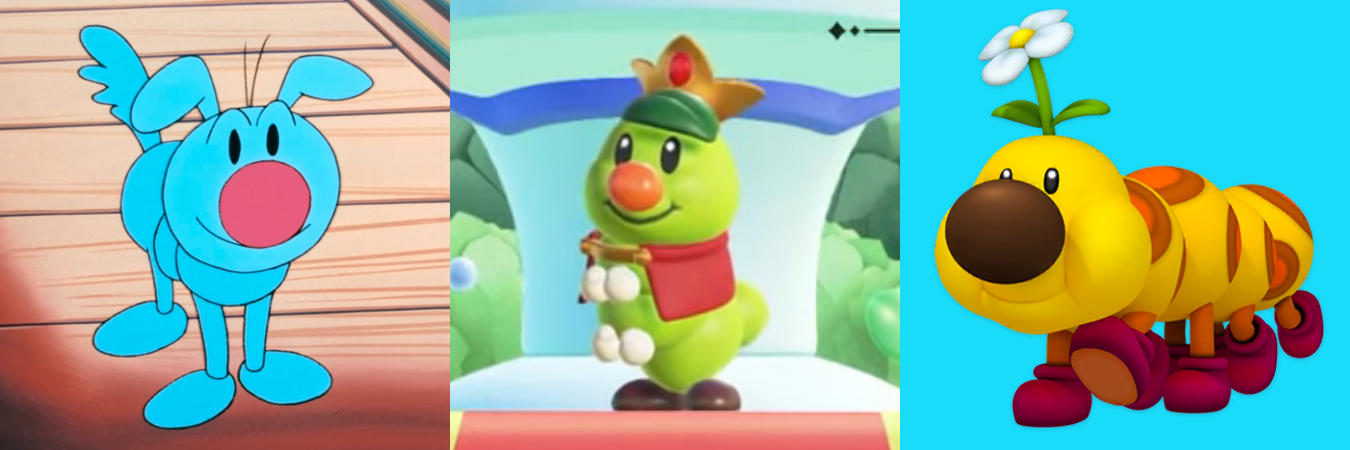
Left to right: Kibidango, Prince Florian and a Wiggler.
At the end of the anime, it’s revealed that Kibidango is actually Haru, prince of nearby Flower Kingdom and Peach’s true love, having been turned into a dog by Bowser’s magic. It’s a joke ending, with Mario thinking he’s going to get the girl but unknowingly delivering her to another guy.

Princess Peach and her effeminate dreamboat, Prince Haru.
And because Florian’s story seemed to parallel various aspects of Haru’s, there was some speculation that Florian would end up revealing a true form at the end of Wonder, whether as a foppish prince or maybe even as the game’s true villain. Of course, neither of these things happen. At the end of Wonder, Florian is just happy to get his castle back — and he’s still a caterpillar, even though turning into something else is one of the things caterpillars are famous for doing.
So why would Wonder seemingly throw in a callback to the anime only to skip any of the plot twists?
Easy: I don’t think it did. Wonder takes place in Flower Kingdom not because it’s doing an homage to the anime but just because that makes sense as a place that neighbors the Mushroom Kingdom. The basic Super Mario Bros. power-ups go, in order, mushroom then flower then star. It’s the same reason that Rose Town is the first village you encounter after the Mushroom Kingdom in Super Mario RPG.
Yes, Florian does look a bit like Kibidango, but that’s probably a coincidence. As a caterpillar, Florian was designed to look like Wiggler, the caterpillar enemy introduced in Super Mario World. Caterpillars do have segmented bodies, and Wiggler’s design represents that with rounded segments. Kibidango, meanwhile, is named for a type of rounded millet dumpling served on a bamboo skewer. For all I know, that Japanese dumpling style also influenced Wiggler’s look, but it’s not necessarily true that Wiggler was meant to look like the anime dog. It’s probably a case of convergent evolution, with both designs riffing on the same cultural product — with Florian being the same but likely owing more of a debt, design-wise, to Wiggler than to Kibidango. I mean, Florian does have a flower on his head after all.

Honestly, the Super Mario anime is full of instances like this one, where it seems like later games were incorporating play mechanics suggested by the film. That might be true sometimes, because people who would work on later Super Mario games undoubtedly saw this movie in theaters. For example, the way the anime has Mario dispatch Bowser once and for all does seem like it inspired the way Mario would defeat Bowser in Super Mario 64 ten years later.
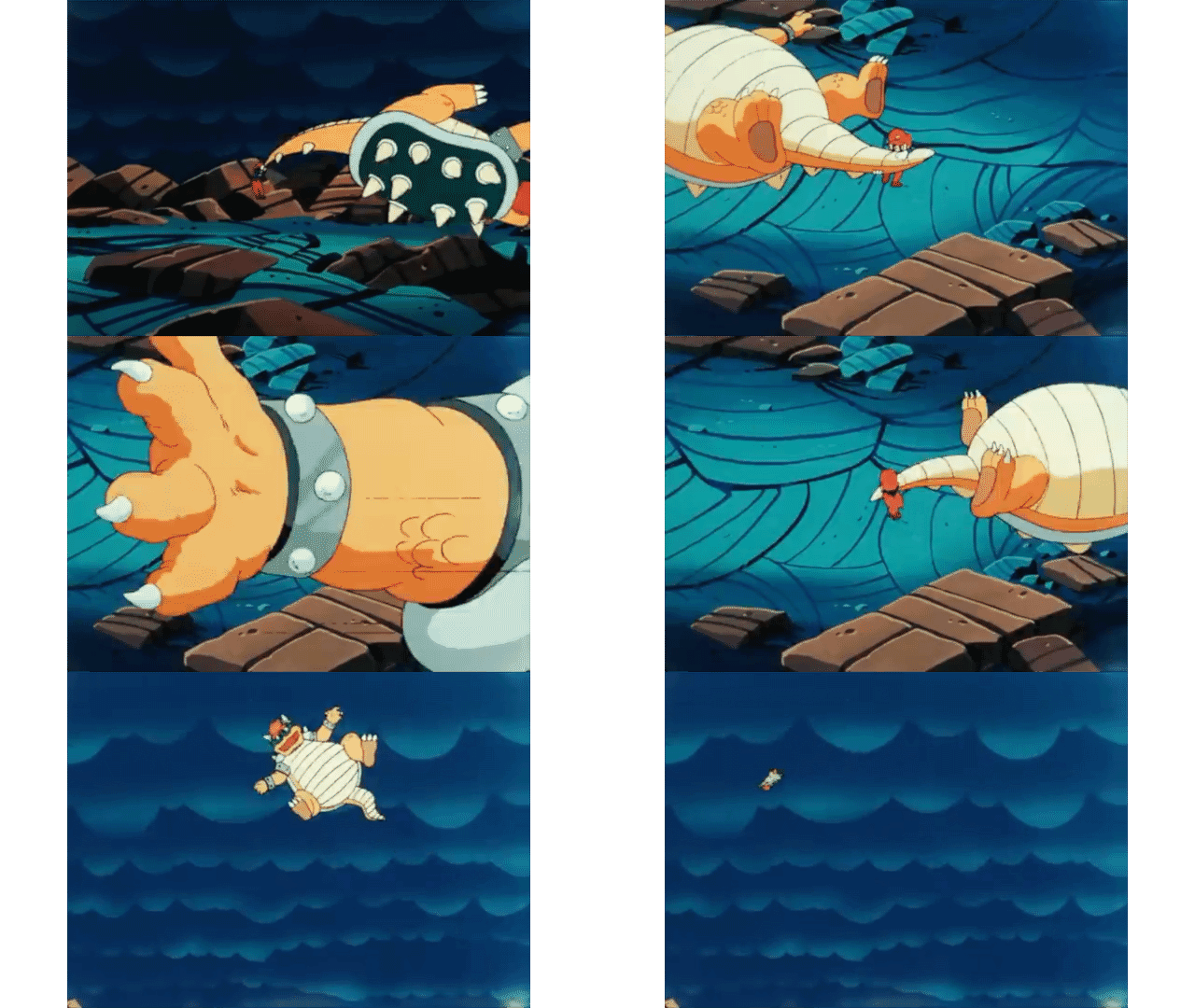
But it’s also true that until someone credits the anime as inspiration, we don’t know. And it’s always possible that two different people arrived at the same idea separately, without the latter one owning a debt to the former one.
This might seem like odd subject matter for the second-to-last item in this list, but I guess I wanted to point out that something seeming like it should be related to something else doesn’t mean that it actually is. I’ve tried to validate my suppositions and theories with accounts from the people involved whenever possible, but it’s also extremely possible that I’ve come to the wrong conclusions here and there. If you think I have done this, tell me. More than anything else, I just want to get people thinking critically about the way video games interact with art and pop culture. Having these kinds of conversations gets us closer to the truth of things.
Along these lines, BTW, I do have a post about how the water world map theme from Super Mario Bros. 3 was not intentionally echoed by the fairy fountain theme from Legend of Zelda, despite how much it seems like that should be the case.
101: Mario and Luigi are not from Brooklyn, yet…
And here we are, at the final item. Granted, it seems like this particular one should have shown up a lot earlier, maybe in the chunk where I was discussing the Mario Bros. arcade game. But it’s showing up here at the end for the simple reason that I did not do this research until just recently. But it seems as fitting a place as any to conclude this project, because it’s central to Mario’s identity while also being confusing and sort of unanswerable.
Basically, we’ve got it in our heads that Mario and Luigi should be from Brooklyn because we’ve been told that by the DiC cartoons, the 1993 live-action movie and the 2023 animated one. However, it’s never been stated in any game that the brothers hail from Brooklyn or really anywhere in the real world. So why does this idea exist?
Well, for one thing, Shigeru Miyamoto has said so — twice. The first time happened in an interview that accompanied a 1996 Japanese-language guide to Super Mario 64 (translated by Shmuplations).
Interviewer: I noticed that Mario speaks with an Italian accent in this game.
Miyamoto: There’s no particularly detailed background or anything, but yeah, it’s a given that Mario is an Italian-American from Brooklyn, New York. That voice was actually done by a professional voice actor. He did Mario’s voice five or six years ago, at a video game event.
The second happens in a 2024 online interview that Nintendo Dream magazine did in promotion of The Super Mario Bros. Movie (translated by Fatimah).
Interviewer: You can’t say too much about the plot of the movie, but it depicts a story similar to the origins of Super Mario where there’s a plumber that goes to a mushroom kingdom. What was the intention behind that?
Miyamoto: It has nothing to do with the movie, rather something that was already decided on for the backstory. That's why the movies that were licensed in the past tended to have that kind of plot. This is generally understood by those involved. Originally in Mario Bros. we randomly decided to have two brothers who worked in the pipe-filled underground of New York — probably Brooklyn. And Donkey Kong takes place in New York, too. … Those pipes lead to the mysterious forest (Mushroom Kingdom) and this is how Super Mario Bros. came to be.
Essentially, Miyamoto is saying that it’s part of the world of these games even if it’s never been mentioned officially. But these answers don’t address why Brooklyn (or anywhere in New York, for that matter) and why it’s not officially stated in any game if it’s something Miyamoto thinks is true. Based on my research into all things protological in these games, I think the most likely answer to both of these is King Kong. (It’s always King Kong, except when it’s Popeye.) The climax of the 1933 movie takes place in New York City, and that could be reason enough for the urban, western feel of Mario’s pre-Mushroom Kingdom games: Donkey Kong and then the spinoffs Mario Bros. and Wrecking Crew.
But why Brooklyn? I think it’s one of those things, like Mario and Pauline’s names, that began at Nintendo of America and traveled back to the headquarters in Kyoto. The U.S. branch was briefly based in Manhattan before relocating to Washington, and I’m guessing New Yorkers working there associated Mario with Brooklyn because that’s the borough that boasted the biggest population of Italian-Americans at the time. There’s a reason that the semi-pro soccer team based here is called the Brooklyn Italians, after all, but I’d wager it’s a thing most New Yorkers would know but your average Japanese person would not. (And go all the way back to item no. 5 to read about how it was decided that Mario should be of Italian descent.)
That said, I can’t find any instance of the Nintendo mascot being linked with Brooklyn before 1989, which is when The Super Mario Bros. Super Show! made Captain Lou Albano the face (and voice) of Mario. That’s also when the Brooklyn association starts showing up on, for example, archives at Newspapers.com.
But the DiC series isn’t the first adaptation to make this connection; it’s actually a Golden Book titled Super Mario Bros.: Trapped in the Perilous Pit. And on the first page, it’s stated that Mario and Luigi arrived in the Mushroom Kingdom via a Brooklyn sewer.
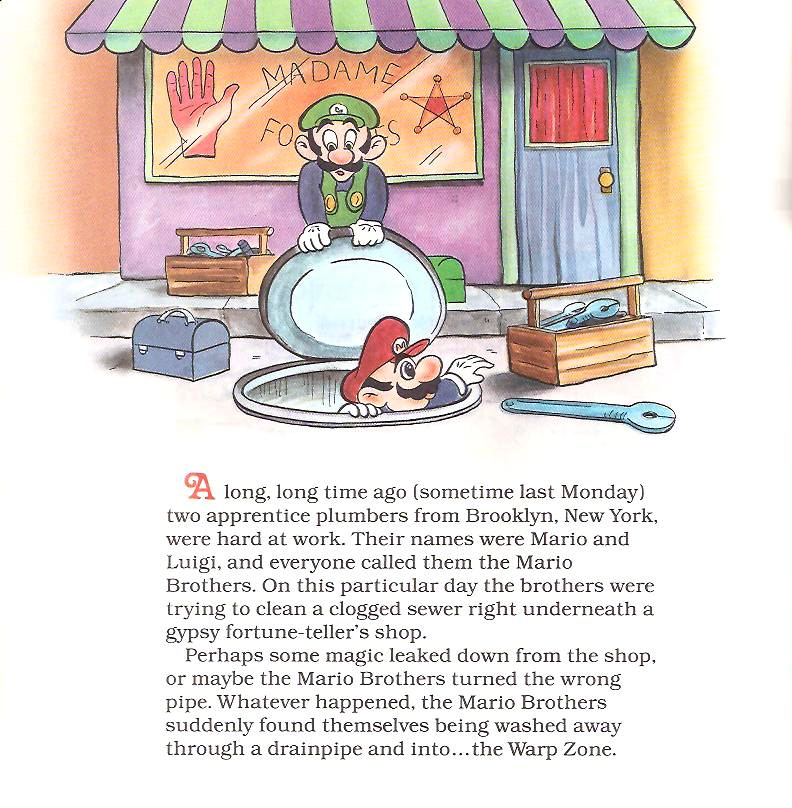
The book was published in the U.S. in July 1989. The DiC cartoon would premiere the following September and so obviously had to be in production long before the book hit shelves, and maybe even before work on the book began. Either way, this is something these two unrelated adaptations have in common, and although it could be a coincidence or a result of assumptions about where Italian-Americans tend to live. However, I assume there was some official world from Nintendo of America that said Mario and Luigi were from Brooklyn, maybe via a press packet or some corporate guide to how to use the Super Mario characters, even if it didn’t make it to the public before these adaptations were released.
Later games would feature very New York City-like settings, most notably New Donk City in Super Mario Odyssey, but Nintendo has never actually stated on the record that this results from Mario’s first game, Donkey Kong, being inspired by King Kong. In fact, Nintendo doesn’t talk much about King Kong at all. I assume this results from the Universal Studios lawsuit, which I’ve talked about quite a bit by this point. Even though Nintendo emerged victorious, it was certainly not a given that this would be the case, and it would have been financially disastrous for Nintendo if the judge had ruled in favor of Universal Studios, to the point that the company wouldn’t exist the way it does now and might not exist at all. Today, Universal distributes the new Super Mario movies and therefore has a much peachier relationship with Nintendo, but this period remains one that Nintendo that Nintendo seemingly prefers to keep in the past.
Thus, Mario and Luigi are totally from Brooklyn, except they’re not officially, but they totally are.
If you want to read the evolution of Mario’s accent and why Charles Martinet makes him sound Italian rather than Italian-American, I get into that in this post. And then in a post about Grinders in Yoshi’s Island, I talk about other ways Mario represents an Italian stereotype, for good or for bad. Yes, there is always a longer post.

And with that, I am concluding Mario 101.
This ended up being a lot more research than I was anticipating, but I’m hoping if you made it this far, I have taught you a new way to think about Mario and his games. Truth be told, I have at least a hundred more of these items, and I may tack them on in new additions down the line. They’re more centered around supporting characters and concepts that are less central to the main games, however, and I decided to keep this one somewhat focused on the arcade titles, the NES trilogy and then Super Mario World, Yoshi’s Island and Donkey Kong Country.
Either way, there is more to come — and if there’s interest, I’d re-use this format to discuss Zelda, Final Fantasy, Street Fighter and more.
I’m assuming most people who pride themselves on knowing a thing or two about Mario already have something in mind that they’re surprised I didn’t mention. Please drop a comment below indicating what thing I’m a bonehead for leaving out.
EDIT: Just kidding! Now there is a part eight.
Navigation:
Part One (1-15): Mario and Luigi origins / Donkey Kong and Mario Bros.
Part Two (16-30): Bowser, Peach and Toad / Super Mario Bros.
Part Three (31-45): The enemies of Super Mario Bros.
Part Four (46-60): Super Mario Bros. miscellany / Super Mario Bros. 2
Part Five: (61-75): Super Mario Bros. 3 and Super Mario World
Part Six (76-90): Yoshi and Donkey Kong (and friends)
Part Seven (91-101): Various beloved supporting characters and also Stanley the Bugman
Part Eight (102–116): A sort of junk drawer including Peach’s dad, Bowser’s wife and the infamous field horsehair plants