

Mario 101: Part Six

76: Yoshi was and maybe still is a Koopa.
Because Super Mario World takes place in Dinosaur Land (恐竜ランド or Kyōryū Rando), it would make sense to just presume that Yoshi is, in fact, a dinosaur. After all, many of the enemies introduced in this game appear to be dinosaurs, including Blargg, Dino-Rhino and Eerie. The enemy Rex is even drawn remarkably like the version of Yoshi we’d get in the future — cuter, pudgier and with a more human-like posture.
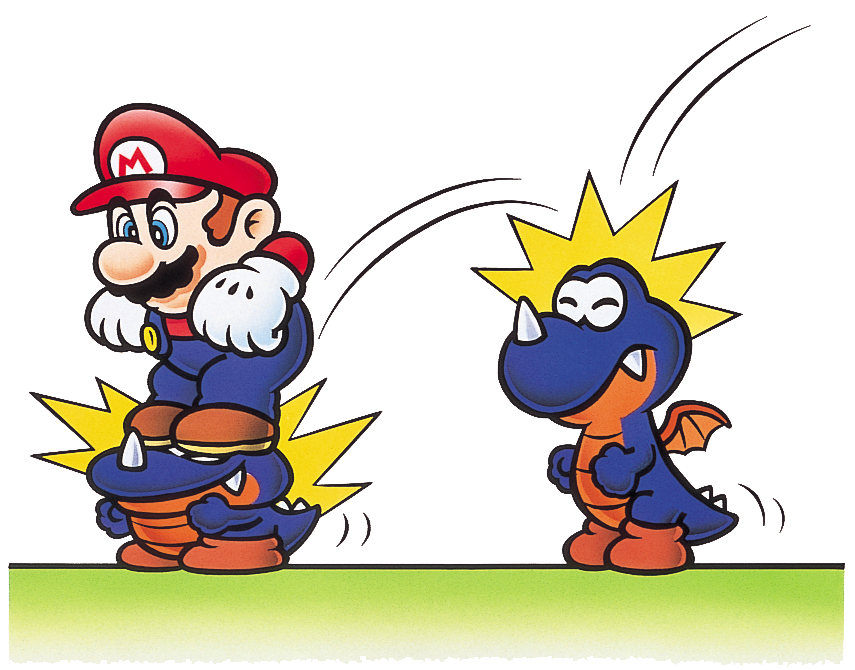
Of course, nothing is ever that simple when it comes to the creative whims of Nintendo decision-makers. According to the 2017 developer’s roundtable promoting the Classic Mini, having Yoshi look fully lizard-like did not work visually, and so the character was altered to make sense within existing creature designs in the series — all the way down to his shell.
Takashi Tezuka, director of Super Mario World: Yeah, it felt out of place to have a reptile suddenly appear in Mario’s world, so we went back and talked about how maybe it shouldn’t be like a crocodile.
Akinori Sao, interviewer: In other words, the two of you consulted each other as you searched for the prototype for Yoshi. How did that croc-like creature shape up into Yoshi?
Shigefumi Hino, character designer: Tezuka had done a rough sketch and it was cute and pretty good, so I polished up Yoshi’s design based on that.
Tezuka: That happened relatively quickly. I kind of forced the design through, saying, “It’s related to turtles.” (laughs)
Sao: That’s why, instead of a saddle, what’s on Yoshi’s back is...
Nogami: A shell. Even after I joined the company, Tezuka kept insisting that it was a shell. (laughs)
Sao: (laughs) And that’s how Super Mario World, which debuted Yoshi as kin to turtles, became the top-selling title worldwide for Super NES.
Tezuka: Really…?
Sao: As if you don’t know! (laughs)
Tezuka would repeat his belief that Yoshi is some sort of turtle in a 2019 interview with Nintendo Dream promoting Yoshi’s Crafted World.
Interviewer: We talked about this in a previous interview for the SNES Classic Edition, but Yoshi is a turtle, isn’t he?
Tezuka: Yes, I had to always insist he was a turtle… (laughs) Because we wanted a character that wouldn’t feel out of place in the Mario universe, we decided on a turtle. It might have been Miyamoto’s idea but I’m not entirely sure.
Interviewer: I think because the message you can read at Yoshi’s house says “Super Dragon” people thought that he might have been a dinosaur.
Tezuka: I think we wrote that without really thinking about it too much. (laughs)
That last comment refers to the way Yoshi signs the note to Mario seen at the start of Super Mario World — as スーパードラゴン ヨッシー or “Super Dragon Yoshi.”
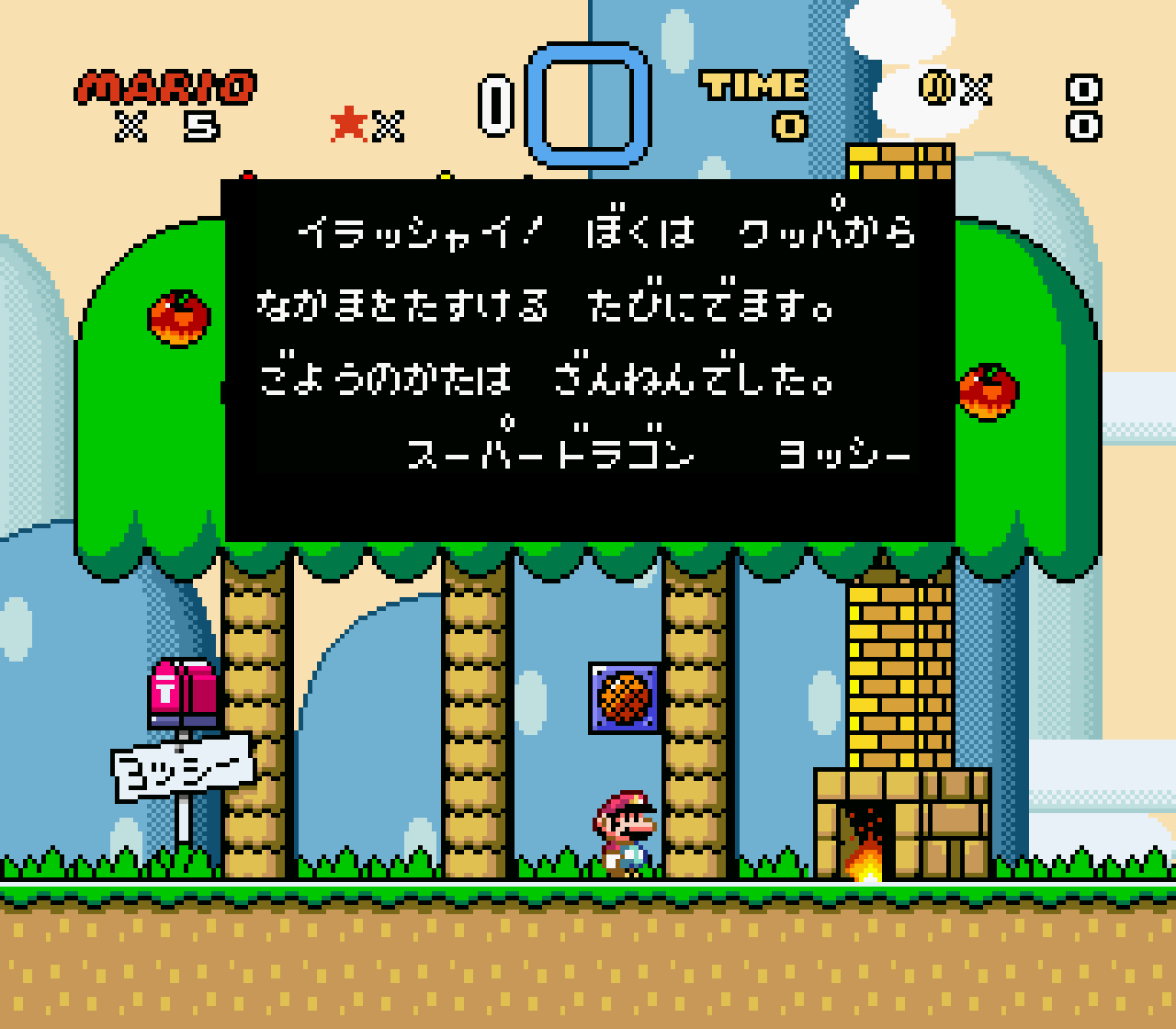
Translation: Welcome! I’m going on a journey to save my friends from Bowser. Apologies to anyone who’s come all this way.
— Super Dragon Yoshi
Image via The Mushroom Kingdom, whose “Mario in Japan” pages are as much an inspiration for this project as anything,
This dragon connection actually shows up in Super Mario World in a way that remains in the localized version, though it’s hard to spot. The collectable coins bearing Yoshi’s face are called Dragon Coins, so in one sense I suppose this version of the game is saying yes, Yoshi is a dragon. But that name probably has more to do with the Japanese word for “dinosaur,” 恐竜 or kyōryū, literally being the kanji for “fearful” and the one for “dragon.” Curiously, the sprite for the coins in Super Mario World actually looks something like a cross between a Yoshi and a Koopa Troopa. It lacks Yoshi’s spikes, and if you just modified the nose to be a bit sharper and beakier, it would look like a Koopa Troopa.
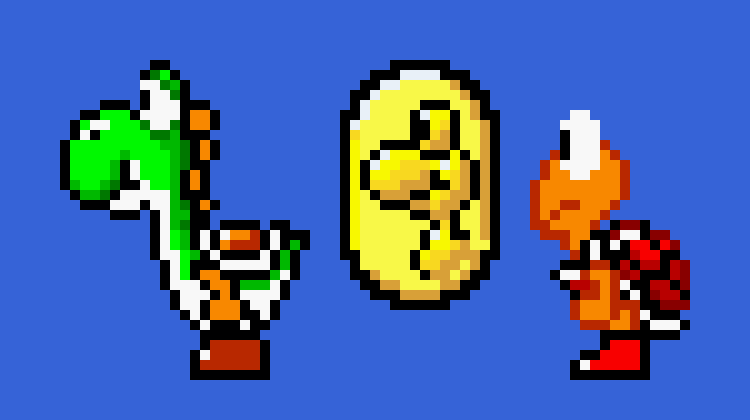
I wonder if the design of the coins is perhaps a vestige of the original Yoshi design that ended up in the final version of the game.
77: No, his full name is not actually T. Yoshisaur Munchakoopas.
This might seem like it’s… not worth a numbered item if I’m limiting myself to only 101 for this list, I realize, but I think it illustrates a point that I’ve been trying to prove elsewhere. Yes, there is a 1992 character reference manual that alleges that Yoshi’s “proper” name is T. Yoshisaur Munchakoopas. It’s probably meant to be understood as Yoshi’s scientific name, but the wording is poorly chosen and the capitalization isn’t right. (Convention has it that the genius name is capitalized and the species name is not.)
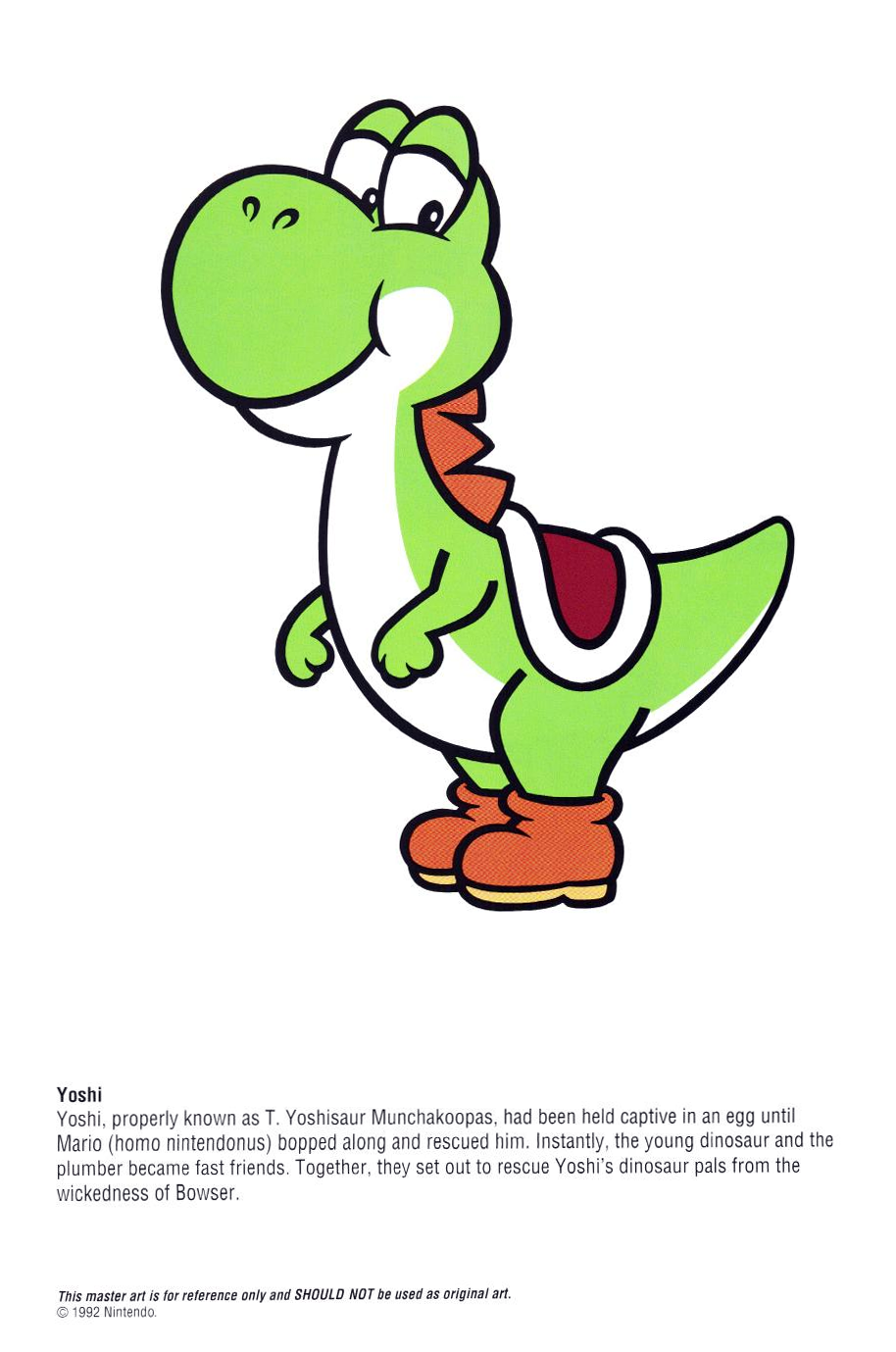
As far as I know, it came to public attention as a result of Blake J. Harris, author of Console Wars, though I specifically encountered it in a post on Matthew Green’s Press the Buttons about Harris’s tweets about this document.
But no, we don’t need to think this is actually true. Sometimes, official-seeming entities put out statements that are wrong or just plain stupid, and this is one of them. No one has since referenced T. Yoshisaur Munchakoopas as being any type of “real” name for this character, but it’s not even a matter of westerners attempting to add to a canon that isn’t recognized by Japan — not strictly, at least. No, in this document, I’ve noted a few times that senior Nintendo of Japan employees have given histories that conflict with other ones. And while listing them all and calling attention to the resulting contradictions is the strategy I’ve gone with for this project, I think instances like this one allow fans who have done their homework to say what they accept and what they reject.
And I, for one, reject that T. Yoshisaur Munchakoopas has real value to this series.
78: Donut Plains ≠ Donut Lifts.
Super Mario Bros. 3 introduces Donut Lifts, the rounded, hollow blocks that fall if Mario stays on them for too long. They’ve appeared in many subsequent games, including Super Mario World. For some reason, I figured the Donut Plains area of Super Mario World was a reference to the lifts — I guess because I imagine that the donut farmers grew the Donut Lifts on the Donut Plains? — but that’s not the case. In Japan, the Donut Lifts are called the チクワリフト or Chikuwa Rifuto, with chikuwa (竹輪) being the circular-shaped surimi item that, when sliced, looks like the rounded lifts seen in the games. The Japanese name for the Donut Plains, however, is exactly that: ドーナツ平野 or Dōnatsu Heiya, which is a reference to the fact that this area circles around the central hole that is the body of water in the middle.
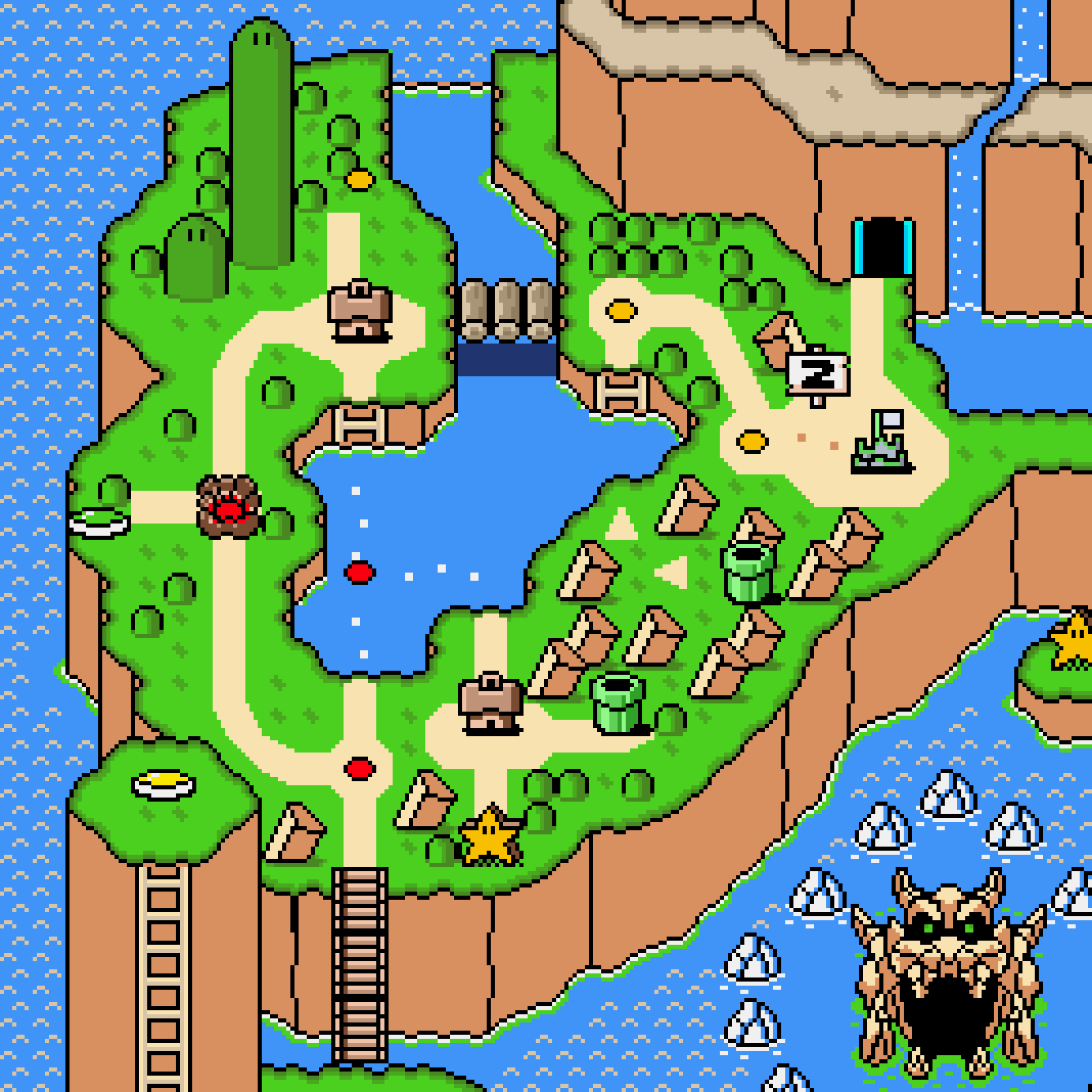
Not only are the Donut Lifts and Donut Plains two separate, unrelated things in the original Japanese, but also I never realized that the name of the latter came from ist circular shape. How ignorant I was. May this 101-item list be my act of contrition.
79: The Forest of Illusion is a Lost Woods, more or less, but it’s more complicated than that.
The Super Mario and Legend of Zelda series have been referencing each other since the beginning. In fact, earlier this year, the hard-to-spot Piranha Plant reference in the original Legend of Zelda kicked off my search for the oldest Nintendo crossover. (Spoiler: I think it may be a Sky Skipper song showing up in Donkey Kong Jr.) One instance of the Super Mario series referencing Legend of Zelda that a lot of people miss is that Super Mario World’s Forest of Illusion area is a callback to Zelda’s Lost Woods. Not only do you need to find the secret exit in a Forest of Illusion stage to keep from treading the same circular path on the map screen, but also the Japanese name for this area, 迷いの森 or Mayoi no Mori, happens to be the same as the Japanese name for the Lost Woods.
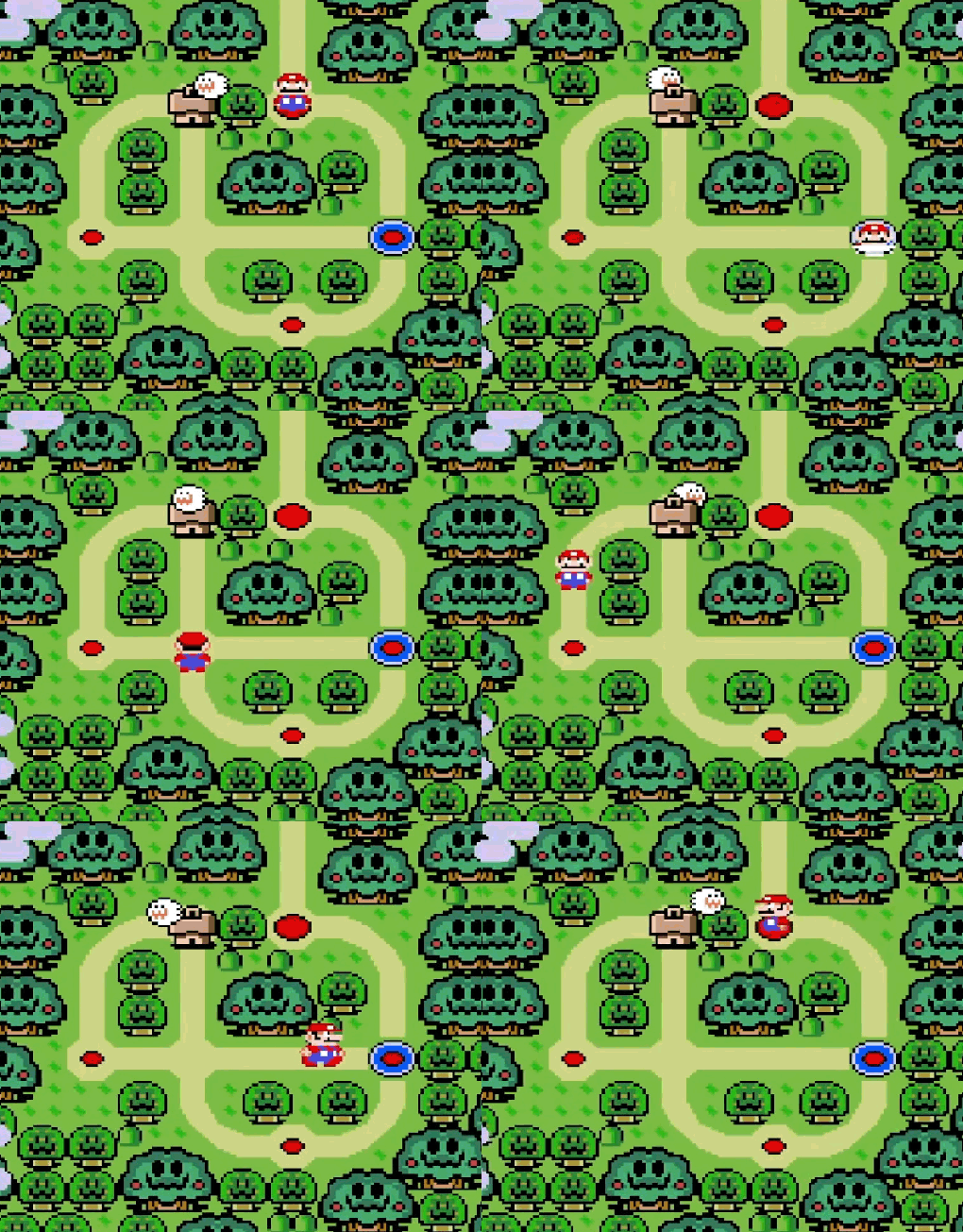
It’s possible to get this far in Super Mario World without finding a secret exit, but the only way to escape the endless loop of the Forest of Illusion is to start finding them. In the sense that you need to know a secret to advance, this area works like Zelda’s Lost Woods.
Bonus points if you can hear this gif.
As this Legends of Localization post points out, the Japanese word mayoi can be translated a few different ways, to the point that Lost Woods and Forest of Illusion are both reasonable translations of mayoi no mori. It then goes on to list several areas in other games that are also called some variation of this in the original Japanese, including the Forever Forest in Paper Mario, the Phantom Forest in Final Fantasy VI, the Forest of Illusion in the first Lunar, the Lostlorn Forest in Pokémon Black and White, the Neverglade in Dragon Quest V, the Forest Maze in Chrono Trigger, the Forest of Doubt in Arcana and even the Maze Woods in Wario Land II.
Obviously, every game listed in the Legends of Localization post came out after Legend of Zelda, which was released in 1986, so it might seem like each one is a nod to the Zelda Lost Woods, but I’m not sure that’s necessarily the case. It’s more that the Zelda example is a famous video game version of the concept of a confusing, winding forest path, which has existed in non-video game media since, well, people walked through dark forests and lived to tell about it, I would guess. But that said, I had trouble finding an example that pre-dated the first Legend of Zelda and which referred to it by any of the ways that mayoi no mori can be written in Japanese.
At the very least, I can find this phrase being used in conjunction with the anime Windaria, which was released July 1986; the Famicom game Valkyrie no Bōken, which was released August 1986; and the video game version the movie Labyrinth, which opened in theaters June 1986. But I think the relative scarcity of the phrase referring to non-video game-related things or anything before the release of Legend of Zelda might actually indicate that Nintendo named the concept or popularized this particular name for it, even if it existed long before video games ever did.
80: Sometimes Kamek isn’t Kamek.
For English-speaking players, Kamek debuted in Yoshi’s Island, where he was the Magikoopa who acted as the surrogate parent for Baby Bowser. For Japanese players it’s a little less clear, because Kamek, the individual Magikoopa who is often depicted as being Bowser’s right hand guy, has the same name as the generic Magikoopa that started appearing in Super Mario World. They’re all カメック or Kamekku, a combination of 亀 or kame, “turtle,” and the katakana rendering of magic, マジック or majikku. In this sense, Kamek functions like Yoshi, Birdo and Toad; all four are simultaneously every member of their species and also the singular version that, say, appears as a playable character in Mario Kart or Mario Tennis.
However, this gets complicated in situations in which it’s not clear if a character is supposed to be the head Magikoopa or not. A good example is Super Mario RPG, when Mario’s party must fight a Magikoopa that has fallen under the thrall of the game’s big bad, Smithy. Once defeated, the dialogue indicates something of a warm familiarity between this Magikoopa and Bowser, to the point that it seems like it should be Kamek.
In the localization of the original game, however, he’s just called Magikoopa, even though the Japanese version calls him カメザード or Kamezādo, seemingly a blend of Kamekku and the katakana rendering of wizard, ウイザード or uizādo, suggesting maybe that he’s an elevated version of the normal, run-of-the-mill Magikoopa. If Mallow uses his Thought Peek ability on him, this character seems to recognize Mario as the baby from Yoshi’s Island, saying “Is that the baby from that time!?” But rather than just call him Kamek, the remake chooses to call this character Wizakoopa. No, I don’t know why, but yes, I would have gone a different direction.
For the record, however, I’m not sure if we’ve ever been told that the playable character nixed from the finalized version of Mario Kart 64 was Kamek or just a generic Magikoopa.
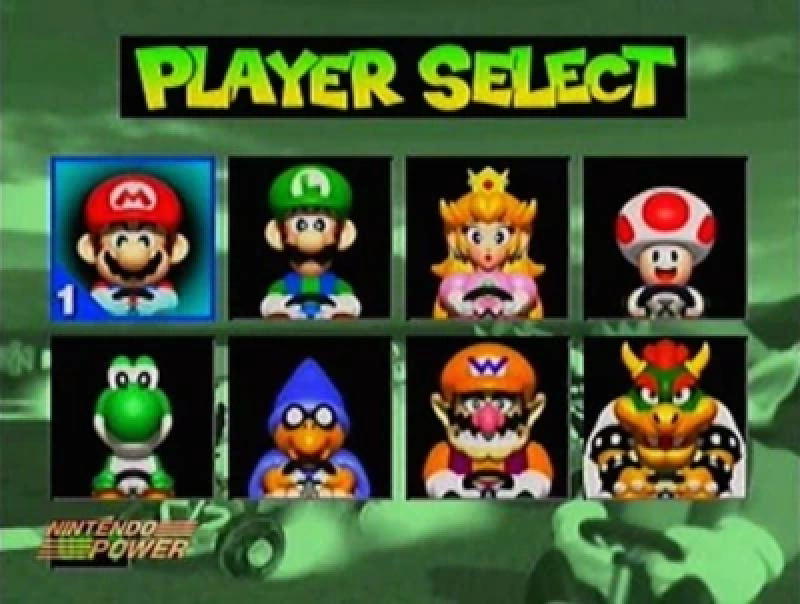
Most people seem to have assumed that it must have been *the* Magikoopa rather than just *a* Magikoopa. Either way, he lost his spot to the new Rare remodel of Donkey Kong by the time the game actually came out and didn’t end up actually playable in a Mario Kart game until Mario Kart Tour, twenty-five years after Mario Kart 64 was released.
81: Poochy’s name is actually a rather good localization choice.
At first glance, Poochy might seem like a very obvious name for the little dog friend that debuted in Yoshi’s Island and has subsequently recurred throughout the series. And it probably is, but there is just one added layer of meaning that warranted its inclusion on this list. Poochy’s Japanese name, ポチ or Pochi, is actually a common Japanese dog name that has nothing to do with the English word pooch but instead means “dot” or “spot.” And that makes sense because Poochy does actually have spots.
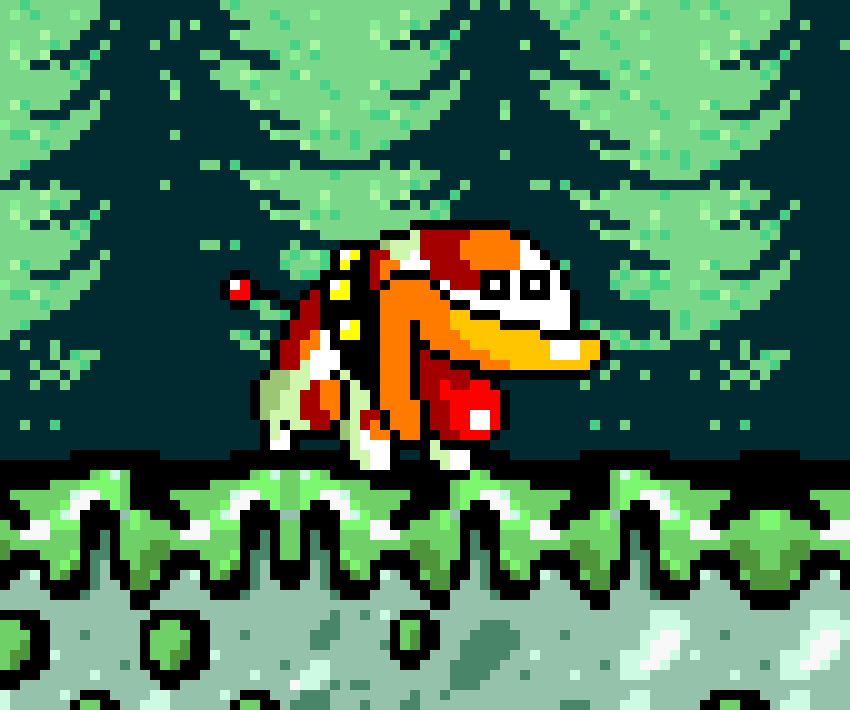
But rather than call the dog Spot, the Yoshi’s Island localizer just decided that Poochy was close enough to the original Japanese name and went with that. Personally, I think it was the better choice.
82: The history of Donkey Kong’s name is complicated, but not necessarily for the reason you think.
I’ll bet you thought that I just skipped over Donkey Kong. Nope! But this project has been so Mario-centric that it just made sense to follow that throughline until now, when Donkey Kong Country made the character relevant again. Here is all the Kong-centric stuff I didn’t put at the start.
Earlier this year, I wrote “Who Put the ‘Kong’ in ‘Donkey Kong’?” about the origin of the second part of Donkey Kong’s name. It comes from King Kong, obviously, but I wanted to figure out how the creators of the 1933 movie came up with this syllable. The short version is that Merian C. Cooper, one of King Kong’s two directors, felt that hard “K” sounds in place names such as Kodiak and Komodo evoked a certain sort of strength that captured the spirit of the adventure story he wanted to tell. And so “Kong” was created to represent a faraway place that would seem exotic to everyone, because it wasn’t from any one real culture, but would also bring a sense of ferocious strength to the titular creature.
In that piece, I focused on the second part of Donkey Kong’s name because I felt like the first part had been done to death. Back in the day, urban legends usually explained away Donkey Kong’s name as a Japanese person with a loose grip on English thinking that donkey meant “stupid” and kong meant “monkey.” The source of this story might actually be Nintendo Power itself, as its 1991 Mario Mania guide says exactly that.
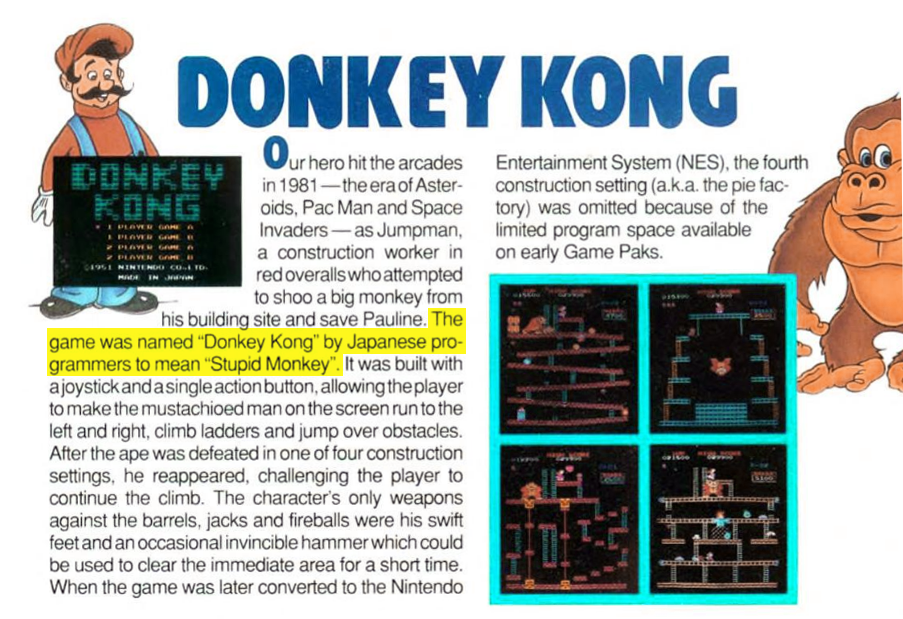
More recently, the story of Donkey Kong’s strange name assigned the credit (or blame, depending) to Shigeru Miyamoto. As the story is told now, he allegedly insisted that this name had the right sound to it even after it was brought to his attention that donkey does not actually mean “stupid” in English. In researching this post, however, I found that there’s actually a credible theory for the name Donkey Kong having nothing to do with Miyamoto at all. I was both surprised and not surprised at the same time — the former because most discourse about the creation of this character name has put Miyamoto front and center, the latter because I’d already started this project and written up the items explaining how the story of other series elements, like Mario’s name, had competing and contradictory accounts.
According to research done by The Gaming Historian (a.k.a. Norm Caruso), the name Donkey Kong was invented by Shinichi Todori, whose work as an export manager for Nintendo had him paying attention to what game titles made sense in overseas markets. Caruso found this in documents related to the 1983 copyright infringement lawsuit Universal Studios filed against Nintendo regarding similarities between King Kong and Donkey Kong. In those papers, it’s stated that Todori was tasked with coming up with a list of potential names for the game, most of which also made sense as the name of the character himself. According to Caruso’s analysis, it seems that it was Miyamoto’s boss at the time, Gunpei Yokoi, who told Todori to do this — not Miyamoto. And the decision on the game’s name was made by then-president Hiroshi Yamauchi — again, not Miyamoto.
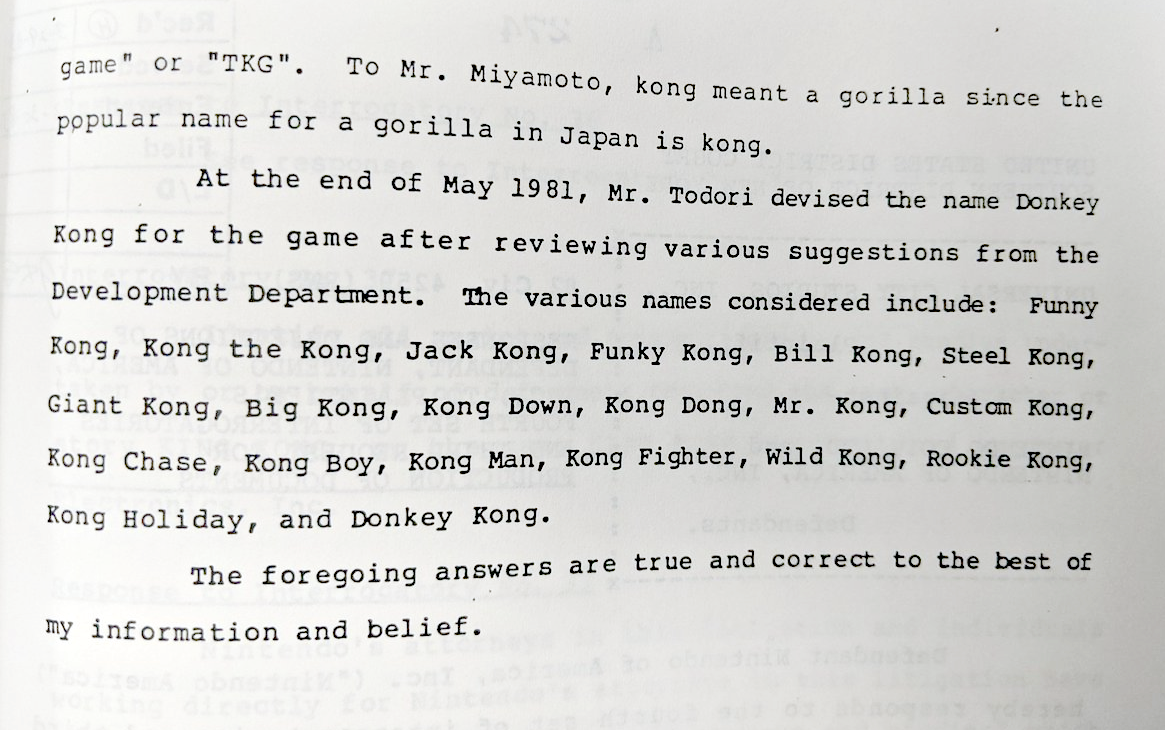
Yes, one of the names considered for one of the most important video games of all time was Kong Dong. If only. (Via Norm Caruso on Twitter.)
Once again, I am not sure how to account for the discrepancies between the various accounts for how this video game got its name. I do make a few feeble stabs and making sense of it all in the original post.
Oh, and no, kong does not mean “monkey” in Japanese, slang or not. Stop telling people that.
EDIT: After this went live, it was brought to my attention on Bluesky that the Super Mario Facts account on Twitter was a hoax account, purposefully posting incorrect “facts” as a joke. So I guess I got got, but the idea of kong meaning “gorilla” or something thereabouts in Japanese pre-dates this post. In the original post, where I go into greater depth, I point to people asking about this connection — and doing so in Japanese, which makes me think that Super Mario Facts did not make this up so much as just repeated a debunked rumor as if it were true.
83: Donkey Kong predates Mario, if we’re being technical about it.
When we talk about how Donkey Kong (the game) began as a vehicle for Popeye characters, we usually make it seem like the replacement of Popeye with Mario, Olive Oyl with Pauline and Bluto with Donkey Kong (the character) happened at the same time. In a sense it did, but it’s worth pointing out that Nintendo had already begun considering replacing Bluto with a giant gorilla while Popeye was still the game’s hero. Game historians have obtained the mockups that prove it.
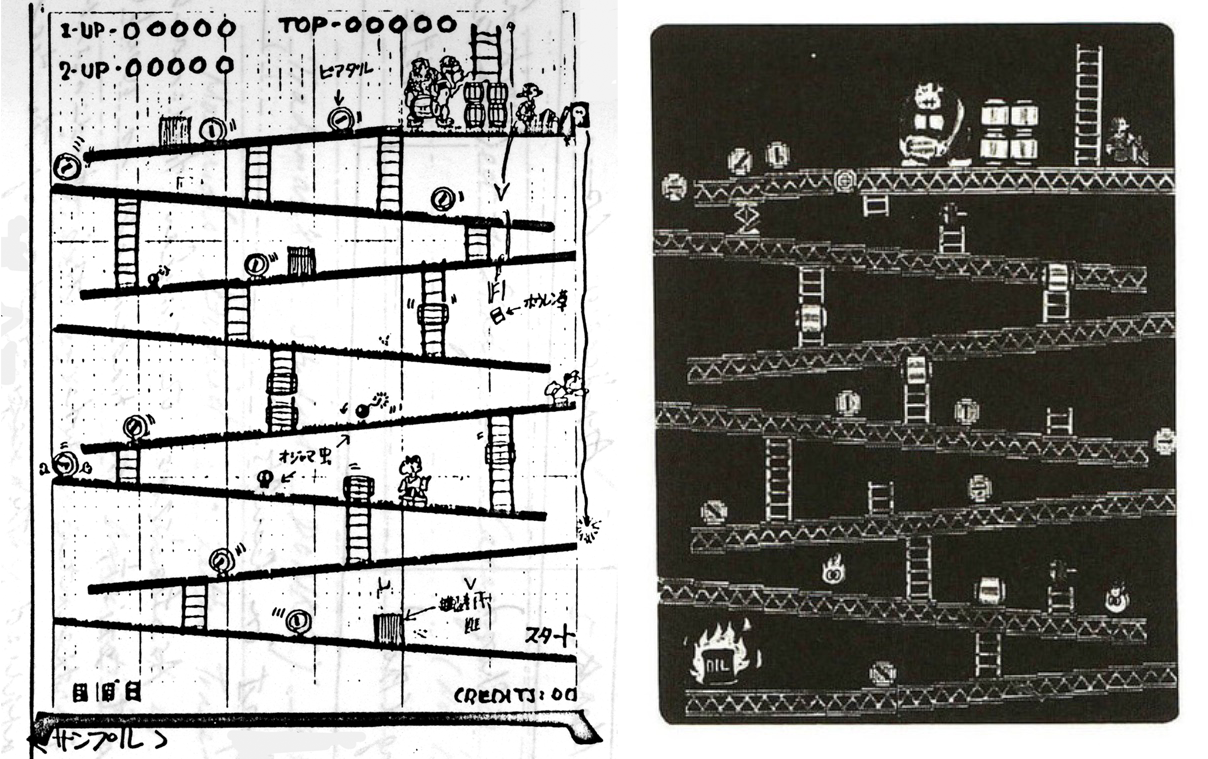
Left: A sketch showing a prototype version of Donkey Kong with Bluto/Brutus as the one rolling barrels down the scaffolding. Right: A revised version of that image showing Olive Oyl as the damsel in distress but a Donkey Kong-looking ape as the new villain. (Both images via The Cutting Room Floor.)
That doesn’t necessarily mean that the ape is Donkey Kong, I suppose, but at the very least, it’s an unnamed barrel-throwing gorilla who would become Donkey Kong relatively shortly. And in that sense, Donkey Kong does, in fact, predate Mario.
Because we know now that a lot of the story elements relating to Donkey Kong (the game) were pulled from the movie King Kong, it seems reasonable to think of this Bluto-less version as being a blending of Popeye and King Kong into something new. That’s what I think makes sense, at least, but for what it’s worth, Popeye did tangle with a gorilla. The 1933 short “Wild Elephinks” has Popeye stranded in a jungle populated by hostile animals, including a gorilla who attempts to kidnap Olive Oyl.
If I were one of the lawyers arguing on behalf of Nintendo in that lawsuit filed by Universal Studios, I’d point to this cartoon as being an explanation for why the villainous ape in Donkey Kong (the game) is not based on King Kong. But as you’ll see in item no. 85, that’s not the tactic the lawyers eventually went with.
84: And the barrels pre-date Donkey Kong.
It’s a matter of some contention, but my personal opinion is that we can’t be sure why Donkey Kong ended up throwing barrels. As I write about in greater depth in this post, a working title for the game that would become Donkey Kong was Popeye’s Beer Barrel Attack Game (ポパイのビアダル攻撃ゲーム, with ビアダル or bia daru specifically referring to a beer barrel.) This seems like evidence enough that barrels were part of the central gameplay starting early on in the development process. But in one of the depositions Gunpei Yokoi made as part of the lawsuits between Universal and Nintendo, it’s mentioned that the original setting for the game was a seaport and not a construction site.
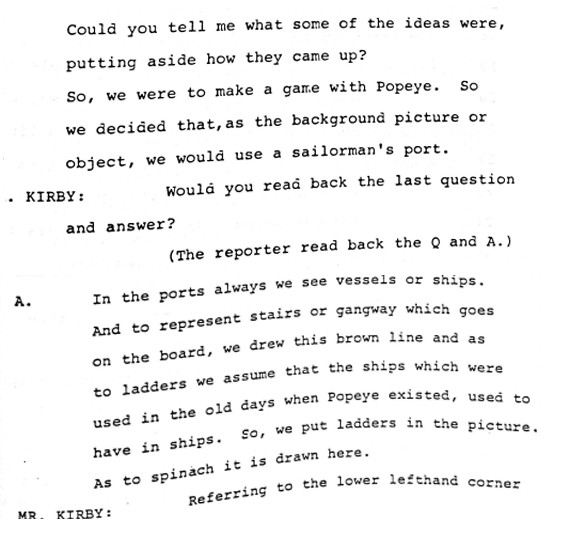
Barrels have a place on construction sites too, but the fact that the original title specifies beer barrels makes me think a maritime setting makes more sense. There’s a reason that Capcom’s Pirate Ship Higemaru series is so barrel-centric, after all. In his 1997 book, Gunpei Yokoi stops just short of saying that the barrels originated in Popeye. In one paragraph, he’s explicitly crediting the aforementioned Popeye short “A Dream Walking” as being an inspiration for Donkey Kong.
There was an episode in the cartoon show for Popeye in which Olive was sleepwalking and wandered around a construction site. Whenever she was about to lose her footing, miraculously enough another platform would come out of nowhere and support her, and this left quite an impression on me. So we figured by using a construction site as the setting, there would be all kinds of things we could do, and thus chose that as the setting for our Popeye game.
And then in the next paragraph he’s talking about barrels, but it’s not clear if this thought is related to the preceding one.
Once we had established that the game would be set at a construction site, Mr. Miyamoto suggested, “Let’s make it a game where there are barrels falling from above, and the player has to dodge them.” At that time, he had a simple gameplay idea which was that whenever a barrel fell the player could get on ladder and avoid it. Once the barrel had passed, the player would get off the ladder and then back on the platform to continue climbing.
While he credits the idea for barrels to Shigeru Miyamoto, it’s not clear if Miyamoto got the idea from Popeye. It’s entirely possible that this could be the case, however. The 1960 cartoon “Popeye Revere” does in fact feature the character jumping over tossed barrels in a way that seems unmistakably Donkey Kong-like.
And while this may seem like a sure thing — the clip does show Popeye jumping over a rolling barrel, Donkey Kong-style — the connection is complicated by the fact that jumping over barrels didn’t become the basis of Donkey Kong’s gameplay until long after Popeye ceased to be the controllable character. It was later in the development of the game that it was decided that the heroic character should jump over barrels. Instead, he just climbed ladders to avoid them. As explained by Kate Willaert, it wasn’t even Miyamoto who came up with the idea of giving the ability to jump to the character who would eventually become Jumpman.
I will admit that all the evidence is there, just *almost* in place for all of this to make sense. But the fact that the various pieces seem to be entering the timeline out of the logical chronological sequence makes me think that there’s a decent chance that this one Popeye cartoon is not, in fact, the reason that Donkey Kong ended up throwing barrels in a way that would alter the course of video game history.
85: Mario, Donkey Kong and Nintendo owe their continued existence to Dino De Laurentiis.
Here’s a weird one. Dino De Laurentiis is a producer whose filmography includes a diverse array of films, including Conan the Barbarian, Three Days of the Condor, Blue Velvet, Barbarella, the 1980 Flash Gordon, Death Wish, Transformers: The Movie, Halloween II, Evil Dead II, Maximum Overdrive and every movie in the Hannibal Lecter franchise except The Silence of the Lambs. He’s also the grandfather of food personality Giada De Laurentiis, and while any of that would make a person notable, a true student of Nintendo history should know that Dino De Laurentiis played a pivotal role in the survival of Nintendo — if entirely by accident.
In 1976, a remake of King Kong was produced by De Laurentiis’ company and distributed by Paramount Pictures. Not everyone agrees on whose idea it was to remake the 1933 classic, but De Laurentiis always maintained that it was his. For the purposes of this story, let’s pretend this was the case. Actually getting this movie on screens proved complicated; Paramount was negotiating a deal to remake the movie with RKO, which distributed the original King Kong and allegedly still owned the rights, but at the same time RKO was negotiating a deal with Universal, which also wanted to remake King Kong. Eventually, everyone sued each other. The details aren’t relevant to this discussion except for that in preparing their case, Universal’s lawyers discovered that the novelization of the 1933 King Kong had lapsed into public domain. This, they’d argue, meant that no one needed to buy the rights to King Kong, and on November 24, 1976, the judge presiding over the case agreed.
The Dino De Laurentiis remake opened December 17, 1976. It ended up being a financial success, and a percentage of the box office went to Universal in exchange for scotching work on its own King Kong movie. Notably, the 1976 King Kong features different human characters than does the 1933 original. For example, the main female character, played by a then-unknown Jessica Lange, is not named Ann Darrow, the name of the role Fay Wray originated. (Lange’s character is named Dwan, which is a choice.) Universal ended up buying the rights from Merian C. Cooper’s son and releasing its own remake, but years later — it’s actually the 2005 King Kong, directed by Peter Jackson, in which Naomi Watts plays a female lead who is named Ann Darrow. And the fact that Universal claimed to own the rights to King Kong from then on out is why it’s the plaintiff in the 1983 lawsuit claiming that Donkey Kong infringed on its copyright of King Kong.
But here’s where De Laurentiis’s accidental heroism comes into play. In this lawsuit, Nintendo’s lawyers claimed that one of the reasons Universal did not have the right to sue for copyright infringement was that the previous lawsuit against RKO had Universal’s lawyers arguing that King Kong should be considered public domain. The judge in this trial eventually sided with Nintendo, and although he might have anyway, it certainly helped that this had already been entered into the legal record by Universal itself. And it never would have been if Dino De Laurentiis hadn’t decided to remake King Kong in the first place.
Long story short: Dino De Laurentiis accidentally helped Nintendo win its lawsuit against Universal, meaning Donkey Kong could continue existing in arcades and Nintendo didn’t have to pay Universal a huge sum for copyright infringement. Therefore, Donkey Kong got a sequel, Mario got his own spinoff and Nintendo became the video game juggernaut it is today.
Sure, there’s a version of the story where it’s actually Michael Eisner who gets the cred because he might have been the primary mover on the effort to remake King Kong. But I really prefer this version for its remarkable (if accidental) Italian-American solidarity.
(If you want more information on the details of the Universal v. Nintendo court case, read Ethan Johnson’s excellent piece for Gaming Alexandria.)
86: Pauline might pre-date Mario and Donkey Kong.
Way back in item no. 6 I mentioned that Mario may have evolved from Mr. Jack, the main character in the arcade game Sheriff. There’s actually evidence that Pauline, the damsel in distress in Donkey Kong, actually *is* the damsel in distress in Sheriff, which would mean that she joined the Nintendo mythology before Donkey Kong or Mario did.
Pauline didn’t get a name right away, and early on English materials usually referred to her as The Beautiful Girl. Japanese materials referred to her as Lady (レディor Redi) and kept it that way long after other regions were calling her Pauline. She looked more or less how we know her now, with the ragged, Fay Wray-style red dress but just blond instead of brunette… except when she sported a look that I’d describe as… schoolmarmish — sort of Princess Peach by way of Little House on the Prairie. Take, for example, the rather prim way she’s depicted in a 1994 “character encyclopedia” released in Japan.

That “prairie” version of Pauline happens to correspond remarkably well as the love interest from Sheriff, who’s known by a few different names in various English versions of the game but in Japan only as… Lady.

This either makes me think that the Sheriff damsel either is Pauline or is a predecessor to Pauline. I’m tempted to say it’s the former, because as I will show in the next item, there was an effort early on to make Pauline recurring in different franchises the way Mario (a.k.a. Mr. Video) was, and it’s entirely possible that this female character began her franchise-spanning video game career in Sheriff. In one of those appearances — Family BASIC, a 1984 programming peripheral that came bundled with a keyboard — Mario and Pauline even re-create an iconic screen from Sheriff, suggesting that the connection is real.
This is a much-condensed rendition of an argument I laid out in an in-depth post all about Pauline, which also explains why Japan regards Pauline and Lady as two separate characters, which is simply too confusing to get into here, even with the multiple Pauline posts I’ve got coming.
87: Pauline was Luigi before Luigi was Luigi.
Before Mario Bros. introduced Luigi as the default player two, Mario showed up here and there alongside Pauline. That Family BASIC program I mentioned in the previous item, for example, features two playable human characters: Mario and Pauline, the latter having all of the animations Mario had. Given that Mario Bros. was released in arcades in March 1983 and the console version the following September, it’s actually surprising that it’s Pauline and not Luigi who appears in this game, but either work on Family BASIC began before or Nintendo just opted for a more familiar face rather than some new guy.

Art appearing in the Family BASIC manual also showed Pauline as Mario’s player two — and in one, she’s given Mario’s trademark potato nose, making her appear to be a female version of Mario, more or less.

A similar-looking mystery woman shows up in the flyer advertising the Nintendo VS. arcade system. In it, Mario wears various costumes to represent the various games you could play — even ones like Ice Climber, which featured characters who were not Mario. The drawing for VS. Ladies Golf might make you think that it’s supposed to be Mario in drag, but I don’t think that’s the case. I think that’s actually another version of Pauline, because that’s what Kate Willaert thinks, and she’s usually right about this kind of thing.

Willaert even points out that one version of the in-game sprite for the female duffer in VS. Ladies Golf looks remarkably like Pauline — and even surprisingly like Pauline’s activewear look in Mario Tennis Aces.

If that’s Pauline in VS. Ladies Golf, then that means Pauline is the first female playable character in a Nintendo game.
88: You will probably not be surprised to learn that Pauline’s name is also complicated.
The official story is that Pauline was named after the then-wife of Don James, who I mentioned in item no. 1 in the confusing history of Mario’s name. James was the manager at Nintendo of America’s warehouse in 1981. Here’s how James explained the Pauline connection in another part of that 2012 episode of Wired’s Game|Life podcast that I mentioned earlier: “Yeah, the girl [that got kidnapped] actually was kind of a faux pas because our president, Mr. Arakawa, thought that my wife at the time was named Pauline, but she was actually named Polly, so he named her after my ex-wife, Polly.”
Even taking the language barrier into account, it might seem weird that Minoru Arakawa would mistake the name Polly for Pauline, especially because Polly can be a nickname for a few different feminine names. But I actually think there’s a solution to this, and it has to do with a 1914 film serial. The Perils of Pauline starred Pearl White as the title character, and though she is often thought of today as a prototypical damsel in distress — the maiden tied to the railroad tracks by a mustache-twirling villain — she’s actually more of an action hero. But that didn’t stop a 1947 musical about Pearl White, also called The Perils of Pauline, from including a scene where this version of Pauline is tied to railroad tracks.
This movie eventually made it to Japanese theaters in 1952, when Minoru Arakawa would have been six. Even if he did not see it, I think it made Japan collectively misremember Pauline as a damsel in distress the way it did to Americans as well. And I think it did play a role in the Donkey Kong character getting the name she got. I suppose it could have been a simple misunderstanding that Arakawa got James’ wife’s name wrong, but the fact that he thought that it was the name shared by a character widely believed to be a professional damsel in distress seems like too big a coincidence to me. Which is to say that Don James isn’t wrong, but I think there’s more to the misunderstanding than he mentions in the podcast interview.
89: There’s a reason Pauline is a singer.
Since her reintroduction to the series in Super Mario Odyssey, singing has been Pauline’s “thing,” in the way that stars are Rosalina’s and relentless enthusiasm is Daisy’s. Donkey Kong Bananza, for example, featured Teen Pauline using her singing voice in ways that actually affect gameplay. And while it might seem like this is a new thing for the lady who used to run in place atop construction sites, it’s something that goes back to her earliest days.
At one point, the original arcade Donkey Kong was supposed to feature voice clips of Pauline — one of her yelling “help!” in the intro sequence and another of her congratulating Mario with a “nice!” every time he leaped over a barrel. According to a 2016 Wired magazine interview with Shigeru Miyamoto, the samples were abandoned because they didn’t sound good enough. The “help!” one in particular sounding more like Pauline was yelling “kelp!” I’ll let you be the judge with the following sound files, obtained from The Cutting Room Floor.
But Nintendo tried to give Pauline a voice even still. The edutainment title Donkey Kong no Ongaku Asobi (“Donkey Kong’s Music Play”) was at one point scheduled for release on the Famicom in December 1983. Apparently focused on music theory, it would have had two different modes of play. “Music Quiz” would have had players controlling Mario or Pauline, hitting keys on a piano with hammers to answer questions. The second mode, “Donkey Band,” was apparently a karaoke-style game that had Pauline as the vocalist of a band that included Mario on piano, D.K. Jr. on drums and Donkey Kong on guitar.

I’d like to think Nintendo giving Pauline her own vocal music number in Super Mario Odyssey was an effort to make good on an aspect of her character that never got realized back in the day.
As with the other Pauline-related items, I do cover this in greater depth in my big Pauline post. And to read about how Pauline’s singing career fits in with a larger pop culture trend that include’s Sonic’s first girlfriend, Madonna, read this post.
90: D.K. Jr. originated Mario’s trademark death animation.
In a way, Donkey Kong Jr. got screwed. He’s the second-ever playable character in a game in the extended Super Mario series, but he has all but vanished today. And no matter which Donkey Kong timeline you choose to endorse — the original D.K. being Cranky Kong or the original D.K. being the current D.K. — D.K. Jr. gets left in the dust because Diddy Kong quite literally took his place at the big guy’s little buddy, which I will discuss in item no. 92. But despite only a handful of appearances between the release of his self-titled debut in 1982 and today, D.K. Jr. does live on… ironically in the way he died.
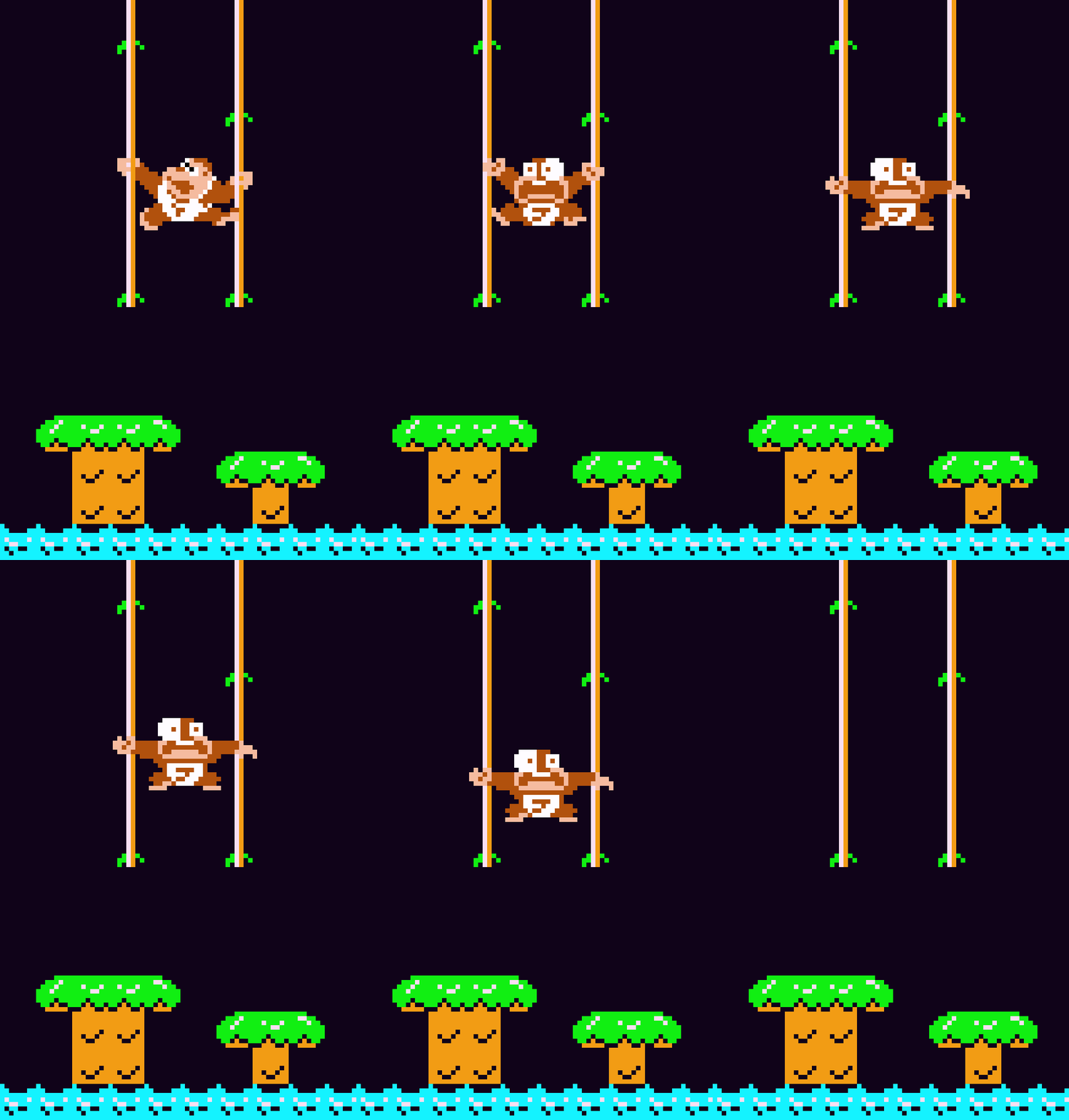
Donkey Kong Jr. was the first video game to represent losing a life by turning to the screen and then jumping up and through the platform they were standing on. When Mario did it in Mario Bros., he even waggled his arms like D.K. Jr. did.
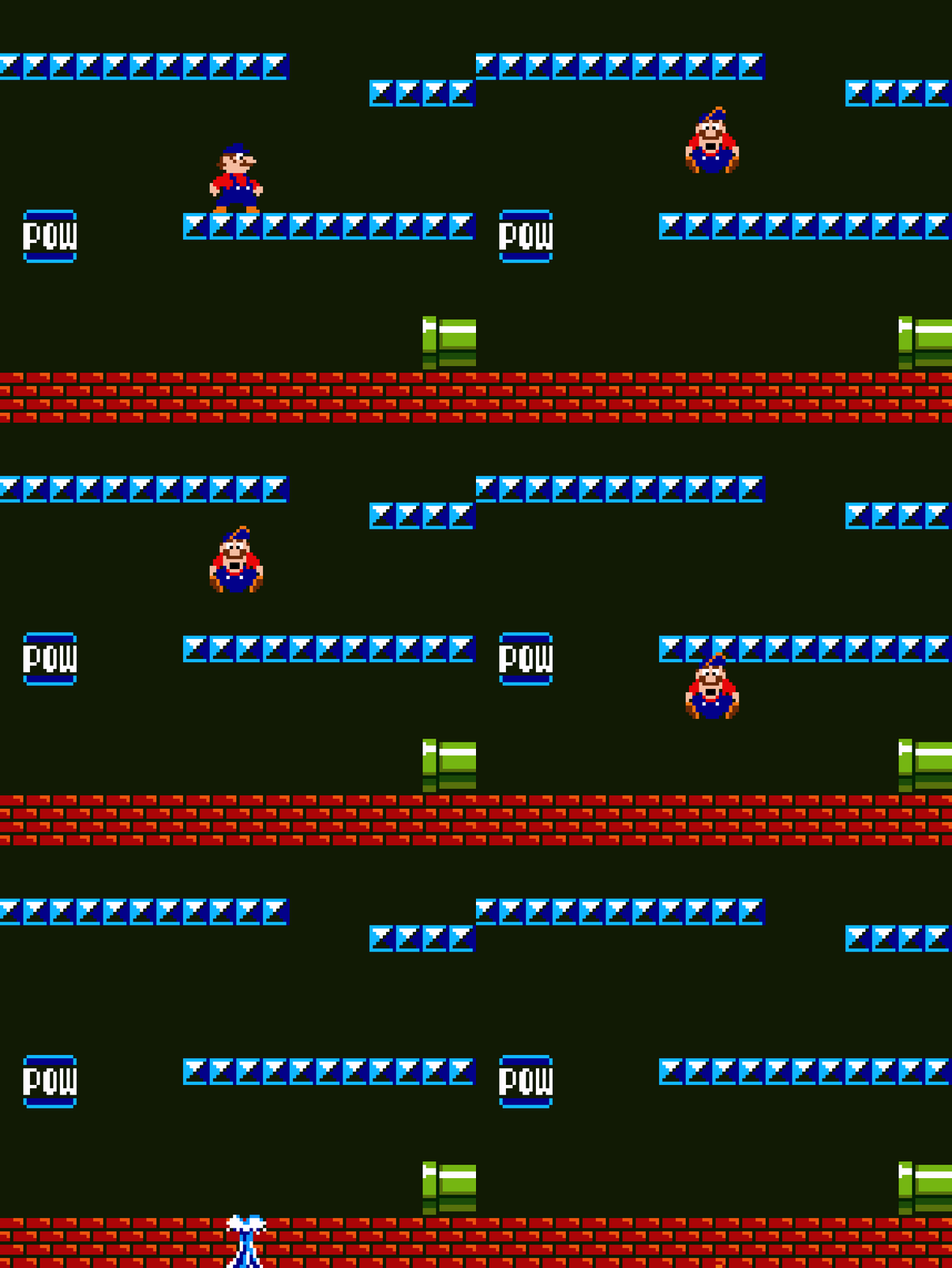
Variations of this showed up in other Nintendo titles, including Balloon Fight, Ice Climber and Kid Icarus, as well as a lot of non-Nintendo titles too, but by the time it showed up in Super Mario Bros., it more or less evolved into its final form — and would stay that way in basically any traditional, two-dimensional Super Mario game.
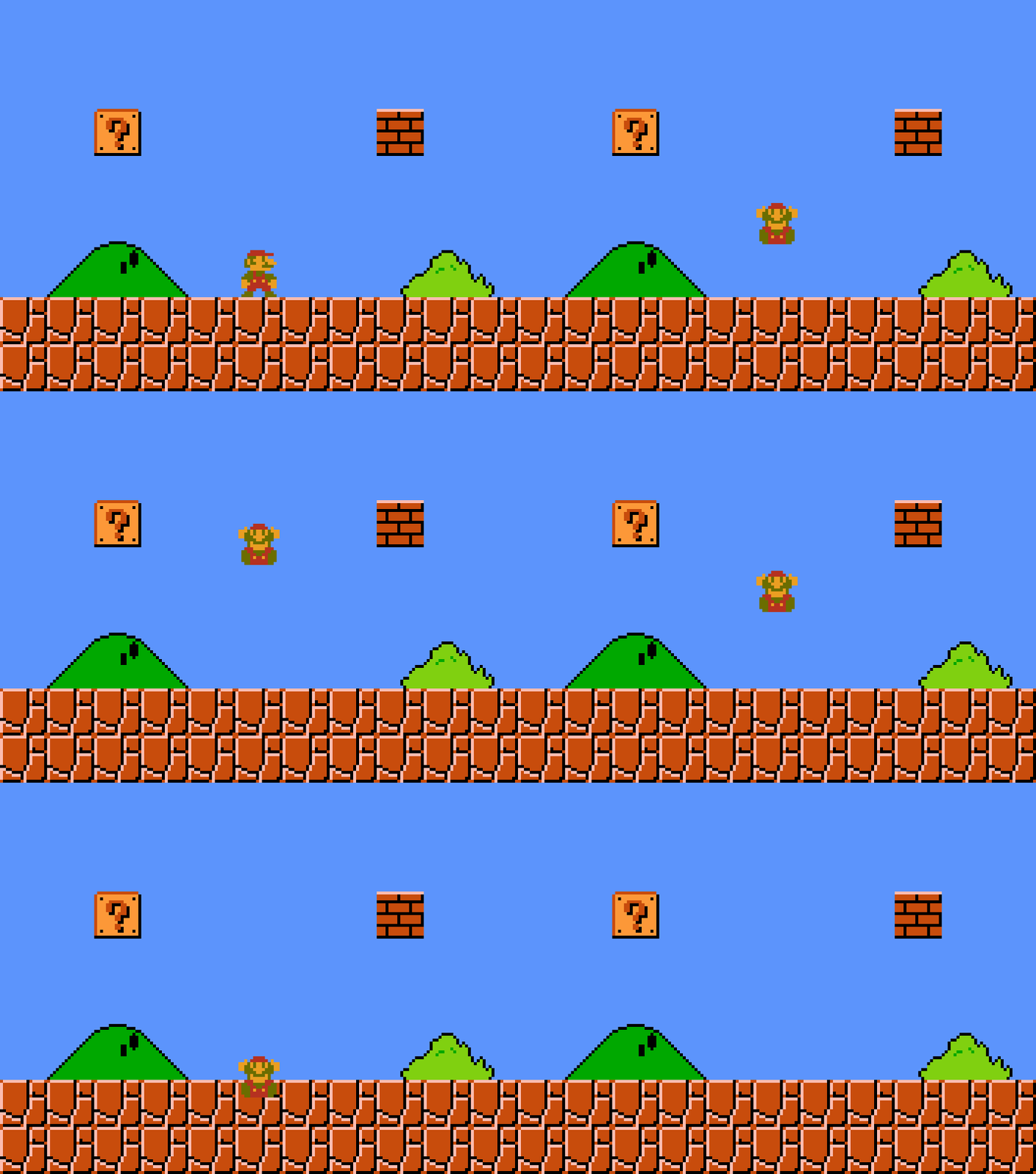
And how did Nintendo say thank you to this video game icon for his contribution to the Super Mario series? They stuck him in Donkey Kong Junior Math.
I have an in-depth post featuring examples from various games as well as an explanation as for why Nintendo would have developed this particular animation for Donkey Kong Jr. when onscreen death looked so different in the original Donkey Kong.
Navigation:
Part One (1-15): Mario and Luigi origins / Donkey Kong and Mario Bros.
Part Two (16-30): Bowser, Peach and Toad / Super Mario Bros.
Part Three (31-45): The enemies of Super Mario Bros.
Part Four (46-60): Super Mario Bros. miscellany / Super Mario Bros. 2
Part Five: (61-75): Super Mario Bros. 3 and Super Mario World
Part Six (76-90): Yoshi and Donkey Kong (and friends)
Part Seven (91-101): Various beloved supporting characters and also Stanley the Bugman
Part Eight (102–116): A sort of junk drawer including Peach’s dad, Bowser’s wife and the infamous field horsehair plants