

Why Does Donkey Kong Throw Barrels?
It’s a new year, and I have to apologize for getting a late start on posts in 2026. My reasons are good, I’d like to think; I got a second dog, and so far all of January has been devoted to getting the new one situated in the house alongside the first one. Because that process is still under way, I wanted to write a relatively short post about an iconic video game element that I’d never questioned until recently.
Does Donkey Kong throw barrels because the original 1981 arcade game takes place on a construction site? (And also you would conceivably find barrels in such a place, I guess?) Or could there be a different reason for why the most famous ape in video games became connected with these items?
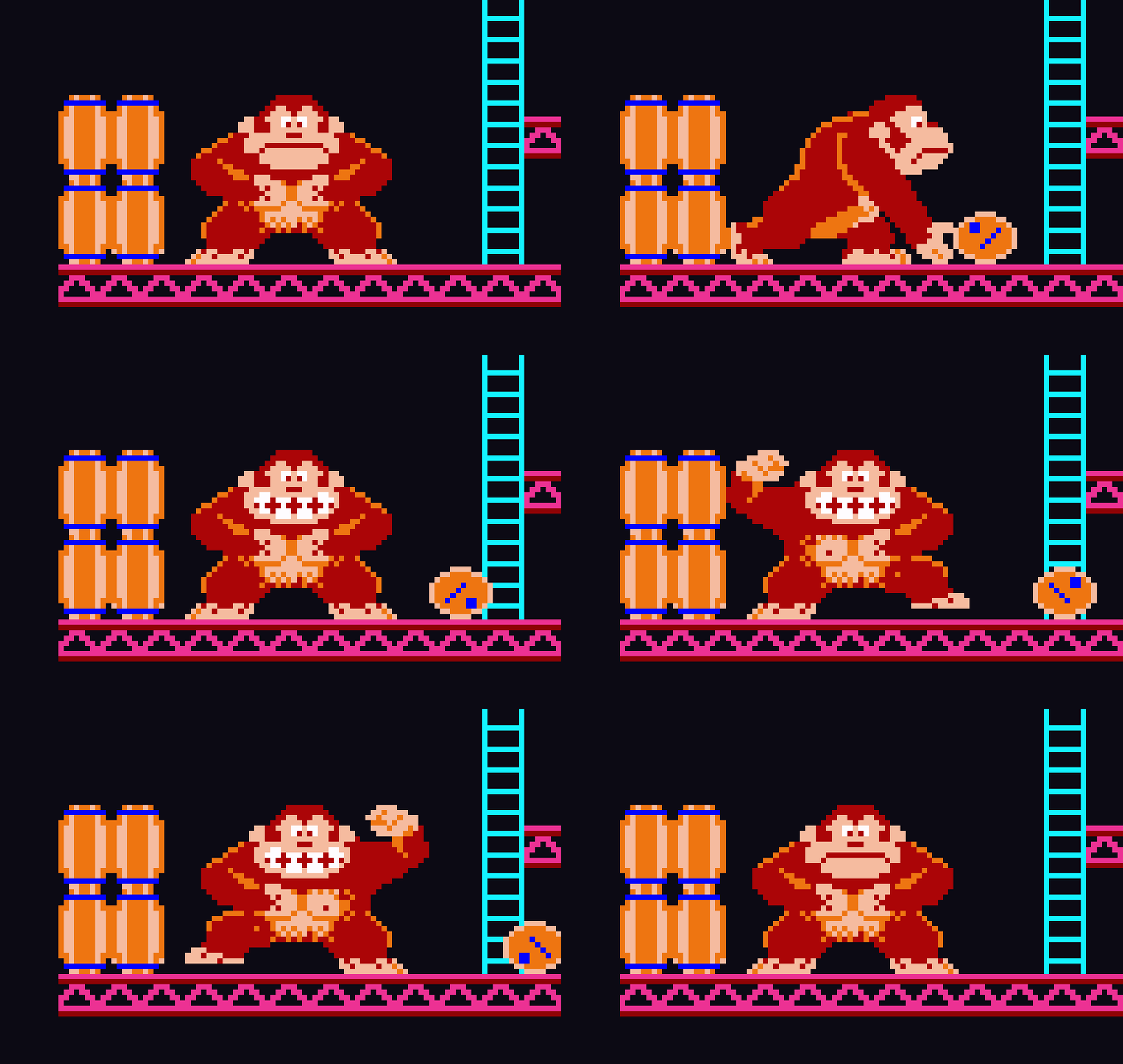
Alongside bananas and that necktie, barrels are one of the objects that have come to function as a shorthand for Donkey Kong — the game and the character. Barrels actually predate the bananas, which didn’t appear until Donkey Kong Jr., and the tie, which didn’t come along until Donkey Kong ’94, but it wasn’t always a given that they’d remain in this character’s orbit, however. No barrels appear in Donkey Kong Jr. or Donkey Kong 3, for example, and it’s actually the 1984 Game & Watch title Donkey Kong Circus that’s the first game to bring the barrel back in any form. It uses it in a different way — D.K. rides on top of it rather than throwing it as a weapon — but still.
It was Donkey Kong Country that made the barrel a permanent part of gameplay from there on out. In this game and its sequels, barrels were for riding, attacking and unlocking secret passages. The 2007 Wii release Donkey Kong: Barrel Blast even makes them such a central part of the gameplay that they snuck into the game’s title. And while last year’s Donkey Kong Bananza may have switched up gameplay in many ways, barrels are still there, tossable and smashable, because it would seem weird not to have barrels in a game that mines the character’s deep video game history.
So yes, they’ve been there from the start, but if we want to get technical about it (and I always do), those famous Donkey Kong barrels actually predate D.K. himself. I assume that anyone reading this site would already know how the Donkey Kong arcade game evolved out of Nintendo’s failed first attempt to make a Popeye title. If you don’t know this, either read my piece “How Popeye Changed Video Games” or just take my word that this is the case. Either way, the pitch for the game that became Donkey Kong initially starred Popeye and had him rescuing Olive Oyl from Bluto. This is a fairly famous story, as far as video game lore goes, but thanks to a push from game historian Kate Willaert to translate an April 1997 article in the Japanese computer journal Bit, we have some additional details that weren’t widely known in the English-speaking world until fairly recently. One of them relates specifically to the barrels! According to programmer Hirohisa Komanome, a working title for this pre-Mario version of the game was Popeye’s Beer Barrel Attack Game (ポパイのビアダル攻撃ゲーム, with ビアダル or bia daru specifically referring to a beer barrel.) Just based on this tidbit alone, it seems likely that the barrels did not become part of the gameplay because they made sense on the construction site setting, because they weren’t, like, holding bricks or cement mix or whatever materials you might store in barrels in such a place, for all I know. No, the barrels initially contained beer, which seems like something you wouldn’t want in vast quantities in such a location.
So why are beer barrels? Why barrels at all? Well, for one thing, the original conception of the game seemed to pull from Popeye in a few different ways. For example, the game’s action takes place on these magenta girders, which have themselves become rather iconic, and per the recollection of Gunpei Yokoi in his 1997 book, those came from a specific Popeye cartoon.
There was an episode in the cartoon show for Popeye in which Olive was sleepwalking and wandered around a construction site. Whenever she was about to lose her footing, miraculously enough another platform would come out of nowhere and support her, and this left quite an impression on me. So we figured by using a construction site as the setting, there would be all kinds of things we could do, and thus chose that as the setting for our Popeye game.
The internet has determined that Yokoi was probably talking about the 1934 short “A Dream Walking,” though later Popeye cartoons would revisit this concept.
What’s interesting is that the book’s very next paragraph discusses the origin of barrels. Yokoi does not identify them as coming from Popeye, however. In fact, as he phrases it, he seems to be crediting Shigeru Miyamoto with coming up with the idea, and for all we know that’s what Yokoi thought the origin was.
Once we had established that the game would be set at a construction site, Mr. Miyamoto suggested, “Let’s make it a game where there are barrels falling from above, and the player has to dodge them.” At that time, he had a simple gameplay idea which was that whenever a barrel fell the player could get on ladder and avoid it. Once the barrel had passed, the player would get off the ladder and then back on the platform to continue climbing.
And it could actually be the case that Miyamoto came up with this idea on its own, without consciously drawing it from a Popeye cartoon. However, it’s also possible that Popeye was the inspiration, because there’s a short that ran as part of the 1960 animated TV series that features a character jumping over barrels in a way that looks distinctly Donkey Kong-like, only twenty years before Donkey Kong was a name that meant anything to anybody.
I present to you the scene in question from “Popeye Revere,” which originally aired in October 1960.
You may have noticed that the characters are all in Revolutionary War drag. Yes, “Popeye Revere” is one of those cartoons that has characters essentially doing a period piece, and if we want to be annoyingly technical about it, it’s not actually Popeye who is seen jumping over barrels. The short begins with Popeye recalling the story of Paul Revere but claiming the true hero was his ancestor, who is “played” in the short by Poopdeck Pappy, Popeye’s father. Also, it’s not actually Bluto playing the barrel-chucking redcoat, but instead Brutus, because these cartoons came out during the period of time when King Features mistakenly believed that Paramount Pictures owned the rights to Bluto. (Brutus was later retconned to be Bluto’s twin brother, though the canonicity of this is up for debate.)
Technicalities aside, this Popeye cartoon does in fact feature a big villainous lug rolling barrels at a hero who jumps over them, and as far as anyone looking into this can tell, this is the first instance in any medium of what would become the central gameplay feature of Donkey Kong. At first glance, at least, this would appear to be a fairly good indication that D.K. throws barrels because of Popeye, for the same reason that the main action takes place on steel girders.
Right?
Unfortunately, it’s not that simple. For one thing, it’s not barrels of beer that are being thrown in “Popeye Revere.” Brutus specifically mentions that they’re barrels of molasses, so the fact that the video game versions would seem to have originated as beer barrels seems suspicious to me. I mean, why were they termed beer barrels as opposed to barrels containing any other substance? Unless ビアダル (bia daru) is just a generic term for this sort of container, regardless of what’s inside.
That might seem like a minor quibble, but I’ve actually got a much bigger one: At the point when barrels were introduced as a gameplay mechanic, the heroic character in question wouldn’t have been jumping over them because the jump button came along later. If you go back and re-read the passage from the Gunpei Yokoi book discussing the barrels, it notably doesn’t mention jumping at all — just climbing up on ladders to avoid barrels and other hazards. It’s worth asking whether it makes sense that a scene of Popeye jumping over a barrel would be the inspiration for the Donkey Kong mechanic when the barrels were brought into the mix without the idea that anyone would be jumping over them.
I won’t get into it because Kate Willaert has covered it in greater depth in her video, including the evolution of Donkey Kong’s jumping mechanic but also how the sleepwalking Olive Oyl cartoon also seems to have inspired the Game & Watch games Manhole and Mario’s Cement Factory. It’s a good watch!
Something I learned from Willaert’s research is that the idea of the barrels being thrown by an ape came along before it was decided to swap Popeye out for Mario and Olive Oyl for Pauline, and you can see a mock-up for how a Popeye-starring version of the game might have looked if the villain of that game were a big ape.
We don’t know that the simian in question would have been named Donkey Kong specifically, but you have to admit that there’s not all that much to differentiate this D.K. prototype from the real thing. Does this mean that D.K. predates Mario? Yeah, kind of! But it also queers the notion of barrel-throwing originating in Popeye, necessarily, since it apparently wasn’t such a direct nod that Miyamoto had any qualms about taking that action away from Bluto and giving it to a random ape character he just decided to invent.
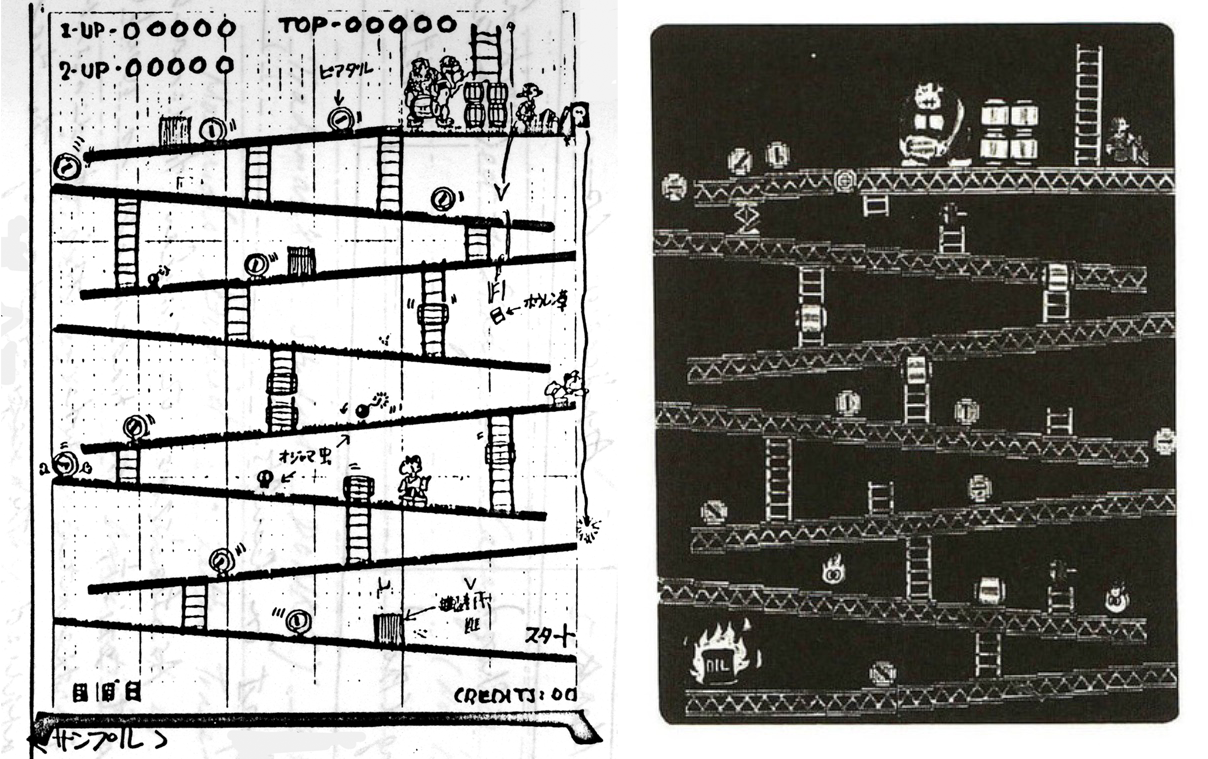
Left: A sketch showing a protoype version of Donkey Kong with Bluto/Brutus as the one rolling barrels down the scaffolding. Right: A revised version of that image showing Olive Oyl as the damsel in distress but a Donkey Kong-looking ape as the new villain. (Both images via The Cutting Room Floor.)
For what it’s worth, I wasn’t able to determine whether “Popeye Revere” ever aired in Japan. The series for sure did — back in the ’60s, when Miyamoto would have been about ten and therefore a primo cartoon-watching age — but the records I could find for which of the episodes actually aired over there are spotty. I could imagine this episode not getting localized for Japanese audiences, however. While the story of Paul Revere would be well-known to American children, I’m not sure it’s one that children in Japan or any other country would know or find especially interesting. Please tell me if I’m wrong, however.
And during our conversation on Bluesky about it, Willaert clarified that as far as she knew, “Popeye Revere” was the only instance of barrel-throwing or barrel-jumping in a Popeye cartoon. So to be clear, it’s not like this was a regular thing in Popeye cartoons and I’m just choosing the Paul Revere-themed version of it because it was the first example I found. In fact, I couldn’t find many examples of anyone, cartoon or otherwise, jumping over barrels in any media of note between “Popeye Revere” and Donkey Kong. There is an ersatz TV Tropes wiki that has a page for barrel-throwing, but it’s mostly recent examples, the one exception being “The Sea Haunt,” a 1965 episode of Jonny Quest that has a monster chucking one at Race Bannon.
No jump. No 100 points. They’re not even wooden barrels.
So let’s circle back to the question posed in the title: Why does Donkey Kong throw barrels? Based on all this info I’ve laid out, I don’t think we can say exactly how barrels became part of Donkey Kong (the game) and by extension associated with Donkey Kong (the character). It’s super tempting to point to this one Popeye cartoon that explicitly shows barrel-throwing and barrel-jumping and say “this *has* to be it.” However, I think there are enough reasons why not to conclude that it might actually be a coincidence — and sometimes two things really seem like they should be related even though they’re not. (I’ve got a whole post about VGM soundalikes that are also coincidences, in case you want evidence of this.) If it is a coincidence, it is a rather striking one, I have to admit, but sometimes a striking coincidence is only that, all signs to the contrary notwithstanding.
Are there barrels in Donkey Kong simply because it takes place on a construction site? Again, I don’t think we can be sure, but the fact that the barrels may not actually be common on construction sites IRL makes me suspect that this is not the case. I’d offer to research construction sites in person, but I’m pretty sure my motivations would be something other than scientific accuracy. Besides, that whole beer barrel thing would seem to indicate that no, that was not actually the intention — again, despite all the superficial evidence that would seem to indicate otherwise.
I’m perfectly happy to revise my verdict if anyone has any information I missed or sees any flaws in my logic on this one. I would like there to be a single, solid answer as to why Donkey Kong throws barrels, but I just don’t think we know yet.
Edit January 21: One day later, I’ve got two additions to make, one sort of supporting the idea that the barrel thing might come from Popeye and one possibly refuting it. In the comments of this post, someone alerted me to a 2009 Popular Mechanics interview in which Shigeru Miyamoto responds to a joke question in a way that suggests that yes, this game mechanic possibly did come from a cartoon, if not Popeye specifically.
After playing these games, you have to wonder: Did anybody ever throw barrels or fireballs at you when you were growing up?
Miyamoto: Nobody ever threw barrels at me, but I did read a lot of Manga comics in Japan and see a lot of cartoons and you'd often see silly things like that happening.
Separately, on the VGHF DIscord, Ethan Johnson told me that he and Norm Caruso are in the process of going through the documents related to the lawsuits between Universal and Nintendo related to Donkey Kong. In a deposition related to the first lawsuit — there were three — Gunpei Yokoi explained that the initial setting for the Popeye game that would become Donkey Kong wasn’t a construction site at all. It was a seaport, because Popeye is a sailor. The platforms that would become the magenta girders were conceived of as gangplanks.
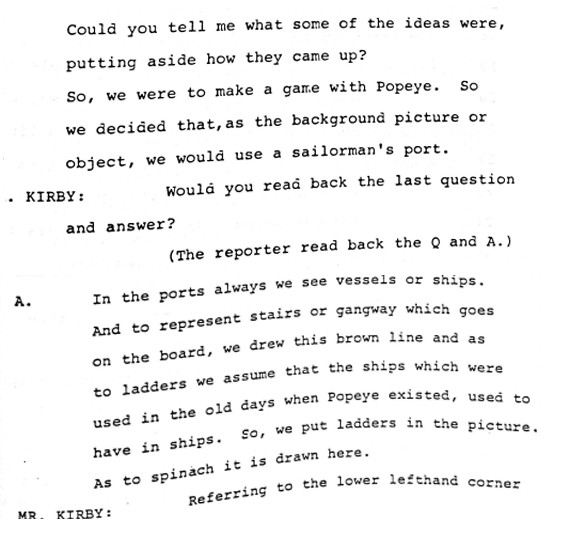
Because barrels make a lot more sense on in a harbor than they do on a construction site, especially if they contain alcohol, this makes me think that no, this game element was potentially not inspired by Popeye, or at least this one specific Popeye cartoon. That said, we don’t have any documentation of barrels in any stage of the game until Miyamoto’s sketch of how the game would work — specifically the one showing Bluto I put earlier in this post. Regardless, Johnson and Caruso are making their way through all lawsuit-related documents with an eye for what might be new to our understanding of how Donkey Kong came to be. I thank them for their service and eagerly await their findings.
Miscellaneous Notes
Because I’ve been writing online for a while now, I have a pretty good sense about what people will likely disagree with, and I can already hear people objecting to how I decided that the barrels most likely didn’t come from that Popeye cartoon. If you don’t think the evidence adds up, I suppose I can’t argue with you, but I’ll at least give one more example of how coincidences can feel “right” even if they don’t mean anything. As it turns out, it’s Donkey Kong-related too.
So far, I’ve not written about the etymology of Donkey Kong’s name. I should get to that one day, but among the many theories for how it came to be is one that makes sense from a specific perspective, even if a small amount of critical thinking will reveal that it’s basically bullshit. And that is the King Midas theory. Even people who don’t know much about Greek mythology at least know the story about how Midas was granted the gift of being able to turn anything to gold just by touching it. Spoilers: It doesn’t turn out well for him, and I guess it’s all meant to be a parable about greed? There is another story about Midas, however, involving him judging a musical contest between the gods Apollo and Pan. When Midas dares to say that Apollo, the god of music, was not the decisive winner, Apollo curses him to have the ears of a donkey. Because it’s not appropriately regal to have donkey ears, Midas hides his curse under a turban, effectively keeping it a secret from everyone except his barber, who felt so burdened with this knowledge that he one day dug a hole and whispered into it, “King Midas has donkey ears.” Reeds grew in this spot, and when the wind blew, you could hear them sharing that secret: “King Midas has donkey ears.” And so everyone eventually found out what Midas was trying to hide.


King Midas of Lydia: the original Donkey Kong? (No.)
I’m… less clear what the moral is here, to be honest, except that perhaps this could be an ancient world version of the Streisand effect, wherein the effort spent to prevent people from knowing a thing only ends up ensuring that an even greater number of people find out about it. You may be wondering what the Donkey Kong connection is, but it’s specifically that this story is the only precedent (allegedly) of a king and a donkey being linked other than Donkey Kong. With the video game character, his name is clearly based on King Kong’s, the outcome of Universal City Studios, Inc. v. Nintendo Co., Ltd. notwithstanding. But the first part switches out King for Donkey, which according to the theory is a deliberate callback to the other story we have about King Midas.
Does this sound stupid? Yes. It’s the kind of thing a freshman year English major comes up with while stoned. I understand why people might hear this story and believe it has something to do with Donkey Kong’s name, I guess, but just because it kinda sorta fits doesn’t mean it’s correct at all. If you think about it for, like, five seconds, I think you’ll correctly come to the conclusion that there’s no real reason why Donkey Kong’s name would be meant to recall this story. Furthermore, there’s nothing inherent in the original game or really another game featuring D.K. that makes this comparison meaningful in any way. It is just a coincidence, but it’s nonetheless an explanation I’ve seen offered here and there for how Donkey Kong got his name, wrongheaded though it might be. I can only conclude that some people are desperate to find meaning in any and all coincidences. (There are probably bigger implications for this tendency that are beyond the scope of a post about Donkey Kong barrels.)
Finally, as a non-King Midas-related conclusion to this piece, I wanted to say that in using the Shmuplation translation of that Bit magazine article, ドンキーコング奮闘記 (Donkīkongu Funtō-ki or rather melodramatically “Donkey Kong: A Chronicle of Struggle”), I found that you can support Shmuplation on Patreon. And now I have! Because this website has frequently helped my research and I’m really grateful that we have a means to get high-quality English translations of Japanese resources that would otherwise never come to light in the west. Case in point: There are no hits for the working title Popeye’s Beer Barrel Attack Game that predate the translation of this piece. And I’m glad we now know that the game that would become Donkey Kong was previously called this. It amuses me to think that Mario’s video game empire originated with Popeye’s Beer Barrel Attack Game.