

Why Can Pokémon Only Say Their Names?
As I said at the beginning of the previous post and will probably say again, this is not a Super Mario blog, and this post is not about the Super Mario games.
That said, it did start there.
In paring down the list of 101 items for my big post on Super Mario history, I got rid of one about how Yoshi, who debuted in Super Mario World in 1990, could be seen as anticipating Pokémon, which debuted in 1996. There are a few tenuous parallels. For example, Yoshi and all the various Pokémon creatures both straddle the line between beloved pet and animal soldier in your personal army that you will sacrifice to achieve your goals. But that’s not all. A big part of the Pokémon games is growing your creatures to the point that they class-change, essentially, into more powerful, more “adult” forms, and that’s a thing that exists with Yoshi as well, if only in a specific context in Super Mario World.
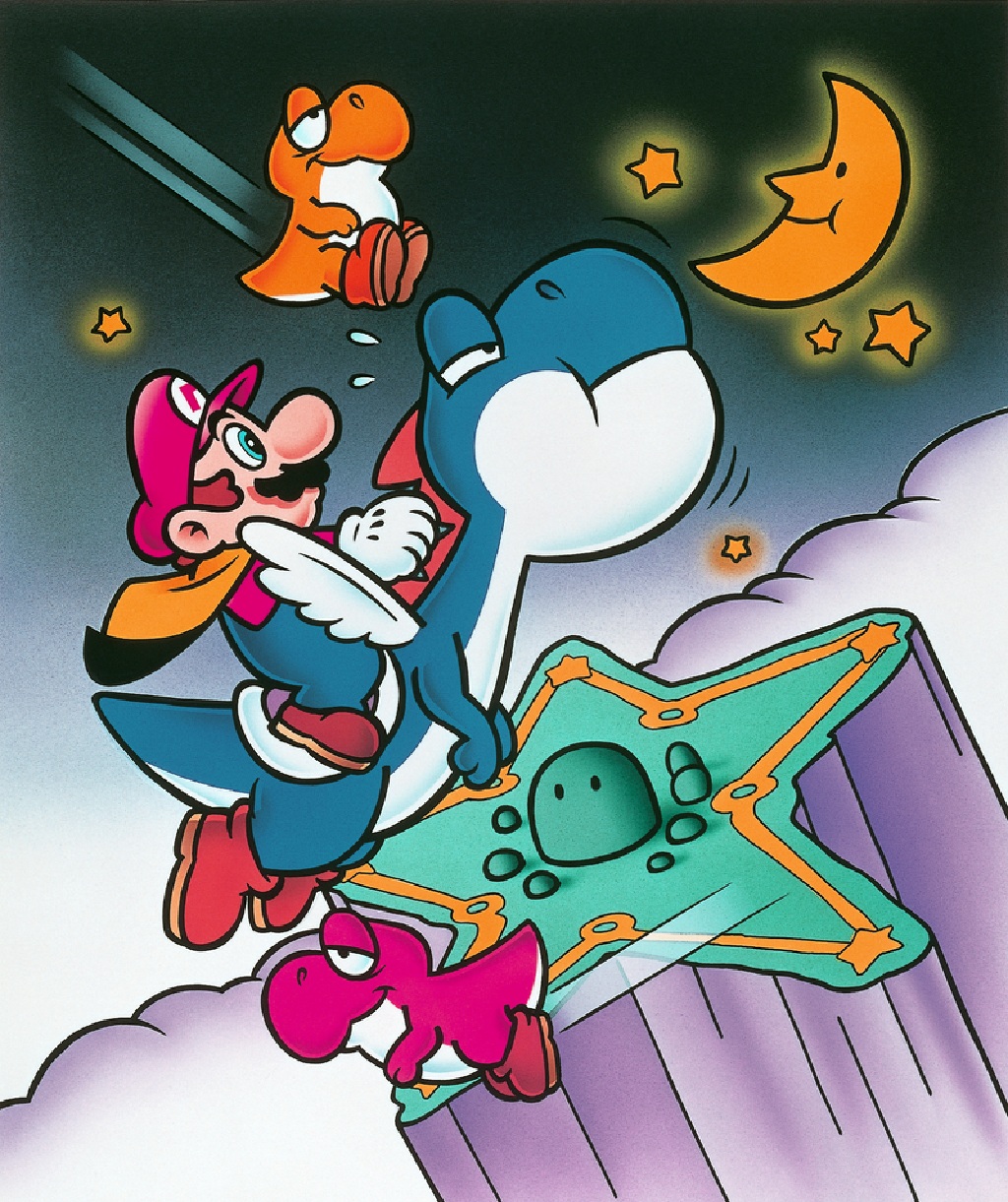
In Super Mario World’s Star Road levels, Mario can find baby Yoshi of varying colors and feed enemies and items to them to turn them into a more useful, more powerful grown-up version.
And of course both Yoshi and Pokémon can say their names — by which I mean that they have a range of vocalizations, but basically all of them consist of their names or parts of their names. To me, in the same way that Yoshi serves as a callback to Tamagon, the hero of 1984’s Devil World, Yoshi could maybe be seen as a predecessor of sorts to an idea that Nintendo would more fully flesh out in Pokémon.
< Support this site: on Patreon! • on Kofi! >
This item did not make the cut, however, because I eventually realized that one of the parallels I was seeing didn’t really count. Yoshi did debut six years before Pokémon Red and Pokémon Blue hit shelves, it’s true, but he didn’t actually start speaking in this particular style until Yoshi’s Story, the Nintendo 64 follow-up to Yoshi’s Island, which debuted in 1997, after Pokemon was released. As much as I could imagine those triumphant cheers of “Yoshi!” upon completing a stage in 1995’s Yoshi’s Island, they didn’t happen, and the only noise associated with the guy at the time was the “zip-zup” sound effect you hear when Mario hops on his back.
So I guess it’s fair to say that Yoshi may anticipate the dawn of Pokémon in some ways, but speech isn’t one of them. If anything, Yoshi ended up following a trend that was established by Pokémon, at least as far as Nintendo characters go. But is this really a thing that Pokémon gets to own? And why was it decided that Pokémon can only speak by saying their names or part of their names?
It’s a worthwhile question, at least as far as the ones that have been asked on this blog, but I was reluctant to look into it because Pokémon is one of my biggest video game blind spots. You see, when the first Pokémon titles were released for the Game Boy, I was in the eighth grade, about to enter high school. And though I loved Nintendo and had been previously willing to try out any franchise it threw at me, I decided that Pokémon was for babies and skipped over it. To be clear, I was not even quite fourteen years old, and while I could in good conscience still enjoy Mario or Zelda or Metroid or Star Fox or even Kirby, the marketing of Pokémon reminded me of Mighty Morphin Power Rangers, which my cohort had considered and then discarded when it debuted in 1993. There’s something about this age range that makes you deathly allergic to anything that’s associated with kids even a year or two younger than you.
Of course, Pokémon was a runaway success and quickly became one of the pillars of Nintendo’s video game empire. The imperative motto of “Gotta catch ’em all!” proved irresistible the world over, and the franchise has never really gone away. In fact, it’s only built on itself. The gamers who embraced Pokémon early on attained an encyclopedic command of the various creatures appearing in the game in the same way that kids are also able to learn the multisyllabic names of every dinosaur in addition to a short list of facts about each one of them. In many cases, these now-adults still remember their Pokéfacts and have learned about the subsequent generations as well.
I abstained, however, and I only learned about Pokémon through their representation in the Smash Bros. games, so basically Pikachu, Jigglypuff, Mewtwo and the various ones that can pop out of Pokéballs or appear as stage hazards. Barring one or two exceptions, all of these Pokémon announce themselves by speaking their names, and so the reflexive nature of Pokéspeak was one of the few details about this franchise that I thought I knew.
However, it’s more complicated than that. Upon looking into it to write this post, I learned that many Pokémon have vocalizations that aren’t based on their name — or aren’t based on their localized name, at the very least. And even then, the notion of any Pokémon saying their own name originated in the anime adaptation, which first started airing in Japan in 1997 and the U.S. in 1998.
A 2017 article in Game Informer says that the decision was made by the production company behind the cartoon.
The idea of the Pokémon speaking their own names is an idea that can also be attributed to OLM Inc., and Game Freak was hesitant about it at first. “They actually had [Pikachu’s] voice actress, Ms. Ikue Ōtani, do a take on the voice, and they showed us a clip of it and we listened to the sound of it saying its name over and over in a really cute way,” Masuda says. “We weren’t really sure about it, but it worked out.”
Apparently, the games don’t feature this nearly as much, and when they do, it’s as a nod to the conventions of the anime. So I suppose what I’ve experienced in the Smash series is actually more of a tip of the hat to the latter.
Regardless of the specifics, this is a thing that’s associated with the franchise in general. Even if I’m pretty sure no one would presume that Pokémon invented this peculiar type of speech, it’s something that people might know about even if they don’t play video games: Pikachu says “Pikachu” in the same way that a cow says “moo.” Funny how the persistence of Pokémania has that effect on humans who were just trying to live their lives.
< Support this site: on Patreon! • on Kofi! >
It was about a month ago when I first posted to Bluesky asking for theories about the origin of Pokéspeak. One person attempted to give me the in-universe reason — that it’s not so much that they say their names as they are named based on the noise they make. This is well and good, I guess, but it does require some considerable suspension of disbelief to think that, for example, the Pokémon that’s psychic and that also looks like a duck just randomly happens to make a noise that sounds like a portmanteau of those two qualities.
Also, do we just assume that humans in this fictional universe got around to calling fancy light fixtures chandeliers because they looked like the Pokémon Chandelure, the real-life etymology of chandelier be damned?
Celebrated artist Nina Matsumoto also replied, however, and pointed out that Pokéspeak is actually very similar to the vocalizations of the title creature in Pokonyan, an anime that began airing in 1993 and was popular enough to last for 170 episodes, concluding in 1996.
Pokonyan is a cross between a tanuki and a cat — you know, as opposed to the version appearing in Super Mario Bros. 3, which is apparently a cross between a tanuki and a raccoon. The cartoon is based on a manga that was first published in 1975, written by Fujiko Fujio, the same creative pair that also created the more popular Doraemon. In fact, various stories told in the Pokonyan manga first were adapted into episodes of the Doraemon cartoon series, with Doraemon characters standing in for Pokonyan characters. (Apparently neither the Doraemon or Pokonyan TV series were produced by OLM, which made Pokémon. The closest connection I could find was that OLM did make the TV series adaptation of another Fujiko Fujio manga, Mojacko.) The TV series debuted when the first Pokémon games were being developed. It doesn’t seem impossible that this could be the reason — or at least *a* reason — that the Pokémon would eventually end up speaking in a very similar way.
That said, this is not something that Pokonyan invented either, and a look around online will turn up a few examples of even older characters that talk in a similar way. Marvel’s Groot debuted in 1960, for example. Bam-Bam joined The Flintstones in 1963. And Grog, an even more primitive caveman appearing in the prehistoric-set comic strip B.C., debuted in 1966. It’s not that any of these had much bearing on Yoshi, Pokémon or Pokonyan, necessarily. But they’re all talking this way because they’re meant to sound somewhat primitive compared to the characters who can talk “properly.” With that in mind, I began to suspect that the origin of this specific thing didn’t come from pop culture at all.
And surprise! The answer came to me via the Super Mario games.
As I wrote about in Mario 101, the enemy introduced in the western version of Super Mario Bros. 3 as the Chain Chomp is in Japan known as Wan Wan, which comes from the Japanese onomatopoeia for the noise a dog makes, ワン or wan. This monster was inspired by a dog and would later make dog noises starting in Super Mario 64. And it’s for this reason that the version of the character that exists in the Legend of Zelda games is called Bow Wow, because whoever localized Link’s Awakening took a look at the character’s Japanese name and just decided to replace it with the English equivalent for the noise of canine barking.
That’s not to say it’s the Japanese word for dog — 犬 or inu, of uncertain etymology — but ワンワン or wanwan does serve as a way that a Japanese-speaker could refer to a dog if they wanted to sound childish, cutesy or informal. It’s just like how if an English-speaker pointed at a dog and called it “a woof-woof,” everyone would understand what that person was saying. I’m not going to claim that every language has a version of this for the animals that its speakers spend the most time around, but many languages do. Spanish-speakers in California, for example, for sure use guau guau to represent the noise a dog makes but also the dog itself. I’ve heard them. And if you’re an English-speaker talking about, say, a moo-moo, a baa-baa or a quack-quack, you are essentially making that animal say its own name, Pokémon-style. Japan has this as well. For example, ぶーぶー or bū bū can be the sound a pig makes or the pig itself. And ぶんぶん or bun bun can the buzzing of a bee or the bee itself — and in Super Mario Land, there’s actually a bee enemy named this in both the Japanese and English versions. Because of the Kerokero Cola item in Super Mario RPG, I know that ケロケロ or kerokero is the Japanese word for the noise a frog makes. And if it’s not also a term for frogs in general then at least the term for that one frog that hangs out with Hello Kitty.
It’s not even limited to “childish” terms for animals. I’m not sure about other languages, but I know that English has official names for animals that are imitative in origin, including cricket, katydid, whippoorwill, cuckoo, gecko, and shrike. And I’d bet that there are even more out there that have not entered English, because it seems like a very human tendency to call an animal by the noise it makes. It might be true that the Pokémon anime had its creatures speak this way as a result of the popularity of Pokonyan. And it’s entirely possible that Pokonyan got the idea from some property that I just didn’t turn up in my research for this post. But I think the most zoomed-out, “big picture” look at this phenomenon is that each manifestation can be traced back to something hardwired into human culture — not to name something so much as to let that thing name itself. Really, it seems like a respectful way to discuss the non-human creatures we meet: to use the name they offer.
However, I did think of one more potential explanation for the origin of Pokéspeak: It’s good marketing. One of the reasons that Pokémon has succeeded — and one of the reasons I have a distanced respect for it, even if I don’t play the games — is that it’s a perfect proposition from a moneymaking perspective. It’s a game that tasks players with learning about and then capturing a whole host of cute creatures that can then be hunted down in real life in the form of merchandise — full “Gotta catch ’em all!” conversion, if done correctly. And for that to happen, you need a high level of brand recognition, so you can ask for the one specific Pokémon you need to complete your collection.

When you’re playing the game, the names of the creatures appear onscreen, at least when one Pokémon is battling another. That doesn’t happen when you’re watching the TV show, so having these creatures repeatedly announce their names helps make sure kids are learning the names of their favorites regardless of where they’re encountering them. From that perspective, it is surprising that Game Freak needed any convincing that this tactic would pay off, literally and figuratively, because it seems like it fits so perfectly into the overall Pokémon marketing plan. But at the very least it makes sense that it has remained ever since.
Miscellaneous Notes
When I think about the boys my age rejecting Pokémon and Mighty Morphin Power Rangers because it seemed like it skewed too young for us, I have to note irony in how this same group — myself included — also decided to collectively embrace Teenage Mutant Ninja Turtles, because we were five when the cartoon version first hit airwaves in 1987. I’m sure the kids who were a year or two older than us similarly decided to pass on that, not as a judgment of quality so much as a reaction to the fact that younger kids (“babies”) clicked with it.
Considering how Baby Yoshi was introduced alongside regular Yoshi in Super Mario World, it’s notable that the Yoshi spinoff series, which features baby versions of many characters, hasn’t really done much Baby Yoshi, though it’s appeared in more Super Mario games than you might expect.
If we want to be technical about it — and I always do — then the idea of Yoshi saying “Yoshi” debuted in Super Mario Adventures, the Super Mario World comic adaptation that ran in Nintendo Power in 1992. Mario and Luigi purchase the ACME Yoshi Language Learner from a traveling salesman named Friendly Floyd. The joke is that it turns out to be a total ripoff, because the translation of everything into Yoshi language is simply “Yoshi.”
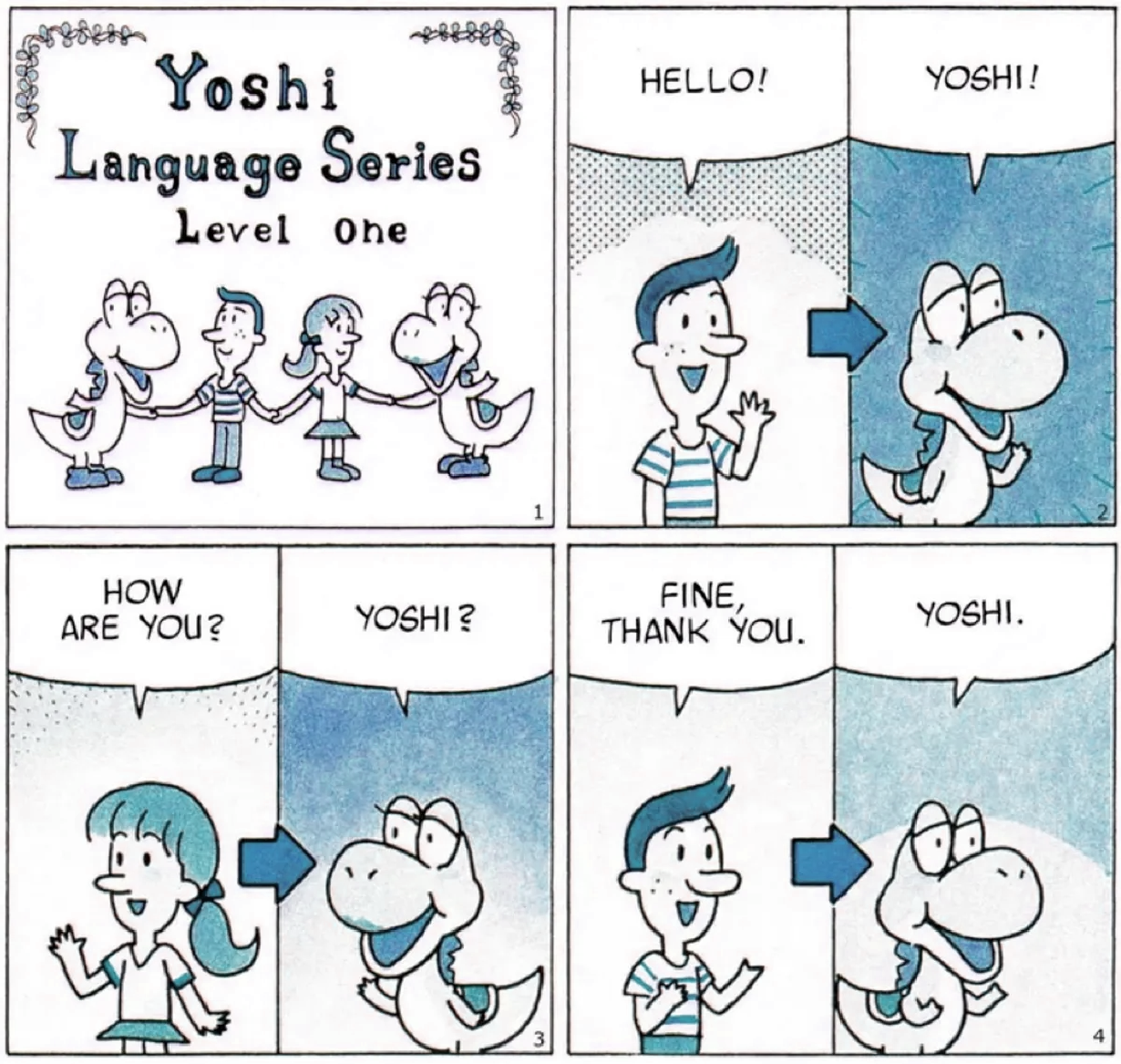
And yes, I’m surprised as anyone that it’s taken this long to get around to mentioning Friendly Floyd.
Of course, Birdo also says her own name, I assume because Nintendo has modeled her on Yoshi ever since her reintroduction to the series. In fact, her saying “Birdo” is one of the reasons I think we don’t need to call her Birdetta, the Super Mario Bros. 2 manual be damned.
Other characters who famously say their name but who didn’t figure into this post, per this TV Tropes page:
Shy Guys in the Super Mario games, even though they say their Japanese name, Hei-ho
Annyong in Arrested Development (until the big reveal)
the Chao in Sonic the Hedgehog
Timmy from South Park
James Baxter from Adventure Time
Coco from Foster’s Home for Imaginary Friends
Gleek from Super Friends
Kvack the duck in Hagar the Horrible
Chibi-Chibi in Sailor Moon as well as some Sailor Moon monsters
Digimon in their larval stage
And I guess the Aflac duck? But it’s never made clear that his name is actually Aflac.
There’s actually quite a few on here that don’t seem to meet the criteria, but what do I know?
Given that Pokonyan is part tanuki and part cat, it makes sense that his name reflects that. The first part comes from ぽんぽこ or ponpoko, an onomatopoeia for the noise of drumming — and in this context, specifically tanuki making a drumming noise by striking their large bellies. I’m not sure if it originated in a 1919 poem by Ujō Noguchi, but it seemingly helped popularize it when the poem was set to music in 1925. And yes, that’s where the Studio Ghibli film gets its name. The second part comes from にゃん or nyan, an onomatopoeia for the noise a cat makes. Curiously, the proper Japanese word for cat, 猫 or neko, may also be imitative in origin. The Wiktionary etymology claims that the first syllable may also descend from cat onomatopoeia, with the second syllable being the diminutive suffix -ko. Looking elsewhere, however, it seems the etymology is debated.
My dad’s family is from New Zealand, and though I have spent a lot of time there, I have never seen a kiwi bird out in the wild. They’re nocturnal and fairly shy. However, I have heard them calling out in the countryside at night, and from the time I was a little kid, I thought it sounded like they were saying their name: “kiii-wiii!” It turns out this is very much the case, I’d find out later in life. The Maori name for the bird comes from imitating their cry. And in case you’re wondering, yes, the fruit gets its name from the bird. Though not native to New Zealand, it was grown there and because its shape, color and texture reminded people of the bird, which is native, people called it kiwifruit. Really, you could stick a beak and legs on the fruit and it would look like the animal. I wonder why there hasn’t been a kiwi-inspired Pokémon yet?
Finally, one major difference between Yoshi’s speech and Pokéspeech is that Yoshi generally doesn’t speak in partial syllables, unless I’m remembering wrong. He says his whole name or the the various, hard-to-transcribe gibberish syllables that accompany him fluttering or doing a hip drop. The closest I could find to him using the syllables of his name of their own is “Yo-Yo-Yoshi,” the one “rap” track from the Jelly Pipe stage in Yoshi’s Story.
I guess you get to decide for himself if that’s meant to be Yoshi “rapping” or not.
EDIT: A comment on this piece pointed out that Yoshi saying his name actually debuted earlier than I originally stated. In the puzzle game Yoshi’s Cookie, first released in Japan in 1992, Yoshi cheers victories in the game’s versus mode by saying “Yoshi!” — and in a higher-pitched, more feminine-sounding voice than he ever would again.