

What’s the Correct Way to Pronounce Mario’s Name?
This past week, the Retronauts public feed got the first of two episodes about my Mario history project. And while good discussion was had about the weird inconsistencies in the lore of the Super Mario games, this post will focus on a subject I have not addressed previously: how to pronounce Mario’s name. To be blunt about it, if you speak English, you’re probably not pronouncing Mario’s name correctly, at least by Italian standards. But it remains to be seen if that’s the standard we English-speakers should be following.
The Retronauts panel for this episode included three Americans — me, Bob Mackey (no relation) and Jeremy Parish (also no relation) — and we all pronounce Mario’s name the same way, despite having grown up in different states. The fourth panelist was Stuart Gipp, an avowed Britisher who pronounces Mario’s name in a way most Americans would probably find wrong and offensive: more like “Merry-o” as opposed to “Mah-rio.”
So what gives? And who is the least incorrect here?
To answer that, I have to explain a little bit about linguistics. This field of study uses the International Phonetic Alphabet to write out pronunciation. It can sometimes be tricky to decode because the symbol associated with a given sound doesn’t always match what we use when we write in English. That aside, the IPA is a decent attempt at documenting pronunciation. Wikipedia has a visual aid showing all the different sounds and the symbols that represent them. I’m not sure it would mean much if you didn’t study linguistics enough to know the difference between a trill and a fricative, but the thing that’s most important here is the chart showing the different vowel sounds. They exist on a grid demonstrating the extent to which someone’s mouth is open when they make any of these sounds and also where in the mouth these sounds are made — the front, like the vowel sound in sit, or the back, like the vowel sound in goose. Pronounce them in your mouth right now and you can feel the location change for where the vowel sound is originating. It’s wild if you’ve never considered the real estate of your own oral cavity.
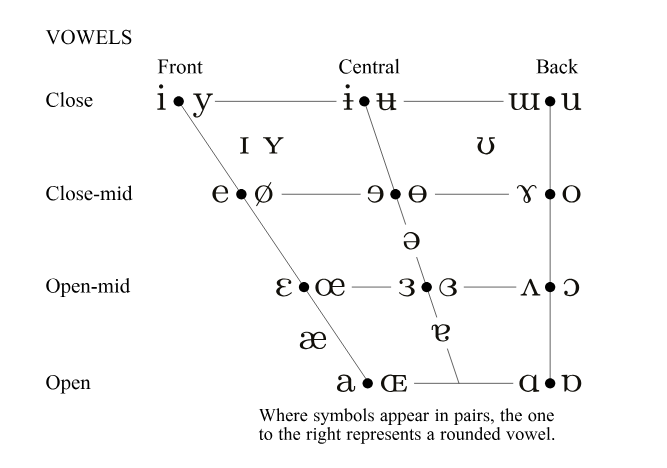
I had to look somewhere for a base of comparison for this, so I picked the Wiktionary page for the name Mario. Someone might quibble about using a wiki-anything, but in my experience, Wiktionary is the best place to look at pronunciation variations, because it collects them for multiple dialects of multiple languages. It gives the following pronunciations for different dialects of English. In British English, there’s /ˈmaɹiəʊ/ and /ˈmɑːɹiəʊ/, with the vowel in the first being the one in hat and the second the one in palm. It gets more varied in the U.S., with three pronunciations: /ˈmɑɹioʊ/, /ˈmæɹioʊ/ and /ˈmɛɹioʊ/. In order, those first vowel sounds should be read as the one in hat again, the one in cat and the one in bed. This might be surprising to some American English-speakers. For one thing, I’m not sure which version I, a native Californian, use, but I’ll return to that later in this post. And for another, I’m not sure that I pronounce the vowel in hat and the one in cat differently, and sitting at my desk saying these words again and again only makes me less sure of how I’d pronounce either if I wasn’t thinking about it.
The official Wiktionary transcription for how an Italian-speaker would say Mario’s name is /ˈma.rjo/, and you may notice that the vowel sound given, [a], does not appear in any of the American pronunciations but it does in one of the British ones. So score a point for British English, I guess, because at least by Wiktionary’s documentation, it gets the vowel sound correct.
Of course, I am not the only person to take to the internet to investigate how to pronounce Mario’s name. Four years ago, the video game history YouTuber Thomas Game Docs posted a response to Americans claiming his British pronunciation sounded wrong.
In the video, Thomas speaks with linguist Yoïn van Spijk, who identifies the vowel in the Italian pronunciation slightly differently than Wiktionary does. He puts it between how most British speakers say it and how most Americans do: [ä], which the IPA pronunciation guide approximates as the vowel sound in bra if you’re American but the one in trap if you’re British, generally speaking. In defense of Americans, however, he also points out that the American version “keeps the vowel length of the Italian vowel” — the long “ah” at about the 2:54 mark in the video if you want to hear it — but the British, lacking that particular sound, shorten the vowel, hence why it sounds like they’re hitting the first syllable less hard and more quickly than either the Italians or the Americans do. More or less, both American and British English get partway there but fall short. So like I said earlier, whether you’re doing it in the U.S., the U.K. or somewhere else, you’re probably pronouncing Mario’s name in a way that doesn’t line up with how it would be pronounced in Italy.
This is complicated, however, by the fact that not all American English-speakers pronounce Mario’s name the same way. More than a few east coast natives say it a third way, which I would write out as “May-rio,” more or less rhyming with stereo. I am most familiar with it from the American TV spot for Super Mario Bros. 2, which leads with the announcer saying the name of the hero in a way that sounds even more incorrect to me than any way a British person would pronounce it. My attempt at writing out this pronunciation using the IPA is something like /ˈmeːɹiəʊ/, with the first vowel sound being something more like the one in bay, but that’s just my guess.
I have seen this commercial many times, but only today did I realize that it’s made with the pre-release version of the game. You can tell because there are no white pixels in Mario’s eyes. More info here.
In the Retronauts episode, Jeremy brought up an ad spot for the Atari port of Mario Bros. that also features this pronunciation in the narration, even if the actor playing Luigi pronounces it more in the west coast-style. (And yes, that is Luigi featured in the commercial, because Nintendo had not decided he was skinny.)
Weirdly, I had never seen this commercial before writing this post and had not even heard of it until Jeremy mentioned it in the episode. I have no excuse for this aside from having been born in 1982. Whatever the case, this commercial is epic.
So clearly you can find variation in the pronunciation of Mario’s name without even leaving the continental U.S. What gives? That’s easy: accents! But also it’s not easy at all! It’s actually very complicated.
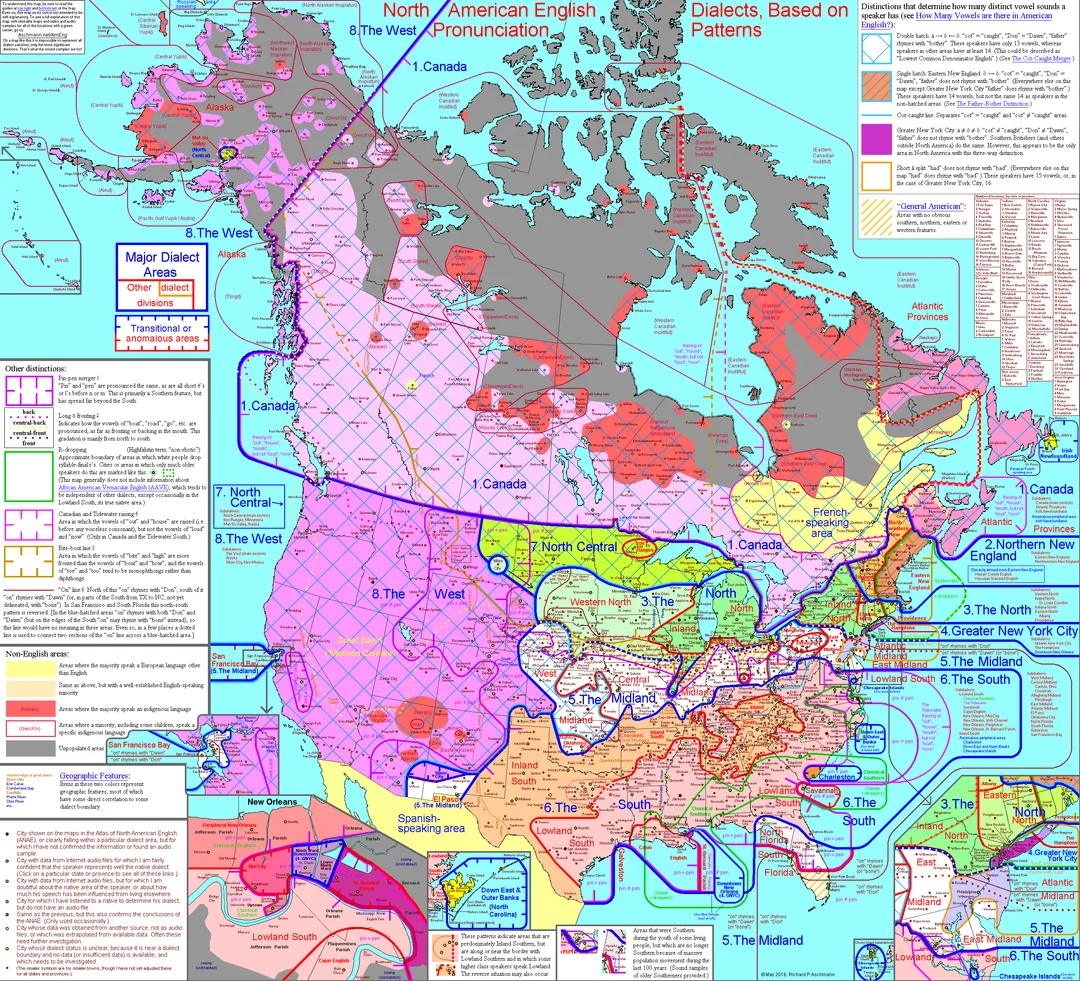
It may not surprise you that different Americans who grow up in different parts of the U.S. have different accents. That’s how accents work. What’s peculiar to me, at least, is that a giant swath of the country has the same accent, whereas the east coast has much smaller pockets with multiple accents, New York City accent being one of the most concentrated, as far as square mileage goes. This means that a whole lot of the U.S. talks like me, a Californian, even if some of these people live closer to the middle of the country and also regardless of how people in other states might stereotype how Californians talk.
Check out this map of North American accents via a Reddit post if you don’t believe me.
In the Retronauts episode, it’s suggested that New Yorkers might pronounce Mario’s name differently because they’re from different boroughs that each have their own variations within the New York accent. This may not be true. I have not spent enough time there to have an opinion myself, but I will say that the linguistic evidence seems scant. Read the 2018 paper “The Myth of the New York City Borough Accent” for more on why people in New York and beyond believe that each borough has its own accent.
I don’t know where either of the narrators of the above commercials come from, but they clearly pronounce that vowel differently than I do, and the explanation I’d point to is the linguistic phenomenon known as the Mary–marry–merry merger. For most American English-speakers, these three words are pronounced identically. I’m one of them. In fact, when someone is demonstrating how they pronounce these three words distinct from each other, I have to strain to hear the difference. But for many east coast speakers — including most people from Philadelphia, New Jersey, New York City, Rhode Island and Boston — these three each have a unique vowel sound. Generally speaking, the female given name, /ˈmeɹi/, uses the vowel sound in bay; the adjective meaning “happy,” /ˈmæɹi/, uses the vowel sound in cat; and the verb meaning “to wed,” /ˈmɛɹi/, uses the vowel sound in bed. There’s a sound clip on the Wiktionary page in case you want to hear someone who does not have the merger pronounce these three words.
I think the announcers in both commercials are pronouncing Mario very similarly to how they’d pronounce Mary — kind of as if they were saying Mary O., who, don’t forget, is technically a Mario character. And they do this because like most people in those cities I mentioned in the previous paragraph, they change their vowel sounds in Mary, merry, and marry in a way that I and the majority of North Americans do not. People who have the the Mary–marry–merry merger, all three are something like /ˈmɛɹi/, using the vowel sound in cat.
But that’s not how I pronounce Mario’s name, however. Remember when I said early that none of the three American pronunciations sounded right to me? I stand by that, and I think that might be because I grew up in California in a town with a lot of Spanish-speakers, including more than one actually named Mario, and as a result my pronunciation is actually closer to the Italian one than what’s being cited in these examples. When I say his name, the vowel sound I’m using sounds like the first one in taco, agua and adios — or /ˈtako/, /ˈaɣwa/ and /aˈdjos/, all of which use the same [a] used in the Italian pronunciation for Mario’s name.
Here, you listen and tell me what you hear.
In the Thomas Game Docs video, the featured linguist says that English lacks the vowel used in the Italian pronunciation of Mario. While that may be true, it’s maybe not accounting for regional versions of American English that absorb something very close to that vowel sound as a result of regular interaction with Spanish-speakers.
Does this mean I am correct? Did I create this whole mini-lesson in linguistics to argue that I am less incorrect than most English-speakers and therefore better than you? No, because I’m not sure we should think of the Italian pronunciation as being more accurate.
The Thomas Game Docs video ends with the assertion that Mario is Italian, but I’m pretty sure that is not true. Officially, he’s not really anything, even if many adaptations turn him into an Italian-American from Brooklyn. Those depictions seem to have informed Charles Marinet’s performance of the character, but he’s using something a lot closer to an Italian accent than an Italian-American one, even if Nintendo has never said that Mario is supposed to be from Italy. And the current voice actor, Kevin Afghani, is basing his interpretation largely on the foundation that Marinet laid. As the years go by, however, I wouldn’t be surprised if Nintendo has Afghani downplay some of Mario’s more overt Italianisms, not unlike in the way the second Super Mario movie did compared to the first.
In the end, I agree with the conclusion that the video ends with: that no one is truly right or wrong in how they say Mario’s name. For one thing, no one culture gets to claim Mario as theirs. (He’s an international collaboration, as I argue in this post.) And for another, it’s weird and narcissistic to presume that your pronunciation of a name is more correct than someone else’s. And this is true even if we’re talking about your actual name, because some people just can’t nail your pronunciation as a result of the language they grew up speaking. Spanish and Japanese-speakers both have a little trouble with my name, for example, but that doesn’t mean I’m going to coach them through getting their pronunciation closer to mine; that’s just how they do it. It’s fine. I know they’re talking to me when they say my name. And I don’t think speakers of American English should hold the British to a different standard just because we speak versions of what’s considered the same language. We know who you’re talking about when you talk about Merry-o, the way you know who we’re talking about when we say it our way.
I’m even going to find fault with the premise that the original Italian pronunciation should take precedence over how English might interpret Mario’s name. In the U.S. and the U.K. both, we have a lot of guys named Mario (no relation) who pronounce it however feels natural for wherever they live. English is actually really good at taking foreign words and bending them to our rules. That’s why we have our own way of pronouncing bruschetta, champagne, and karaoke. Purists of Italian, French and Japanese might object, but it’s foolish to argue that English can’t make any word its own — or any name, even Mario’s.
Somehow, I doubt this post will settle any arguments about the correct way to pronounce Mario, but I hope those of you who made it this far will know that it’s not the British or the Americans who are wrong; it’s only the people who insist that their way is right.
If you want to listen to the conversation that brought this essay into existence, you can listen to the Retronauts episode here.

But also consider supporting Retronauts on Patreon, as more than a few episodes I’ve guested on are behind that paywall.
Video games and linguistics, previously:
And rest in peace, Mary O. I’m sorry Nintendo murdered you before you could be playable in a Mario Kart.