
Translating the Long-Lost Sequel to Super Mario Bros. 2
Did you know there was a sequel to Super Mario Bros. 2?
And no, I don’t mean Super Mario Bros. 3. I mean a 1996 follow-up of sorts to the solitary “plucking and chucking” chapter in the Super Mario story. Nintendo would not attempt something like this again until Super Mario 64 DS, released in 2004, but the game historically known as BS Super Mario USA — and which, for the purposes of this project, has been renamed Satellaview Super Mario Bros. 2 — resists comparison to anything else because it was released for the Satellaview, a Japan-only satellite peripheral that allowed Super Famicom players to download games and participate in special “live” events.
Released in four chapters staggered across four weeks, BS Super Mario USA offered souped-up versions of levels from Super Mario Bros. 2 that had already been souped up three years earlier for Super Mario All-Stars. But each chapter would only be available for a fifty-minute window each — and to complete the experience, players could tune in to a satellite radio broadcast to hear an audio drama that complemented the action onscreen. It’s quite a thing to behold, even if you’re just watching a few seconds of the original Japanese version. Mario and friends would chat among themselves and bicker back and forth with Wart and his minions in a way that offers more depth and character than had even been glimpsed in an official Nintendo product before.
Below, watch a clip of the original, untranslated version.
For years, this would remain one of the most tantalizing aspects to the Super Mario Bros. 2 experience because it was released in Japan only — and that’s ironic considering how SMB2 only exists in the first place as a game released outside Japan. As a result of its obscure status, this sequel became something for super nerds to tease our mid-level counterparts with, in the same way I began this post: Did you know there was a sequel to Super Mario Bros. 2? Where Mario and Luigi and Peach and Toad go back to Subcon to fight Wart? And there’s a king of of Subcon and his bizarrely Waluigi-looking commander? And golden Mario statues? And three Birdos who are voiced by newhalf performers, in what amounts to the most as close as Nintendo has ever come to explicitly calling Birdo trans?
This changed last week with the release of Satellaview Super Mario Bros. 2, a fan project that not only aimed to make the game playable again but for the first time with full English voice acting.
If you like Super Mario Bros. 2 as much as I do, this is a big deal. Not only does Satellaview Super Mario Bros. 2 offer a new way to experience the game, it’s also interesting to see how this acted as a stepping stone between the Super Mario All-Stars version and the one released as Super Mario Advance in 2001. It’s essentially a reworking of the original title into a score attack, but it also is the origin of elements western gamers would associate with the latter, such as oversized enemies and turnips.
In addition to being a game you can play right now, the project also exists as four YouTube playthroughs showing off all the voice acting:
Episode 1: We, the Super Birdos!
Episode 3: Fryguy at the Sea of Ice!
Episode 4: Wart’s Trap! Watch Out, Super Mario Bros.!
The project was a collaboration between LuigiBlood, who handled programming duties, and Sin Cama, who oversaw the script and voice direction. I interviewed them because I was genuinely curious to know what inspired this tribute to the great kingdom of Subcon. Below, read how they explain the arduous task of bringing this weird, wild game back to life.
[Note: Their responses have been edited slightly for clarity. I also interject explainers throughout the piece. Anything in brackets is coming from me, just BTW.]
This certainly seems like a lot of work. Can you just give me an overview of what all went into this, start to finish?
LuigiBlood: SinCama was already doing the work behind the dubbing for the past year. I joined while the work for episode four was getting done. I happened to have rebooted my initiative to get Satellaview games more accessible, everything just kind of happened at the right time while I was recommended to SinCama.
My work was to reverse engineer the BS Super Mario USA ROMs enough to figure out how to make a ROM that contains all four episodes in one with MSU1, first in Japanese, then I worked on the english version which involved reworking graphics and text while ensuring to be easy to polish and finetune, and then reworking everything into Satellaview ROMs. This took about three weeks to do for me overall.
[Note: The MSU1 that LuigiBlood refers to here is a hypothetical enhancement chip that allows emulated Super NES games to feature higher-quality audio that would have been possible had the system had a CD-ROM peripheral. It also allows games much larger than what would have been possible using a Super NES cartridge. You can read more about it here.]
SinCama: It certainly was a big undertaking, especially since this was all one big passion project! While I am actively studying Japanese and can read/write hiragana and katakana and even speak some full sentences, I am not fluent in Japanese. Once I got a transcription of the audio and got myself an understanding of the full picture of the episode and its story, then I would follow it up by going scene by scene and line by line with the help of jisho.org to either polish the line or to change it entirely if the fast verbal pace of the original Japanese ended up being too quick for our English recordings. That’s not to mention creating the instrumentals to the Soundlinks for the episodes, which easily took the most effort since I tried to source the sound effects from the original broadcasts, which took a good deal of music and voice separation for some of the custom sounds and even the music tracks. Other songs were easy enough thankfully since they used official Mario arrangement albums and licensed songs. Thankfully this allowed me to create a “streamer safe” version once I mapped everything out and could swap out the licensed songs at will, opting for some of the other official Mario arrangements that matched the original vibe as best I could.
[Note: If you watch the playthroughs posted to YouTube, you’re going to hear the licensed versions, in case you’re wondering.]
How did you first learn about BS Super Mario USA?
LuigiBlood: A long time ago, when I first learned about the Satellaview and then messing with the ROMs that were already out there. I remember not understanding the point, but that’s because I didn’t have the audio with it. Since then I have much improved my Satellaview knowledge.
SinCama: I want to say I knew vaguely what it was before this year, but since people didn’t talk about it as much, it faded away into my subconscious. It was only after I finished and published my full dub for the Mario anime movie, The Great Mission to Rescue Princess Peach, I happened to ask Cabbusses (Satarou Light) for permission to use his footage of the Mario World animated special that went along with the Terebikko phone toy. He brought up to me if I’d ever be interested in dubbing BS Super Mario USA. I told him I’d think about it, and after some research and seeing just how deep the rabbit hole went for Satellaview, I found myself more and more interested, especially since this was brand new territory for English speaking audiences. Even if this never became popular, I wanted to know the story for myself as a lifelong Mario fan!
[Note: You can see the fan dub of The Great Mission to Rescue Princess Peach here.]
What do you hope people take away from this project?
LuigiBlood: I hope people will understand better what the Satellaview really was, as there was really too much misinformation and I really want people to get a real feel for it. I want to do similar work for other games, including games that were already translated before.
SinCama: Likewise, I want others to learn more about the Satellaview and how there’s so much of the library that’s currently lost media but can still be recovered! Like, I’ve noted in one of the videos (through the narrator), I believe art in any form deserves to be preserved and shared so that it may inspire current and future generations. In that same vein, I hope our work here can inspire others to tackle their own efforts, whether it’s another dub of BS Super Mario USA, a different Satellaview game, or just anything! To be able to create and then share your efforts is such a rewarding part of the human experience to me.
In general, how did you go about the translation? The in-game dialogue seems very casual and conversational, and I’m curious how you went about preserving that versus adapting it for a non-Japanese audience? Were there any bits that proved especially tricky?
LuigiBlood: In my case, I was not involved in the process of translating or dubbing the audio, but I handled the graphics from the game data itself, which wasn't too complicated. But it was oddly more complicated than ever to fit in the graphics like the title cards compared to my previous work with Marvelous ~Another Treasure Island~.
SinCama: Way back when, I did assist in translation for another YouTube channel for a JoJo’s Bizarre Adventure game that had not come out in the west yet, and I was more focused on being accurate to the original Japanese, which was a good teaching lesson for me on how I should be more flexible. While for BS Super Mario USA I did aim for accuracy, I was also trying to match the energy and timing of the original voices while trying to make sure these sounded like how “normal” people should talk — however normal Mario characters can be anyway, haha.
So instead of focusing on being “word perfect,” I tried to match the original spirit of the Japanese audio and make it just as fun for English-speaking audiences. The tricky parts are the usual suspects: certain phrases in Japanese that were hard to figure out if they were actual expressions used in conversation or if maybe the Birdos are just being extra quirky, considering we now know that their diet consists of worms, poisonous jellyfish, etc. (See episode three.) To your point, however, the dialogue does feel very conversational despite the supposed high stakes. Even the Subcon King responds to a knock on his door with a more casual “nanda ne?” So I tried to keep the appropriate speaking conventions when possible.
Tell me about casting. How did you decide who should play what character? And then, once cast, did you give much direction for the actors as to how they should play their characters?
SinCama: Many of the voice actors come from our dub of that Mario anime movie, including Mario, Luigi and Peach. Most everyone in the cast are people I know personally from the local theater scene in Atlanta and who I knew wanted to get into voiceover. Since I knew their voices and their talents well enough, I was able to cast according to each actor’s strengths, so there was no need to audition them. This made timing and coordination much simpler, as well. Others who joined remotely, like Martin or Kitty Kaboom, I brought in for similar reasons because I had previously worked with them on other voice-based projects and knew which roles they would be great for.
As far as direction, I did leave some cues in the script if I felt specific comedic beats needed to be hit, such as “deadpan,” “cute,” or “explodes in anger.” During recording sessions, I was able to either give live feedback or ask for retakes later after giving specific notes. The amount of retakes ended up being very few, because all the actors made very strong and fun choices. They gave performances that, in my humble opinion, did their respective characters justice.
I noticed that Mouser was played with a certain sort of accent. Is there something in the original Japanese version that you decided to translate that way?
SinCama: Mouser’s accent wasn’t so much based on any speaking patterns, but I did write him with some bravado since he either refers to himself as “ore-sama” or the full “Don Churuge-sama” (or the even fuller “Nezumi no naka no nezumi, Don Churuge-sama”). Just the fact alone that “Don” is already part of his name like he’s some mafioso, added with the guts to use the “-sama” suffix let me know he thinks way too highly of himself. With that in mind, his VA and I came to the same conclusion that he should talk like some low level mafia goon who thinks he owns the place, sprinkled in with some Meowth for good measure — and I let Mouser call himself “The Big Don” as an homage to his Japanese name.
[Note: As I explain in greater depth here, Mouser’s Japanese name is ドンチュルゲ or Don Churuge, with that first syllable being either the Spanish or Italian title don or the Japanese onomatopoeia for the noise of an exploding bomb. It also quite likely could be both, given the Japanese pop culture connection between mice and bombs. And the Japanese phrase cited translates more or less to “The mouse among mice, Lord Don Churuge, with the -sama suffix being honorific.]
The characters that did demand a certain manner of speaking were Fryguy and Clawgrip. Fryguy spoke in an older Japanese style with “Sessha” pronouns and “de gozaru” endings to match his honorable samurai persona. And since the sound cues locked me in to keeping him Japanese, I also tried to have him speak in an older English to match his older soul. Clawgrip was a fun challenge since they decided to make him a full-blooded American-type who spoke in broken Japanese. Since a banjo music cue and certain plot points where his manner of speaking would get him in trouble meant that I also had to keep this aspect, I leaned into it more for the English adaptation and made him aggressively redneck, which ended up being an excellent contrast to Mario hailing from New York. (Watch episode four to see what I mean!)
Let’s talk Birdo. Obviously, Nintendo made a specific choice in casting three newhalf performers for the original Japanese version. Did that inform your choice for who would be playing the Birdo sisters in this version?
SinCama: So this will be a point of contention for some, and apologies in advance if anyone disagrees with the decision. The scale of our production was small, and the goals for our team were to showcase the talents of our band of actors and then to meet the self-imposed episode one deadline of MAR10 Day. If I knew enough trans actors or had time for a casting call, I would have prioritized casting those talents since I did note the Birdo voices were performers for the White Room club in Japan. The fact that the headshots chosen for them were in full feminine outfits and that White Room got a Special Thanks in the credits indicated to me that Nintendo/St. GIGA had great respect for them and their identities.
For our English cast, the three of us assigned as the Birdo sisters are all masculine-presenting. We all had experience playing queer roles for professional theatres, and our Birdo Pink VA has experience performing in drag shows. With this in mind, after a careful conversation, we all decided to take on the roles and perform them with as much respect as the original performers deserved and to avoid any negative stereotypes. To my surprise and delight, the original Japanese script seemingly does not make any averse mention of the Birdo sisters’ identities. All characters accept them as female, so there was thankfully little need to adjust any lines regarding them. I hope our performances shine through and are worthy interpretations for these fun characters.
[Note: The White Room (Shiro Heya) is a Shinjuku nightclub known for featuring performers who identify as trans or newhalf. See my big article on the history of Birdo’s gender for more information.]
This game can be a chaotic thing to experience. This was my takeaway even back when I first glimpsed the original Japanese version. There’s just a lot of talking going on, and it’s not always clear what is being discussed and whether it’s just background chatter or if it’s referencing something onscreen. Was this something you were tempted to tame at all for this English version?
SinCama: It’s a note I’ve seen when a clip of the huge argument between Peach and the Birdos from Episode 1 got uploaded to YouTube on Cabbusses’ channel with minimal context; they were overall very confused as to what they were even listening to, haha. I also saw a stream of the game recently where the streamer felt overstimulated with all the voices, especially when trying to talk with their chat. I opted not to tone those parts down since Peach’s very sudden moments of violent rage are purposeful and lead to the in-game events where she tosses the giant turnips that can cause friendly fire and one-shot the boss Birdos. I wanted to make sure those moments were earned in the dialogue. Plus, it’s not a character trait often associated with Peach, and it will get callbacks in future Satellaview series like Excitebike: Bun Bun Mario Battle and BS Super Mario Collection. (I also like to think Peach’s attitude in the kicking rocks scene from the Mario Galaxy movie was a sly callback to these broadcasts, but I’m sure that’s just me!)
Did anything in these scripts surprise you?
LuigiBlood: It depicts the Mario cast somewhat differently than I’m used to these days. It almost gives me a vibe of the French audio dramas that were made on the Internet for a while, particularly on that moment when Peach gets censored.
[Note: Below is the clip where Peach screams one long, censored string of swear words. It comes from the 39:45 mark in episode one. There’s another one at the 43:23 mark in episode three.]
SinCama: There were some people online (before these dubs got made) that speculated there might be some “hidden lore” locked away in this game, but… sorry everyone, there isn’t any! Mario is typically not a series that concerns itself too much with lore, anyway. If anything, it does try to do a weird, soft-retcon where Mario and friends never fought Tryclyde, Fryguy, or Clawgrip in the first game, despite this story being framed as a direct sequel to SMB2/USA and taking place after Wart’s initial defeat. Despite that, there’s just a lot of fun character moments and interactions between the cast, like the aforementioned Peach rage, Mario being much more talkative and making the rare snide remark, Luigi and Toad getting really into gambling, etc. So yes, these characters feel a bit different, but I did try to still make them recognizable to longtime fans!
So maybe there are no big lore reveals, but I’m curious to know some of your favorite moments to “unearth” in translating the original scripts?
SinCama: Oh man there are some gems! Fun spoilers ahead! In episode two, Birdo Green makes a reference to “people with turbans” showing up in Subcon before Mario and the others arrived, perhaps the only reference to the original cast of Doki Doki Panic in Mario/Nintendo history past the original release? Then in episode three, we get two Nintendo references: a soccer broadcast on the TV that the King of Subcon watches explicitly mentioning, “Link has scored a goal for the Hyrule Legends!” (Which I also find interesting since the latest Zelda game at this time was “Link’s Awakening,” where Wart himself makes an appearance!). Then the two delivery guys announce themselves as from Escargo Express, complete with the same music from Earthbound. (And thank you Vinny Vinesauce for the vocal cameo!)
In my original Birdo article, I thought it was interesting that she exists as a building in the BS hub world and that you enter her by going through her crotch. Does this seem weird to you too? Am I alone in thinking this is a… suggestive thing to be featured in a Nintendo game?
LuigiBlood: I'd definitely say it's suggestive. It’s the more exotic one out of all the broadcasts too.
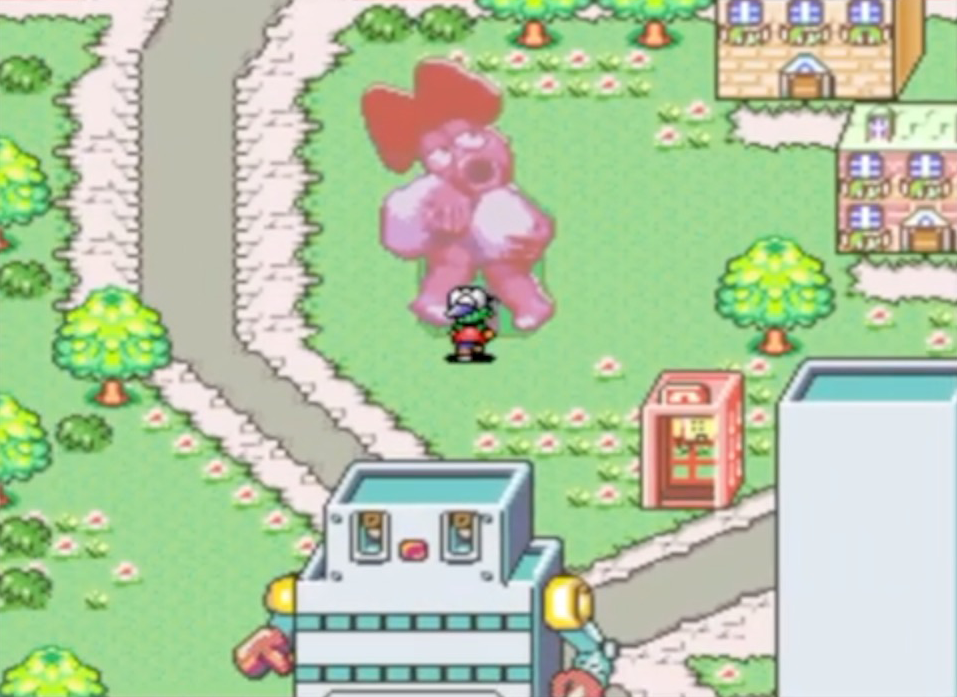
Get in there, kids!
SinCama: I mean, yeah… it’s not the best usage of that screenshot from the Japanese Super Mario USA commercial. If it’s any consolation, the Japanese text when you speak to the Birdo Mansion doesn’t mention anything too suggestive; it’s just standard flirty speak. Not like Nintendo is any stranger to adult humor; remember Super Mario RPG where you can find “Peach’s ???” (or in Japan “Peach’s XXX”) tucked away in her room?
[Note: I do, in fact, remember that, and I discuss it in a post about a potential virbator joke in Super Princess Peach.]
Do you have a favorite character?
LuigiBlood: This is mainly talking from the context of the English dub, but I like most of them, haha.
SinCama: I hated editing the Birdo sisters because they’re so chatty and took up the most time, but I have to admit they absolutely steal the show for me. A special shout out to the commander, who despite not having an original bone in his body, is somehow the Rizzler of Subcon??
What else would you want people to know?
LuigiBlood: This project became part of the Project Satellaview initiative, and I want to do similar work to more Satellaview games, and hopefully get more translated. I am already working on what’s next, hopefully coming sooner than later. I am also aiming to make Japanese MSU1 versions, but restoring Japanese audio is definitely a skill that we don't really have. I am also hoping to use this initiative as a way to motivate the few people who have clean recordings of the audio to share them with us. We do have a few, but it’s not everything.
SinCama: This was a long journey to get here, but it’s been very worthwhile to see all the positive reactions to people experiencing this story for the first time. I’ve seen people play this on real hardware, on a CRT, and recorded onto VHS tapes, and that makes my inner child who grew up with the SNES so incredibly happy. I plan on dubbing more obscure pieces of media in the Mario space, I have a JoJo dub planned sometime in the future too, and I welcome any other suggestions! I would love to dub the other Satellaview games too, but, like LuigiBlood says, the archive is currently incomplete. There are some ROMs that haven’t been dumped and there are some broadcasts that got censored on YouTube because of the licensed music used, so that means missing dialogue too. If anyone has any leads on either of these necessary items, please help us out! Help preserve this unique library! And support real artists and real humans!
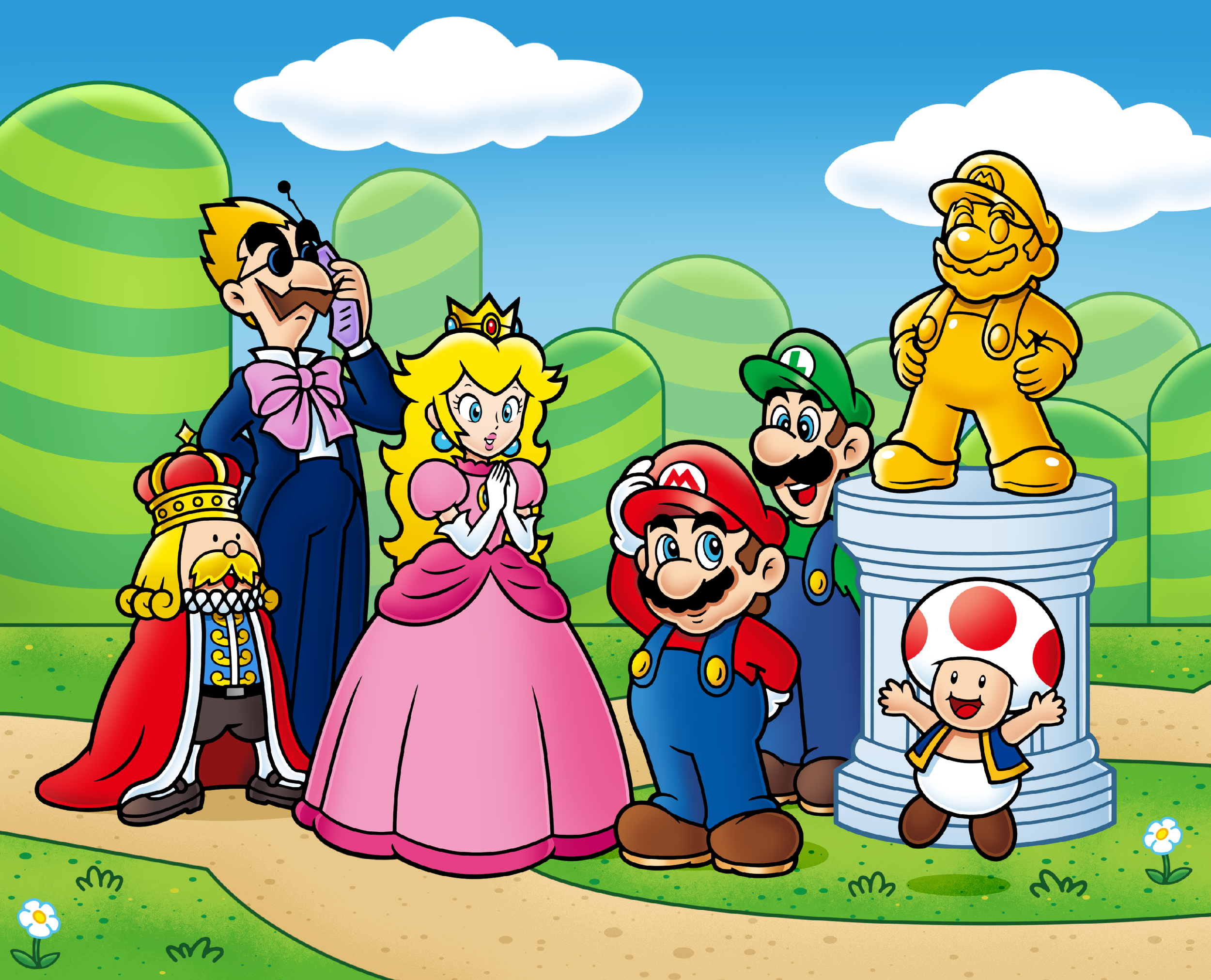
A wonderfully Yoichi Kotabe-esque reworking of the original in-game art by Clarissa Arts, posted here with permission by SinCama. Left to right: The king of Subcon, the Waluigi-esque commander and four more characters that you should not need identified if you frequent this blog.
Miscellaneous Notes
Of especial note is the fact that this dub project uses a title that’s different than the one the game had long been known by in the west: BS Super Mario USA. SinCama did explain to me that one of the reasons for titling this new version Satellaview Super Mario Bros. 2 is that BS has a distinct meaning in English. What’s interesting to me is that I had it in my head incorrectly this whole time that BS stood for “Bandai Satellaview,” and that the peripheral was one that Nintendo made in conjunction with Bandai. The device was actually made in conjunction with St. Giga, a now-defunct Japanese satellite radio company; Bandai had no involvement with the Satellaview. I don’t know how this connection was made in my head, but it’s apparently common enough a misnomer that the Nintendo Wiki page for the Satellaview notes that it’s not true. I swear this is not my fault; this is not a Mister Peepers scenario. Anyway, LuigiBlood reports that the BS in the Japanese title can mean “broadcast satellite” or “by satellite.”