
I don’t know if you were aware of this already, but I know a lot about the Super Mario games. That doesn’t mean there’s a lot I still don’t know, however, and on the latest episode of the Overworld podcast, I actually learned something new about Super Mario Bros. 3: that it has a surprising connection to Disneyland. And in this post, I am going to attempt to investigate this connection in greater depth than anyone else has ever before.
But first, a plug!
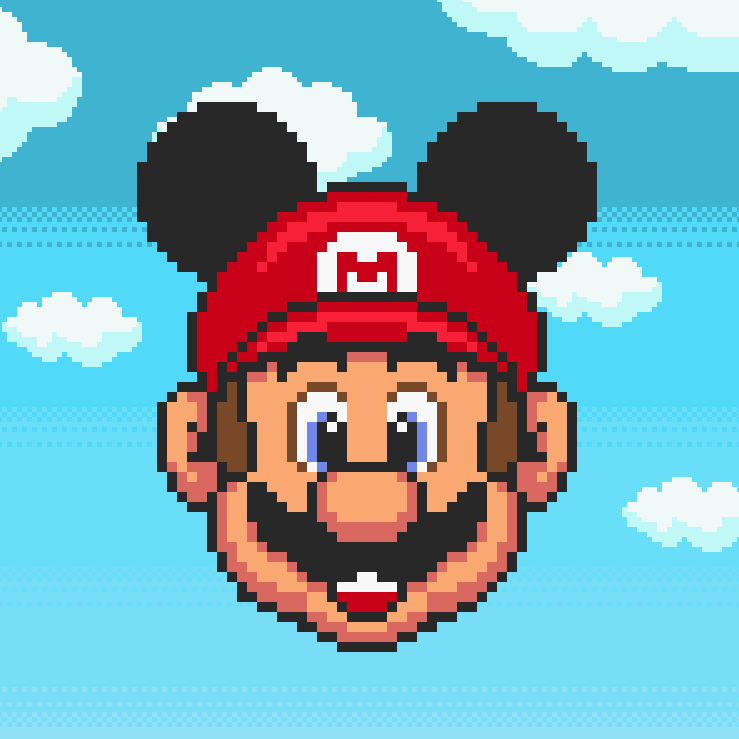
Overworld: How Design Connects Great Games is a new podcast that examines the one hundred titles on the Polaris List, a 2025 ranking of the most influential video games. The podcast is co-hosted by Dr. Ada Wish, a gaming design professor at the University of Nebraska. You should listen! And not just because it’s a good show, but also because Ada made a pixel art gif of me joining the regular panel for this Super Mario Bros. 3 episode.
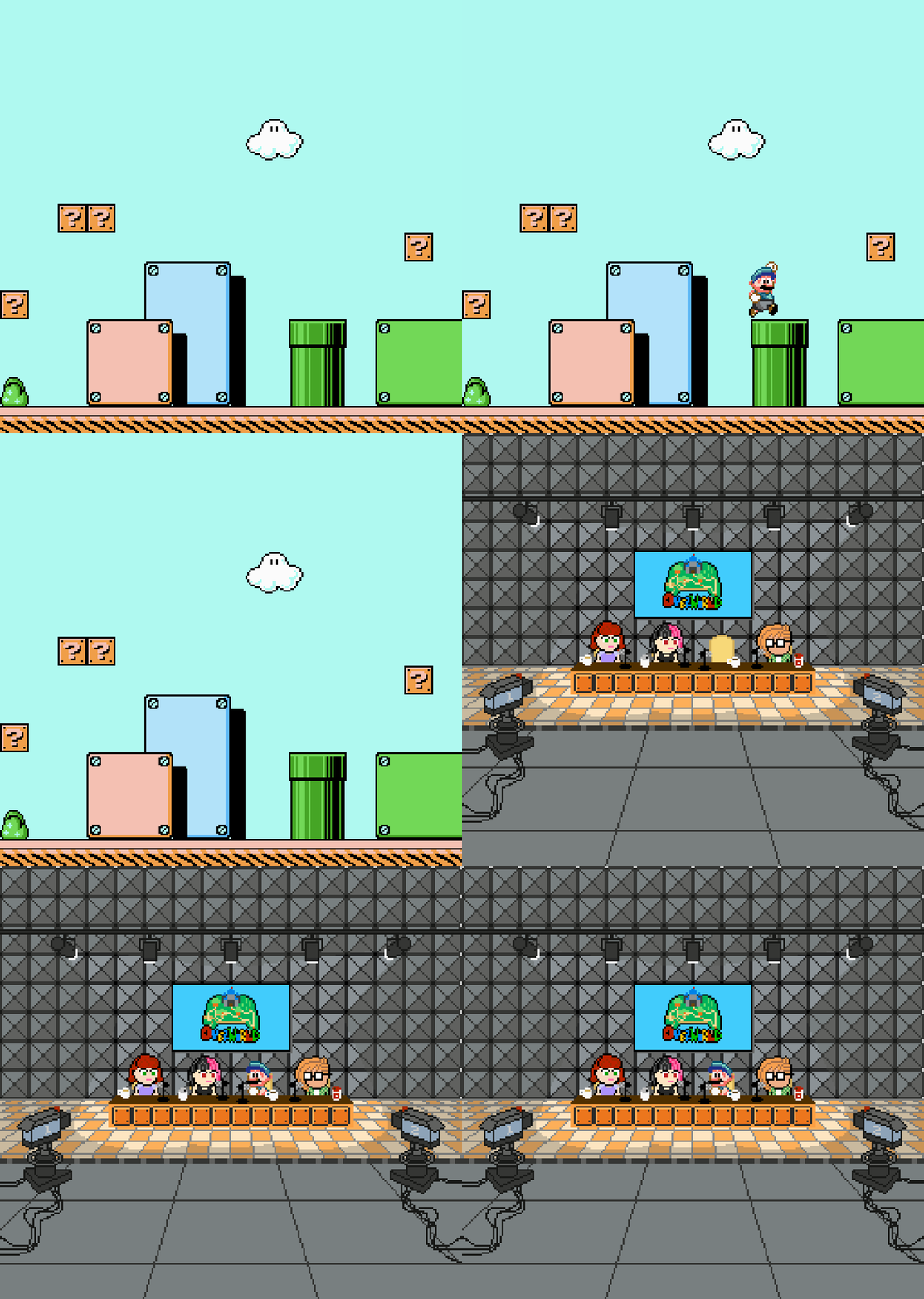
It should surprise no one that I look like Mario, because as it turns out, I have grown up to be a man who kind of looks quite a bit like the fictional character with whom I have spent the most time. Happenstance? Destiny? Blue collar mustache fetish? You decide!
Ada is also the one who brought to my attention something that I’d never heard despite a lifetime spent reading about the Super Mario games: that during the production of SMB3, Shigeru Miyamoto took the creative team to Disneyland. Depending on who’s telling the story, the intent behind the trip was to find inspiration for the game or to provide a break from the gruelling schedule making the game or some combination of both. I was surprised that I hadn’t heard this bit of SMB3 lore before, because it’s the kind of thing that you’d think would have inspired countless gamer thinkpieces back in the day. The notion of Nintendo in Disneyland represents an intersection of two pop culture juggernauts that have never quite come together in a public-facing way — which is too bad, considering how Mario and Mickey Mouse have similar temperaments as well as taste in handwear.
Just looking around online, the first reputable source I found discussing this trip is the Gaming Historian’s 2020 video on Super Mario Bros. 3. It’s a fairly quick mention, beginning around the 12-minute mark.
As the video puts it, the trip was definitely a work one designed to find inspiration in New York City, San Francisco and not Disneyland but Florida’s Disney World. I’m willing to bet that if someone was going to get this correct, it would be Norm Caruso, but it’s worth pointing out that two of the sources he includes in his notes for video have Miyamoto’s team going to Disneyland and not Disney World: Alyse Knorr’s 2016 book on SMB3 and William Audureau’s 2013 book The History of Mario. I can’t explain that disparity, but for the purposes of this post, it doesn’t really matter which Disney park Nintendo visited. It’s more just that it happened and, as a result, there’s the possibility that some of the Magic Kingdom seeped into the Mushroom Kingdom.
I thought the best way to tackle this would be to break down the alleged connections into their own sections. In each, I’ll explain how it’s supposed that a Disney park may have inspired Super Mario Bros. 3 and how likely I think that this actually did influence the game in any real way.
A Land of Many Lands
Both Disneyland and Disney World comprise smaller areas organized by themes that dictate not just each one’s aesthetic but also the kind of attractions you can find there. For example, the California park has Tomorrowland, Frontierland and Fantasyland, each of which have their own distinct look to the point that you could tell when you’re passing from one into the other even if that border weren’t clearly marked. (Also, in a feat of marketing synergy, all of these three areas correspond to genres of movies and cartoons Disney used to make back in the day, and I have to admit, I only realized this in writing this post.)
Support this site: on Patreon! • on Kofi!
Super Mario Bros. 3 has this as well. The game moves the setting from the Mushroom Kingdom to the larger Mushroom World, which comprises seven areas ruled by seven kings, each with its own look. In fact, SMB3 did this so successfully that it became a staple of future Super Mario games, nearly all platformer games and many video games in other genres.
Based on the previous paragraph, it might seem like SMB3’s various lands might have been influenced by the ones at Disney parks. Knorr’s book acknowledges this idea but doesn’t exactly endorse it, instead ascribing to other researchers — not her.
As Jeff Ryan puts it in his history of Mario, “This game, more than any other before it, was built to reward the completionist. Simply winning wasn’t the goal anymore. The new goal was to visit every location the game offered, do every activity, soak in each experience. This wasn’t a race, it was an amusement park.”
Others have echoed this claim — in fact, a handful of game historians have suggested that SMB3’s themed worlds and levels were inspired by a trip that Miyamoto and several members of Nintendo’s R&D4 team allegedly took to Disneyland in 1987. It’s not a totally crazy idea — SMB3 and the Mario games that followed it (especially SMW and SM64) do feel, in many ways, like theme parks with small worlds inside of them to explore.
In his book, however, Audreau seems to be saying a little bit more emphatically that he sees a throughline. (Note: This text is pulled from Brian Ashcraft’s translation of Audreau’s French text.)
The visit of Miyamoto’s team to the famous American amusement park is certain. In 1987, the Nintendo R&D4 members involved in this project flew to the United States, where they visited Nashville, the historical capital of country music, and Walt Disney’s theme park. There, Miyamoto, Tezuka and the others discovered a series of interlocking worlds. The park had, in fact, several universes, each one with several attractions; it looked like a small colourful fairy tale world, but it only took several hours to visit. At that point, they decided to say goodbye to the vast stretches of monotonous land in Zelda and the relendess successions of random landscapes in SMB1 and 2. Disneyland, with its geographical distribution, provided the framework upon which Super Mario Bros. 3 would be built. The game would also have several worlds, each having several levels, and it would give the overall impression of a small magical and colourful amusement park that could be visited in several hours. This was only the first lesson in universe construction that Nintendo received from the famous enchanting park.
[...]
Of course, it’s not necessary to imagine that each world at Disneyland had a direct equivalent in Super Mario Bros. 3. In any case, Miyamoto and Tezuka have never admitted that such a connection exists, and it would be hard to find an echo of Frontier Land, a vision of nineteenth-century America, at least before Wario’s mine in Mario Kart Wii (Nintendo, 2008). But just like the areas in the theme park, the worlds in Super Mario Bros. 3 became deeper. It was no longer about world “1-1” but “Grass Land.” Mario traversed “Desert Land,” “Water Land,” “Giant Land,” “Sky Land,” “Ice Land,” “Pipe Land,” “Dark Land” and “Secret Land.” The Game Boy Advance re-release would give them more poetic and evocative names such as “Desert Hill,” “Big Island” and “Pipe Maze”. Something resembling a Mario universe was in the process of taking shape, and it was as if, since Super Mario Bros., the plumber were a car driver who only referred to the cities he traversed by their mile marker and then suddenly discovered they had a name.
But that’s not to say that Super Mario Bros. 3 invented the concept of themed lands. As Audreau himself points out, you can see the beginnings of what SMB3 would later perfect all the way back in Doki Doki Panic, released more than a year before. As opposed to one-off levels featuring different terrain, Doki Doki Panic has whole desert worlds with quicksand or whole ice worlds where you fall off a ledge and die for no reason.
I actually don’t know the first game to have desert and ice levels that amounted to more than a simple color overlay; that seems like something to hunt down for a future post. But also the notion of themed worlds seems like something that video games were steadily progressing toward before work on SMB3 began. Perhaps Disneyland helped usher that concept into existence more fully, but I feel like it’s an overstatement to credit their existence to Disney parks as if no trace of them existed beforehand.
A Weenie on the Horizon
Are you familiar with weenie as an architectural term? It was a plot point in the recent Lanterns series, but it’s very much a Disneyland thing; Walt Disney designed the original park with Sleeping Beauty’s castle as a central focal point that you could see from basically anywhere and that would draw guests toward it. In the version of that original park that exists in Disney World, the Magic Kingdom, it’s Cinderella’s castle, but it serves the same function. Other Disney parks use something other than castles as a weenie, but the castle in particular became so associated with the company that it began appearing as the logo of Walt Disney pictures starting in 1985 — ironically with the release of The Black Cauldron, which is a movie the company otherwise tries very hard to forget. That original castle — and the less abstracted ones that showed up in later years — aren’t necessarily supposed to be Sleeping Beauty’s castle so much as one that combines elements from that one with the one from Disney World.
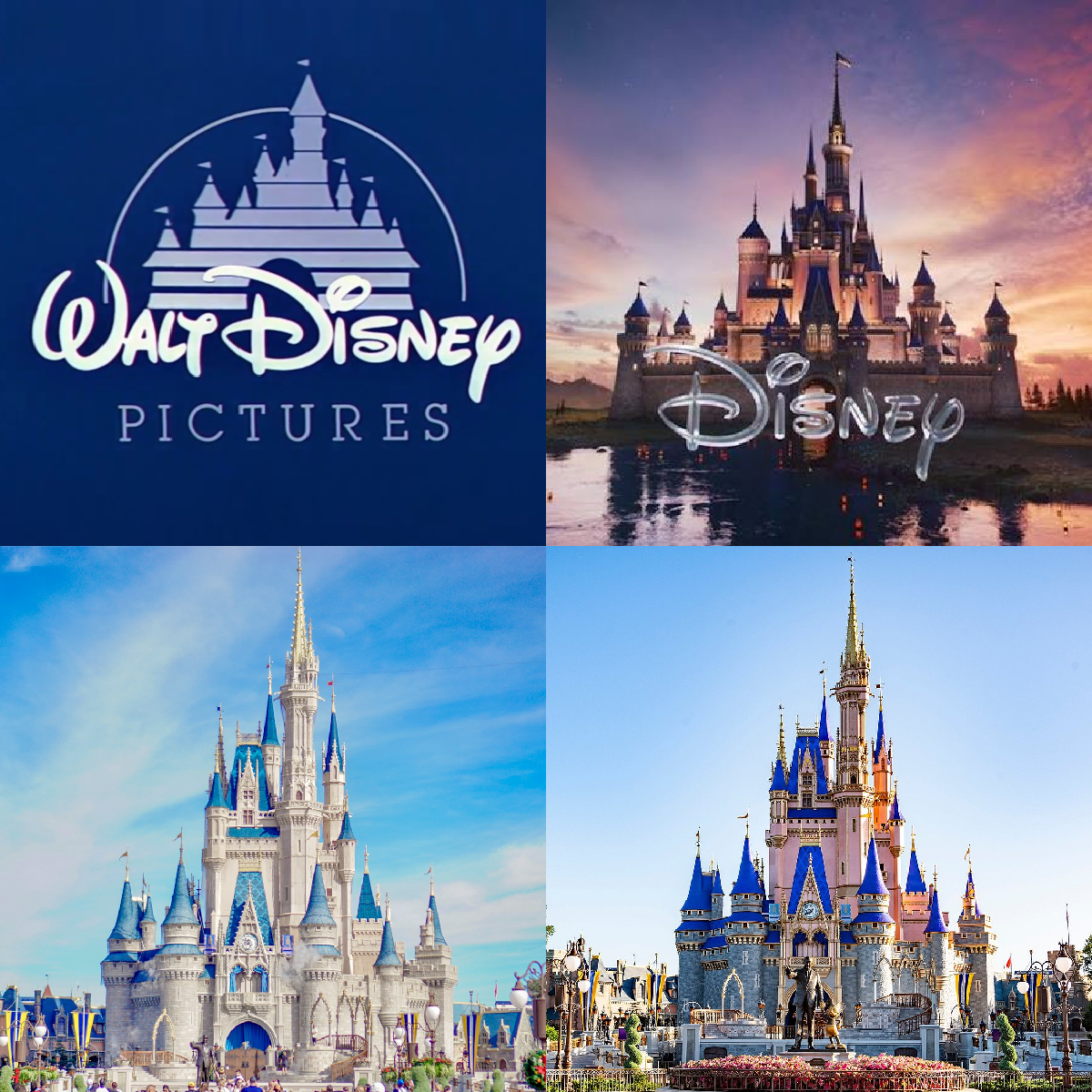
Clockwise from top-left: The original 1985 logo, the current version of that logo, Cinderella’s castle in Disney World and Sleeping Beauty’s castle in Disney Land. For my money, the bottom two look damn near identical, but get at me, Disney freaks.
The map screens of Super Mario Bros. 3 each have a weenie castle, if you want to think about it in these terms. It’s only visible from the starting point in Grass Land, as each subsequent world map is more than one screen big, but the fact that it’s the obvious destination in that first map makes it clear that this is what you’re headed for in every subsequent area.
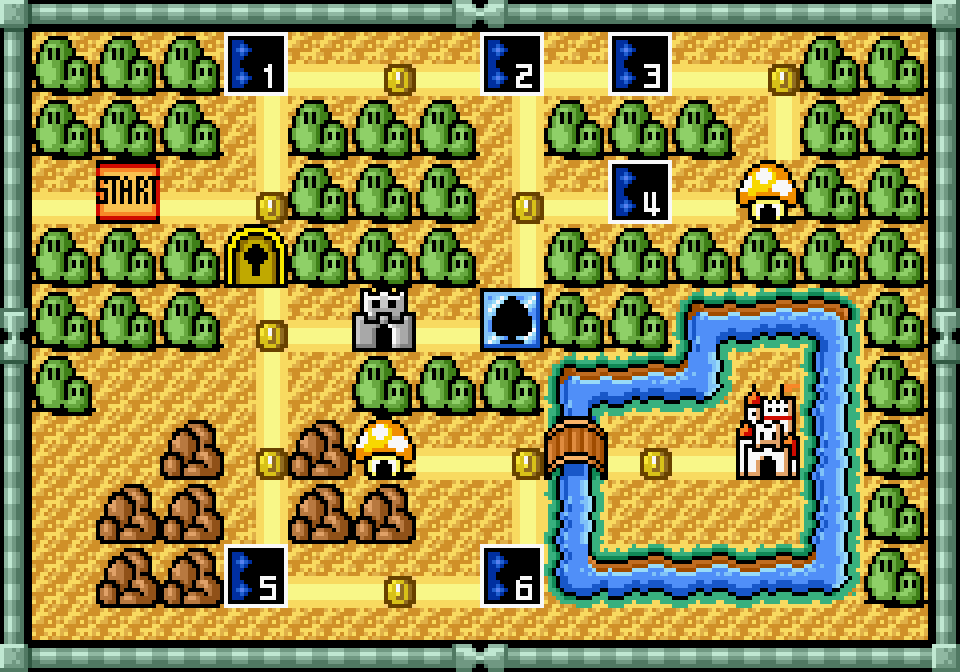
Both Knorr and Audreau both bring up the function of the SMB3 castles being very like the castles in Disney parks, but only Audreau claims the former was designed specifically to look like the latter.
The concept and the architecture of the castle would be used — with its towers of different heights, pale colour and colourful roofs — in Super Mario Bros. 3 for the princess’s castle, which is established as the focal point of the different levels and paths in each world.
I think he may be right here. If it wasn’t clear, I approached this post with some healthy skepticism. A connection seeming possible doesn’t mean a connection exists, after all. And while structures we call castles did exist in the original Super Mario Bros., they looked a lot different. In fact, that original design seemed to have been repurposed as fortresses in SMB3, which are indoor levels that end in a fight against Boom Boom, the game’s recurring midboss.
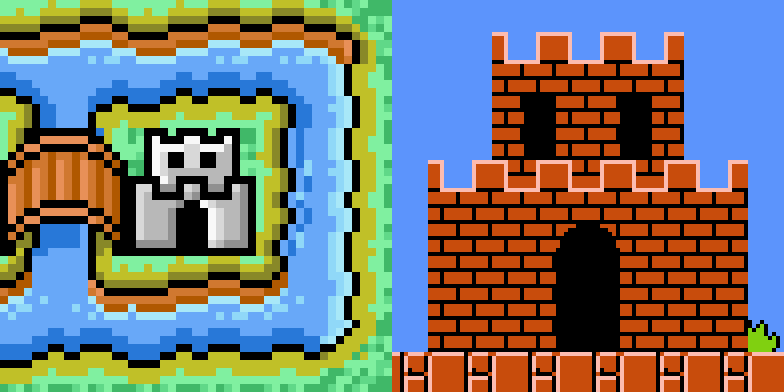
Left: the SMB3 fortress icon. Right: the end-of-level castles in the original Super Mario Bros.
In SMB3, these fortresses are never the ultimate destination the way the white-towered castles are. And while I’m not sure if the SMB3 version looks more like the Sleeping Beauty castle or the Cindella one, I suppose the fact that the Disney logo is both and neither means it doesn’t have to be a one-to-one match.
At this point, you may be wondering: why weenie? The popular story is that it has to do with using sausages to train dog actors, and that seems as logical and explanation as any, but there’s not much official documentation online.
A House Full of Ghosts
Speaking of Super Mario Bros. 3’s fortresses, it’s worth pointing out that they feature some seemingly undead enemies that had not existed previously in the series. Boo and Dry Bones both debuted in SMB3 and would later appear in nearly every sequel and spinoff. Boo in particular would become iconic, even in a series full of iconic enemies. I think because the Boos lend themselves to fun facial expressions that could be realized in the 16-bit era, they got their own domain in the next game in the series, Super Mario World, which featured haunted house areas in addition to the fortress areas that carried over from SMB3.
But could Disneyland and its famous Haunted Mansion ride have inspired these haunted house levels? Well, I feel like one of the arguments against should be the fact that we know the origin story of the Boo, and Disneyland has never come up in any of the times this story has been told. As we discuss in the Overworld episode, Takashi Tezuka based the enemy on his wife, who grew resentful when all his work on SMB3 kept him in the office, and this was immortalized in Boos only bearing their teeth when you’re ignoring them. (I suppose that origin story doesn’t explain why that quality was assigned to a ghost character specifically as opposed to literally anything else, but I’m open to your theories.) Beyond that, Disneyland didn’t invent the concept of a haunted house ride. Gracey Manor is just the bigger, better, Disneyfied version of the haunted attractions that had been common for decades at other amusement parks and carnivals in English-speaking territories. Nintendo could have been inspired by any of them, technically speaking, even if the Disney version is the most famous. Or they could have been inspired by none of them, at least by their own weird standards. Don’t forget that this is the company that says Ghosbusters was not an inspiration for the game where you suck up ghosts with a vacuum cleaner.
In favor of there being a Disneyland connection, I guess, would be the fact that desert and ice levels make a little more sense to include in a video game because desert and ice areas exist in real life. Maybe? Like, you could get in your car and drive to either right now and either get sucked into quicksand or fall into a crevasse and die if you really wanted to, but it would be harder to get to a Super Mario-style or Disney-style haunted house. But then again all three of these environments are ones you’d be much more likely to experience via pop culture than you’d be in person.
Is there a gif for a confused-looking Boo just shrugging?
Mice, Ducks, Tanuki and Frogs
You know what Super Mario Bros. 3 has in common with Disneyland? People in animal suits, though one of the two is doing a better job than the other at hiding the fact that there’s a human being inside.
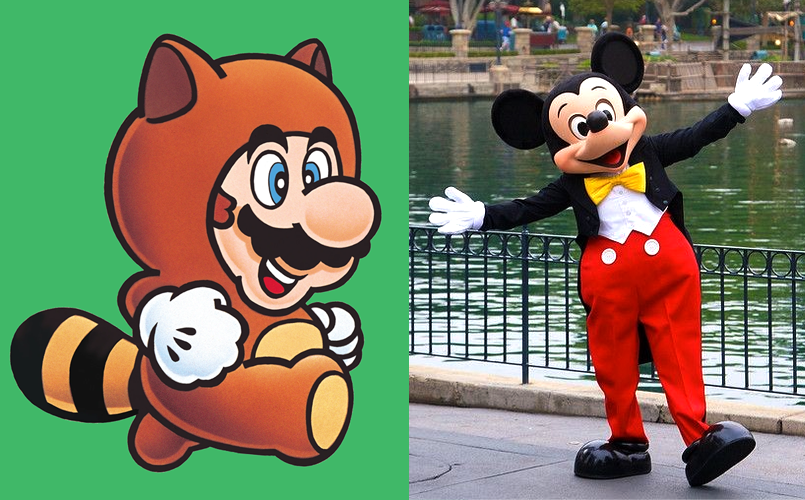
I’d somehow never thought about this connection before researching this post, but yes, it does seem notable that SMB3 would introduce full-body animal suits to the series immediately after a trip to a park famous for actors wearing full-body costumes. And while Knorr does nod in the direction of this parallel being meaningful, she also points to a theory from Audreau that puts the origin of this element a lot closer to Nintendo’s headquarters in Kyoto:
Miyamoto’s idea [to have Mario ride a dinosaur] gave Tezuka the inspiration to completely redesign the plumber’s transformations. Since Mario couldn’t ride on an animal, he should be turned into a hybrid creature himself.
Where did Tezuka find his inspiration? Maybe from Altered Beast, the action game released in Japanese arcades in 1988. As he was moving forward, the hero turned into a wild animal, such as a werewolf, a bear, a dragon or a tiger-man. Miyamoto’s right-hand man must have known about Sega’s game since two different copies sat on his desk. The idea was not shocking in the plumber’s world. After all, Super Mario Bros, had already established the idea that a hero could grow and change colour and abilities by eating a mushroom. All they had to do was insert new magical items so that Mario could also benefit from beastly powers.
The reference to Tezuka’s desk is explained in a footnote. As explained by Chris M. Covell on his site, the Japanese children’s book The Stars of Famicom Games includes a snapshot of Tezuka’s workstation, and you can see the two copies of Altered Beast in addition to other Mega Drive Games.
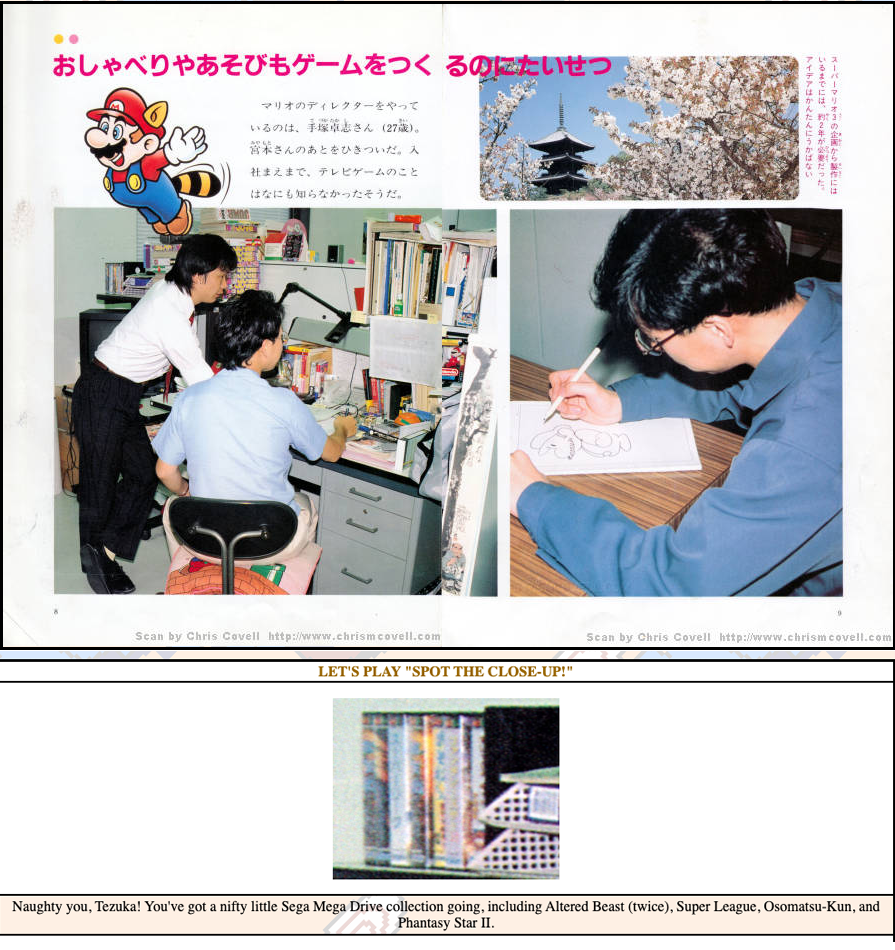
Via chrismcovell.com.
I like Audreau’s theory — and not only because it backs up mine about how the infamous Centaur Mario power-up that got nixed from SMB3 was considered in the first place because it was an attempted workaround to the problem of not being able to program Mario riding a dinosaur. I also tend to think inspiration is more likely to come from other video games than it was anywhere else, generally speaking. Besides, it’s not as if having park employees in full-body animal costumes would have been unique to Disneyland. Mascot characters abounded in Japan during the time SMB3 was in development, at amusement parks and otherwise.
Support this site: on Patreon! • on Kofi!
Of course, the default form of the main power-up in Super Mario Bros. 3 isn’t the full Tanuki Suit but the version that just sticks ears on Mario’s hat and a striped tail on his butt. In the west, we call this Raccoon Mario, but in Japan it’s always been しっぽマリオ or Shippo Mario — literally “Tail Mario” — and the tail is meant to be a tanuki’s even if the real-life animals don’t have tails like that. (It’s actually super complicated, and I’ve got a whole piece about how SMB3 came to put a western raccoon’s tail in the game.) Is it notable at least that Mario spends a decent portion of this game sporting fake animal ears on his hat when Mickey-style mouse ears are one of the most common souvenirs people bring home from Disneyland?
I mean, it was a tempting enough connection that it’s what I decided to use as the thumbnail art for this post. But if I was going to guess an origin for those ears on Mario’s head, there are two potential origins that seem more likely to me. First, there’s the one I get into in my longer tanuki piece, and that’s the Akira Toriyama anime Dr. Slump, the intro to which featured one its main characters wearing what amounts to a pink version of the SMB3 Tanooki Suit — and this was back in 1981.

Please note that Arale is also holding her hands exactly the way Mario does in SMB3 when he reaches full speed.
But even that is complicated by the fact that according to interviews with staff who made Super Mario Bros. 3, it was the tail that was implemented first, specifically as a means to swipe enemies on either side of Mario. It wasn’t even decided that the tail could also make Mario fly until later in the development, and presumably the full Tanooki Suit came along even after that. So it’s a little unclear exactly when Dr. Slump might have entered the equation, but it sure seems like the tanuki representation that ended up in this game resulted from a desire to implement a tail first, with everything else coming after.
The other reason I’d disinclined to associate Mario’s ears with Mickey’s has to do with the popularity of catgirls in Japanese pop culture. I feel like it would require a great deal of research to do a proper history of this trend, if you can even call it that, and there are probably people online who have already done this work. But the long and short of it is that humans have been wearing cat ears for one reason or another for a lot longer than you’d probably guess, and in all parts of the world, too. In Japan in particular, the notion of catgirls became a specific thing at some point in the twentieth century, with perhaps the character of Hecate in the Osamu Tezuka series Princess Knight being one of the reasons that people eventually agreed that this could be a cute sexy thing. Below is a clip from an episode of the anime series that ran 1967–1968, though the character debuted in the manga before that.
There’s a Japanese book whose title translates to something like Youth + Showa Era Lifestyle Encyclopedia. I can’t find a copy online, and I’m pretty sure no English translation exists, but it puts the height of the catgirl trend in the 1980s. That would fit in with SMB3 giving Mario what look a lot like cat ears but just happen to be the ears of a different animal.
They Don’t Love You Like I Love You
This might seem like a minor point to even include, but I do write this site anticipating how randos will respond, and I wanted to shoot down the idea that SMB3’s map screens might have originated with Disneyland. True, you do get a handheld map when you enter a Disney park, and no doubt the Nintendo team did when they visited in 1987.
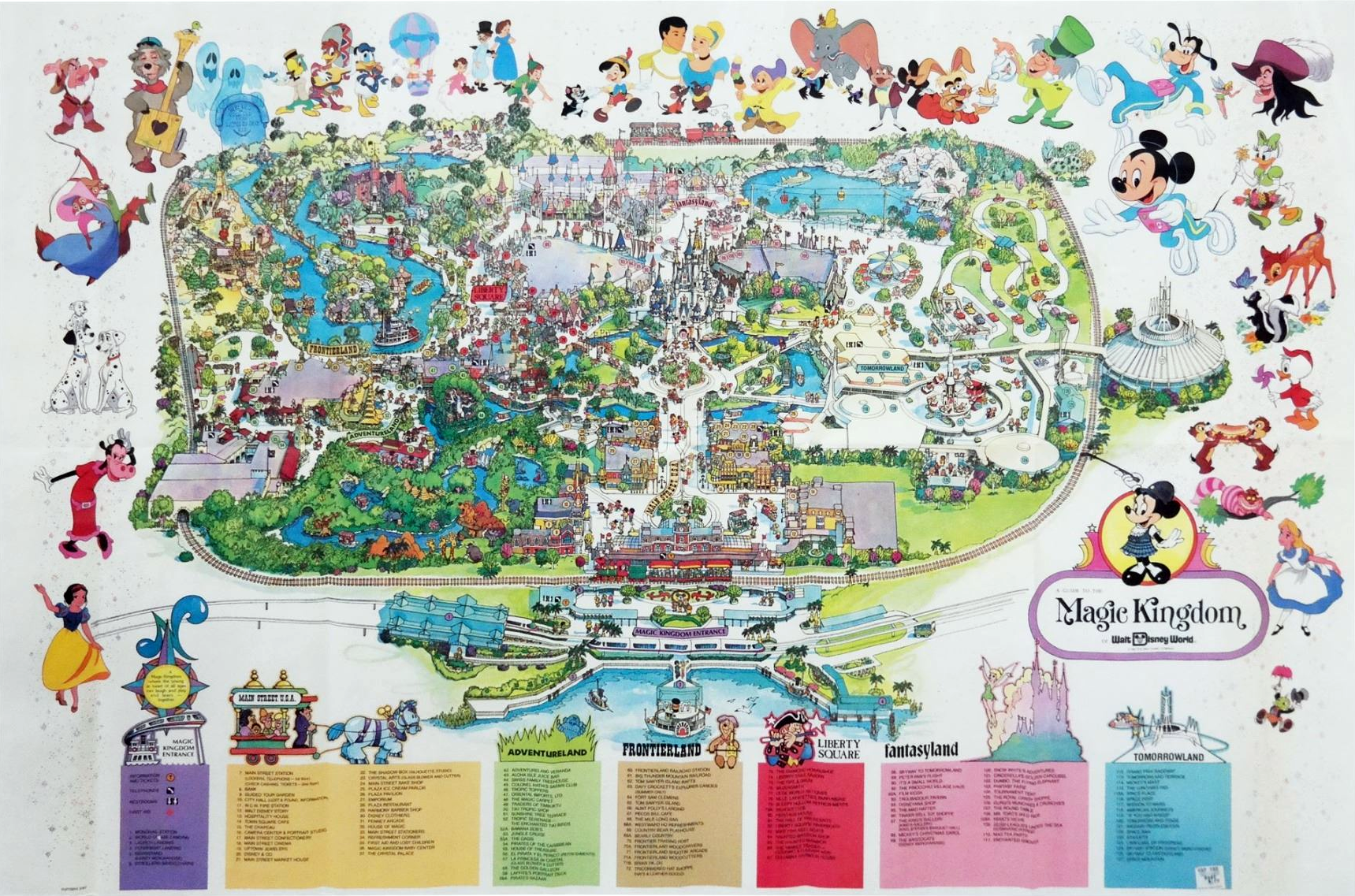
A 1987 map — not of Disneyland but of Disney World’s Magic Kingdom, but you get the point.
However, Audreau makes a fairly convincing argument that this SMB3 element more likely grew out of a creative give-and-take the series had with Legend of Zelda.
[I]n 1986 and then in 1987, three Famicom games expressed the idea that an adventure could be developed within a united, palpable world spread over several successive screens and offer the freedom to wander and explore. Dragon Quest (Enix, 1986) and Final Fantasy (Square, 1987) were among them, but so was The Legend of Zelda by Miyamoto and Tezuka.
The new hobby of Mario’s father consisted of suggesting to his team that they borrow elements from one game and use them in another. The Legend of Zelda: The Adventure of Link, for instance, was based on a mix between Zelda and Super Mario Bros.. From the former, it kept the big map seen from above as well as the items, dungeons and the exploration. From the latter, it took the side view, the ability to jump and the big character. The only real difference was how the monsters were killed: Mario squashed them while Link slew them with his sword. This mix of genres convinced the team, and the very concept behind Zelda 2, with its switch between a world seen from above and levels seen from the side, was used again almost identically in Super Mario Bros. 3.
Magic Motion Rides
Super Mario Bros. 3 has two types of auto-scrolling stages: the airship ones that end in a fight with a Koopaling and the ones in the Dark World where Mario has to traverse Bowser’s army tanks or naval ships. Knorr’s book points toward another writer, Raphaël Lucas, who compared these stages to the various dark rides at Disneyland that impose motion on riders, forcing them to experience the attraction at predetermined speed.
Translated from French, the passage from a 2013 post on the blog Geek-o-Matick reads as follows:
A trip to Disneyland in 1987 left its mark to this day, even in the latest iterations of the series, such as the semi-open world map where Mario (or Luigi!) moves more or less freely from zone to zone — like a visitor in the different areas of Disneyland — or the levels offering different challenges, settings, and atmospheres (deserts, meadows, etc.), or even the wooden ships or tanks, directly inspired by the pirate ship from Pirates of the Caribbean.
You may be unsurprised that I question Lucas’s word choice of directly — or I guess directement in the original French. I suppose it’s possible that Pirates of the Caribbean might have inspired the physical structures you see in the game, though I feel like I could get a whole post out of the evolution of the concept of steampunk-style airships in western culture, in Japanese pop culture and then video games in general.
The major difference between these SMB3 stages and Disney dark rides is that the latter shows you various tableaus as you pass by. That’s the whole point of them. And that seems like a very central element to be missing from the SMB3 version, if it’s even meant to be a version at all. In any case, elsewhere in her book Knorr also likens the Koopaling airships to Captain Hook’s ship in the Disney version of Peter Pan, which also flies once sprinkled with Tinkerbell’s fairy dust.
Later in the passage, however, Lucas acknowledges that there was a precedent for auto-scrolling stages long before SMB3.
Beyond its undeniable artistic flair and simple graphics, Super Mario Bros. 3 finally plays with some of the franchise's established conventions. While SMB2 USA featured bidirectional scrolling (allowing players to backtrack), Miyamoto now uses this very tool — scrolling — to energize the 2D presentation of his plumber’s adventures. In certain missions — the fortresses, for example — the scrolling advances relentlessly, imposing the level’s rhythm on the player, who, until then, had been the one dictating it. This idea was undoubtedly inspired by shoot-’em-ups and their inexorable advance toward a boss waiting at the end of the level, or perhaps by the linear attractions of Disneyland, the rides and roller coasters, with their straight lines and dynamic motion imposed on the visitor.
For what it’s worth, 1981’s Jump Bug is often suggested as the first platformer game to feature auto-scrolling, but *every* stage auto scrolls. Unless I’m mistaken, SMB3 is the first platformer title to have a handful of auto-scrolling stages among the regular stages where the player controls the rate of progress.
Lands, Worlds and Everything in Between
If there was one concept that the Super Mario series might have inherited from Disney parks, I was willing to bet that it would be the notion that the next step up from a land would be a world. Disneyland, after all, was succeeded by the bigger park in Florida, Walt Disney World — more commonly just referred to as Disney World. And this would seem to be paralleled by 1989’s Super Mario Land being one excursion to a new, self-contained region previously not explored, and then 1990’s Super Mario World being that again, just with the region in question being much bigger.
I posted this thought to Bluesky last week, thinking I really had something, but I was surprised by people who responded saying that it was actually just a natural progression: land being synonymous with nation and therefore part of the world, and then the world being the bigger thing comprising all of the nations. And sure, I get the point being made, but what I’d humbly suggest is maybe these people have lived with the Disney land/world binary for so long that they’d just taken it for granted that you go from one to the other and skip all the stages in between.
Support this site: on Patreon! • on Kofi!
Like, yes, we often use land in English to mean nation — for example, Thailand is the land of the Thai people and Switzerland is the land of the Swiss people. But we use it in other ways too. There’s Cleveland and Maryland and Dixieland and Auckland and Oakland, to name just a few of the examples that use that -land suffix but aren’t sovereign nations. And then there’s a great many common nouns that use it as well — grassland and fatherland and heartland and fairyland and hinterland, again just to name a few. And absolutely none of these springboard naturally to larger versions that use any form of world.
But let’s pretend that both Disneyland and Super Mario Land are both evoking the sense of the -land that does imply nationhood, which I don’t think is necessarily true but let’s just go with it. There are gradations between a specific land and the entire world that are being skipped over, if you want to get really technical about it — and I always do! But even then, the word world didn’t always mean “the entire globe” the way we tend to use it today, even while land was, more or less. The idea of world being the next step up from land is relatively new and probably unique to only some senses of these words.
So did Super Mario Land and Super Mario World get their names following a precedent set by Disneyland and Disney World? I would guess yes, actually. In fact, of any of the ways that famous Nintendo field trip might have impacted the Super Mario series, I would say this one seems the most likely to me. And if you’re one of the people looking at these examples and saying, “No, this is just a logical way to label the increase in size and scope,” I would say that I understand why you might think that but you may be a victim of living in a reality where Disneyland and Disney World and Super Mario Land and Super Mario World just made this progression so baked into culture that it seems like a given. It’s not, really, and if you look into the history of the words involved, you might be inclined to agree with me.
To answer the question posed in the title of this post in terms of what we know, based on comments from Nintendo employees, the answer is probably disappointing: we don’t know for sure. But using the work of other video game historians who have come before me, plus a little critical thinking, I think it’s fair to make some educated guesses about what did figure in versus what might just be similar as a result of happenstance. And for the record, the two I think are most likely are the design of the map screen castles and the notion that you go from lands to worlds, even if that second one wouldn’t be realized until the game after Super Mario Bros. 3. That said, I’m fully open to hearing from anyone else about evidence I might have misinterpreted or whole parallels I didn’t even look into.
I enjoy guesting on podcasts because conversations with real, live people can make me arrive at new conclusions about something in a way I’d never get to on my own. In this case, Ada had me on Overworld as a guest who already knew a lot about Super Mario Bros. 3, but she ended up introducing me to this new factoid, which led to me writing this post, which at the very least has taught me a little bit about Super Mario Bros. 3 as well as a great deal about all the culture around these games. The result is something that couldn’t be more on-brand for this blog, because I got into the weird ways video games interact with culture at large — and then, you know, yell at people for not knowing enough about etymology.
In the end, I ended up being impressed by all the parallels shared between the Super Mario series and the Disney empire. But given how massive these entities are and how long they’ve been competing with each other for our attention, I was also surprised that I couldn’t point to more that the former might have borrowed from the latter. Surely, there is more of this conversation to be had.
Miscellaneous Notes
I don’t want to jinx this post, but recently the posts I’ve done to promote podcast appearances have done exceedingly well, at least in terms of clicks for me. The previous posts that began as means to trick people into listening to podcast appearances but ended up becoming actual posts of interest in their own right include “Why Does Luigi Fight Ghosts With a Vacuum Cleaner?” and “What’s the Correct Way to Pronounce Mario’s Name?” I hope this one does well too. It helps that it’s Mario-related, of course, but I maintain that this is not a Mario blog.
Neither book sourced in this post included quotes about an explicit connection between any Super Mario game and any Disney park. The closest I could find was in Knorr’s book, with Shigeru Miyamoto comparing the creation of Super Mario 64:
It was as if we were building up an amusement park. We first found our location. We purchased the mountain, and afterward, we thought of some interesting things we wanted to implement on the mountain.
However, the quote comes from Steven L. Kent’s The First Quarter: A 25-Year History of Video Games, which is sold now in updated form as The Ultimate History of Video Games. In the original context, it’s clear that he’s not talking about Super Mario 64 in general but specifically that game’s ice area, Cool, Cool Mountain:
One thing that was different with Super Mario 64 was [that] we wanted to make some snow mountain, a really big one. That came first, and afterward we asked [each other] for the ideas [sic] about how to make use of this mountain. It was as if we were building up an amusement park. We first found our location. We purchased the mountain, and afterward, we thought of some interesting things we wanted to implement on the mountain.
All of which is to say that no, I don’t think amusement parks — Disney-owned or otherwise — were top of mind during the creation of any Super Mario game. Of course, now the existence of the Nintendo-themed parks at Universal Studios make it next to impossible to find quotes about this subject. Let me know if you know of any interviews I’m not finding.
While it seems like Disney was the first to establish the idea that the “land” version of something should naturally progress to the “world” version, there is technically a little snowflake-shaped asterisk on this store in the form of Holiday World, the Indiana theme park that was previously known as Santa Claus Land. The park opened in 1946, nine years before Disneyland would open. It tends to get its name-dropped in conversations about lands and worlds because it eventually changed its name to Holiday World, but this didn’t happen until 1984, thirteen years after Disney World opened. So if anything, it led Disney in the beginning but followed Disney in the end.
It’s not often discussed as such, but the 1993 live-action Super Mario Bros. movie is technically a Disney colab. The U.S. theatrical release was distributed by Buena Vista Pictures, which was responsible for everything from iconic Disney movies such as Mary Poppins and 101 Dalmations. I do wonder if Disney might have invested more in Nintendo if the 1993 film had made more money. Perhaps the Super Mario-themed amusement parks might have gone up on Disney land instead of land owned by Universal.
And for what it’s worth, the Before Mario blog has a great look at various products that Nintendo put Disney characters on before the company got into the video game business, including board games and playing cards.
Listen to the Overworld podcast, of course. It’s on Spotify and on Apple Podcasts and all the places you’d normally find audio content. If you’re a listener of my now-former podcast, Gayest Episode Ever, you’ve heard Ada’s voice before. As Ada-Rhodes Short, she was a guest on two different episodes — one about Dorothy’s trans sibling on Golden Girls and another about how a pro-gay marriage Simpsons ep got really transphobic. Along with Henry Giardina, Ada hosts Totally Trans, a podcast about trans representation in TV and elsewhere, and Overworld is part of that larger podcast network.