

When Chris Plante (no, not that one) asked on social media if he knew anyone who might consider themselves a Luigi expert, I humbly volunteered. Obviously, I’m a Mario expert and a Birdo expert, but in reading and writing about these games all these years, certainly I learned more than the average bear about the other brother. Right?
Hopefully yes! Because I recorded the episode of Plante’s Post Games podcast, which is now live in both audio form (here) and video form (below).
I’d like to think I gave good podcast, and my promise as a guest is that not only will I promote the episode on social media, but I will also promote the episode via a post on this blog. And this is that! The Post Games episode is about Luigi’s Mansion, and the issue I’m choosing to explore is one that’s perhaps a little more complicated than it might seem at first glance: In Luigi’s Mansion, why does Luigi fight ghosts with a vacuum cleaner? The answer that most people would offer is probably “Because of Ghostbusters, doy,” but I’m writing this out because I wanted to see if this actually checks out.
For starters, what Luigi’s Mansion does is simpler than what Ghostbusters does. In the Ghostbusters movies, it’s not the handheld device that does the vacuum action. The team walks around wearing the Proton Packs, which is the backpack unit plus the handheld “wand” that shoots out the proton beam. But then there’s also the trap that sucks the ghost off. That trap is a separate thing, used in concert with the Proton Packs.
Here, in case you need a reminder, look at the scene from the original Ghostbusters in which the crew, pre-Winston Zeddemore, take down Slimer.
If this wasn’t made clear enough by the live-action movies themselves, it would have been reinforced by the cartoon spinoff, the Real Ghostbusters, as well as by the vast array of toys that supported either wing of the franchise. The traps were usually sold separately, and while it’s unfortunate how capitalism demanded that our parents had to spend more to buy us the full set, it did at the very least remind Ghostbusters fans that these were two separate devices: the thing you point at the ghosts and then the sucker-upper.
Now, it would be perfectly logical to step over this detail; you don’t need both devices to make it clear that you’re referencing Ghostbusters. If you’re just kids playing Ghostbusters in your backyard, you can get that across by lugging your mom’s vacuum cleaner around, but that’s also true if you’re a movie or a TV show or a video game referencing Ghostbusters in a more formal context. You might even collapse the Proton Pack and the trap into one device just because you forgot that the movie made them two separate things. It’s probably some combination of these reasons that resulted in the live-action Casper movie — released in theaters in 1995, eleven years after the first Ghostbusters — uses a household Hoover as the primary means of capturing ghosts.
But that’s not to say that I think Luigi’s Mansion is riffing on a Christina Ricci movie. No, I think there’s something deeper going on here.
For one thing, even though Ghostbusters separates its apparition apprehension devices, it should be noted that the franchise title sounds a lot like the name that Black & Decker gave to its handheld vacuum cleaner, the Dustbuster. This product was introduced in 1979 and proved successful enough that you can still buy handheld vacuum cleaners with that branding even today.
The Dustbuster would have been very much in the public consciousness at the time the first Ghostbusters movie hit theaters, and regardless if one had much to do with the other, I think people might have associated the two just because they sound alike. Case in point: Back in the day, I can remember singing my own version of the Ghostbusters theme about our household Dustbuster. It… wasn’t good, especially, but I’m pretty sure I’m not the only one who did this.
If you search online to see if there’s any connection between the Dustbuster and Ghostbusters, however, you’ll be told that the similar names are just a coincidence, with the film franchise taking its name from The Ghost Busters, a 1975 live-action children’s show about detectives who investigate the paranormal. I’m not it’s actually a coincidence. Vanity Fair’s 2014 piece on the history of the film claims that the movie name was picked before the creatives involved realized it had already been used for something else.
To the team’s chagrin, they discovered that there had been a short-lived Saturday morning mid-1970s children’s show called The Ghost Busters, creating a legal barrier to use of the name. Already deep into the shooting, they had to create several different signs bearing the name of the fictional operation to post above the front door to the Ghostbusters’s firehouse headquarters. Alternate names included Ghoststoppers and Ghostbreakers. The issue came to a head when the team shot a scene in which hundreds of extras stood on Central Park West shouting “Ghostbusters! Ghostbusters!” over and over again. Joe Medjuck recalls: “I got on a payphone and called Burbank and said, ‘You guys have got to clear that name.’” (It was eventually cleared for film use.)
But in his 2022 book A Convenient Parallel Dimension: How Ghostbusters Slimed Us Forever, author James Greene Jr. includes quotes from people who claim that Dan Aykroyd took the title knowing that it had already been attached to an existing project.
Erika Scheimer, daughter of Filmation founder Lou Scheimer, insists that the Aykroyd Ghost Busters was no case of parallel thinking. “[Our] Ghost Busters was a teenage or college kid cult show,” she says, “and the guys on SNL loved it. They absolutely stole the concept and refused to get the rights until we contacted them.” A corroborating story came from Kathy Burns, who worked as a secretary at Universal Studios in the early ’80s. As Burns told filmmaker Anthony Bueno, one day during that period she overheard a visiting Aykroyd talking about the paranormal comedy he was planning. When Aykroyd referred to this project as Ghost Busters, she had to interject; Kathy was married to Bob Burns, the actor who played the gorilla on the Filmation Ghost Busters. She told Aykroyd he couldn’t use that name because of the TV show. Allegedly, Aykroyd replied, “Yeah, but we’ll just give ’em a million dollars and that’ll be the end of it.”
(Esquire’s oral history of Ghostbusters from 2014 doesn’t really weigh in on this matter one way or the other, for what it’s worth.)
I don’t know what to think of this apparently conflicting information, but the long and short of it is that we don’t know why Aykroyd changed the title of the title to Ghostbusters after having called it Ghost Smashers in his original script. As I see it, there are four possibilities:
The title Ghostbusters was inspired by the original Filmation series.
It was inspired by the name of the Dusbuster.
It was inspired by one and then supported by the existence of the other.
It was inspired by neither the Filmation series or the Dustbuster but instead came about because there were already a handful of similar terms in English ending in -buster — among them, gangbuster, blockbuster, broncobuster, ballbuster and crimebuster.
Regardless of which was the case, I’d bet that people heard the title Ghostbusters and thought about the Dustbuster anyway, and the association with vacuums becomes part of this franchise (and the pop culture works that reference it) regardless. As evidence of that, we have the 1984 Activision video game adaptation of Ghostbusters, in which one of the options for outfitting your vehicle is a ghost vacuum.
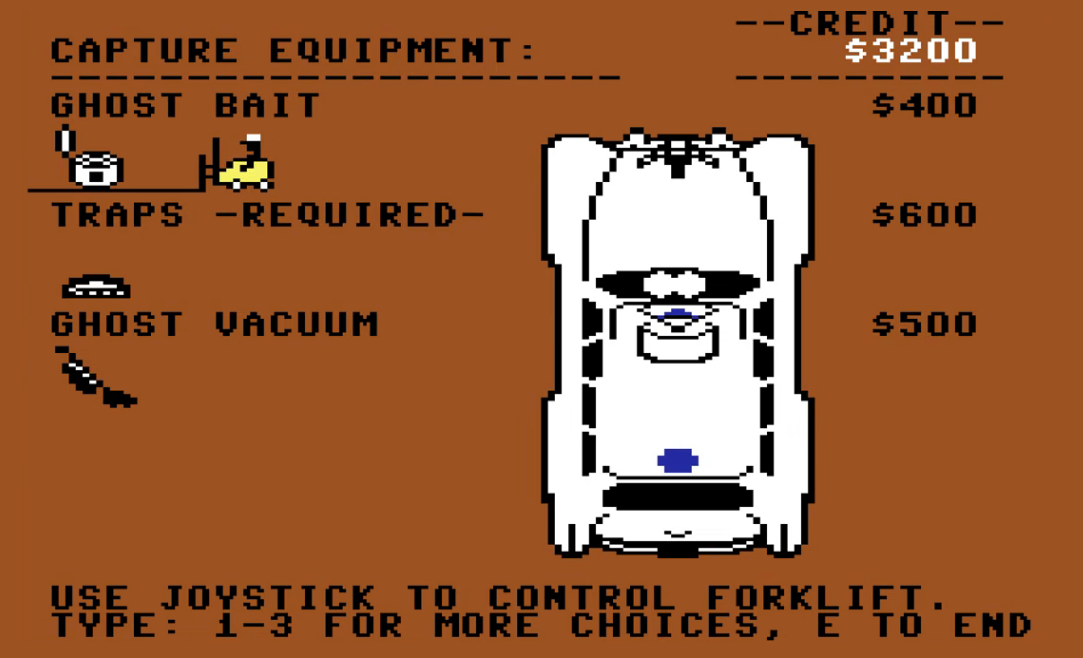
Granted, it’s an upright and not a handheld, but you try drawing a recognizable handheld vacuum with limited pixels and see how you do.
This device is unique to this game, at least until an episode of the cartoon that aired in 1990 featured something called the Ghost Sucker. A different invention, the less suggestively named Ghost Vacuum, would later debut in the follow-up series Extreme Ghostbusters in an episode that aired in 1997, and it just seems like even the actual Ghostbusters series can’t help incorporate vacuum cleaners eventually.
In fact, there was even a ghost vacuum in the “fake” Ghostbusters cartoon — which is to say the 1986 animated adaptation of the original Filmation show, which premiered on American TV in September 1986, just days before the animated adaptation of the live-action movie Ghostbusters, which changed its title to The Real Ghostbusters in an effort to make it clear that it was the one affiliated with the movie. Disclaimer: I have no idea what the fuck is happening here, but you can’t say that’s not a ghost vacuum.
At this point, I was just sitting at my desk, thinking about how ghosts and vacuum cleaners seem destined to be together, when all of a sudden it occurred to me to look into whether there’d been any sort of interaction before the 1984 Ghostbusters. Because if there were, it’s possible that everything I have mentioned so far might trace back to that. And even if the live-action Ghostbusters movies don’t actually fight ghosts with vacuum cleaners, maybe that seed of an idea resulted in Dr. Venkman and crew fighting off the paranormal with what amounts to a high-tech stand-in for a ghost vacuum cleaner.
Right?
Well, that pre-Ghostbusters evidence does seem to exist in the 1942 Tom and Jerry cartoon “Fraidy Cat.” The fourth short featuring the cat and mouse duo, “Fraidy Cat” begins with Tom getting rattled by a scary story on the radio, and so Jerry responds by trying to trick him into thinking a ghost is in the house. Jerry turns on a vacuum cleaner that has a white sheet draped over it, and to Tom it looks like a ghost. What’s more, Jerry then chases Tom with the vacuum cleaner, which sucks out his nine feline lives one by one — each represented as a ghostly, translucent version of Tom — until he can pull them back into himself.
Here, watch:
While this is not exactly fighting ghosts with vacuum cleaners in the way you see in Luigi’s Mansion, it is somewhat close to that. And while it might seem like a bit of a leap, both content-wise and era-wise, between this and the high-tech version of it you see in Ghostbusters, I’m going to return to one of my previous posts to explain why I think this may be the origin of this trope. Back in August, I attempted to answer a reader’s question about why mice are often associated with bombs in Japanese-made video games. On my Bluesky post and in the comment section to that post, people pointed out that I may have overlooked Tom and Jerry as a possible origin for this association. Not only was Jerry depicted as holding a bomb in a piece of key art that would have been familiar to Japanese viewers, but also since the debut of the dubbed version of these cartoons in 1964, Tom and Jerry shorts have become more popular in Japan than most westerners might realize, giving their antics outsized importance on Japanese pop culture. Notably, a 2005 ranking of the 100 most popular anime by the Japanese station TV Asahi listed only one non-Japanese series: Tom and Jerry (a.k.a. トムとジェリー or Tomu to Jerī) at no. 58.
Does this mean that all this business with ghosts and vacuum cleaners on either side of the Pacific might result from this one scene from this one Tom and Jerry cartoon? Maybe? Maybe not. But given that western Boomers like Dan Aykroyd and Harold Ramis would have also grown up watching Tom and Jerry, it’s certainly possible that Ghostbusters and Luigi’s Mansion both might have been riffing on ideas put into public consciousness by this cartoons decades beforehand.
Or, you know, the reason Luigi’s Mansion features a vacuum clear as a central gameplay concept could have been as a means to show off the technical capabilities for the Gamecube, which could simulate wind and dust movement in a realistic way that no previous Nintendo console could. In fact, in an interview given for the official Nintendo Power guide to Luigi’s Mansion, director Hideki Konno claimed that one programmer worked for six months programming the physics of dust particles.
There’s also that, though I suppose that only explains the vacuum itself and not the presence of ghosts as well. Unless the connection was so baked in culturally that the need to show off dust resulted in the implementation of a vacuum which resulted in the implementation of ghosts, just because those things apparently go together.
Miscellaneous Notes
If you want to support Chris Plante’s work on Patreon, you can listen to a bonus segment that is not part of the public feed version on my episode. This one is about the strange spot Luigi occupies in meme culture, and if you want to get into niche Weegie fetish art and the strange parallels between Mario’s brother and real-life assassin Luigi Mangione. Listen to that here.
I feel like it’s an underexplored facet of the Super Mario series that E. Gadd is responsible for the creation of the Poltergust, F.L.U.D.D. and Bowser Jr.’s magical paintbrush. You have to wonder if Gadd is perhaps a morally gray arms dealer who’s willing to invent weapons for anyone who needs them?
Fun fact: The Erika Scheimer quoted in the book about Ghostbusters earlier is also a voice actor who played the roles of Queen Angella, Perfuma and Peekablue in the original version of She-Ra: Princess of Power.