
In this post, I will do something that years of being online have taught me not to do: admit that I didn’t notice something. I’ll explain why this is extremely brave of me in the miscellaneous section at the end of the post, but for now I’ll just get straight to the point: Yeah, I somehow never put it together that there’s a very obvious Halloween thing happening in Super Mario World. I suspect I’m not the only one who knew of this thing and did not identify it as specifically Halloweenish, however.
I speak, of course, of the secret that in the original, SNES version of the game is unlocked by beating the Special Zone, the collection of especially challenging stages you access via the Star Road. Once you beat the eighth and final stage, the world map gets a different look; essentially, everything that was green before becomes brown, save for the sixth area of the game, Chocolate Island, which is now a minty green.
Support this site: on Patreon! • on Kofi!
This is usually interpreted as the seasons having changed. The Super Mario Wiki terms this change “fall,” but that’s never explicitly called that anywhere in the game itself. In fact, the original Japanese term for this aesthetic shift is just 裏ワールド or ura wārudo — figuratively “hidden world” but literally something like “reverse side” or “other side,” with 裏 or ura being a term that’s likely familiar to Legend of Zelda fans.
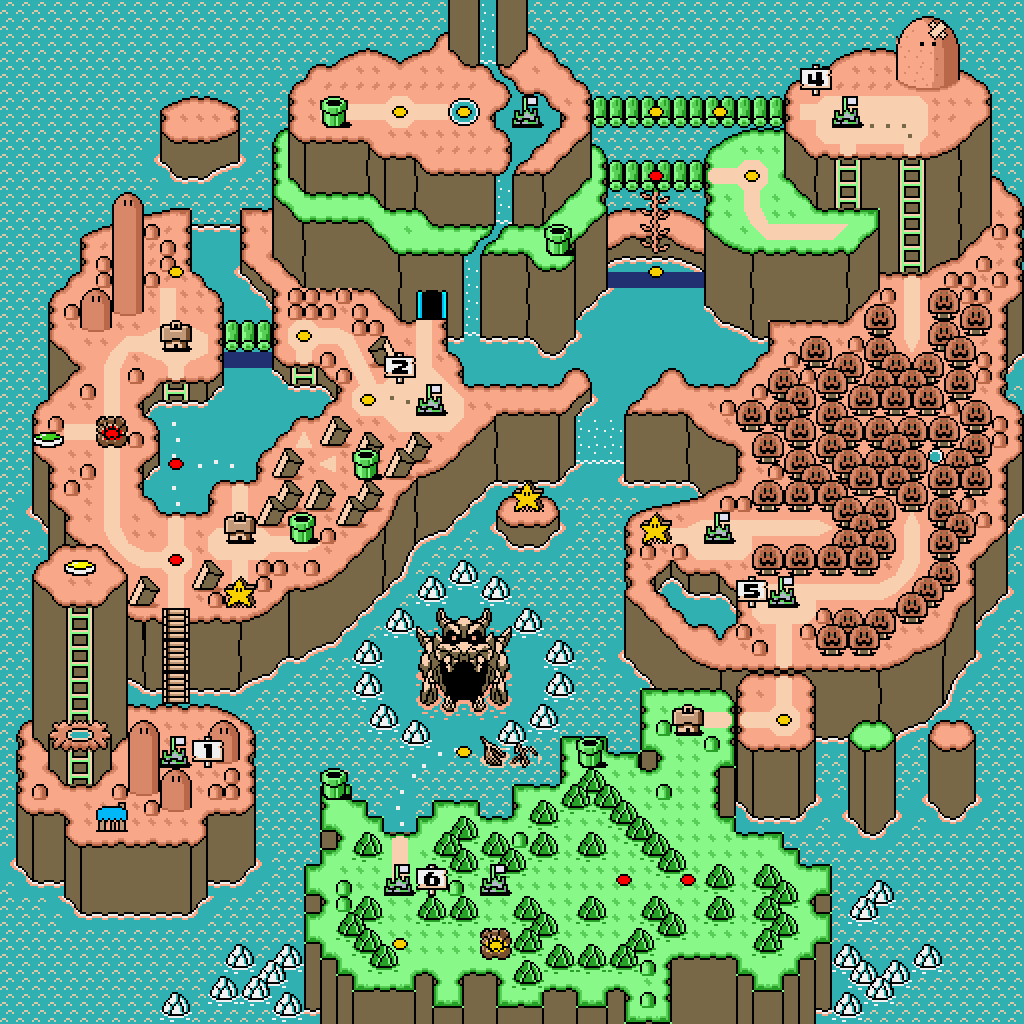
“Hey kids! Would you like to see your colorful overworld map reimagined in drab ‘70s colors?”
But that’s just the world map; the color shift does not happen in the game’s actual levels, but instead certain enemies take on a new appearance. The Koopa Troopas are suddenly wearing Mario masks, for example, the Piranha Plants become pumpkins and the Bullet Bills are replaced by Pidgets — a black bird enemy from Super Mario Bros. 2.
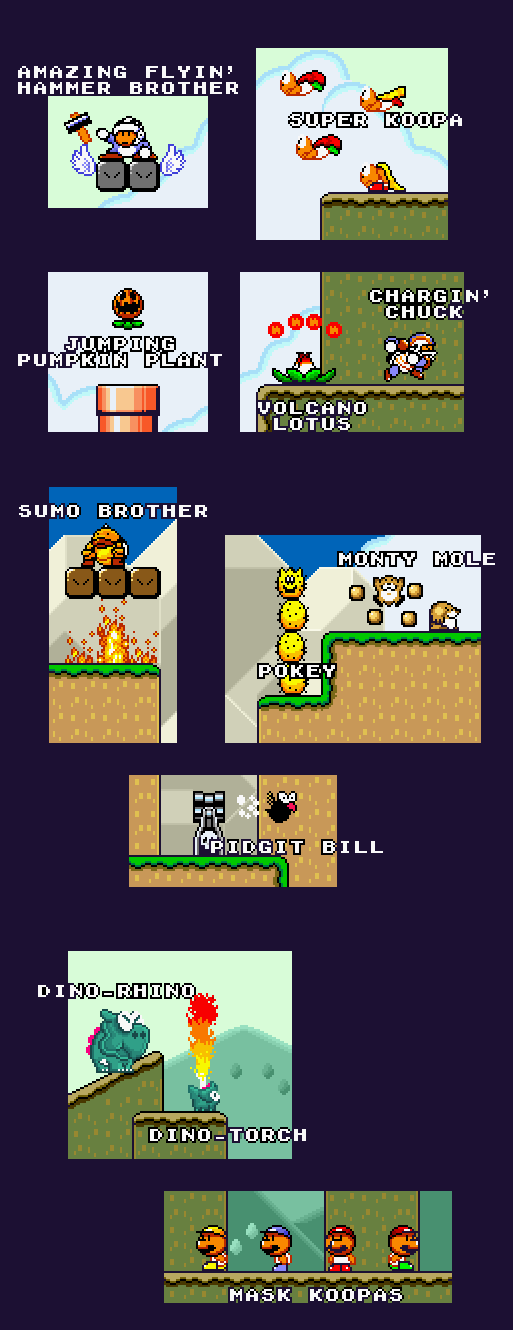
And yes, the end credits do reflect the changed enemy sprites. (Via the Video Game Museum.)
Taken altogether, it just seems like beating the Special Zone gets you a weird version of Super Mario World, with different colors and three altered enemy designs, to the point that I always liked the game less once this change had been triggered. Maybe that’s why I never really thought about it a whole lot, but what was apparent to some players back in the day is that this amounts to a mini Halloween celebration in the game. Not only does the color shift put the season around the time of Halloween, but also the Koopa Troopas are wearing Mario masks because they’re dressed up in costume like trick-or-treaters. The Piranha Plants don’t just look like pumpkins — they look like jack-o’-lanterns, and the Pidgets are getting pulled in not necessarily because anyone liked them in Super Mario Bros. 2 so much as they look like the kind of crow or raven decorations you might put up around this time of year.
I tried to look around to see if this had ever been discussed in any interviews with the team behind Super Mario World. As near as I can tell, it hasn’t come up, and therefore I suppose we can’t say with certainty that this Halloween read is accurate. I do think it is, however, even if I didn’t process it this way until a recent conversation on this site’s Discord. And I’m willing to bet I’m not the only one who didn’t put two and two together until way after the fact.
Again, if this is something you understood right off the bat, you’re probably saying “no duh.” But if you’re one of those who didn’t get that this surprise was Halloween-themed, I’d say it might be a result of it being a fairly minor shift overall. Again, landscape changes on the map screen only; the background of the levels looks the same. But it’s in the levels where you’d see the altered enemies, though rarely would you see the three of them in close enough proximity to make it look like a Halloween party.
When Super Mario World was re-released for the Game Boy Advance as Super Mario Advance 2, the transition was triggered not by beating Special Zone but by discovering all 96 exits in the game. In fact, once you cross that last exit, you get a special cut-scene that shows Mario and Luigi literally throwing the masks from a hot air balloon for the Koopa Troopas to collect.
Two more enemy changes were thrown in, but they don’t necessarily make the Halloween theming any more obvious. In this version, Goombas turn yellow and wear sunglasses and Pokey’s various segments are now sharp, bladed things that the Super Mario Wiki terms saws but I see more as razor blades or something.
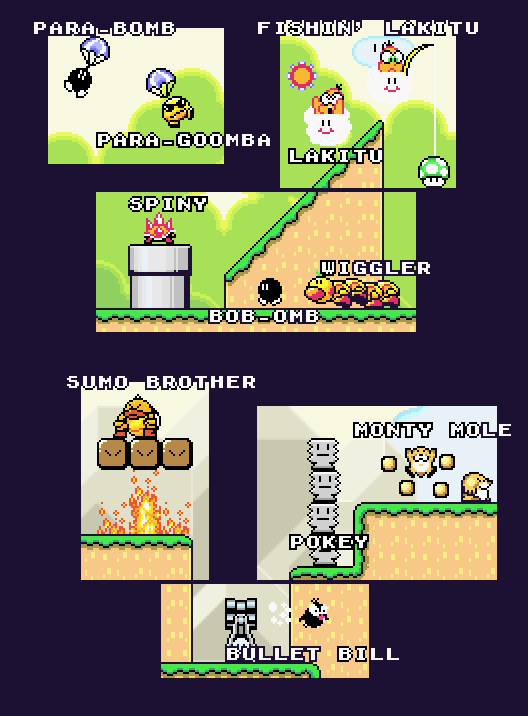
Although the Pidgit is misidentified in this version, it was given a flapping wings animation, so that’s something. (Via the Video Game Museum.)
Notwithstanding any urban legends about candy, neither of these new additions makes the aesthetic shift seem any more Halloween-related, I don’t think, so I wouldn’t say that they were thrown in to make that intention clearer. And even then, it’s still a fairly small shift. If they wanted to change the sprites for every enemy so they all appeared to be in costumes, that might make it seem more like a Halloween celebration. But as it stands, even in this slightly more expanded version, it’s not a whole lot — just enough to muck up the game’s default aesthetic, if you’re not super into it.
I’m writing this post, I guess, to say “Hey, isn’t this weird?” but also inquire if anyone else has any further insight — either into anything the developers have said that might explain why it exists or anything you’ve noticed that I haven’t mentioned yet.
I will say that it seems like a precursor of sorts to Pumpkin Zone, a more explicitly Halloween-themed area in Super Mario Land 2, which was released two years after Super Mario World and which was designed very much in that game’s image. This area’s levels are populated with a mix of yokai and western monsters, even including the Masked Ghoul, whose Japanese name, J・ソン or Jei-son, makes it clear that it’s referencing the Friday the 13th franchise. To me, Pumpkin Zone makes it clear that creatives at Nintendo were well aware of American Halloween traditions and could cobble together a vibe that unmistakably pulls from that season.
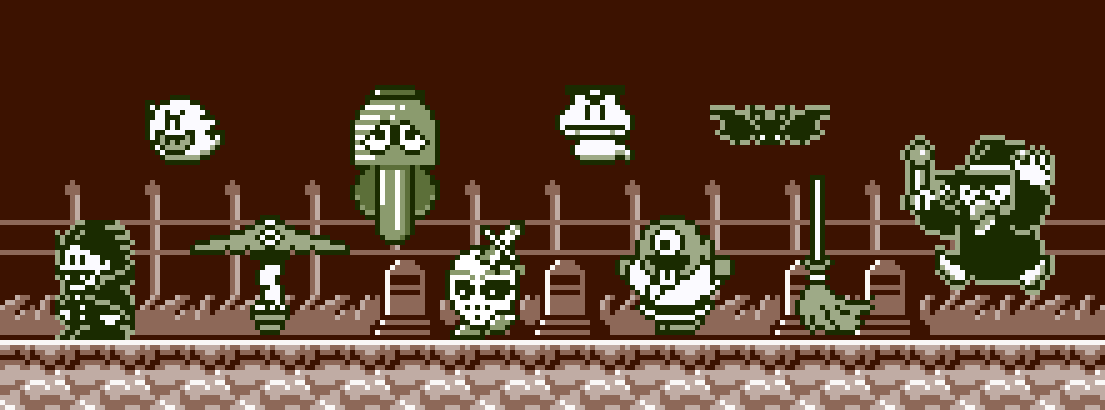
The Halloween crew from Super Mario Land 2’s Pumpkin Zone, left to right: Kurokyura the vampire, a Boo, Karakara the karakasa-obake, Bero the chōchin-obake, the aforementioned Jason Voorhees knockoff, a Ghost Goomba, Kyororo the hitotsume-kozō, Minikyura the bat, Rerere the witch’s broom, and finally the boss herself, Sabāsa the witch.
But that leaves me wondering why the Super Mario World version of Halloween, if that’s what it’s meant to be, is so subtle by comparison. If it was thrown in at the last minute, then it seems like Super Mario Advance 2 would have been the place to change that and make it more substantial, but the two little extra changes don’t seem like enough. But if it’s not supposed to add up to a nod to Halloween, how the hell else are we meant to interpret it?
What do you think?
Support this site: on Patreon! • on Kofi!
Miscellaneous Notes
The reason I don’t like admitting to not having realized something is that doing so often puts me in contact with a very particular sort of online person who expresses surprise at this in an annoying way. As an extremely online person for the past 25 years or so, it is very unsurprising to me when I encounter someone whose experience of a given thing is different than mine. In fact, I assume that other people will have a different experience, because the internet has been very good at making me interact with people who are nothing like me. This kind of thing is one of the reasons I retired my podcast earlier this month. It was about gay episodes of old sitcoms, but I am someone who never thought Will & Grace was funny or good, and people online (mostly on Facebook) would react like I told them I didn’t like chocolate. (I also don’t like chocolate.) So I’m writing this in hopes that it will prevent someone from responding with something like “How could you have never noticed this???” I have gotten this before — in the comments on this post and this post, to point to two recent incidents — and my response to this response is always confusion about how I’m supposed to react. Am I supposed to agree with you? Apologize? Say that I think you’re smarter than me? My only real takeaway is that the person does not have enough practice understanding that other people often experience the world differently. If someone hasn’t come to the same conclusion you have, that doesn’t mean they’re stupid or you’re smart. It probably means they were just noticing something else — quite possibly something you did not notice.
In researching this, I learned that the Japanese name for Chocolate Island is a pun of sorts that doesn’t really translate to English. In Japanese, its name is チョコレー島 or Chokorē-tō, with that last syllable making the name a sort of portmanteau. The katakana rendering for chocolate would be チョコレート or chokorēto, but in this case the final character has been swapped out for 島 or tō, meaning “island.”
There’s a bit of a mystery involving this game’s aesthetic shift and what would appear to be a sort of forerunner to Super Mario Bros. Wonder’s flower-headed Poplins, appearing decades before their actual debut. The Super Mario Wiki page for the fall shift states that one of these guys may have been intended as the alternate look for the Piranha Plant. The source for this is a now-deleted Twitter post, so I found the poster on Bluesky to ask if this was accurate.
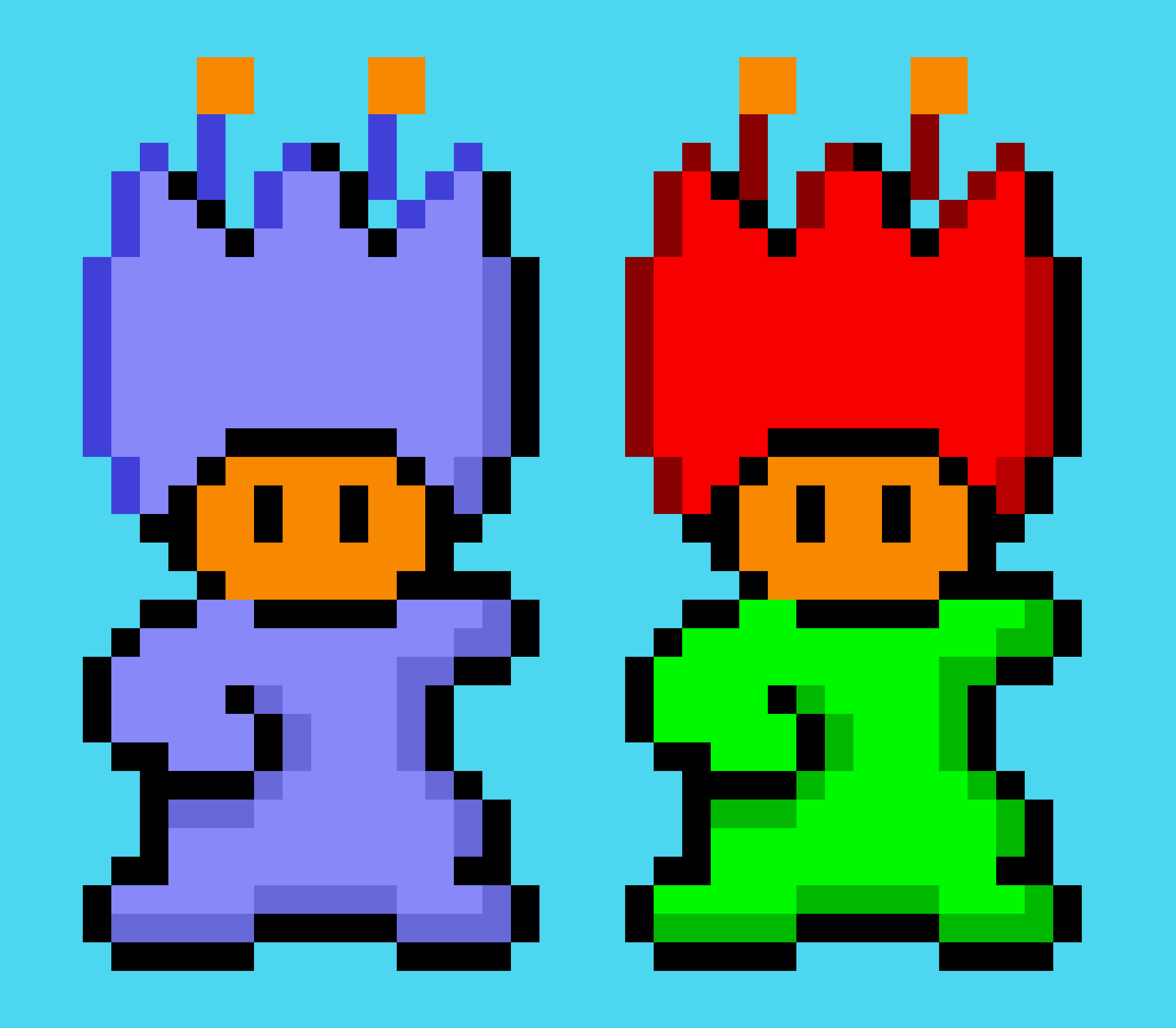
He says no. He says he found the blue flowerhead sprite in the files related to one of the many Nintendo data leaks. It’s now posted at The Cutting Room Floor, although with different coloring, along with all the other leaked sprites. As he remembered it, he only guessed that the flowerhead guy might have been an alternate design for the Piranha Plants, but he now realized this character was most likely an NPC. So there you go, I guess. However, I would love to hear if these guys eventually ended up rematerializing in Super Mario Bros. Wonder three decades later.