

This past August, the fortieth anniversary of Metroid came and went with little notice from Nintendo. But because this site has become a place where I write about urban legends in video games, I thought I’d write about the mysterious Justin Bailey, who also turned forty, whether or not he actually exists. Whatever you heard about him back in the day was probably wrong, but that doesn’t mean there aren’t larger lessons that Justin Bailey can still teach us, all these years later.
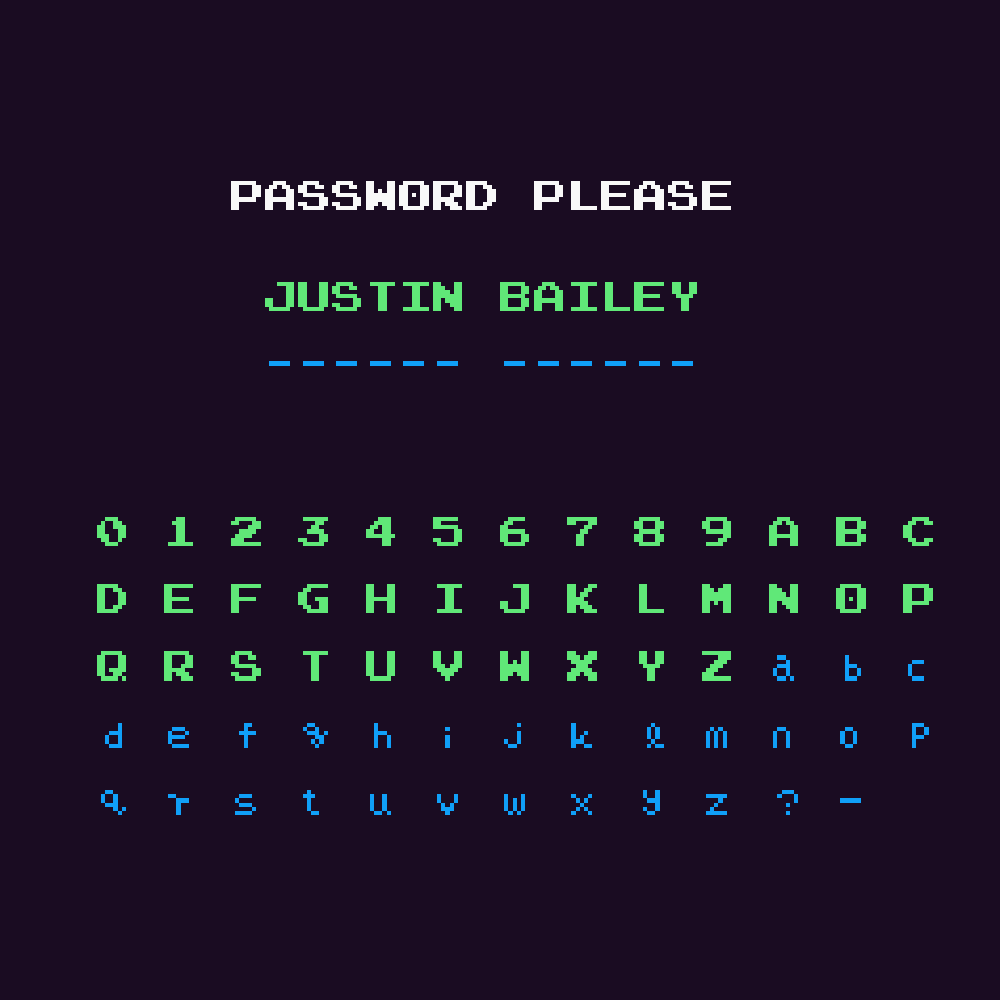
In true urban legend style, I must have learned about Justin Bailey via word of mouth, because I think it pre-dated my subscription to Nintendo Power or any other gaming magazine. But in case you don’t know, entering JUSTIN BAILEY on the first two lines of the password input screen in the original Metroid (and then a series of hyphens below) allowed even the most unskilled player to discover Samus’ secret: This adventurous spaceman was actually a spacewoman, with long, flowing locks and a costume that wouldn’t have been out of place in Barbarella’s closet.

A fun aside: As I mentioned in a previous post, there most likely is a little bit of Barbarella in Metroid.
Normally, you’d have to beat Metroid in a certain amount of time just to see Samus in any state of undress. So if you were not especially skilled in the video game arts back in the day, the Justin Bailey code would be the only way to play as a clearly female version of the character, to say nothing of also having a better-stocked arsenal of items and weapons than you normally start the game with. This was, in video game terms, a big deal. No such equivalent code existed in Super Mario Bros. or Legend of Zelda — and no such surprise gender reveal either. As a result, this is the kind of lore that got passed around. Anyone playing Metroid would hear about Justin Bailey, if not from a gaming mag then from someone on the playground who was way too excited about the prospect of Samus showing off some pixelated skin.
A few years back, Metroid maven Kate Willaert wrote about Justin Bailey on her blog and even attempted to find the real Justin Bailey, figuring that the code could have been discovered by someone who typed in his own name into the password screen to see what would happen. This seems like a plausible origin story to me, but for the purposes of this essay, I’m more interested in how the legion of Justin Bailey believers attempted to understand how this secret code would have been implemented in the first place. Per the thinking of kids not properly schooled in the ways of video game creation, Justin Bailey had to be someone important, otherwise his name wouldn’t be associated with something so powerful that it more or less breaks the game. That would end up not being the case, but you can forgive the assumption, I think, because it mades sense at the time, given the limited evidence to which we had access.
To some, Justin Bailey had to be someone who worked on Metroid, and he inserted himself in it as some sort of “I was here” tag or testament to his video game-creating prowess. To others, Justin was more likely a relation of someone who helped make the game, his name being used as this special code was a sort of in-game shout out. After all, how else would Justin Bailey have known to enter his name in the password screen unless this relative — quite possibly the infamous uncle who worked for Nintendo — had tipped him off?
Knowing what we know now, none of these attempts at explanations make sense because everyone who worked on Metroid was Japanese and therefore the idea that any of them would be named Justin Bailey or would have a nephew named Justin Bailey doesn’t seem especially likely. Back around 1987, when Metroid went on sale in North America, I’m not sure most kids were aware that Metroid, all Nintendo games and most video games in general were made in Japan. I don’t know when we collectively came to understand this — maybe around the release of Super Mario Bros. 3, when coverage of it made it clear that it had already been playable in Japan for some time? Regardless, it didn’t exist as knowledge common enough that we could dismiss those theories at the time. And for what it’s worth, I suppose it could have been technically possible that a non-Japanese employee working at Nintendo’s Washington state office could have snuck in a reference to Justin Bailey. Again, we didn’t realize at the time, but that password screen did not exist in the original Japanese version of Metroid; it was only implemented in the western version of the game because the NES lacked save files the way the Famicom Disk System in Japan did.
Beating the game does allow you to see a credit roll for the people who actually did work on the game, however, and there is no Justin Bailey mentioned, though more than a few staffers go by a nickname or some other pseudonym.
Still others wondered if Justin Bailey was some kind of video game whiz kid who either beat the game first or beat the game in some kind of incredible, decisive way that Nintendo had to make him part of the game. Of course, that wouldn’t make sense if you had access to the first versions of Metroid to his North American shelves, because the code worked right away, complicating the whiz kid timeline. To this, the stupidest kid on your playground might respond with something like, “Okay, what if this Justin was so good at video games that Nintendo just sent him all the games before they went on sale? So he could beat them?” And then I’d say something like, “Oh, shut up, Frankie. Why would they send him free games just because he’s good at games?” And then Frankie would be like, “You don’t know everything, Drew! Mrs. Taylor, Drew told me to shut up because I’m stupid.” And then I’d have to tell the teacher, “I didn’t actually say he was stupid.” But I would get a talking-to anyway, about how sometimes we don’t need to say out loud to have it be understood.
ANYWAY.
The other theory suggested here and there online was that we’d been misreading the text this whole time. It wasn’t a reference to a person’s first name and last name so much as “just in bailey,” bailey being some regional term for a bathing suit. Usually, it was suggested that it might be British or Australian English, and I suppose this does make some sense, given their tendency to make cutesy, folksy abbreviations — like telly for television and brolly for umbrella. If I had heard this one growing up, I would have asked my New Zealander father if bailey was a thing. It’s not. No version of English has every truncated bathing suit to bailey except in old message board discussions about Metroid. But you wouldn’t need a foreign parent to prove this. Anyone with access to an unabridged dictionary would have been able to look up bailey and see zero mentions of swimwear.
In the end, Justin Bailey probably wasn’t anyone important in the grand scheme of Nintendo or video games. In her blog post, Willaert guesses that the code was most likely discovered by someone who saw that the password screen allowed for the precise number of characters to spell out the name Justin Bailey — and then it just happened to be that this combination of characters resulted in an advantageous set of circumstances. But the Justin Bailey code was never programmed into the game by someone on the Nintendo side. It was random, with this combination of characters adding up to grant the player a lot of the items in the game from the outset, though tellingly not all of them. The ice beam is not included and still needs to be grabbed before you can defeat Mother Brain. And if the Justin Bailey code were the ultimate Metroid cheat, why wouldn’t it also give you the ice beam?
Other real-life names, with a six-letter first name and a six-letter last name, might achieve an equally good result or even a better one just as likely as could twenty-four characters of total gibberish. You’d just have to sit there and see how one character in one position versus another would affect the associated in-game values. You could try Evelyn Shnurt or Marcus Acosta or JizJiz Fuqbut to see what they get you, if you had that much time to sit there and tinker with the password system. They might include the ice beam and put Justin Bailey to shame, for all we know. But I suspect that no one ever bothered to find a better cheat because Justin Bailey was good enough, ice beam be damned.
I don’t really care who discovered the Justin Bailey code first. What interests me about this asterisk in Metroid history is the way it points to a very human need to make sense of a world that is chaotic and therefore dangerous. We humans tell stories to make existence seem more comprehensible and therefore less scary, even if that perceived safety is often an illusion. And the more I thought about this particular example, the more it helped me understand everything from religious zealotry to conspiracy theories, because they work along similar principles.
For the record, I don’t know how ordered our existence is. I’m probably more on the believer side of agnostic, because I think if some intelligence undergirded our day-to-day life, we would not be able to understand it, in the same way that an ant traversing your back yard would never be able to understand your theory of lawn furniture placement. Like the ant with its limited view, we cannot ever zoom out enough to see the big picture. And even if we could, I’m not sure we could understand the logic of a creator so much more advanced than we are. But we sure as fuck like to try to understand as best we can. In fact, the effort to make sense of the world around us has resulted in most of the the things that I like about humans — storytelling, art and ritual, all of which gently suggest an a sense of order — but also a lot of the stuff I don’t, including but not limited to superstition and its more beastly older sibling, dogmatic religion, which insists that an order exists in one specific way and that the loudest voice in the room understands it and also that every other voice saying something different is wrong and also evil.
You’re probably familiar with pareidolia, the tendency to see recognizable shapes in places where none exists. This is the phenomenon that makes us recognize a Shy Guy mask in every electrical outlet and a drunken octopus in that one style of coathook. Technically speaking, pareidolia is a subset of a larger psychological phenomenon: apophenia, the tendency to perceive meaningful patterns where none exists without limiting ourselves to what we see with our eyes. Apophenia describes a broad range of human misconceptions, from a gambler’s misguided belief that their system for hitting a jackpot to a scientific researcher’s discovery of an apparent trend in their data that a more careful investigation would prove to be false. As a species, humans are uniquely good at fooling ourselves into thinking that we see the underlying structure of the universe, but I think it’s easy to understand why: For most of us, it’s more comforting to think there’s order than to worry there’s not.
When it comes to the Justin Bailey code, we were predisposed to assume there had to be a reason that this random person’s name had such a positive effect. We had no evidence for this, but that did not stop us from spinning any number of theories explaining who Justin Bailey was and what he might have done to earn a spot in this video game. And these stories spread, in true the friend-of-a-friend style through which most urban legends spread, because they scratched a very real itch. Forty years later, we’re fairly certain that Justin Bailey was just an apophenic illusion: chaos that randomly ended up looking like order. All the theories have been proven wrong, and looking at the game’s code, we can see no proof of human intention that Justin Bailey should be more important than any other twelve-character string of text.
I can’t tell if this is a happy ending or a sad one. If it’s the former, then the happiness lies in having acquired greater knowledge in the past four decades. Today, we know who made Metroid, how its password system works and how unlikely it was that anyone named Justin Bailey was anywhere near the creative process. If it’s the latter, however, then the sadness lies in our increased comprehension allowing us to see that what once seemed like something ended up not being anything, and purely by accident, chaos took the form of something that seemed more composed.
In the context of this little examination, it’s not nothing that the world of Metroid is a scary one. Samus Aran is a bounty hunter travelling through space alone. Her trips from one hostile alien planet to another are separated by long stretches of emptiness where there is literally nothing — just a void that was just never filled in by whatever creator entity might exist in the Metroid universe. I would imagine every time Samus lands on a new world, she’d hope that she could make sense of it. And maybe she does sometimes, but I think the every subsequent Metroid game has shown us that chaos reigns on every new planet more often than not.
Bummer though it might be, I think it’s important to remember that chaos reigns in our universe as well. It is comforting to imagine that an invisible support structure is holding everything in place. (And again, I’m not saying that one doesn’t exist, because what the hell do I know? I’m a guy who spent an afternoon writing a philosophical essay about Metroid.) But comfort be damned, you might be better off remembering that sometimes it will feel like you’ve figured something out when all you’ve done is imagined a pattern where none exists. There is no pattern. There is no order. There is chaos. It’s usually chaos, actually. It might always be chaos, for all we can know. And that might seem unsettling, but would you rather hold this in your heart and know to question everything you think you see? Or would you rather go through life thinking that Justin Bailey was someone’s nephew or some video game savant who got to — had to? — play and beat every Nintendo game before it went on sale?
I know what Frankie would have picked, and I think It made it clear how I feel about Frankie.
Miscellaneous Notes
As Kate Willaert points out in her Justin Bailey blog post — which you should read, BTW — the Justin Bailey code would seem to imply that Samus has green hair. She doesn’t. The hair on her sprite changes color depending on what armor or weapons you’ve got equipped, just like the spacesuit changes color in the regular version of the game. In this case, having green hair means she’s equipped the Varia Suit. The default color of her hair is actually brown, and it only goes blond when she’s toggled the missiles on. Back on Twitter in 2016, Ole Ivar Rudi of Rain Games showed all the variations.
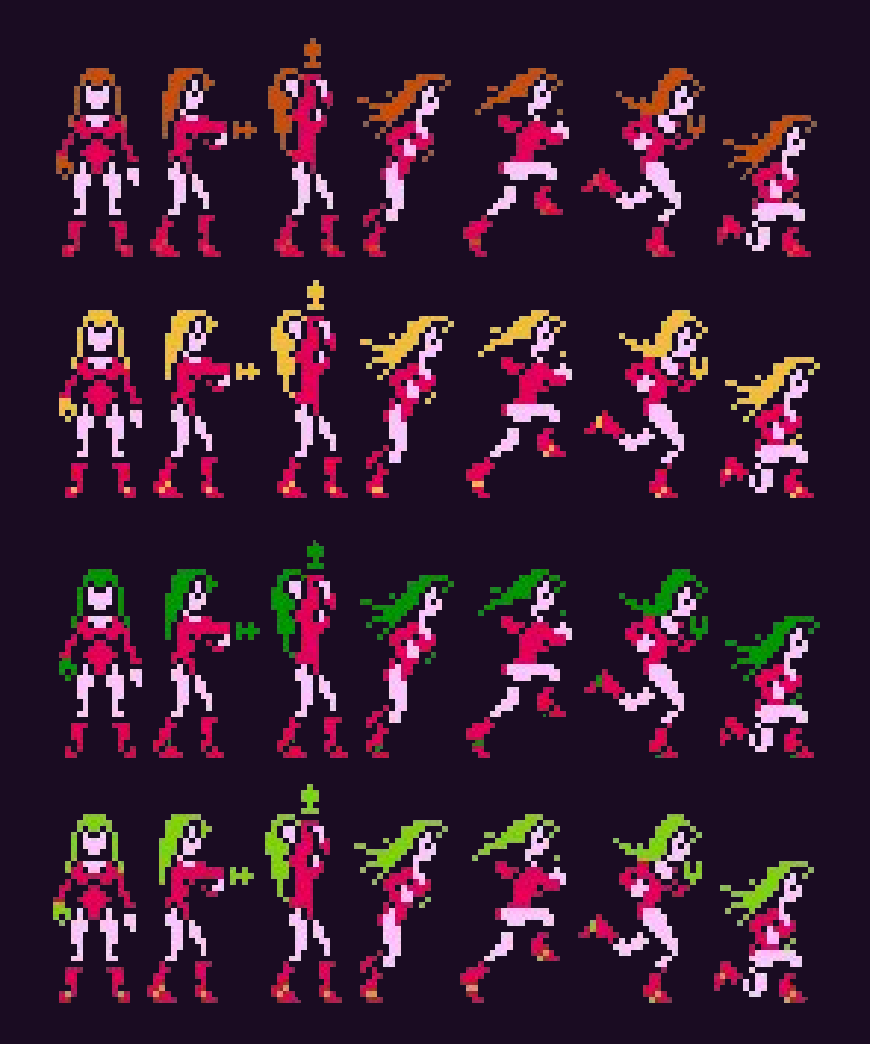
From Super Metroid on, however, Samus has been canonically blond. I wish Nintendo hadn’t made its three lead female characters in the Metroid, Super Mario Bros. and Legend of Zelda franchises all blondes, however. I wonder if this is also Jane Fonda’s fault.
I don’t think I’ve ever mentioned the Varia Suit on here before, so now seems as good a time as any to note that its Japanese name, バリアスーツ or Baria Sūtsu, is literally just “barrier suit.” I kind of like it, however, when an English word gets lost as a result of being transliterated into Japanese and then becomes its own term when it returns back to English. Is there a word for that? Is it just a double loanword?
BTW, speaking of clothes, Kate Willaert suggests that we should adopt bailey as the term for Samus’ trademark long-sleeved leotard, for which their is no name in English. I agree! These tend to show up in superhero genre stuff not infrequently and there might as well be a term for them, and it might as well be bailey.
In many ways, Kid Icarus was Metroid’s “twin,” and it was also originally released in Japan for the Famicom Disk System and then brought to North America with a password system. I’m pretty sure it’s the same password system, actually, and a kinda-sorta equivalent password in Kid Icarus was ICARUS FIGHTS MEDUSA ANGELS. It more or less made you invincible, and while all of those six-letter words mean something in the context of this game, I now wonder if it’s a coincidence that they also have a positive effect.
I did make fun of the idea that the real-life Justin Bailey getting his name in a Japanese-made video game, but to be fair, there is a real-life version of this, more or less: the Chris Houlihan room in Legend of Zelda: A Link to the Past. In this case, it does seem that Chris Houlihan is real, and he really did get his name in the game as a result of winning a Nintendo Power contest. Kevin Hainline did a video on the Chris Houlihan mystery last year and he seems to think he solved it.
But this Time Extension post about Hainline’s video stops short of closing the case entirely, as it is still awaiting confirmation from Nintendo Power editor Scott Pelland. Personally, I wonder if the idea for putting someone’s name in a game might have arisen from the urban legends about Justin Bailey, which surely the Nintendo Power editors had heard when the competition was launched in 1990.
The way they’re used in English, apophenia functions like the bad twin epiphany, which would be the word for when you have a eureka moment and it’s actually real. That divergence isn’t really represented in their etymologies — and yes, they’re related — but I feel troubled by the notion that we may never be certain when it’s one and when it’s the other.
Finally, yes, the story about Frankie was inspired by real-life events. I have always been like this.