

Who Put the ‘P’ in the Fire Flower?
In looking up something about an early build of Super Mario Bros., I happened across what would appear to be a preliminary design for the Fire Flower. We actually don’t know that it’s meant to be that. It could be something else that was scrapped entirely or that was replaced with the Fire Flower. It’s *probably* the Fire Flower? But as far as we can say for sure, we’re limited to “Yep, that looks like a flower. And it’s got a ‘P’ on it.”
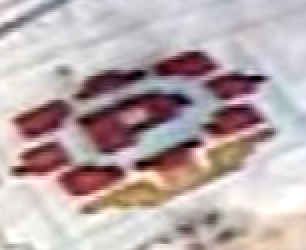
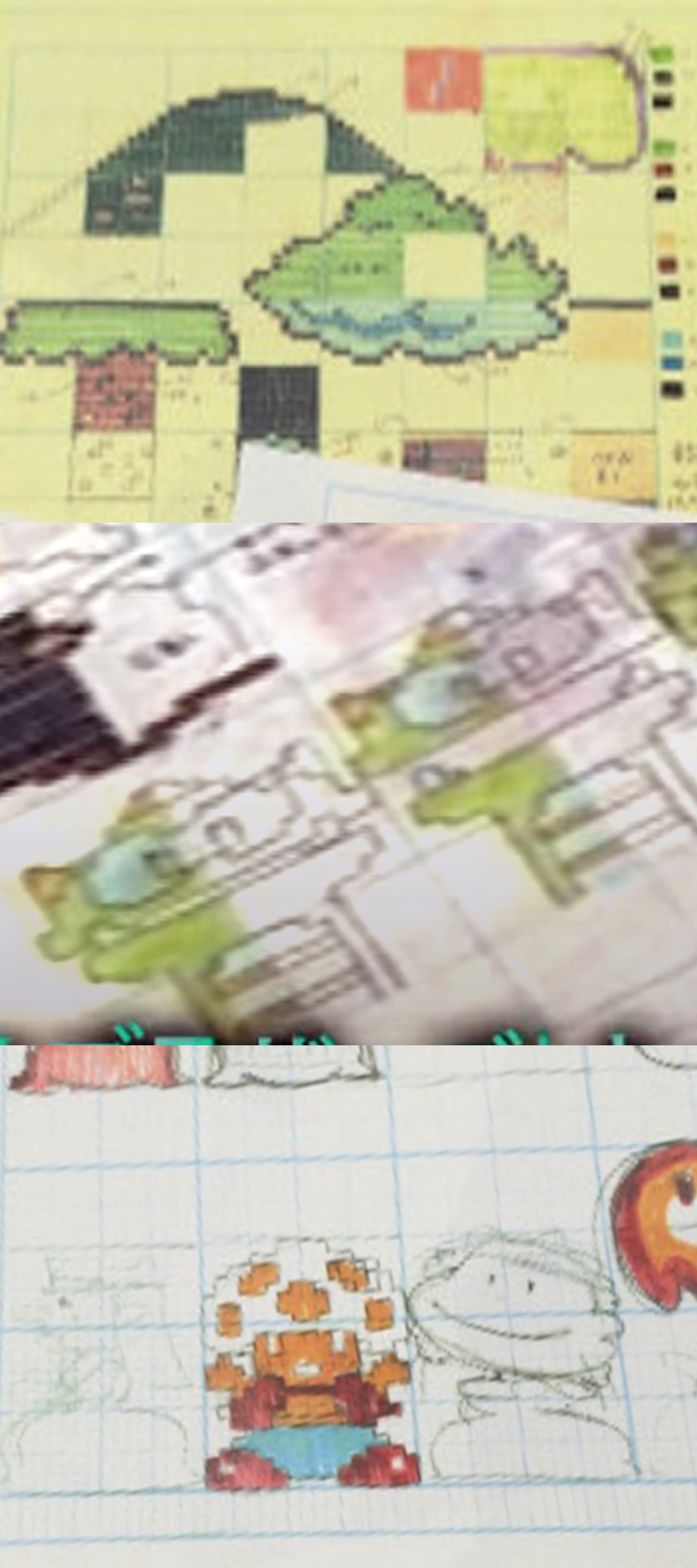
It doesn’t help that the only image we have of this Super Mario artifact is tiny and out of focus, so I decided to mock up what it would look like using actual pixels in the NES palette, only to realize that someone else had done this on The Cutting Room Floor. Here, below, is my versions on the left and in the middle; theirs is on the right.

Based on other attempts to make sprites out of design documents glimpsed in photos or videos, it seems like cyan is used for pixels that were intended to display the color white. You can see it in early versions of the clouds and a weird dragon enemy that may have been a precursor to the Piranha Plants, although a preliminary version of the Mushroom Retainer complicates this somewhat because it shows cyan and white both.
Color differences aside, what most struck me about the P-Flower, as I’ll call it, was that it immediately made me start thinking of the other instances of that letter being used in Super Mario Bros. 3 and Super Mario World. The title of this post, for example, is a reference to one I wrote in 2002, “Who Put the ‘P’ in the P-Wing?” In fact, this post is kind of a reworking of that post, covering some of the same ground but with a different destination in mind.
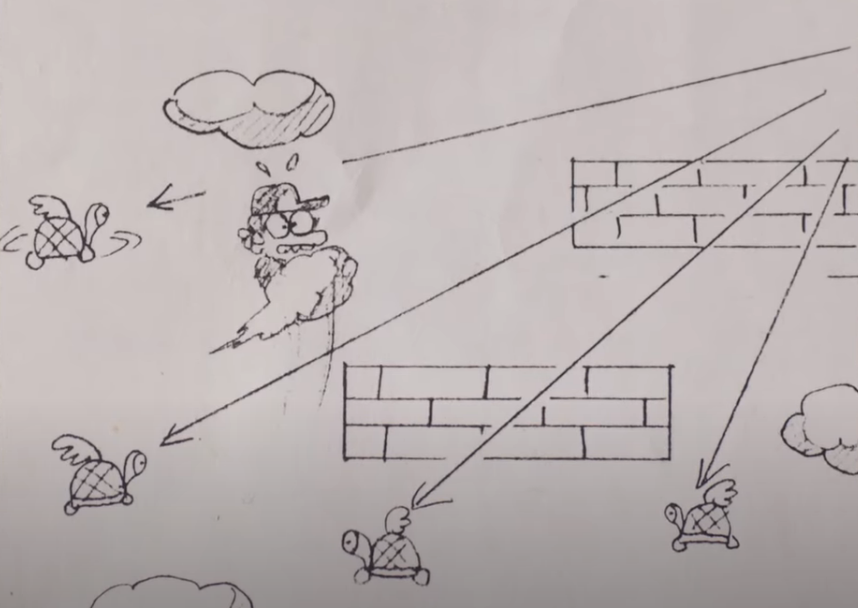
The creators of the Super Mario Bros. games had been dreaming since the first one of ways to allow Mario to take on attributes of his enemies to use against them — something akin to kicking a Koopa Troopa shell, I guess, but moreso. Early design documents for Super Mario Bros. show how the game could have implemented a way for Mario to steal Lakitu’s cloud and ride around in it, for example.
He ultimately got to do that in Super Mario World, and there’s even a kinda-sorta version of it in Super Mario Bros. 3, in which Mario can use the Lakitu’s Cloud item on a map screen to bypass a stage. It’s a more subtle version of a trend in Super Mario Bros. 3, which also allows Mario to steal Goomba’s Shoe, although in level 5-3 only, and to dress up like the Hammer Bros. and throw hammers. In the English version of the game, it’s hard to spot one additional item that is directly tied to one of the original Super Mario Bros. enemies, and that’s the P-Wing. It’s actually the wing belonging to the Koopa Paratroopa, though nothing in the game or manual makes that explicit.
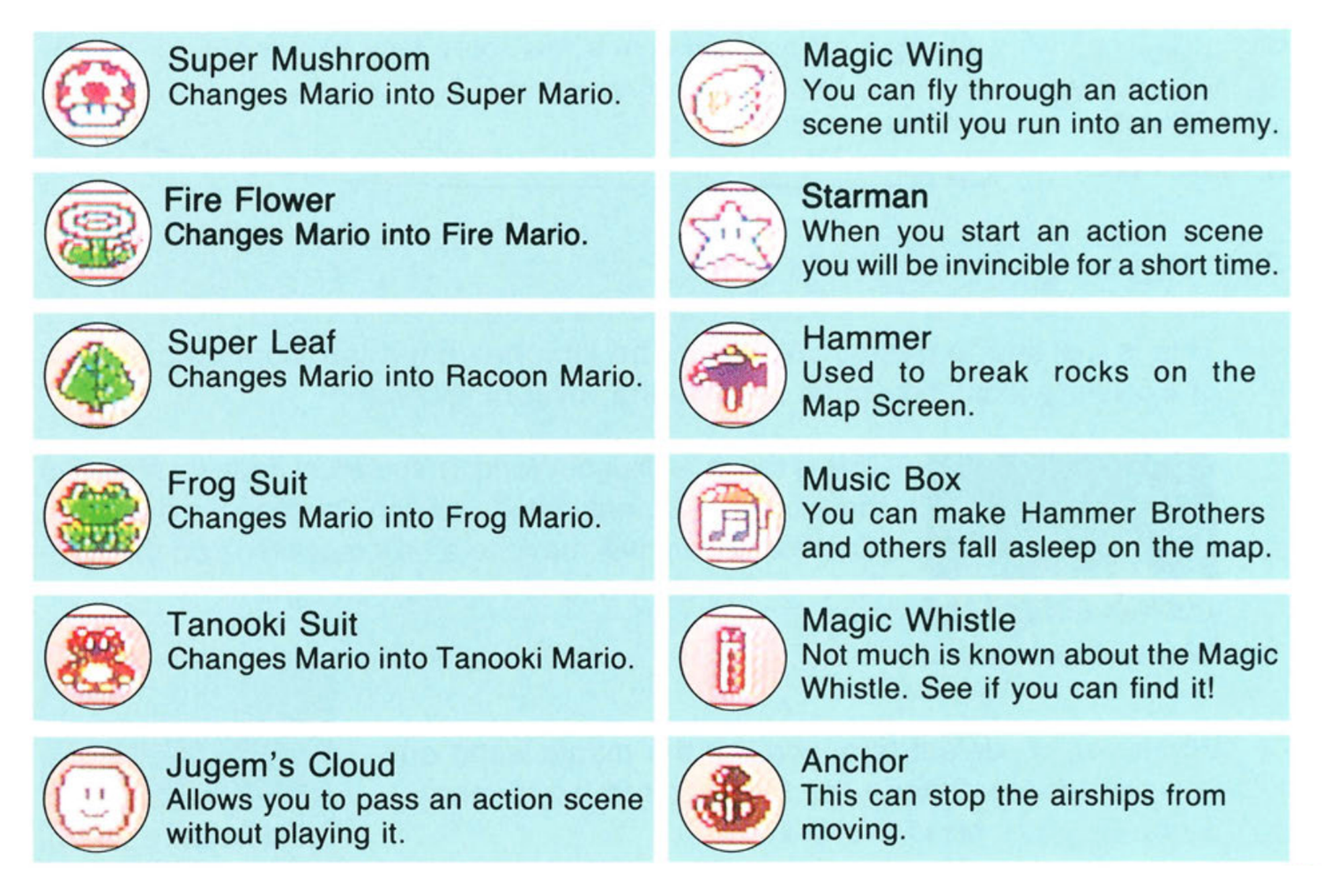
In Japanese, the item is called パタパタの羽根 or Patapata no Hane. Since patapata is both the onomatopoeia for the noise of flapping, the Japanese name could be translated just as “flapping wing,” but given how many other instances this game has of items giving Mario his enemies’ powers, I think it seems very likely that we’re meant to understand that that Mario is ganking some poor turtle’s body parts so he appropriate his power of flight.
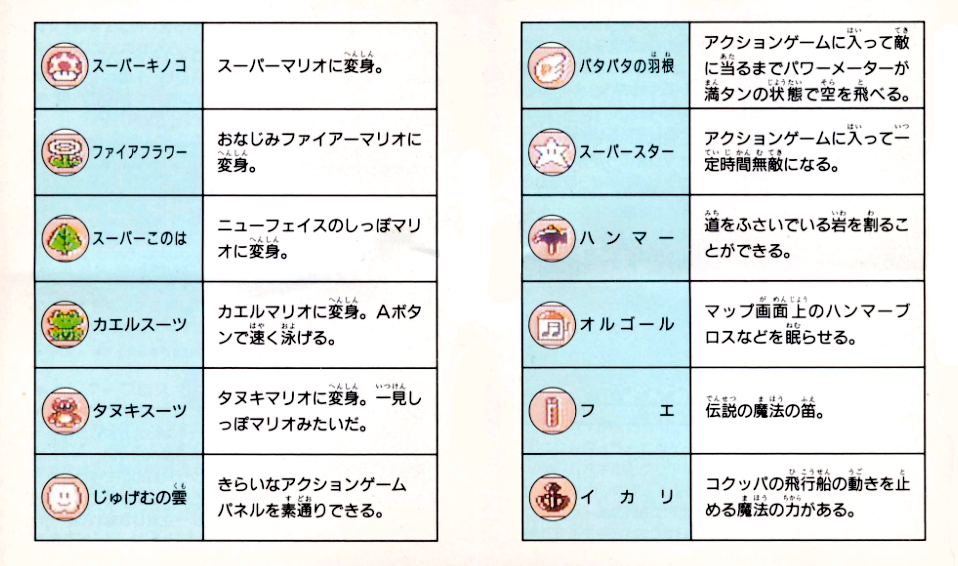
The Japanese description for the P-Wing reads as follows: “Patapata (Paratroopa) Wing: Your power meter fills up completely until you hit an enemy, allowing you to fly through the air at full capacity.”
Without knowing that the P-Wing is a reference to the Paratroopa, you might just assume that “P” stands for “power,” since the game’s flying system revolves around the P-Meter — the thing at the bottom of the screen that whistles when Mario has run a great enough distance, signalling that he can now take off and fly. The English and Japanese versions both explain that the “P” is short for “power,” with the Japanese version referring to this as the パワーメーター or Pawā Mētā.
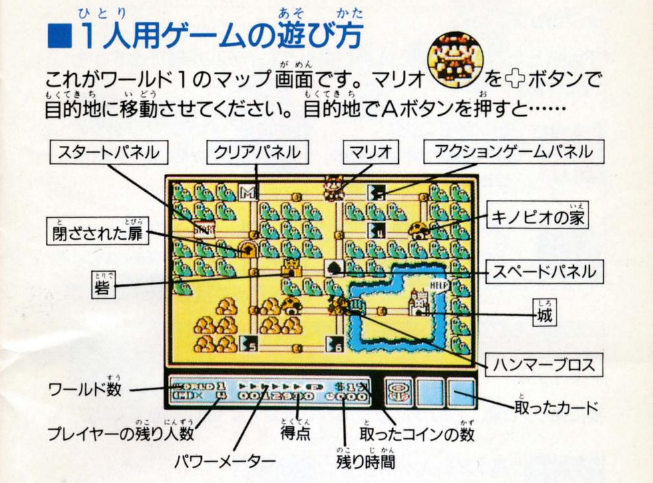
The bottom most text calls it パワーメーター or Pawā Mētā.
But this raises a question: What should the “P” on that P-Flower stand for? Power? Is it a power flower? It certainly is a flower that gives Mario a certain power, and I can’t think of anything else that makes sense. Of course, the Super Mario series has a history of putting the letter “P” on items. Sometimes it means “power,” but sometimes it doesn’t.
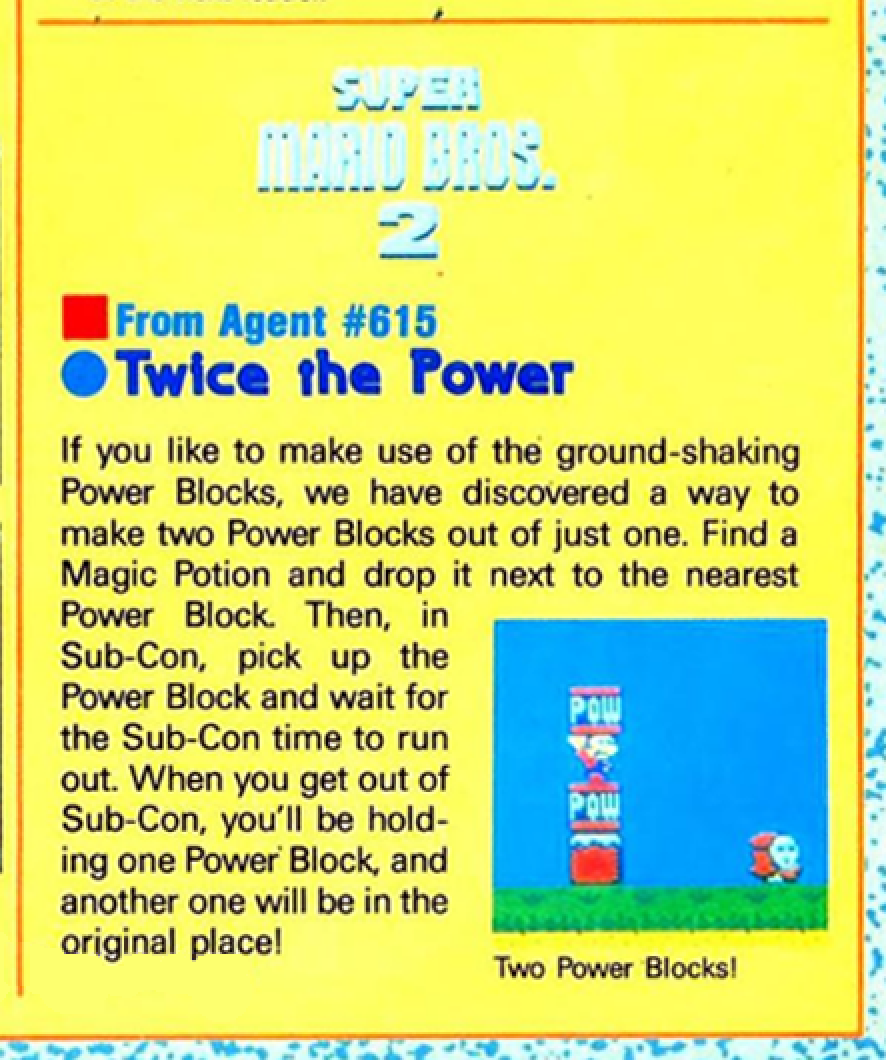
I guess this all starts with the POW Blocks in Mario Bros. It seems too obvious to merit explaining, but because hitting these causes a small earthquake, it seems plausible that the “POW” is short for “power.”

The first issue of Nintendo Power I ever received even calls them “Power Blocks,” even though that’s not been an official term used in any game.
Super Mario Bros. 3 introduces the blue, domed blocks that, once stomped, cause a temporary change in the stage, usually brick blocks turning into coins and vice-versa. They’ve been a series mainstay ever since, and although we call them P-Switches today, I don’t think it’s ever been stated in any game what this particular “P” stands for. The English manual just calls them Switch Blocks, and so does the Japanese version: スイッチブロック or Suitchi Burokku.

But Super Mario World also features the Power Balloon, a rare power-up that allows Mario to inflate like a balloon and float upwards. This also bears a “P” but both the English name and the Japanese one, パワーバルーン or Pawā Barūn, make that association explicit.

So what does the “P” in the center of that maybe sorta prototype Fire Flower stand for? I have no idea. “Pyrokinesis”? “Pew Pew Pew”? “Poughkeepsie”? There’s no way to tell. It’s probably “power,” but the fact that the “P” in P-Wing and the P-Switch both apparently don’t mean “power” leaves me wondering.
I should also point out, I guess, that when I first saw this sketch for the P-Flower, my first reaction was that it was the exact shape and style as the “P” that would appear on the P-Wing, the P-Switch, the P-Balloon and even the POW Blocks. It’s actually not.
They’re all a little different, and that might just be a result of there only being so many ways to draw this letter within the considerable confines of a sixteen-by-sixteen grid. But even if they are a little different, I think there does seem to be a trend in the early days to stick a “P” on something in an effort to make it look cool. At the very least, it began in the planning stages of Super Mario Bros., made it to the final version of Super Mario Bros. 3 and basically never left.
You’re welcome for my restraint in not making a penis joke.
Miscellaneous Notes
I’m going to follow this up tomorrow with a short etymology of power-up, in the video game sense. For now, I just want to point out how strange the localization of Super Mario Bros. 3 is specifically in the sense that relates to enemies being mentioned in item names. As I said earlier, there’s the P-Wing, Lakitu’s Cloud, Goomba’s Shoe, and the Hammer Suit, but the only one that comes close to making the connection to an enemy character clear is the Hammer Suit — and even then, the fact that the official name isn’t Hammer Bros. Suit is still kind of weird, although once Mario is sporting a shell and chucking hammers, it’s pretty hard not to get what he’s supposed to be. However handled the localization of the instruction booklet, whether that be one person or a small team, managed to correctly localize all the enemy names in other parts of the text, but when it comes specifically to items, they seem to have hidden the fact that these items all tie back to enemies that debuted in Super Mario Bros. It’s possible that whoever did this did so accidentally, not realizing what a Patapata (パタパタ) or a Jegumu (ジュゲム) was, although that seems like something someone else would catch. The Goomba’s Shoe item was not mentioned in the manual at all, but the Nintendo Power strategy guide for the game does, and it makes the weird choice to refer to the version of the Goomba hopping around in the shoe as Kuribo’s Goomba.
And that makes sense, I guess, if you don’t know that Kuribō (クリボー) is the Japanese name for this enemy. If you think there’s some unseen character named Kuribo out there, supplying Goombas with magic shoes, this makes sense. But if you know anything about this series — and you’d think Nintendo’s localization would have — the name Kuribo’s Goomba literally means “Goomba’s Goomba.”
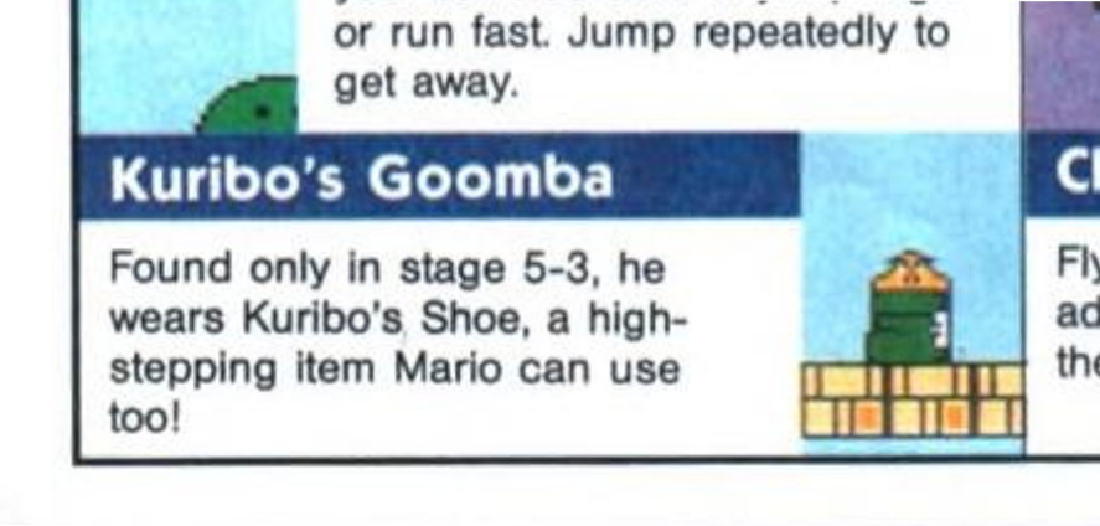
I just can’t think of a good explanation for why this would have happened. Can you?
Finally, this seems as good a place as any to mention that I still don’t know where the Peahats in Legend of Zelda got their name. Whatever it is, it’s not because Japanese people ever seemed to have referred to propeller beanies as “P-hats,” which was my best guess.