

What Is the Etymology of ‘Power-Up’?
For decades, I’ve thrown around the word power-up without questioning how it became an ubiquitous part of video game culture. In writing the previous post, however, it occurred to me that I’d never looked up exactly how it came to exist the way it currently does. Here is that story, as near as I and various nerd-focused lexicographers can trace it.
The Oxford English Dictionary only says that power-up was “formed within English, by derivation,” which is stunningly useless as far as what we’re trying to accomplish with this post. And although it does not identify the specific game, the OED claims the first instance of the term being used in the video game sense is from 1991, which seems way too late for my money. (And I mean that literally. I paid for a one-month subscription to look this up.) While it’s possible that this usage evolved from the compound verb power up, as in “I will power up my computer as soon as I got home,” that’s maybe not the case. There’s a pretty good theory that power-up is actually an example of wasei-eigo, a type of expression I previously brought up in my post about the various names for summoned monsters in the Final Fantasy games. It’s basically a Japanese-specific word or phrase that’s built from English loanwords in a way that gives it the appearance of being something borrowed from English even if English never used those words in that particular way before.
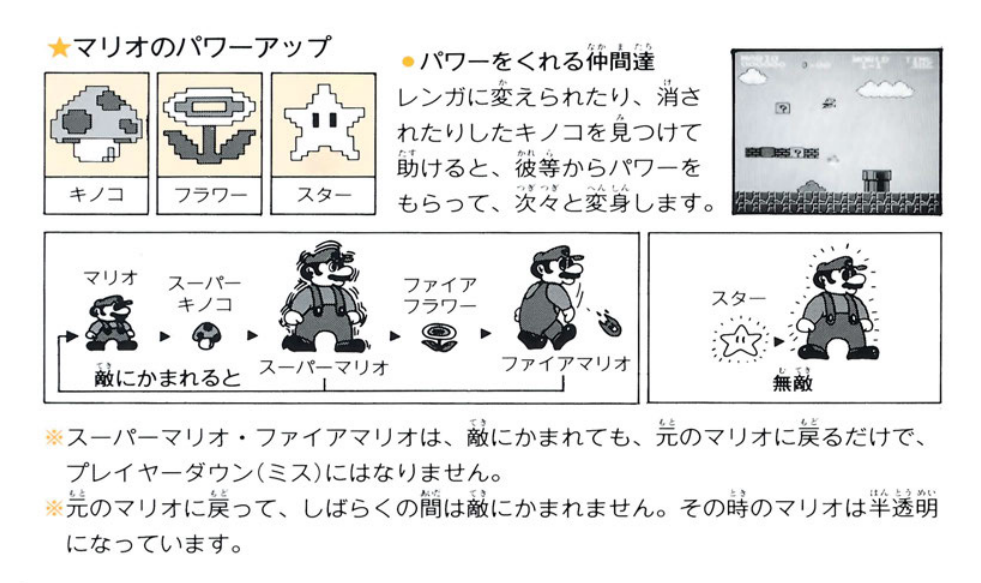
Now, this is not a Super Mario post — and this blog is not a Super Mario blog, even if you’re going to get a lot more Mario content than usual for the next few weeks. But just as a way of showing that power-up likely arose from Japanese and not English, check out the page from the original Japanese manual for Super Mario Bros. that explains the different items Mario can collect. The Japanese version headlines this page with マリオのパワーアップ or Mario no Pawāappu, literally “Mario’s Power-Ups.”
The English version doesn’t do that, headlining its version of the same page somewhat awkwardly.
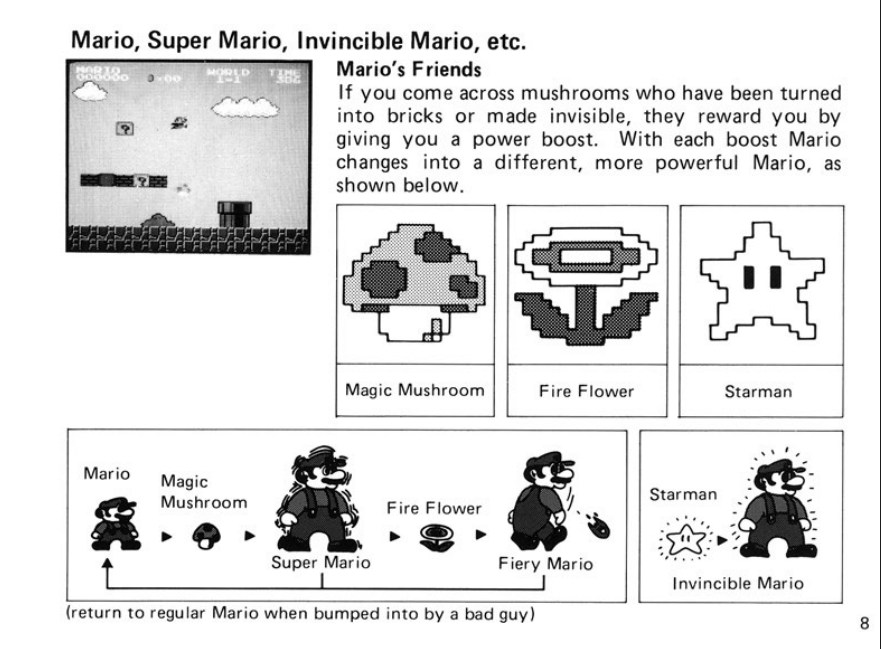
My point is that even if the people writing the localized manual thought North American gamers would have understood the term power-up back in 1985, they would have just used it. They didn’t. If they knew the term, they apparently didn’t think it was widespread enough that the audience for this game would know it — and by extension, that they wouldn’t be able to figure out what this term meant just by context.
I could not find a Japanese resource that points to the first documented use of the term as it’s used in the video game sense. But at the very least, I found via this Reddit discussion that an early use of it can be heard in the 1973 anime Neo-Human Casshern, during the protagonist’s transformation sequence in the first episode. Once he becomes a superpowered robot, he does in fact shout “power up!” in a way that’s not unlike how text on screen in a video game would tell you that you’re now stronger than you were before. It’s a distinctly Japanese use of English and a sense that’s basically communicated “I am enhanced” instead of “I turned the machine on.”
The Casshern anime is not a video game, I realize, but the way the term is being used is very close to how it would be used later in video games. If I had to point out a difference, it’s probably that in most video games, the thing we call a power-up grants a temporary ability that ends after the passage of a certain amount of time or the moment your character takes a hit. In the first episode of Casshern, the human protagonist is being turned into an android permanently, with the sacrificing of his humanity to gain powers being a central plot point for the entire series. (Also, his mom becomes a robo-swan, which seems weird.)
According to the Japanese Wikipedia page, the construction of power-up follows a pattern in wasei-eigo in which “_____ up” is understood to mean “This will increase your _____.” While the parallel example the page offers is 1-up, I think that one is complicated somewhat because it initially meant “First player, it’s your time to play” before it jumped to the “You got an extra life” sense we know today. A better parallel might be level up, which flashes onscreen to tell you that you’ve permanently raised your character’s stats in the RPG sense. In fact, there’s even a Japanese verb, アップする or appu suru, that comes from the English word up and which means “to increase.”
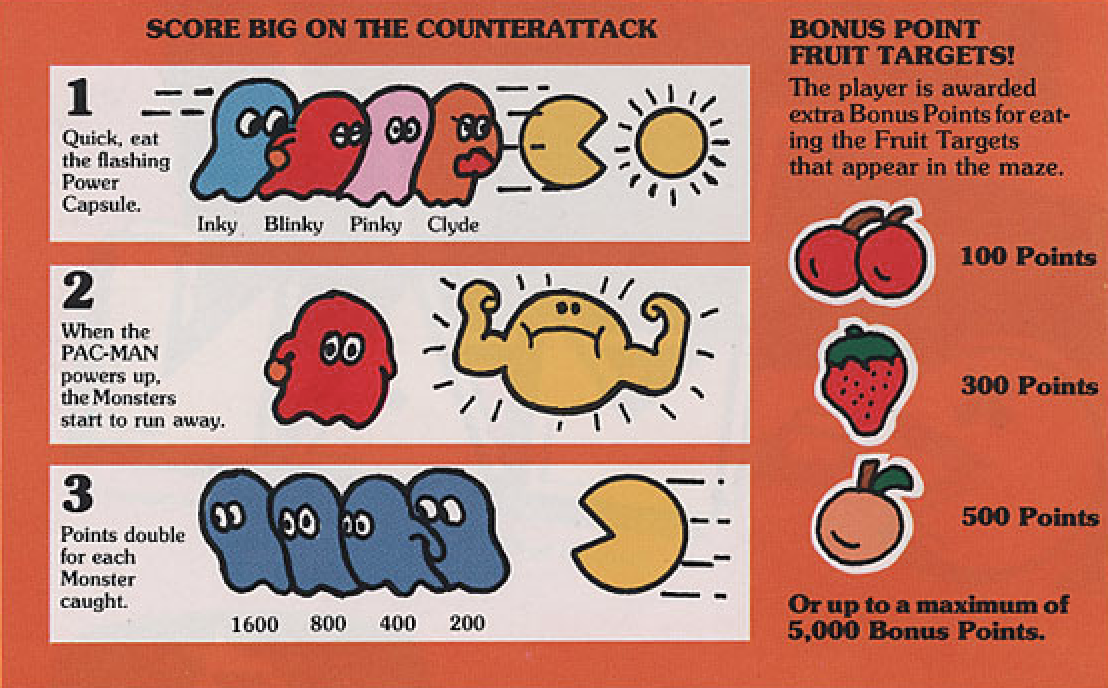
The Historical Dictionary of Science Fiction — a resource of which I was not aware until doing research for this post — has a timeline of textual evidence of the term being used in English. Although it says at the top of the page that “the first such item is usually considered to be the power pellets in Pac-Man,” its evidence for this does not quite match what I’m looking for as far as worse usage. A 1980 English-language flyer for Pac-Man uses an expression that better matches older English sense of power up, as a compound verb: “When Pac-Man powers up, the monsters start to run away.”
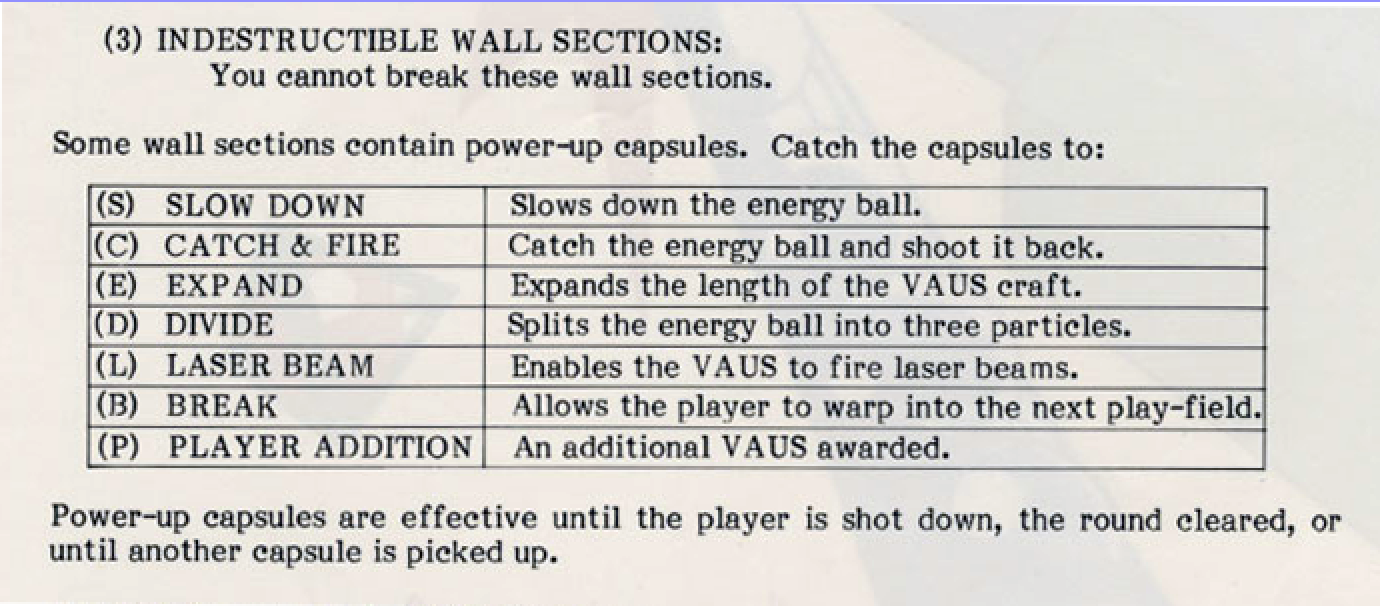
Slightly closer to what I’m looking for can be found in a 1986 flyer advertising Arkanoid. The hyphen is there, meaning that both words are being treated as a unit, but it’s being used as an adjective: “Some wall sections contain power-up capsules. [...] Power-up capsules are effective until the player is shot down, the round cleared, or until another capsule is picked up.” It is interesting to see the progression here, but it’s still not quite where we’d be in a few short years, when you wouldn’t need a noun after power-up — “Some walls may contain power-ups” versus “Some walls may contain power-up capsules,” if that makes sense.
According to the HDSF timeline, the earliest instance they could find of power-up as a standalone noun in English is the May 1987 issue of Computer & Video Games magazine — and in a somewhat bemused review of the Data East title Karnov, no less.

And it takes off from there, likely not because of Karnov or Computer & Video Games magazine, I’m guessing, but more that the Japanese usage just caught on more and more among English-speaking gamers. I suppose that could have happened as a result of increasing contact between western gamers and their Japanese counterparts, but I’d think it more likely that English-speaking gamers picked it up directly from a video game instead — either “gently” localized or not localized at all because the original Japanese version used English text. The earliest example I could think of is Altered Beast, Sega’s 1988 beat ’em up and gay transformation fetish primer, which doesn’t show that text on screen but does feature a voice sample that intones “POWER UP!” every time you do so.
In addition to becoming more muscular, he also gets more naked, so I would also accept a voice sample saying “gay up.” (Clipped from this YouTube playthrough.)
But I’d bet that there’s an even earlier example out there, and if you let me know, I’ll add it to the piece. I’m also down to see any earlier documentation of power-up in English or Japanese — especially if anyone can pinpoint the first video game to use the term. Until new information presents itself, however, I have to agree with the theory that it came from Japanese and wasn’t an evolution of the “I will power up my computer” sense I mentioned earlier. Convergent evolution, I guess we could call it, but it just makes too make sense that the Japanese power-up may have began as wasei-eigo but became part of English as well because it’s immediately comprehensible to English-speakers.
Finally, I tried to look online to see if anyone had documented the first use of power-up in a metaphorical sense, outside the context of video games. I couldn’t find anything, though it’s a tough thing to locate using a search engine. But I don’t doubt for a second that this has happened. The term is so widely use and so easy to understand, even if you’d never played a video game in your life, that you could understand what it means just by context.
Miscellaneous Notes
The image for this post is of Sonic the Hedgehog for a specific reason: I received an email the past week from someone claiming to be Yuji Naka (I don’t not think it was actually him) asking why I don’t cover any of his games on this site. I actually do have a post to write about the evolution of Amy Rose in the Sonic series that I will get to once I get through this small mountain of Super Mario-related content, but to be honest I just don’t know all that much about the Sonic series. So if you’re reading this now and you happen to know some lesser-known facts about how the Sonic series came to be the way it is, let me know. I’d be happy to write these up in the future.