

How a 1991 JRPG Foreshadowed 2026’s New Weird Tiktok Trend
First up, I need to state for the record that I’m 43 years old. As a result, I feel a number of social media apps are just not for me, and one of these is TikTok. I have never used it. If someone sends me a link, I’ll check out that particular video but won’t download the app. I’m not the biggest fan of watching videos on my phone, short or long, and much prefer to read words than watch humans speak them, so the only real way I learn about what’s happening on TikTok is when it leaks to the world of the olds.
Such is the case with the January 23 article in the Atlantic that ran with the subheadline, “If you are older than 25, you probably haven’t heard of Agartha.” That statement is likely true, but if you’ve played Final Fantasy IV, you probably have heard of it, even if you might not necessarily realize. Of course, that’s not the tack the Atlantic chose when reporting this story, as the main headline is “Teenagers Are Pushing Himmler’s Favorite Myth.” I get it. That headline, while not inaccurate, makes the whole story more salacious in a way that will get clicks more than “How a 1991 JRPG Foreshadowed 2026’s New Weird Tiktok Trend,” but this website is not the Atlantic, and I have a specialized audience here.
Agartha is a legendary kingdom purported to exist inside the earth. Stories about it place surface-dwellers’ discovery of this magical place thousands of years ago, but in truth the tale seems to have been invented relatively recently by the French colonial official Louis Jacolliot, who purported to write about arcane Hindu lore but just jumbled together bits of folklore that Europeans were unlikely to know and then added in some weird stuff he just made up. It was specifically his 1873 book Les Fils de Dieu (“The Sons of God”) that introduced Agartha as a lost Indian city described in a 15,000-year-old Sanskrit manuscript, although this version did not exist underground. Apparently it was another French writer, Alexandre Saint-Yves d'Alveydre, who put Agartha inside the earth in his 1886 book Mission de l'Inde en Europe (“India’s Mission in Europe”). But the concept eventually escaped the realm of fantastic stories pretending to be non-fictional; for example, one of the tenets of theosophy, an American esoteric movement founded by Helena Blavatsky in 1875, is the world being ruled by a board of occult know-it-alls known as the Grand Lodge of Agartha.
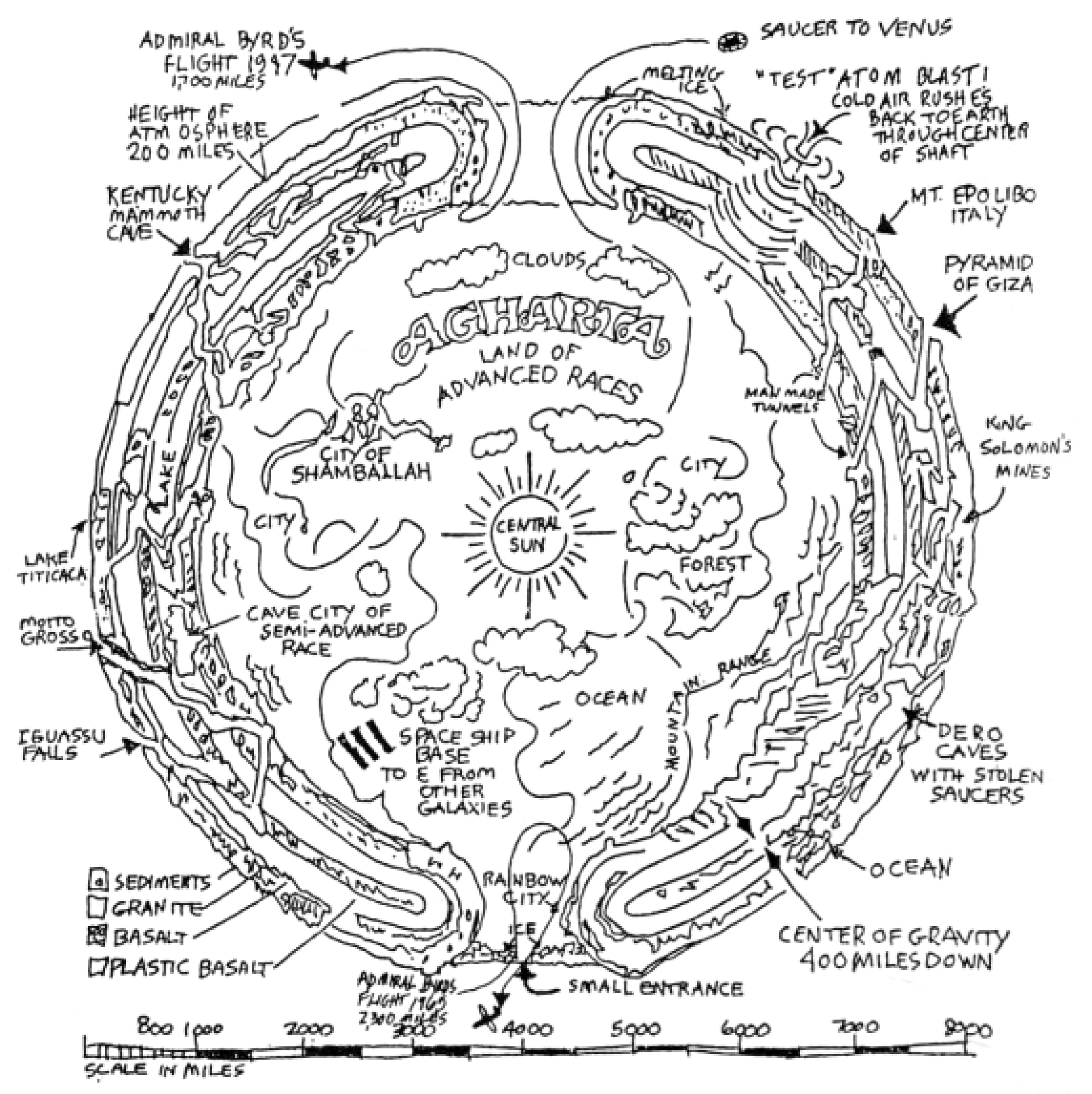
From Walter Siegmeister's 1960 book Agharta, via Wikipedia. And yes, allegedly there’s an entrance in Kentucky, because Mammoth Cave is weird and creepy.
That may sound fairly benign, but Agartha got wrapped up with Nazi leader Heinrich Himmler because he had a lifelong fascination with mysticism and occultism. I’ve listened to enough paranormal podcasts to know that these threads run deep within the Nazi movement, connecting everything from weird fringe stuff such as Die Glock (a.k.a. the Nazi Bell) to foundational stuff like belief in a racial hierarchy. In fact, the Nazi obsession with Agartha ties directly into the latter, as some Nazis believed that the Aryan race descends directly from the underground city, making it different from — and in their opinion, better than — the races that evolved on the surface of the earth. And although the stated purpose of a German expedition to Tibet in 1938 was scientific research, some historians (including Nicholas Goodrick-Clarke, whose 2002 book Black Sun explores Nazi occultism) claim an additional aim of not the real aim was to locate the entrance to Agartha.
Did they find it? I’m guessing no. But Agartha has remained part of white supremacist mythology ever since, hence the concern on the part of adults that teens are making Agartha memes online. Yes, it’s largely absurdist nonsense, but the Atlantic piece explores why some are concerned anyway.
“But Drew, didn’t you say this was about video games?”
And to that I say, “Yes, I just needed to set the stage for how weird all this is.”
When I first read the Atlantic piece, I didn’t recognize the name Agartha. And while that’s what the English-speaking world has largely agreed to call this mythical place, it went by a lot of similar names over the years, including but not limited to Agharta, Aghartta, Agarttha, Agharti, Arghati, or Agardhi, per the Wikipedia page. What’s missing from this list is the name of one of the less memorable towns in Final Fantasy IV: Agart, known in Japanese as アガルト or Agaruto. It’s the home of Corio, the astronomer who is studying the moons throughout the game, but for the purposes of this post, it’s more notable that it’s the place where Cecil’s party drops the magma stone down the town well, opening up the passage to the underworld, where they encounter the kingdom of the dwarves. So despite the slightly different name and the fact that it exists on the world’s surface instead of inside it, Final Fantasy IV’s Agart seems to be very much a reference to the Agartha of legend, because it’s closely associated with a passage inside the earth. It’s just fudging the details in the way Final Fantasy references often do.
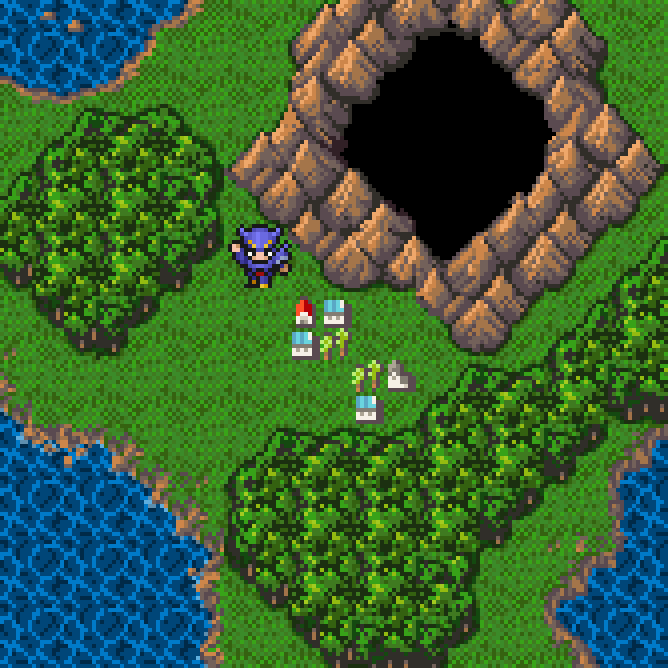

Pictured: Cecil (Dark Knight version) cheerfully waving next to the town of Agart and also the gaping maw he created in the nearby mountain, which he will use to experience the world of the dwarves.
In fact, there are even NPCs in Agart who even claim to be descended from dwarves, so the Final Fantasy version of this underground city story might even be drawing on the ariosophic theories just a little bit, but thankfully the parallels end there. (There is, I suppose, a racial reading of the dwarves that is complicated by the fact that Princess Luca has darker skin than the other party members in Final Fantasy IV: The After Years, but I am not the writer to explore that. Have at it, person who is!)
I wrote this because I’d imagine the people who read this site are more likely to be around my age than they are to be the young people engaging in Agartha memes, at least until something newer and weirder comes along. So you’re welcome and also I’m sorry, I guess, for the explanation of how this fantastical adventure story became enmeshed in Nazi occultism. But for me, at least, I was surprised to have another example of how video games taught me something that I did not expect to encounter again, decades later. But here we are, witnessing Agart’s brief return to relevancy, even if it’s tainted by Nazis.
And yes, this seems like a very 2026 thing to happen.
Miscellaneous Notes
I’m seeing the Agartha’s name rendered in katakana as アガルタ (Agaruta), and I have no explanation for why the Final Fantasy town was named アガルト (Agaruto), with a different final vowel sound. Anyone?
I should point out that the stories about Agartha do not mark the starter birth of the hollow earth movement, which has existed at least going back to 1740 without mentioning Agartha, to say nothing about ancient myths of the inner earth containing a literal underworld. I guess every Agartha story is a form of the hollow earth legend, but not every hollow earth legend is necessarily a story about Agartha. I would have researched what other modern beliefs say exists in the core of the planet, but I got bored and annoyed with all this, so let’s just assume it’s monsters and presents.
How many other Final Fantasy towns are referencing something that most of us have just breezed past? Lufenia? Besaid? Gongaga? Gyshal? Kaipo? Jidoor? I do wonder.