

Does Final Fantasy Tactics Have Two Characters Named After Beowulf?
Here, finally, is one I’ve had on my mind since I played Final Fantasy Tactics for the first time in high school. Does Ramza’s family name, Beoulve, derive from the name of the epic hero Beowulf? And if so, is it weird that the game also features a character who is just named Beowulf Cadmus? Does this mean that there are two different characters in Final Fantasy Tactics named after Beowulf? And why would this be the case when literally any other name could have been used?
On a superficial level, the answer seems like it should be “Obviously no, they’re not both named after Beowulf,” kind of like how the presence of an actual yuki-onna in Final Fantasy VII would seem to indicate that series mainstay Shiva is not supposed to be one, despite all appearances to the contrary. But I think there might be something going on in Ivalice that is more linguistically complicated than what you see in your average video game.
The names in Final Fantasy Tactics are, to be clear, a little weird. The setting is clearly meant to evoke medieval Europe, but while the game’s central conflict, the War of the Lions, is inspired by England’s War of the Roses, the character names suggest other places sometimes, nowhere in particular other times. For example, Mustadio Bunansa sounds vaguely Italian, Ovelia Atkascha could potentially be Russian, and Orran Durai might read a little Indian. I know some people interpret siblings Rapha and Malak Galthena as Arab. But the names of characters like Delita Heiral, Meliadoul Tengille and Valmafra Lenande don’t strike me as sounding like they come from any real-world source while at the same time all kind of sounding like they might be from the same language — just one that doesn’t exist in our world. It’s not a terrible form of world-building, I suppose: pulling from real-life languages here and there but also embedding those borrowings in a world framed by a unique something invented for this fictional setting. I’m not saying that’s what happened here, just commenting on the cumulative effect of it.
But then we have our protagonist, Ramza Beoulve, whose surname comes up a lot because his family’s military history is relevant to the plot. In katakana, that name is written as ベオルブ (Beorubu), which is awfully close to how you’d typically render the name of Beowulf, the character from the epic poem: ベーオウルフ (Bēourufu), with ウルフ (urufu) being the English word wolf transliterated into katakana. However, Final Fantasy Tactics renders the name of the character Beowulf Cadmus in katakana slightly differently: ベイオウーフ or Beioūfu. Either katakana rendering of the name Beowulf sublimates the sound represented by the ‘w’ with a string of vowels. Oddly enough, if you suppose that Ramza’s last name is also some twist on Beowulf, that is exactly what the romaji rendering of it does as well, with the ‘w’ sound hovering like a ghost somewhere between the ‘o’ and ‘u’ in Beoulve.
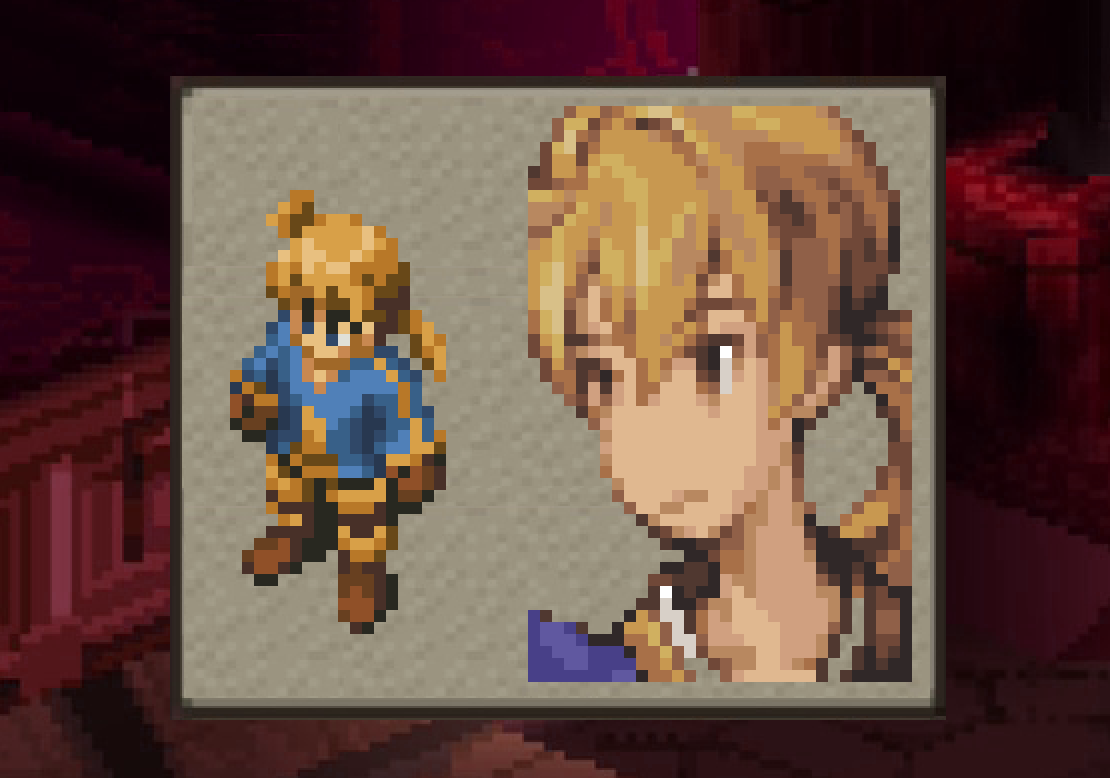
Ramza Beoulve, the newborn baby duckling who ended up leading an uprising.
So should the existence of a second character named Beowulf mean that Ramza’s last name has to refer to something else? Well, let’s look at what we know and what we can surmise.
First, here’s the official pronunciation of Beoulve per a cut scene from Final Fantasy Tactics: War of the Lions, released in 2007.
It’s two syllables: either bay-OLV or bay-ULV, with the final ‘e’ being silent and with the emphasis on the second syllable. For comparison’s sake, the Japanese version pronounces it basically the same. Playing the PlayStation version of the game, which lacked voice acting, I mentally pronounced it with three syllables, with that final ‘e’ not being silent — bay-ULV-uh, I guess? And for what it’s worth, if Beoulve really is derived from Beowulf in some fashion, there shouldn’t be a syllable after the “f”/“v” sound at the end.
Unfortunately, the etymology of Beoulve is not something that’s easy to suss out. There’s not much evidence of this name — with those letters, in that order — showing up anywhere online or in print before Final Fantasy Tactics was released in June 1997. Sometimes Japanese media will specify how a character’s name should be rendered in romaji, and other times it’s decided by the person doing the English localization; either way, someone at some point decided that ベオルブ (Beorubu) was meant to be Beoulve and not, say, any of the other options, including Beourve, Beoulbe and Beourbe. Super translator Fatimah was of the opinion that the choice to make the final constant a ‘v’ rather than a ‘b’ might have resulted from the fact that the ‘v’ seems more in line with the game’s Euro-vague setting.
While there technically is a way to render the V ヴ sound in katakana, it’s not unusual for this to not be used and have it rendered as a B (like the BU ブ in his name). And the V ヴ is often still pronounced like a B anyway. I can see why the localizers might have made the B-to-V jump, sorta like how L sounds are often R in katakana. So one potential theory I have is that since B is often katakana V, and because the Beoulve spelling looks more like a “European-ish” name, they went with that. When localizing names we don’t have spellings from the devs for, we often have to think about the spelling “looking like an actual name spelling,” plus one that feels like it matches the vibe and setting of the game, even if it’s made up.
Fatimah’s take makes sense to me. And while we don’t know the reasoning for how anyone arrived at it, Beoulve has stuck through all permutations of Final Fantasy Tactics, even as other names in the game have changed over the years. In the first English localization of the game, for example, Mustadio’s last name was Bunanza rather than Bunansa. I’m not sure what was gained in revising that spelling, especially because the katakana version, ブナンザ, matches the old rendering.
Long-lived though the name Beoulve has been though the different iterations of the game, the name Beowulf is decidedly older. The epic poem dates back to between 975 and 1025 AD, and while the language it was written in, Old English, is not easily understood by someone speaking any form of modern English, it tends to be a text taught in literature classes throughout the English-speaking world but also the German-speaking world as well. (Don’t forget that English is a Germanic language.)
The poem tells the story of a fearsome Geatish warrior who fights and slays three monsters: Grendel, Grendel’s mother and finally a dragon. The warrior’s name is Beowulf, and today we are not sure about the etymology of this name. My college professor taught that it meant “bear-wolf,” in testament to the hero’s toughness in battle, but looking into the matter today, I’m also seeing the theory that it’s actually “bee-wolf,” that being a sort of poetic, symbolic wordplay way of either saying “bear” (because bears are wolf-like animals that like honey, which is made by bees) or some other animal that acts with lupine courage even when faced with bees, which would cause most animals to run away. This latter sense seems appropriate for Ramza. He’s not a brawny, viking-like monster-slayer like the epic hero. Not at all — in fact, he remains downright twinky for the duration of the game’s story. But as the leader of a rebellion that takes on a corrupt political system, Ramza does remain steadfast even when staring down an endless barrage of enemy soldiers, attacking him like a swarm of bees.
Perhaps it’s just as simple as Beowulf being a hero’s name, and that’s why the protagonist of this game has a version of it as his last name. That seems tidy enough if it wasn’t for Beowulf Cadmus also being in the game — and as a good guy that Ramza can recruit, no less. This Beowulf, it should be noted, looks a bit more like a proper hero. Whereas Ramza begins the game as a lowly squire, Beowulf’s story kicks off with him as a templar knight serving Yvalice’s holy land, snappy armor ensemble and all.
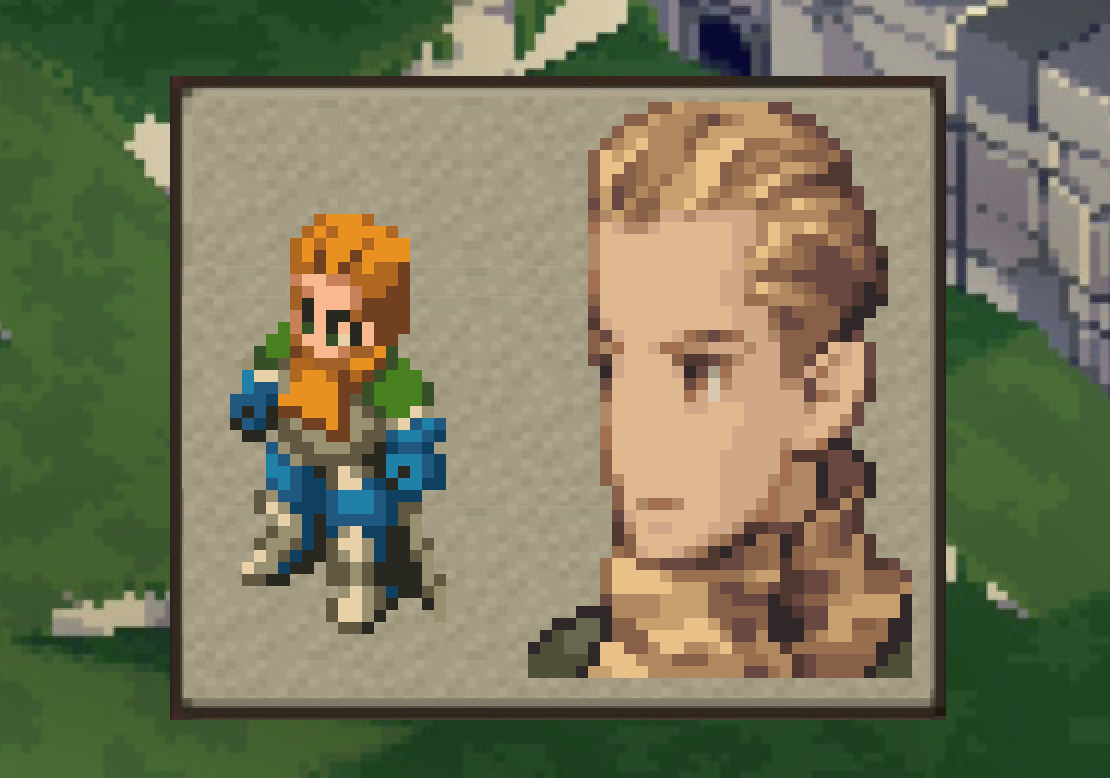
Beowulf Cadmus, who looks like the leading man even though he’s not.
There is a parallel between Ramza Beoulve and Beowulf Cadmus that might explain why they have similar names. (And BTW, Fatimah, if you’re reading this post, stop now so you can experience Final Fantasy Tactics sans spoilers.) In the same way that Ramza breaks from the greater Beoulve clan to fight for what he thinks is a just cause, Beowulf’s affiliation with the knights of Lionel Castle also ends, though for different reasons. As the game unfolds, it’s revealed that a Lionel official, Bremondt Freitberg, schemes to end Beowulf’s engagement to Reis Duelar by labeling Beowulf as a heretic. And while it’s possible to get Beowulf to join Ramza’s party of heroic renegades, his reasons for doing so mostly involve his love for Reis.
All of this is a long way of saying that the parallels aren’t exactly strong, and also this Beowulf’s story couldn’t have less to do with that of the hero from the epic poem, even if it does end up with him battling a dragon. However, I have thought about this for a long time — literally since 1999, when I first played this game. I have a different theory for why there seem to be two different characters named after Beowulf, and it actually ties in with one of most central themes in Final Fantasy Tactics.
When you start a new game, on-screen text tells you right off the bat that the hero of the story you’re about to witness is not the person that history has credited for ending the War of the Lions. That person is Delita Heiral. You’re about to get Ramza’s Beoulve’s story — and presumably a more accurate rendition of the events in which he is the hero instead of Delita. Essentially, there is the person who seems like the hero and then there is the “hidden” hero who maybe doesn’t necessarily seem like the hero type.
Do you see where I’m going with this?
Having two Beowulfs in the story — one whose first name is literally just Beowulf, the other who has it as a last name, just obfuscated through spelling and pronunciation — supports the central theme of the game. Again, we’re told in the first few minutes of the game that Delita is remembered as the one who ended the War of the Lions, even though the true hero is Ramza. This fact is the foundation on which the entire structure of the game rests. And therefore it makes sense to have it reflected in how a supporting character, Beowulf Cadmus, is literally named after one of the most famous heroes in literature in a fairly obvious way, all while Ramza Beoulve is also named after him, just in a way that takes a little investigation to notice.
As you play the game, it’s revealed that this version of events you’re watching unfold, in which Ramza is the hero, is the account stated in the Durai papers, which are withheld from the public for four centuries. In fact, these papers are the record written by the aforementioned Orran Durai — a bit player in the story who does join Ramza for a single battle. When he asserts that Ramza deserves credit for ending the war, it’s deemed so heretical that he is burned at the stake. It’s only thanks to the work of his descendant — Arazlam Durai, the game’s narrator and the source of the preface text you see when you start a new game — that we hear any mention of Ramza Beoulve’s heroism.
I’m not claiming to be any real life Arazlam Durai, I do think it’s worth pointing out that one of the most celebrated games of all time likely had a good reason for writing in what would otherwise seem like a weird redundancy. It’s there for a reason. It’s one of the many reasons that Final Fantasy Tactics is a masterful feat of storytelling.
Miscellaneous Notes
Yeah, I was an English major. What of it? I honestly didn’t love my program and actually started taking art classes instead. And I probably would have switched majors entirely had it not been for Candace Waid, who got me reading a lot of William Faulkner, but also Flannery O’Connor, Louise Erdrich, Eudora Welty and Toni Morrison. That last one is notable because Professor Waid once pointed out that Morrison was masterful because she worked on the level of the syllable, which most authors don’t. When we read Morrison’s 1973 novel Sula, for example, Professor Waid theorized that a character named Nel spells her name in a nonstandard way — not Nell, as you’d see it typically — because her name is meant to reflect her mother, Helene. Nel does not like her mother. She wants to be the opposite of her mother, and this is reflected in the fact that the entirety of her name is contained within her mother’s name, just backwards. This is far from the only example of Morrison imbuing meaning into the tiniest fractions of words. I wrote some papers, let me tell you.
The way English consonant sounds can warp and shift when being transliterated into Japanese (and vice-versa) can be surprising, but I like to remind you that this is not unique to the interactions between these two languages. It happens a lot, and realizing the way words in disparate languages are actually related can sort of feel like unlocking an ancient secret. One of the ways that came to mind in writing this post is that the English wolf is actually related to a lot of other languages’ words for these canine predators. Take the Latin lupus, for example, which gives Spanish lobo, which gave America its beloved Sheriff Lobo. Both wolf and lupus trace back to the same Proto Indo-European root that through Proto Germanic became wolf and through Proto Italic (possibly via Proto Hellenic) became lupus. Those are two different evolutions based on the same source, but looking at how they came to be, it maybe doesn’t seem so random that the ‘w’ in Beowulf ended up a string of fluid vowels in Beoulve — or how the the ‘f’ in Beowulf corresponds to the ‘v’ in Beoulve and the final ‘b’ in Beorubu. (Yes, I also considered doing linguistics as a major.)
As for other Final Fantasy Tactics names, an especially notable one is that of Cidolfus Orleandeu, who is this game’s version of the “old man Cid” that shows up in every Final Fantasy game. Because there’s another character by this name, Cidolfus Telamon, in Final Fantasy XVI, it’s a bit of this game’s particular pan-Euro naming style that has bled into the series proper. I have no idea where Cidolfus (シドルファス or Shidorufasu) came from or if it existed anywhere before Final Fantasy Tactics, but I don’t think is an extant name that anyone typically shortens to Cid. And I should probably explore that in a piece on the etymology of the name Cid, which I’ve never really looked into. One day!
EDIT: After posting, it was brought to my attention on Bluesky that there would seem to be another Beowulf connection in Final Fantasy Tactics in the form of the villain Wiegraf Folles. The transliteration of his Japanese name, ウィーグラフ・フォルズ or Wīgurafu Foruzu, makes it slightly harder to connect him with Wiglaf, a character in the poem Beowulf. Wiglaf is an ally of the hero and not a villain, but the video game connection remains nonetheless, as Wiegraf and Beowulf are palette swaps of each other. They do not interact in the story of Final Fantasy Tactics, however.