

How Did Final Fantasy Turn Shiva Into a Literal Ice Queen?
The glow of Christmas has faded into the chill of winter, and I am marking the occasion with an essay about Shiva, Final Fantasy’s blue-skinned mistress of ice. But in doing that, I’m also discussing how the representation of Hinduism in video games can differ from that of other major world religions. It gets weird, basically, to the point that if you know a thing or two about Hinduism, you might find yourself looking at a screen, seeing something that is apparently named after a Hindu god, and asking, “Wait, why?”

The Final Fantasy IV version of Shiva.
When I posted my piece on the history of Final Fantasy summons to Bluesky, I got a response from Shivam Bhatt, whom I’ve heard bring his punchy enthusiasm to the Retronauts podcast. In addition to being a gamer, Bhatt is also a Hindu priest, and in reposting my link, he said that it made him “chuckle/sigh that so many of the pictured summons are literally Hindu deities.”
He’s not wrong. Though I had the entire series to pull from, half the images I picked were of summons that would seem to be connected to one Hindu figure or another, if refracted through the wackadoo appropriation filter through which Final Fantasy processes everything. My piece included the summons Ramuh, Asura, Lakshmi and finally Shiva, and perhaps it’s telling that it did not occur to me until Bhatt spoke up that my overview leaned a little too hard on Hinduism. As someone who is not of Indian descent and who was raised Catholic, I’d offer an “oops” here, but I suspect this may be more Square’s fault than mine. It’s also bigger than just Square; Final Fantasy’s treatment of Hindu deities is very much indicative of this kind of “pan-religious fantasy” genre, where you find video games, manga and anime that all repurpose entities from multiple real-world cultures in a mix-and-match style.
Although Bhatt and I did not discuss this, there is an argument out there stating that representations of Hindu gods in video games function differently than that of other polytheistic religions. On one hand, if you’re populating your video game with the Greek, Egyptian or Norse pantheons, perhaps it might seem sensible to include Hinduism as well. On the other hand, Hinduism stands apart from these in that it’s very much a living spiritual practice. I’m not sure anyone needs to see an element of their faith reduced to a special effect in a video game, exactly, but at the very least the people who still worship the Greek, Egyptian or Norse gods are relatively few and far between. Hinduism, meanwhile, is the third most popular religion, behind Islam and ahead of Buddhism, boasting more than a billion adherents worldwide. And for that reason, perhaps its deities should be offered some polite restraint when it comes to video games.
Before someone responds in a way suggesting that I don’t already know, yes, video games also borrow Christian or Islamic concepts and entities, sometimes in ludicrous ways, sometimes in ways that might offend the faithful. If you’re curious, I explore this in essays about how Nintendo’s ban on religious references affected the localization of Ghosts ’n Goblins and how I learned the word jihad through researching Final Fantasy VI. The TL;DR summary is that it definitely happens, but if we’re keeping this discussion in the parameters of Final Fantasy for the moment, it’s notable how many Hindu gods appear as summons if you consider, for example, that no Final Fantasy game has featured Jesus or Allah as a summon. The reasons why not should seem laughably obvious — because that would be offensive in a way that would invite accusations of blasphemy — but clearly Hinduism seems fair game in a way other religions did not. I’m not going to hazard a guess as to why; that seems like it should be part of a different conversation on a different blog, but I still think there’s something to learn from looking at Final Fantasy’s Shiva as one of the longer-lived, better known instances of this phenomenon.
While the summons I mentioned in the original post can be tied back to Hindu figures, they look and behave differently from how they exist in the source material, thanks to the wackadoo appropriation filter I mentioned earlier. And the Final Fantasy version of Shiva arguably ends up furthest from its inspiration, to the point that a Hindu person encountering this video game character for the first time might rightly wonder why she is given the same name as a god from their religion. It might seem almost random, because in Final Fantasy, Shiva is distinctly feminine, often showing a lot of her trademark blue skin.
She’s not just a literal ice queen. She’s often also a *sexy* ice queen.

A sexier Shiva from Final Fantasy IX.
I won’t get into it, but Final Fantasy XIII even has *two* sexy Shivas who turn into a lesbian motorcycle.
The Hindu god Shiva is, of course, none of this at all — not female and not possessing ice magic and certainly never a lesbian motorcycle. He’s got no specific associations with ice, snow or winter; in fact, he’s the god of time, among many other things (but none of them being especially cold or wet), and he’s a principal god in many Hindu traditions. In Shaivism, one of the most widely practiced forms of modern Hinduism, Shiva is the supreme being. In another, he’s one of the three supreme deities in the Trimurti, where he serves the role as destroyer alongside Brahma, the creator, and Vishnu, the preserver. In fact, the closest I could come to a link between Shiva and his Final Fantasy alter ego is Rudra, an older storm god associated with and sometimes conflated with him — and even that felt like a stretch, because the distance between storm god and ice goddess is considerable.
The god Shiva is often but not always depicted with blue skin. One of his many epithets is Nīlakaṇtha (नीलकण्ठ), with nīla being Sanskrit for “blue” and kaṇtha “throat.” It comes from a story about Shiva ingesting poison that turns his throat blue, but many depictions just make all of his skin blue. But even that isn’t necessarily Shiva’s thing, as Vishnu is also often depicted with blue skin, and so is Rama, one of Vishnu’s avatars. And although Shiva can combine with the goddess Pavarti, Crystal Gem fusion-style, into an androgynous form known as Ardhanarishvara (अर्धनारीश्वर), literally meaning “the half-female lord,” he’s apparently not known for female forms or female avatars.
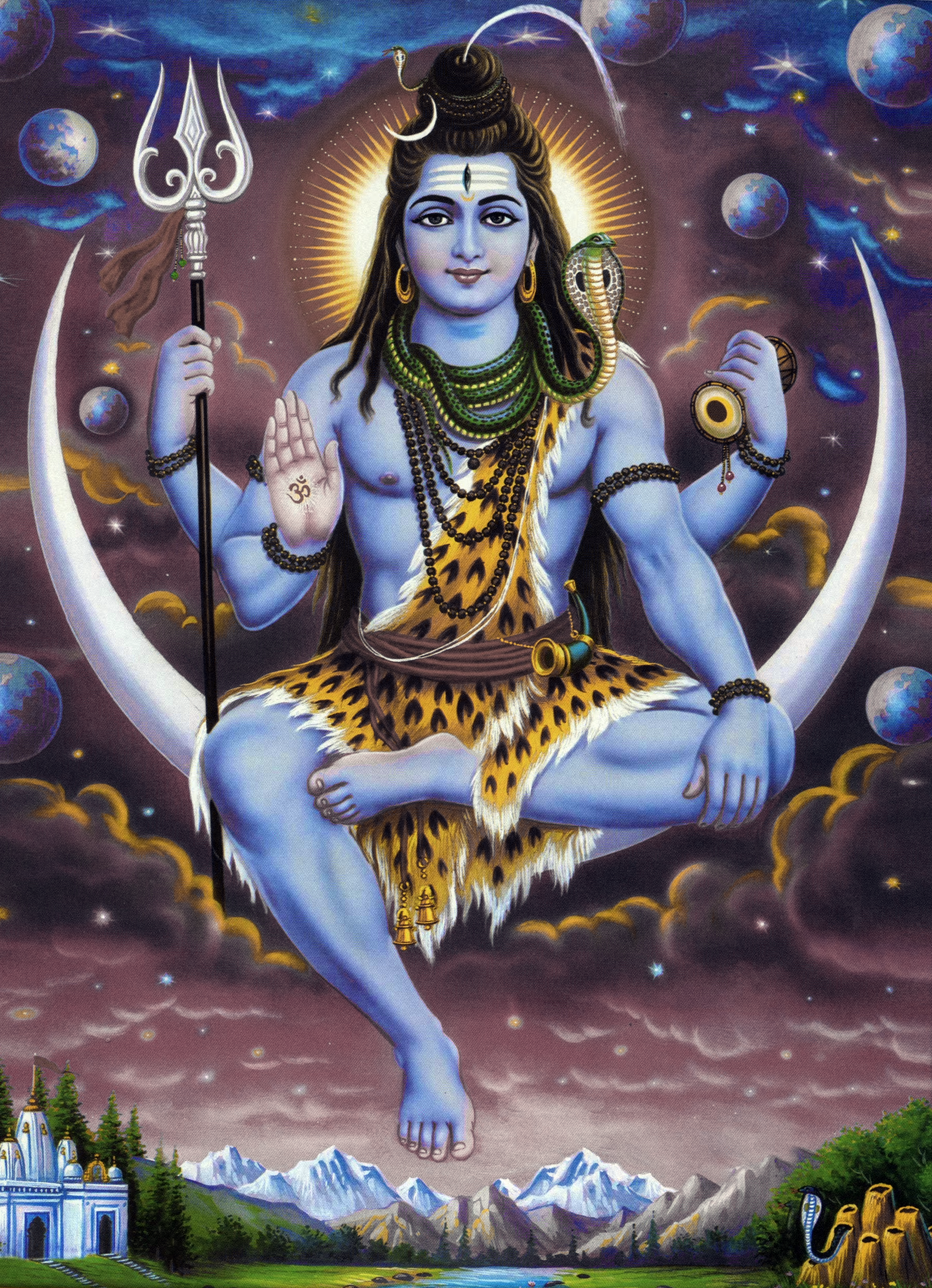
A devotional poster for the Hindu god Shiva.
All of this considered, you should probably be asking why the hell Square would name its sexy ice goddess after a Hindu god that apparently has no connection whatsoever to basically anything depicted in Final Fantasy. Why indeed?
As far as I was able to find, no one who has worked on a Final Fantasy game has commented on this, to say nothing of someone responsible for creating the first version of Shiva for Final Fantasy III. However, my gut feeling is that the Final Fantasy version of Shiva results from Square’s tendency to borrow mythological gravitas and grandeur to make something they invented for their video game sound cool. This is, after all, the company that named a dungeon in Final Fantasy IV after the Tower of Babel, just misspelled, for really no good reason aside from name recognition. For comparison’s sake, Final Fantasy could have just called its ice elemental summon Linda the Ice Lady, but that doesn’t sound cool at all.
Especially considering how heavily the first Final Fantasy leaned on Dungeons & Dragons and then seemed to move away from that in subsequent games, it makes a lot of sense that Square would turn to real-world mythology, folklore and religion, the majority of which is non-copyrightable even if there’s a risk you’d piss off some religious people. The name of a Hindu god might ring a bell even with players who aren’t familiar with Hinduism. It sounds like… something — maybe something you’ve heard in some other fantasy context where its Hinduism ties weren’t obvious, maybe something that just seems ancient and exotic, and I use that last adjective while understanding the implications that come with exoticism as an aesthetic trend. It is, for better or for worse, a name that can work independently of its Hindu origins.
Certainly, it helps that the name of this deity would be rendered in katakana as シヴァ (Shiva), which would be very close to how the the English word shiver might be rendered: シヴァー (shivā). To me, that actually might be enough to explain how the Shiva of Hinduism might have become the Shiva of Final Fantasy. Again, we don’t have an origin story here, but it doesn’t seem improbable that the team planning Final Fantasy III knew the Summoner would need some sort of ice attack and therefore some sort of ice elemental fantasy creature to represent that. Someone might have recalled seeing a blue-skinned humanoid in some Hindu art and then, while scanning a list of deities, settled on Shiva’s name specifically for its similarity to shiver and its own associations with the cold. It really could be as simple as that.
So why is Final Fantasy’s version of Shiva distinctively female? Well, for one thing that name fits a certain sort of western conception for how a female name should sound. And for another, one of the most popular yokai in Japanese folklore happens to be a female personification of a blizzard: yuki-onna (雪女, literally “snow woman”). Shiva is not a yuki-onna and doesn’t especially look or act like one, and perhaps proving that she’s not supposed to be one is the fact that Final Fantasy VII has an enemy character, Snow, that is very much supposed to be a yuki-onna and very much acts like one. But the prevalence of yuki-onna might have helped the Final Fantasy III team feel that it made sense to make the ice elemental summon female. If that’s not enough, there’s also the notion that some artists just like drawing sexy women if they can get away with it, but it actually might make sense especially in this context because almost every Final Fantasy positions Shiva as the counterpoint to Ifrit, the fire summon and a distinctly male figure. Both Shiva and Ifrit are usually showing off a lot of skin, so yay for gender parity, but this even extends to their modes of attack, with Ifrit usually relying on raw firepower and Shiva employing a delicate finesse in her attack.
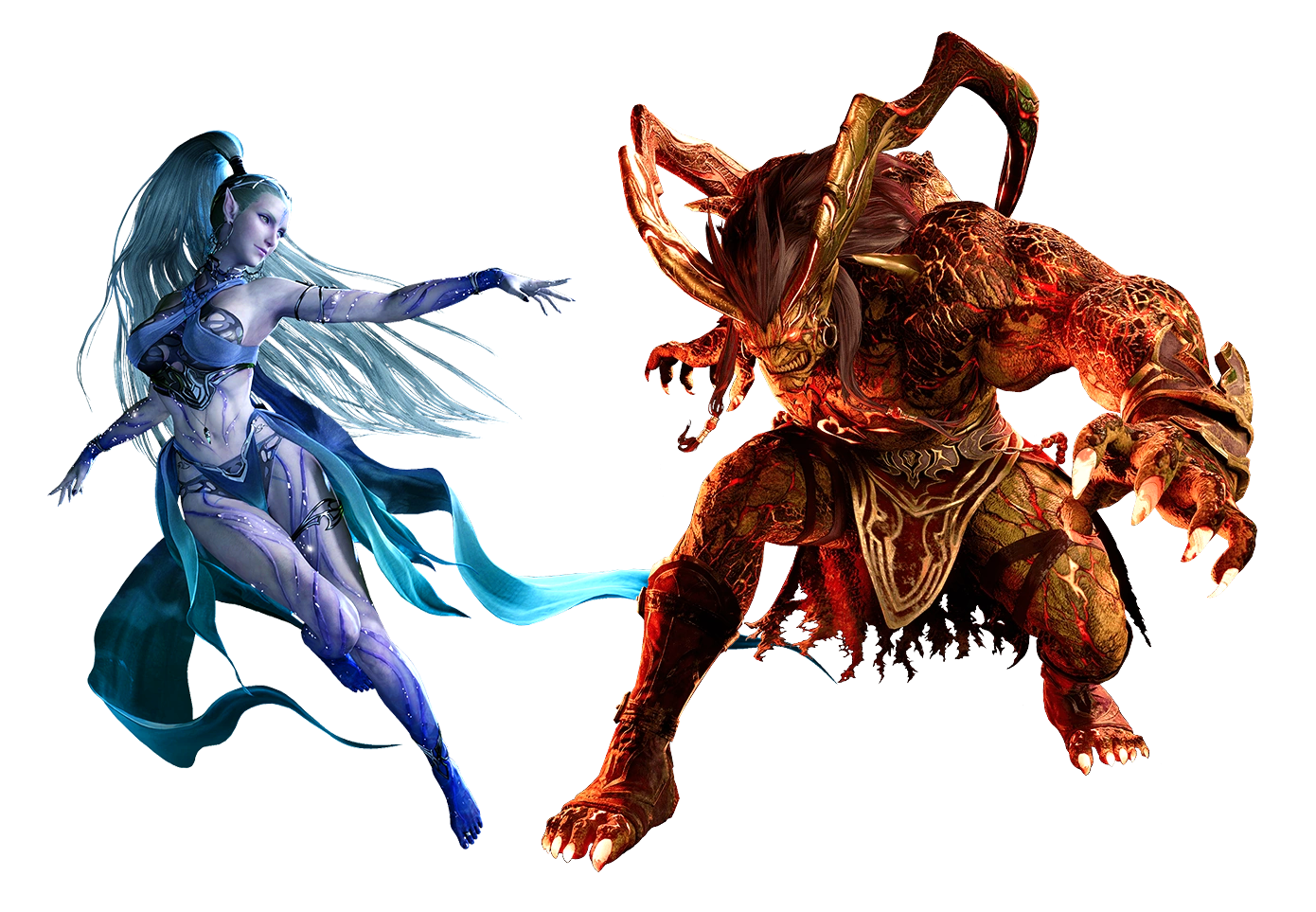
Shiva and Ifrit as they appear in Final Fantasy VII Remake.
However it happened, the end result is a new Shiva whose connection to the Hindu one is only nominal — and I’m using that word in the literal and metaphorical senses both. But because they share a name, you can’t help but to compare them, to see the Final Fantasy version as existing as a variation on the “real” Hindu Shiva. I suppose if the Final Fantasy version continues to exist, the conversation around her might eventually become less of a case of “Why did this video game name its blue ice lady after a Hindu god?” and more of a case of “There is a Hindu god named Shiva, and then over here there is also this blue ice lady named Shiva in Final Fantasy,” if that makes sense. And I suppose if you’re a Final Fantasy player who doesn’t have reason to interact with Hinduism at all, it might already be at that point now.
For the rest of us, however, the Final Fantasy version of Shiva has only existed since 1990, and the Hindu version of Shiva is… considerably older, so it remains to be seen if the ice queen can endure long enough to exist in her own right.
Miscellaneous Notes
Since I’m on the subject, I might as well discuss the other apparently Hindu-inspired summons in the previous piece. Lakshmi is the most straightforward. In Hinduism, Lakshmi is the goddess of happiness, fortune, wealth, prosperity and beauty, among other things, and in any of her Final Fantasy appearances, she is essentially a beautiful, benevolent woman. It’s interesting that the original English localization for Final Fantasy VI renamed her Starlet, because it’s a rare instance of a Hindu name being censored out in favor of one that has no religious affiliation. It is, essentially, an early instance of a Hindu deity being treated with the same polite restraint as early Nintendo games had for references to Christianity.
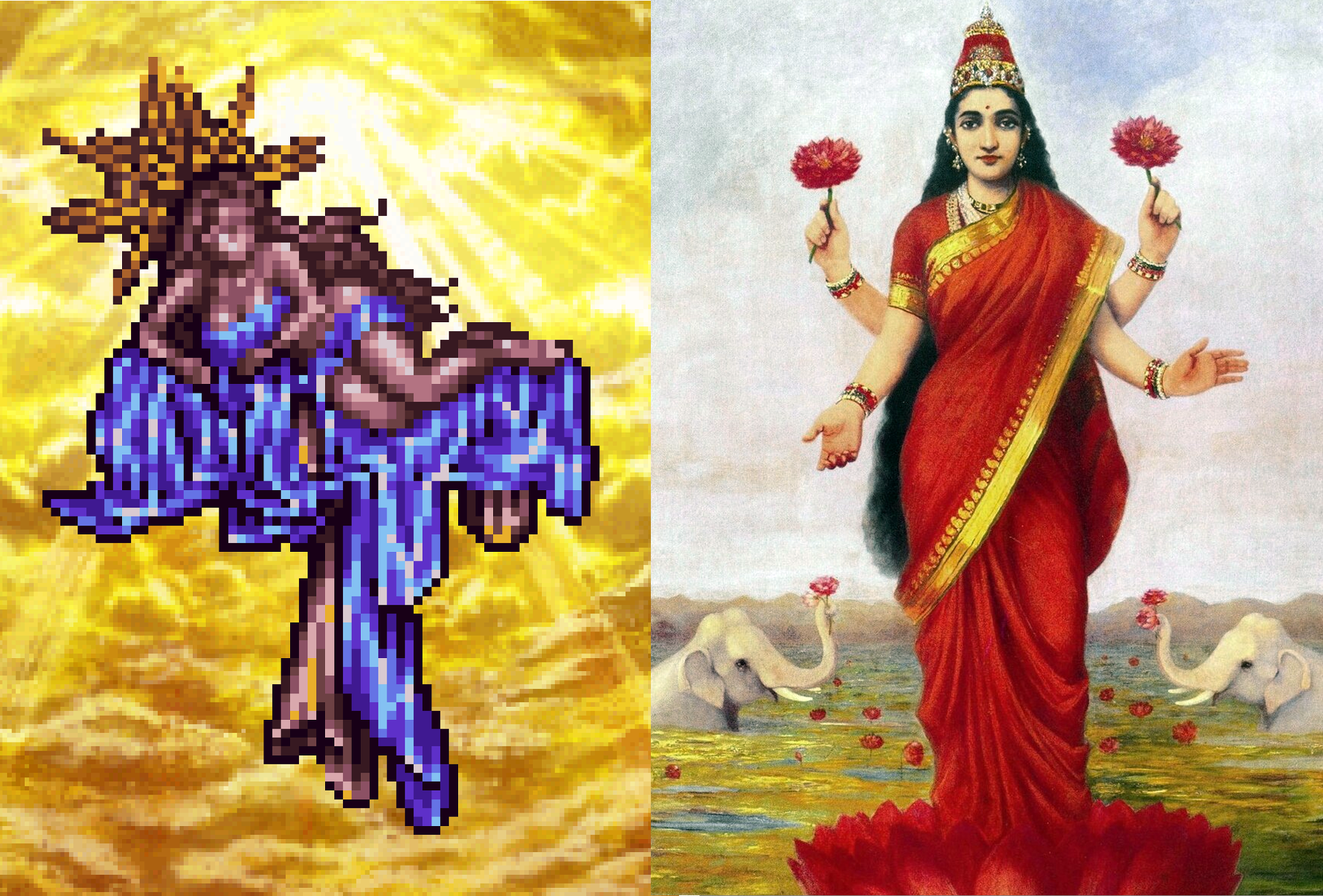
Left: Lakshmi in Final Fantasy VI, appearing as a beautiful woman that could just as easily be a version of Venus, Aphrodite or any other love goddess. Right: A traditional Hindu depiction of Lakshmi.
Asura is a bit of a different case. The Final Fantasy IV version of her is, like Shiva, distinctly feminine in appearance but more monstrous. Her name comes from the Asura (असुर), a class of beings in the Hindu cosmology that are somewhat comparable to demigods or titans in Greek mythology. The Deva are this as well, with the typical difference between the two being that the Asura are generally considered malevolent and the Deva benevolent. The Final Fantasy version of Asura would seem to be more inspired by the Buddhist conception of the Asura, however, as it has three faces and multiple sets of arms, whereas this is not necessarily an aspect of the Hindu version.
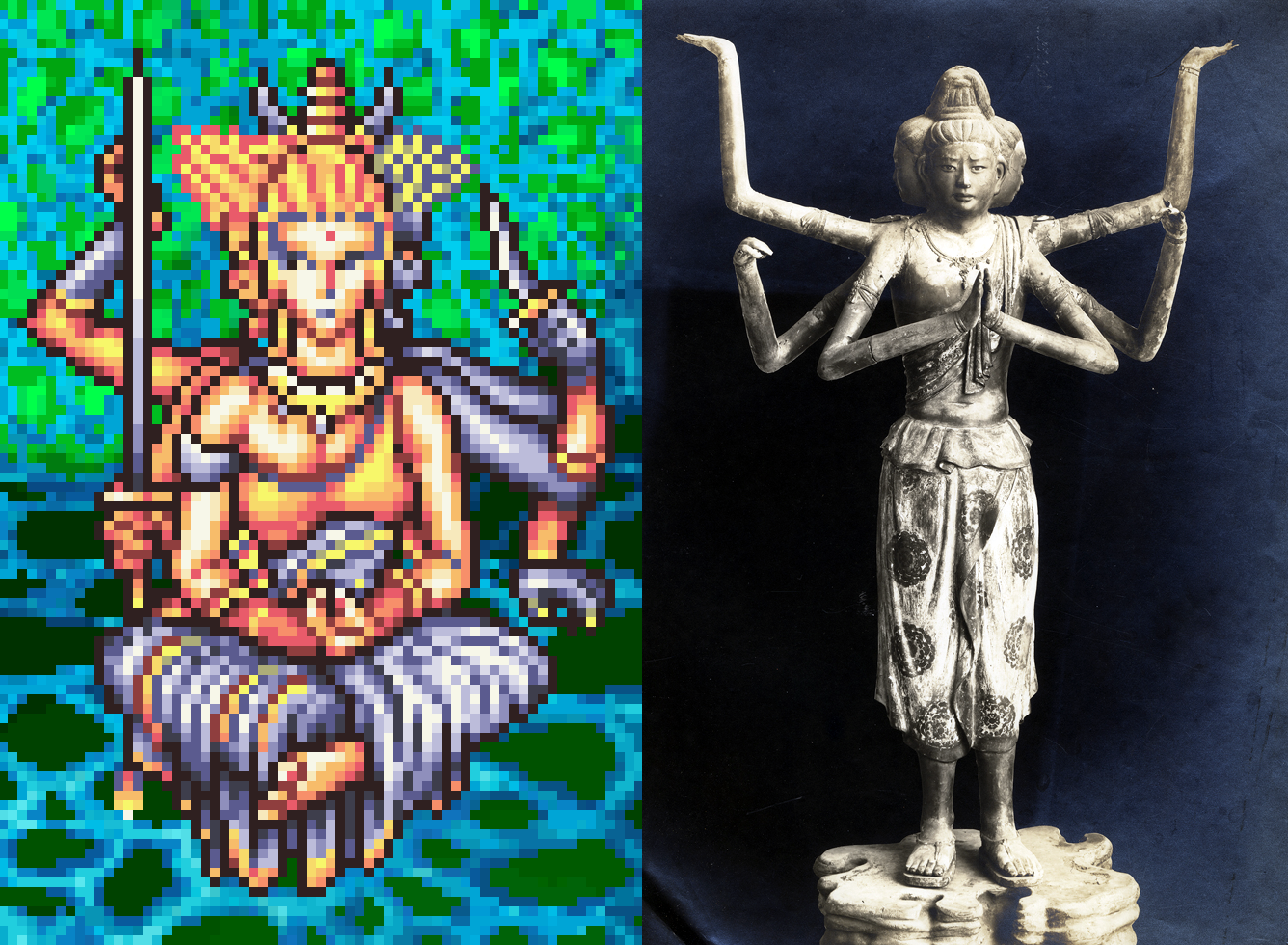
Left: Asura in Final Fantasy IV. Right: A statue of a three-headed Asura at Kofukuji Temple in Nara, Japan, via Wikipedia.
And then we have Ramuh, who doesn’t line up neatly with any one Hindu deity but is speculated to be influenced by several. We don’t know where his name comes from. It’s frequently guessed that his name could be a reference to the god Rama or some combination between Rama and Vishnu’s names, neither Rama or Vishnu are typically depicted as old men, and Final Fantasy’s Ramuh is only ever depicted that way. Curiously, the original English localization of Final Fantasy IV switches Rama’s name to Indra, which would seem to be an instance of swapping one Hindu god out for another. In Hindu tradition, Indra (इन्द्र or Inthra), is the king of the Devas and also the god of sky, lightning and storms, so if anything this change pairs the Final Fantasy character with a Hindu got that actually makes more sense, even if Indra is also not generally depicted as an old man. However, only this first translation of Final Fantasy IV used this name; every subsequent version as well as every sequel used Ramuh, a sensible enough transliteration of his Japanese name, ラムウ or Ramū.
Along similar lines, that same first English version of Final Fantasy IV also gives Ifrit a name that’s never used again: Djinn. In Islam, an ifrit is a type of demon that is apparently separate from but nonetheless associated with the djinn. I’m not sure I completely get the difference between them, and even if I did, I’m not sure this substitution makes sense.
I joked about Final Fantasy never making Jesus or Mohammed a summon, though it’s worth pointing out that Final Fantasy VI comes close with two Espers. There’s Seraph (セラフィム or Serafimu, “Seraphim”), a decidedly non-biblically accurate angel who looks like something you’d hang on a Christmas tree, but she basically never appears again after this one game. And then there’s Crusader, who in the Japanese version of the game is named ジハード or Jihādo, “Jihad.” There’s a lot to unpack there, and I tried my best in an older post.
There’s also some strangeness with the recurring Marilith character in the Final Fantasy games. In the first English version of the first Final Fantasy, she’s renamed Kary, which is speculated to be a misrendering of Kali, the Hindu goddess of destruction. I go into that in my larger piece on the odd give-and-take relationship Final Fantasy has with Dungeons & Dragons.
And now that I bring up Kali, I am reminded that the Mortal Kombat character Sheeva, who has four arms, has more in common in appearance and demeanor with Kali than she does with Shiva. So why would they call her Sheeva? Well, let’s just say that I have my own opinions about Mortal Kombat character names.
Speaking of Rudra, he is actually namechecked in the title of a Super Famicom-era Squaresoft RPG that never made it out of Japan: Treasure of the Rudras (ルドラの秘宝 or Rudora no Hihou). I don’t know that much about it, but it apparently features Hindu concepts even more centrally, with Rudra being explicitly tied with Shiva. There is a fan translation out there, and I do want to play it, but I just haven’t gotten around to it. I swear I will one day. This game does look beautiful.
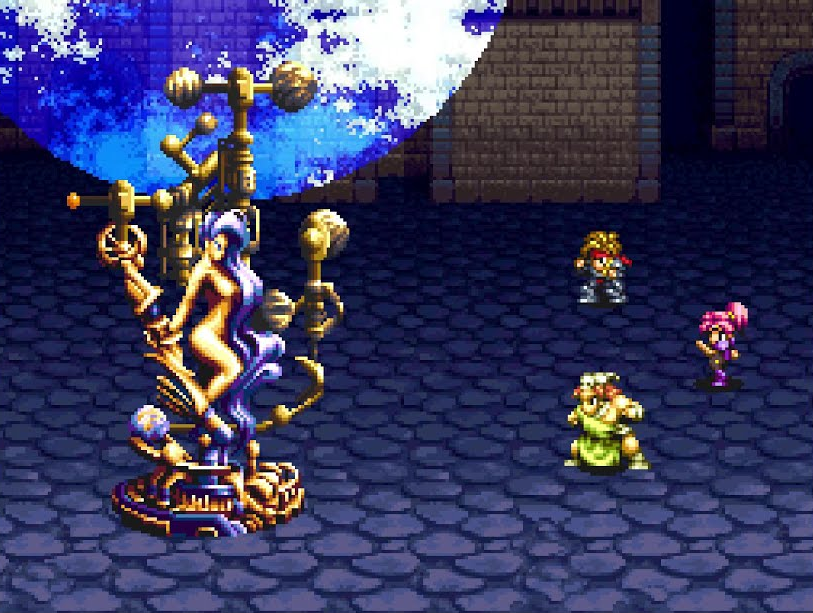

Finally, I thought I’d mention a cool thing about Shiva that I suspect most people don’t know. Her signature attack blasts the entire enemy party with ice magic, and it’s called Diamond Dust. This is a perfect name for this particular character to have, because it sounds rather beautiful, “diamond dust” being a rather poetic way to describe a snowstorm. It’s a real phenomenon, however, wherein tiny ice crystals are suspended in clouds close to the ground. It’s more common in the polar regions, but from how it’s described, it can be quite beautiful.