

Sylph, Undine, Gnome, Salamander and the Swiss Doctor Who Invented Them
As a kid playing RPGs, I learned a lot of new words — some invented for a particular game’s fictional setting but others drawn from the real world. In a sense, the seeds for this blog were planted during the process of finding out if a given word existed outside the realm of video games. If it did, I always wanted to share — like, “Look, mom, a non-educational video game taught me something!” Indeed, this post began years ago with a trip to the dictionary that ultimately led me to Paracelsus, the sixteenth-century physician who also happens to be the creator of the four elementals: sylph, undine, gnome and salamander. Despite the considerable handicap of being a science guy, Paracelsus originated the elemental quartet that fiction and fantasy and RPGs in particular would revisit again and again.
It was during my first playthrough of Final Fantasy IV that I learned the world sylph. In the game, the sylphs are a race of fairy-like creatures who reside in an underworld cave. They’re depicted as being frail individually but considerably more powerful when they join together. They eventually become a summon spell for Rydia, and when called into battle more than one appears onscreen, whereupon they use their magic to sap hit points from an enemy and then distribute them among your party members.
After I finished Final Fantasy IV, I played Arcana, a dungeon-crawler developed for the SNES by HAL Laboratory in between Kirby games. Arcana allows you to recruit elementals into your party, and the one associated with wind is Sylph. She casts lighting magic, and she looks a lot like the sylphs in Final Fantasy IV, which is to say that she looks more or less like your standard storybook fairy.
And then shortly after that, I played Secret of Mana, which features an eight-elemental magic system. The elemental associated with wind was called Sylphid — or that was the case in the original English localization, at least — and although he doesn’t look anything like the fairy creatures from Final Fantasy IV and Arcana, he specializes in a similar sort of magic to the one in Arcana: strong winds and lighting bolts.
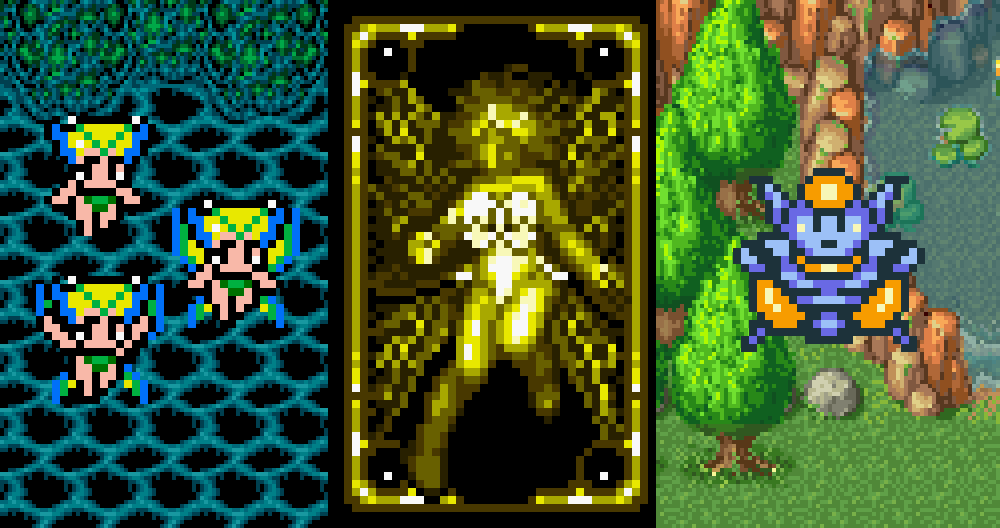
Left to right: The sylphs in Final Fantasy IV, Sylph in Arcana and Sylphid in Secret of Mana.
Clearly, there was something behind these similar video game characters, so I eventually looked up sylph in the dictionary, which defined it as “an elemental being in theories of Paracelsus that inhabits air.” Based on the name, I assumed Paracelsus was one of those famous one-namers who said smart things in Greek antiquity, like Plato, Aristotle or Homer. Imagine my surprise years later when I encountered Paracelsus again while learning about the renaissance. This was a guy who lived a lot more recently than those three toga enthusiasts I just mentioned; he was born in 1493. And while that seems a bit late in the world history timeline to be dreaming up about fairies who ride on the wind, it’s far from the thing he’s best known for. In addition to a nigh-heretical approach to medical conventions, Paracelsus is remembered today for naming zinc, observing hydrogen and establishing the need for doctors to understand chemistry in order to do their jobs well. He also invented the opiate medicine laudanum, and he pioneered the concept of antiseptic wound care. In short, he was a scientific heavyweight, which makes his belief in sylphs all the more surprising to anyone reading about him in the twenty-first century.
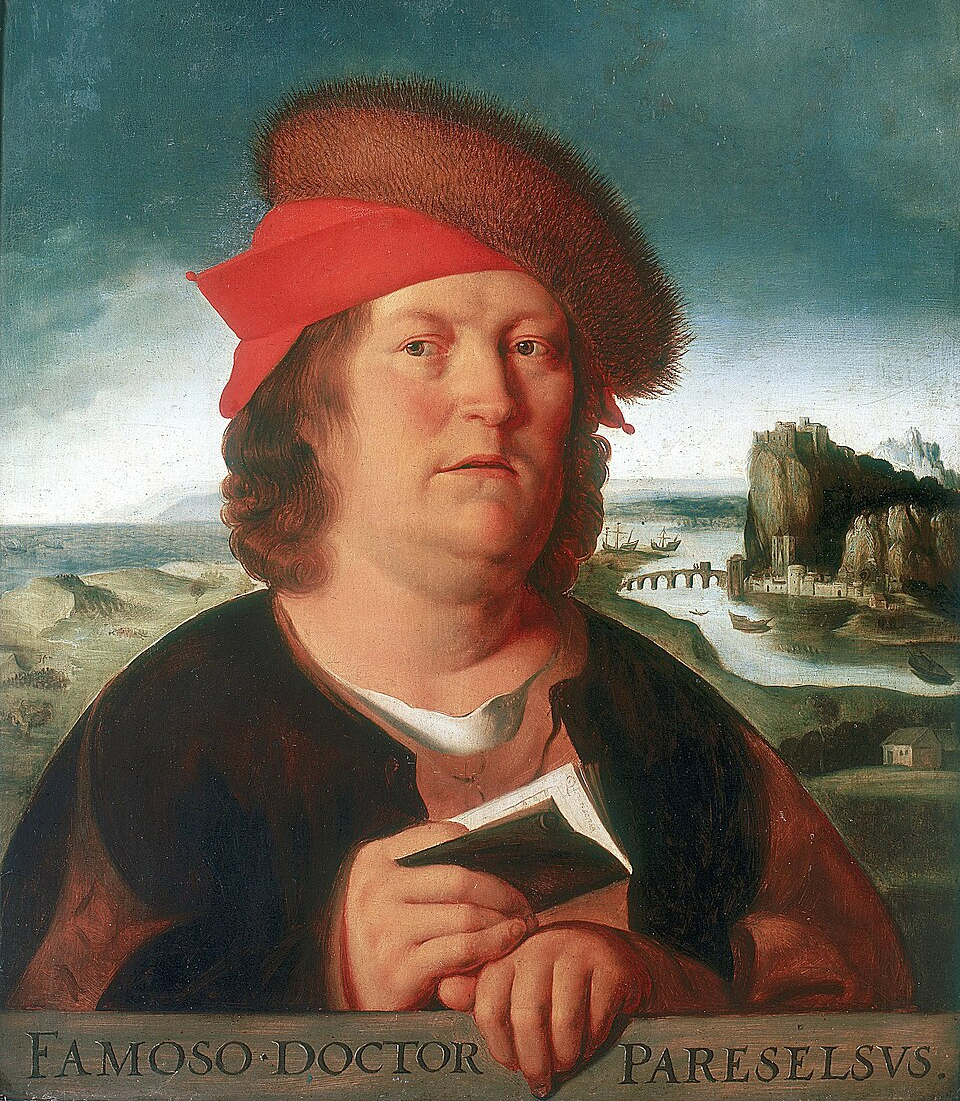
The man in question, as painted by Quinten Matsys. My personal name for this portrait is “You Sure Ate Your Potatoes, Didn’t You?”
Paracelsus was born Philippus Aureolus Theophrastus Bombast von Hohenheim, and if you think it strange that someone with a killer name like that would ever want to go by anything else, it seems to be that Paracelsus was originally meant to be the name under which he published non-medical theories. Of these, one posthumously published treatise is arguably the most famous because it introduced the notion that the four classical elements — earth, air, fire and water — were each the domain of creatures that I hesitate to call supernatural or even theoretical because I don’t think the good doctor would have understood it using those terms. But yeah, essentially, he said that sylphs inhabit the air, undines water, gnomes the earth and salamanders fire — more or less. As a result of this proclamation, these creatures have become staples of fantasy literature, almost always retaining their elemental associations.
< Support this site: on Patreon! • on Kofi! >
The “more or less” in the previous paragraph was meant to flag the fact that the names these elemental beings became known by in English aren’t the ones that Paracelsus actually used. If you want to get technical about it, the treatise was first published in Latin with the name Ex Libro de Nymphis, Sylvanis, Pygmaeis, Salamandris et Gigantibus, etc. — or in English, A Book on Nymphs, Sylphs, Pygmies, and Salamanders, and on the Other Spirits. Yes, the original Latin title references giants while the English one does not, which is weird. And yes, the original Latin version uses names that are fairly different to how English-speakers usually refer to these entities today. I’m actually not sure exactly how English arrived at those specific names, but it’s worth pointing out that the original text has Paracelsus playing fast and loose with terminology. He’s less so laying down dogma than he is collecting various folkloric creatures and assigning them elemental categories, if that makes sense.
From a 1941 English translation by Henry E. Sigerist:
Their abode is of four kinds, namely, according to the four elements: one in the water, one in the air, one in the earth, one in the fire. Those in the water are nymphs, those in the air are sylphs, those in the earth are pygmies, those in the fire salamanders. These are not good names, but I use them nevertheless. The names have been given to them by people who did not understand them. But since they designate the things and since they can be recognized by the names, I shall leave it at that. The name of the water people is also undina, and of the air people sylvestres, and of the mountain people gnomi, and of the fire people vulcani rather than salamandri.
The text goes on to group even more beings from folklore and mythology into these four basic categories. Water elementals, for example, also include Melusine as well as something called Venusberg, which outside Paracelsus’ writings would seem to be more of a place than a creature. Each category also has its own monsters. Water has sirens and seamonks — see this history of the Tonberry for information about the latter — while fire has will-o’-the-wisps, earth has dwarves, and air for some reason has giants, which would seem to be the author’s way of making sense of worldwide stories about a race of extremely tall, possibly semi-divine people who died out long ago.
It’s such a strange text that you might be forgiven for wondering why a science-minded man would write it. The introduction by Sigerist addresses this, underscoring how Paracelsus would have found science and philosophy to be one and the same, even when the latter veers into the folkloric, the fantastical and even the occult. The translator also attempts to justify this treatise in light of the fact that Paracelsus was very much a Christian — and, you know, neither the Bible nor church doctrine makes mention of sylphs, undines, gnomes and salamanders. I’m not sure I buy this defense, but it comes down to Paracelsus apparently wanting to restore to Christendom the rich supernatural taxonomy that existed in pagan times. Whatever gets you there, dude.
From Sigerist’s introduction:
Christianity had a difficult task in overcoming the ancient gods. Its monotheism was too austere for the common man, and soon the Christian heaven was populated with angels and saints, many of whom had taken over the functions and attributes of ancient gods. Venus took abode in the Harz mountain and continued to seduce men, promising them the joys of love and eternal youth. And when she could not act so openly, she was satisfied in being worshipped under the features of Saint Veronica. Her bird, the dove, became the Holy Ghost from whom Mary conceived without sin.
Christianity succeeded in dethroning the major gods of paganism or in filling their place with its own saints, but it had no substitute to offer for the elemental spirits, for all those minor deities and demons that were so close to man in his everyday life. There had to be an explanation for good luck and bad luck. Omina would explain a great deal and the belief in signs persisted to our days. But if you dropped a piece of buttered bread, why was it that it usually fell to the ground with the buttered side down? Was it not logical to assume that this was a practical joke of some goblin? And so, the ancient spirits of nature survived the twilight of paganism.
What’s remarkable about this framing of the text is that it means Paracelsus had something in common with the RPGs that would mine his theories so many centuries later. Both he and they sample liberally from stories and traditions from various cultures and bring them together in a way they’d not existed before, with a creature from a given tradition existing alongside one from a completely foreign one, as equals and as parts of the same balance of nature, however fantastical. In the treatise, Paracelsus does not point to any one European culture as the correct one. Instead, he’s cobbling together something new, taking bits and pieces that he encountered from his travels throughout Europe. This is more or less what every medieval-set RPG would do — you know, when they weren’t lifting directly from Dungeons & Dragons, which also liberally sampled from stories from around the world.
In fact, even the creatures that Paracelsus is credited with creating are mostly just amalgamations of older, existing lore.
The sylph, for example, isn’t based on any one singular fairy. In fact, fairies did not have wings until relatively recently, although exactly when they got them as part of their default appearance is a matter of some debate. As a synonym for sylph, Paracelsus offers silvestris, which occurs in the Aeneid as a way of referring to forest nymphs, silvestris being Latin for “of the forest.” But Jacob Grimm’s Teutonic Mythology uses nympha silvestris as a translation for the Anglo-Saxon wudu-mær, a word that can also refer to an echo or to the female counterpart to the wild man. Enticingly, the origins of the sylph might exist between these two: like an echo, she is the suggestion of something like a human that is heard but not seen and like the wild woman, she is this primordial being who looks human but who is considered dangerous because her allegiances lie with the natural world.
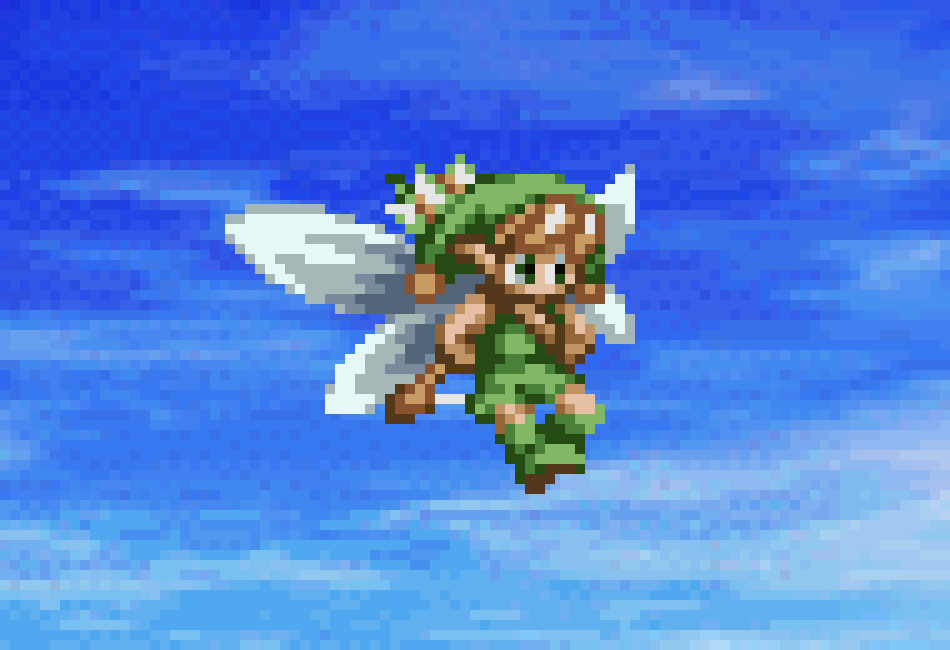
The sylph as depicted in Tales of Eternia.
The link between sylphs and wind seems almost arbitrary, given everything I just explained about forest nymphs. The connection would seem to originate with Paracelsus. I suppose it made sense to him when he was writing it? In a weird sort of way, Alexander Pope’s The Rape of the Lock may have confirmed the connection because it features a sylph named Ariel as a character. That name Ariel is not the adjective aerial and has a completely unrelated etymology, but I feel like you can’t overlook the fact that they sound the same. William Shakespeare sure didn’t, at least, when he gave the same name to Prospero’s attendant spirit in The Tempest. While not described as a sylph, the dramatis personae for The Tempest identifies this Ariel as “an airy spirit.” Most depictions of either Pope’s Ariel or Shakespeare’s look, well, aerial.
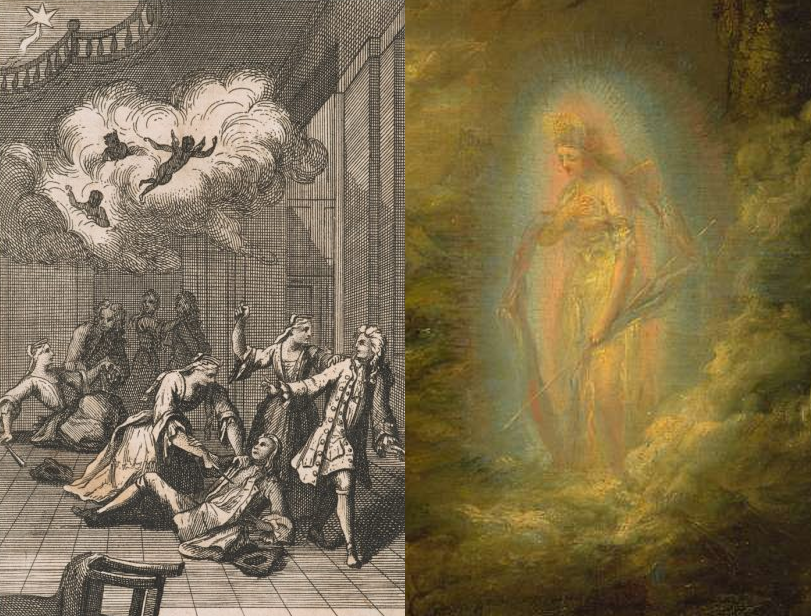
And the transformation of the sylph into a winged fairy may have been completed by the nineteenth-century ballet La Sylphide, in which the title character’s wings are a plot point.
Meanwhile, the term undine also seems to have originated in Paracelsus’ treatise, presumably deriving from the Latin unda, “wave.” But the concept of a sexually alluring water spirit shows up in the traditions of basically every culture that has access to a place to swim. I’m not sure what of Paracelsus’ explanation of undines should also apply to mermaids and selkies and rusalkas, necessarily, but he does make clear that undine is basically synonymous with nymph. That’s a little confusing because I just explained that the sylph was also sort of nymph, but also Greek folklore has a lot of nymphs doing their thing without any water association. Dryads are tree nymphs, for example, and oreads are mountain nymphs. (Ancient Greece was lousy with nymphs.)
On the subject of undines, Paracelsus goes into peculiar detail that he does not give the other elementals, and his explanation of how undines interact with mortals has reverberations throughout culture.
[Undines] come out of their waters to us, make themselves known, act and deal with us, go back to their water, come again — all this to allow man the contemplation of the divine works. Now, they are men, but on the animal side alone, without the soul. From this it follows that they marry men. A water woman takes a man from Adam, and keeps house for him, and gives birth to children. Of the children, we know that they follow after the father. Because the father is a man from Adam, a soul is given to the child, and it becomes like a regular man, who has an eternal soul. Furthermore, this also is well known and must be considered, that such women also receive souls by becoming married, so that they are saved before God and by God like other women.
So yes, Paracelsus may have originated the idea that female water spirits can gain a soul by marrying a human man. And if he didn’t originate it, he certainly seems to have popularized it, This very notion resurfaces in the 1811 romance Undine and its adaptations as a play and ballet — and then again in Hans Christian Anderson’s 1837 story “The Little Mermaid” and its countless adaptations. Curiously, the desire to marry a human is all but absent from most video game versions of the undine, where it exists primarily to cast water magic without any romantic complications.
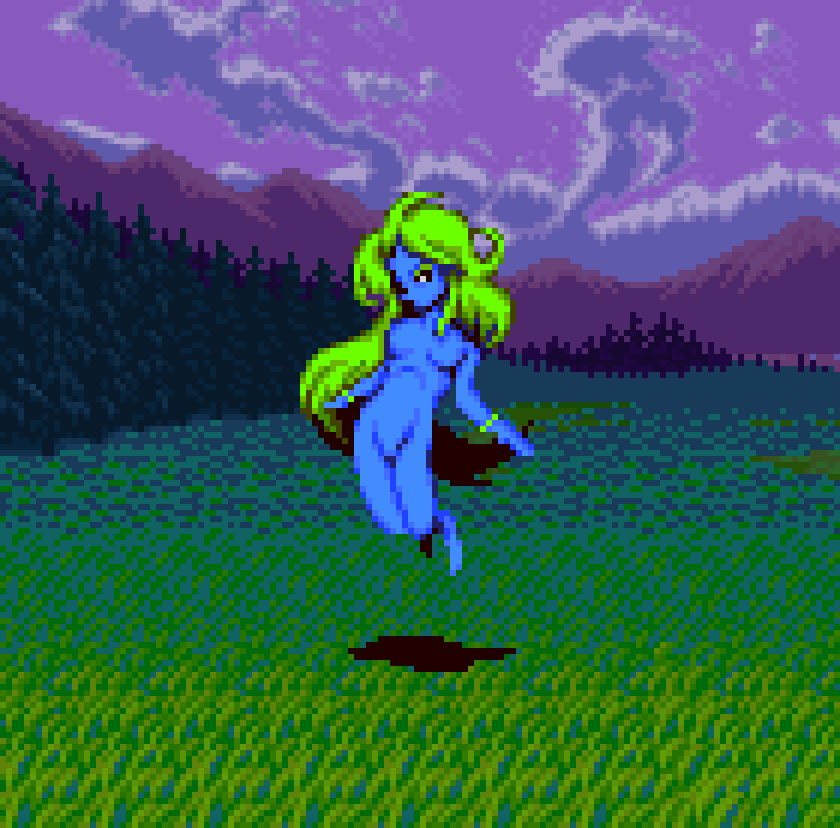
The undine as depicted in Last Bible III.
Paracelsus is also credited with coining the term gnome, with most etymologies attempting to link it to the same Greek roots that give English the word gnostic. But obviously his gnomes are pre-dated by a long history of stories about small-statured humanoids who live in caves and who possess knowledge of metal and stone. Take the kobolds, for example, whose association with the earth is so strong that their name shares an etymology with cobalt. The translation more than once refers to these creatures as mountain manikins, which is apparently a translation of the German Bergmännlein, “little mountain man.” (Yes, this is how I learned that mannequin literally means “little man.”)
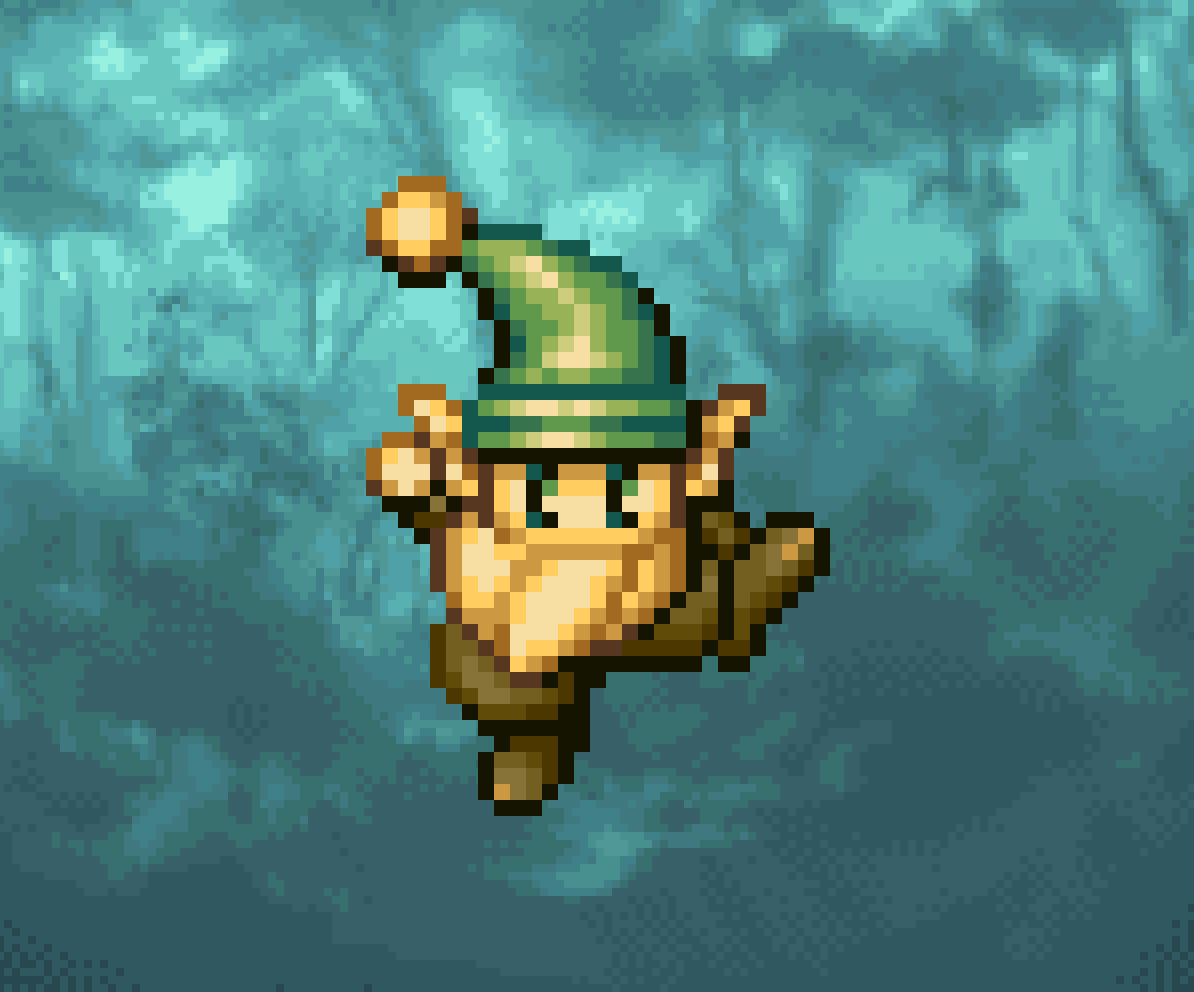
The gnome as depicted in Legend of Mana.
Of the four elemental beings Paracelsus describes, gnomes are probably the most familiar to people who don’t engage with the fantasy genre, and that’s because of a thriving lawn ornament industry. There’s at least one on display in every block in my neighborhood, and while I can’t say if that’s a good thing or a bad thing, I’ll point you to the Decoder Ring podcast if you’re curious about how this creature became part of American kitsch.
And that leaves the salamander, which is both familiar, because most people would know the common animal that goes by this name, but also not, because it’s not exactly that creature. I’d actually say that it’s very analogous to the way Japanese folklore has the tanuki, the very real raccoon-dog, but also the bake-danuki, the mischievous folklore version of that animal, which I discuss at length in this post. Going back to the writings of Aristotle, salamanders were thought to be associated with fire, capable of extinguishing fire or even immune to fire, depending on who’s telling the story. None of this is true, and I can only imagine that the need to test any of these theories resulted in the needless death of more than one salamander.
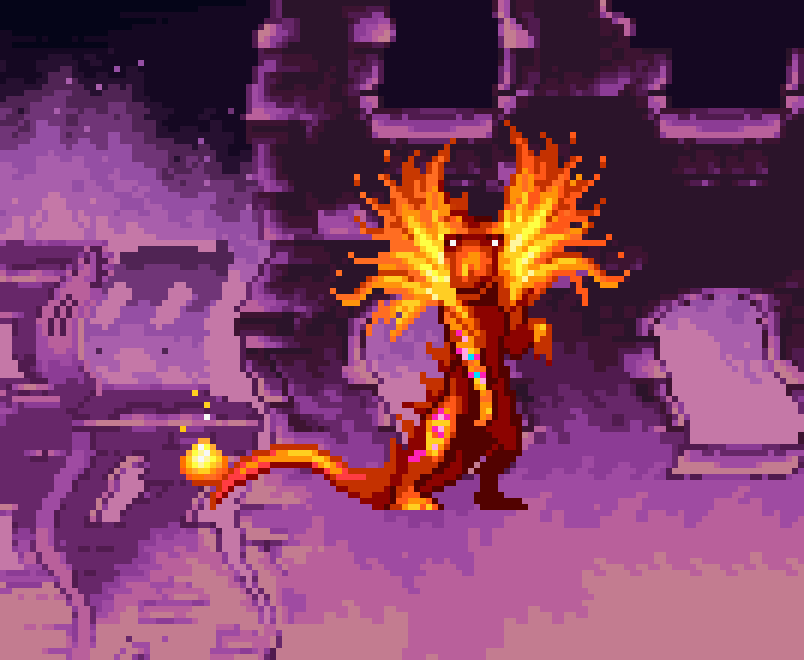
The salamander as depicted in Demon Hunter Legend 4, which I’m pretty sure is not an RPG and which I don’t know that much about, but I really dig the sprite work.
The fire association may seem strange to you, because in real life salamanders are soft, squishy and slimy — and, because they’re amphibians, they’re not infrequently found in wet environments. Wikipedia guesses that the association probably came from the practice of humans putting logs on a fire and seeing salamanders scramble out to safety once they feel the heat. If humans didn’t put together that the salamanders were living in the rotten wood before it was placed on the fire, they might assume that the creatures were created in the fire. That seems logical enough, I guess, though it’s maybe surprising that the footnote attached to this passage connects to a book from 2002. (Surely, this is something that someone must have figured out before, no?) But regardless of the origins, the association stuck in multiple cultures throughout the world.
In the introduction to his translation, Sigerist calls A Book on Nymphs “very unpretentious” and “written in a style that reminds us of fairy tales.” He’s not wrong, and he correctly points out that it’s an aspect of Paracelsus’ work that stands apart from his medical texts. That has only become more so the case now, four hundred years after the book’s publication, with the brute force of rationality making belief in an unseen mystical world even more taboo. But neither Paracelsus or Sigerist could have predicted how this description of elemental beings would become a foundational text for a subset of video games that embrace mysticism. These ideas are still being celebrated and explored all these years later, just in a medium that did not exist until relatively recently.
At some point as I was rolling this idea around in my head, I thought about cataloguing the various appearances these characters have made in games, but I ended up coming to the conclusion that this wasn’t the point I wanted to prove. They’re there. Trust me. You can go look them up yourself if you like. For me, the point of this post was drawing a line between a text that’s not especially treasured among Paracelsus’ various legacies and a genre of video games that really went to town with the concept of elemental spirits. With a lot of the real-world bits of folklore and mythology that end up in RPGs, we can point to a time period or a culture as an origin point, but in this case, we can trace sylphs, undines, gnomes and salamanders back to a single man, who for no reason I can understand decided to write out a treatise on the unseen aspects of the natural world. And because it did not come to public attention until after his death, Paracelsus might be as surprised as anyone that it’s continued to live on at all.
In fact, if it weren’t for sylphs showing up in more than one video game back in the day, I might not have any idea who Paracelsus was. And while I’m obviously thankful he introduced the idea of cleaning wounds as a means to preventing infection, I’m also charmed that this man took the time to assert that the world actually was a magical place.
Miscellaneous Notes
Although I used sprites from Trials of Mana for the art for this post, I actually am going to hold off on discussing the unique way the Mana games interpret elementals for another, shorter post that I’ll write before the end of the week. Stay tuned!
I don’t have a whole post in me about Arcana, but I will point out that Sylph is the only elemental in that game that actually comes from Paracelsus. For whatever reason, the other three were swapped out with different folkloric creatures Fire is Efrite and water is Marid, both of which come from Islamic folklore and both exist in Dungeons & Dragons as a class of djinn. In fact, the Marid’s water association seems to have come with D&D specifically, perhaps as a misreading of the first three letters as a reference to mare, the Latin word for the sea. The earth elemental, however, is Dao, and I’m not sure where that name comes from. I mean, it’s also from D&D and so is the earth affiliation, but I don’t know where D&D drew it from.
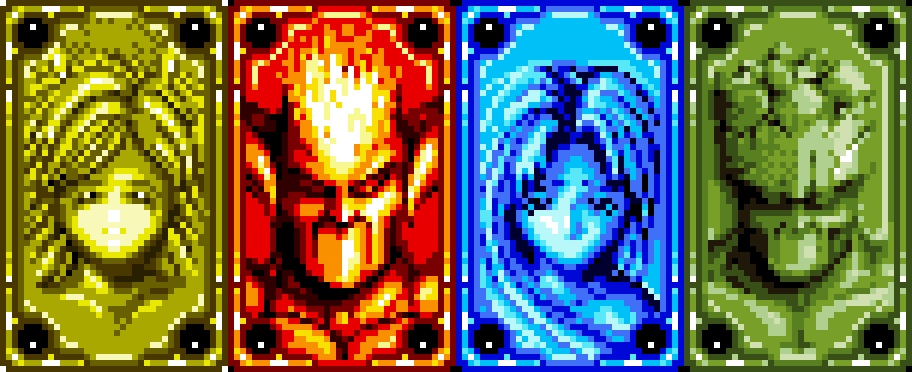
A different kind of elemental quartet. Left to right: Sylph, Efrite, Marid and Dao.
We don’t know why Theophrastus von Hohenheim chose Paracelsus as his pen name. Given that hohen is German for “high” and heim “home,” it may not be a coincidence that the celsus in his pseudonym is literally Latin for “high,” but some also read his name as meaning “beyond Celsus,” para- being Greek for “beyond” and Celsus being the first-century Roman writer of medical texts. That said, it’s not even clear if this was a name that Paracelsus picked for himself or if it was one thrust upon him by his colleagues.
I’m not clear when people started using the word elemental to refer to an occult spirit, as in “The sylph is the elemental of wind.” It’s hard to research because the generic sense of that word makes it hard to pin down the specific sense I’m talking about, but I was going to guess that Paracelsus might be responsible for that coinage as well. Etymonline, however, disagrees and says that sense began in 1877, though it does not say where. Whatever the case, it expanded beyond the four natural elements and came to represent any entity that represents the essence of a natural thing or place. I listen to more than a few podcasts where people discuss their interactions with the paranormal, and I was surprised how often people describe desert elementals, wood elementals and elementals that don’t fit neatly into the four categories described by Paracelsus.
I’m probably missing something, but Paracelsus likens the existence of the monstrous versions of the elementals — sirens, giants, dwarves and will-o’-the-wisps — to comets. I guess per the thinking at the time, comets were thought to be aberrant versions of stars that behave in ways we don’t think stars usually should. It doesn’t quite connect in my head, but it’s an interesting way to think about the normal in respect to the paranormal, I guess?
Born from other stars, the comet is nothing but a super-growth, that is, a growth that has not a natural course, as a star should have, but has been directed by God on purpose into another course. This is why the comet has great significance. And so have the sea wonders and similar things which thus come from water people. They too are such regular comets that God presents to man on purpose, not without meaning and significance.
I couldn’t find room for it in the post itself, but I really liked these two paragraphs from Sigerist’s introduction.
Greek demons joined the legions of spirits of the Germanic and the particularly rich Celtic mythology. As heretofore, man was surrounded by a world of strange beings whose dealings with men were recorded in hundreds of fairy tales. The Church could not deny their existence; they were too deeply rooted in popular belief.
But the theologians — not the true theologians, as Paracelsus said — declared them to be devils that had to be fought. Paracelsus had totally different views. He too believed firmly in the existence of such beings and considered them important enough to devote a special treatise to them. He never says that he had seen them. Like angels they appeared only rarely to man. But on his peregrinations he heard a great deal about them. In the mountains he saw strange excavations which local traditions attributed to the activity of pygmies. And in certain regions, at night, he probably saw flickering lights running around over the ground playfully, will-o’-the-wisps, and people said they were the spirits of fire.
There’s a funny nod to Rape of the Lock in the original run of Futurama. In the episode “The Deep South,” the gang visits the lost city of Atlanta, which sank into the sea long ago. Fry romances a mermaid named Umbriel, voiced by Parker Posey. In Rape of the Lock, the main attendant spirit is Ariel, but at one point another spirit named Umbriel shows up. It’s a joke for English majors, I guess, but more than anything it makes me wonder why the name Ariel was chosen for the main character in the Disney version of The Little Mermaid. Doesn’t that name sound… a little airy for a water creature?
< Support this site: on Patreon! • on Kofi! >
And finally, not every idea that Paracelsus had was necessarily a winner. For one thing, he believed in the doctrine of signatures, which states that medicinal items in the natural world have traits that mirror the ailment they can treat. From Wikipedia:
For instance, birthwort (so-called because of its resemblance to the uterus) was once used widely for pregnancies, but is carcinogenic and very damaging to the kidneys, owing to its aristolochic acid content.
Sounds bad! Yet it gets worse:
For example, the root of the orchid looks like a testicle and can therefore heal any testicle-associated illness.
I’m not sure why anyone ever thought this way, but it does explain why the technical term for the removal of the testicles is orchidectomy.