

The Elementals of Secret of Mana Are Quintessential
When it comes to fantasy RPGs that revolve around the balance of the natural world, the four classical elements are basically your standard starter pack. But not every real-world philosophy limited itself to wind, water, earth and fire — and as a result, more than a few fictional video game philosophies cast a broader net as well. In fact, the Mana series uses eight elements and even perfected its conception of elemental magic in Legend of Mana, only to inexplicably step away from it in later sequels.
What you’re reading now is a follow-up of sorts to the previous post, about the legacy of Paracelsus in video games, but it doesn’t really matter if you read this one first. Really, this began as a paragraph in the miscellaneous notes section before I realized I had a lot more to say. Think of this and the previous as two in a matching set, I guess.
The Greek concept of the four natural elements pre-dates philosophers such as Socrates and Plato, but it was Aristotle who suggested that a fifth element could explain the seeming immutability of the heavens. Basically, the material composing mortal life is corruptible and changeable, but the stars are not. As of the writing of his treatise On the Heavens around 350 BC, Aristotle was calling this fifth element αἰθήρ or aither — “upper air; bright, purer air; the sky,” according to Etymonline — and this term became Latinized as aether. But this does not mean that every scholar following the Greek transition recognized aether as the fifth element or recognized any fifth element at all.
Other philosophies chose somewhat differently, though it’s often easy to see parallels between their picks and Aristotle’s. Manichaeism, founded in the third century AD by the Iranian prophet Mani, includes rōšn, “light.” Hinduism’s fifth is akasha — “sky” but also “space” and “the heavens” — but can also include a sixth: viññāṇa or “conscienceness.” China’s wuxing (“five phases”) includes fire, water, earth, metal and wood. Japan’s godai includes the four classical elements plus a fifth, 空, that can be kuu, “void,” or sora “sky.”
Any video game implementing some kind of elemental basis for its universe can adapt any combination of these, of course. Chrono Trigger uses fire, water, light and shadow, for example, and then the Chrono Cross expands that into a color-coded six-elemental system, with red being fire, blue being water and ice, green being air and wood, yellow being earth but also lighting, black being shadow and white being light. Beyond Oasis gets weird, with its main elements being water, fire, darkness and wood — and then the prequel gets even weirder, expanding on the original four with air and also sound, making it one of the few in-game systems I know that recognizes sonic energy as an essential force. Pokémon might hold the record with nineteen, but to be fair it calls these classifications types rather than elementals, with a lot of them not really having a place in any real-life philosophy, including but not limited to flying, ghost, fairy and fighting.
I think it’s Secret of Mana, however, that may have made the best elaboration on the classical model with its eight-elemental system.
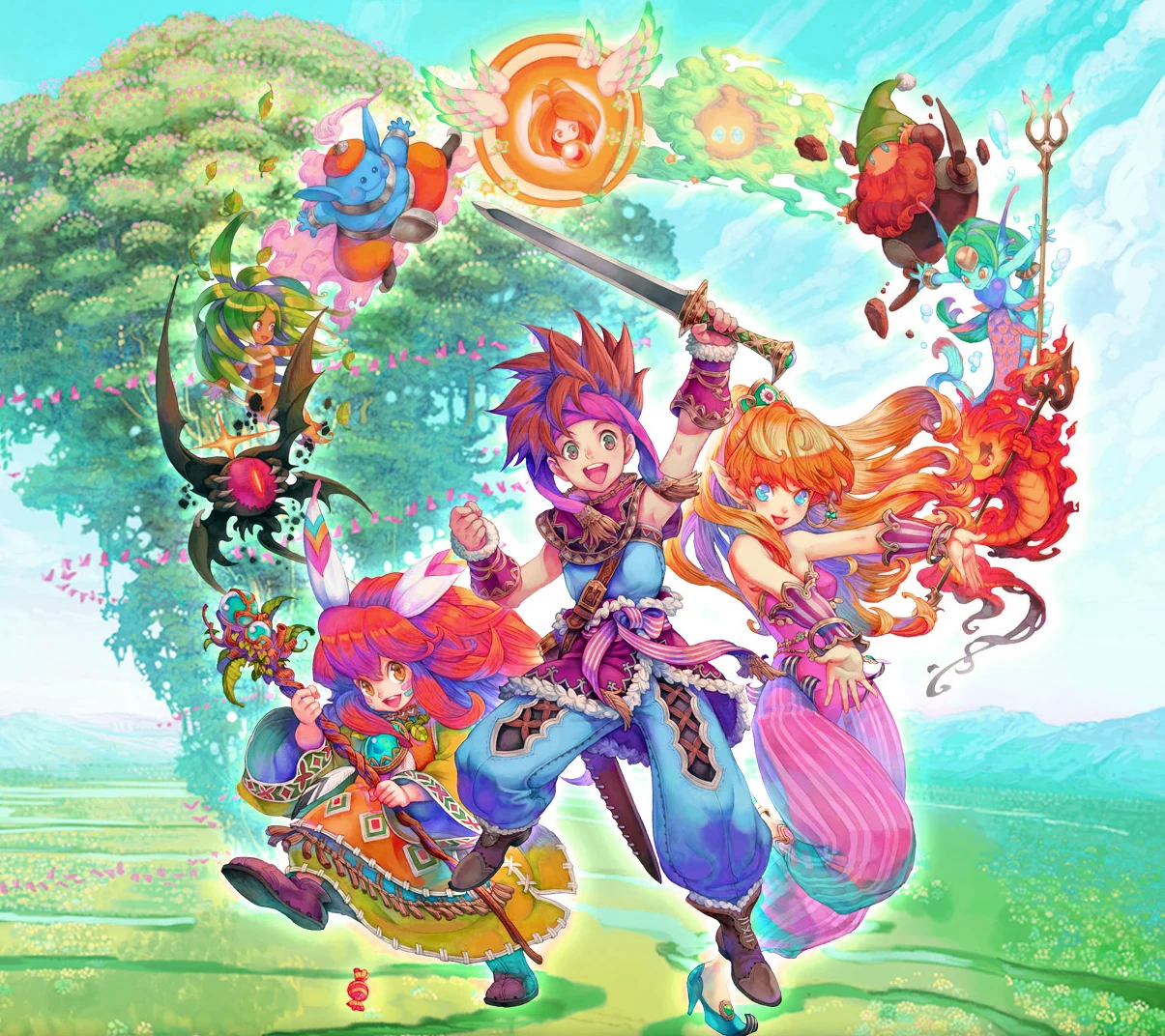
Clockwise from the left: Shade, Dryad, Jinn, Luna, Wisp, Gnome, Undine and Salamando — with Purim, Randi and Popoi completing the circle of life at the bottom.
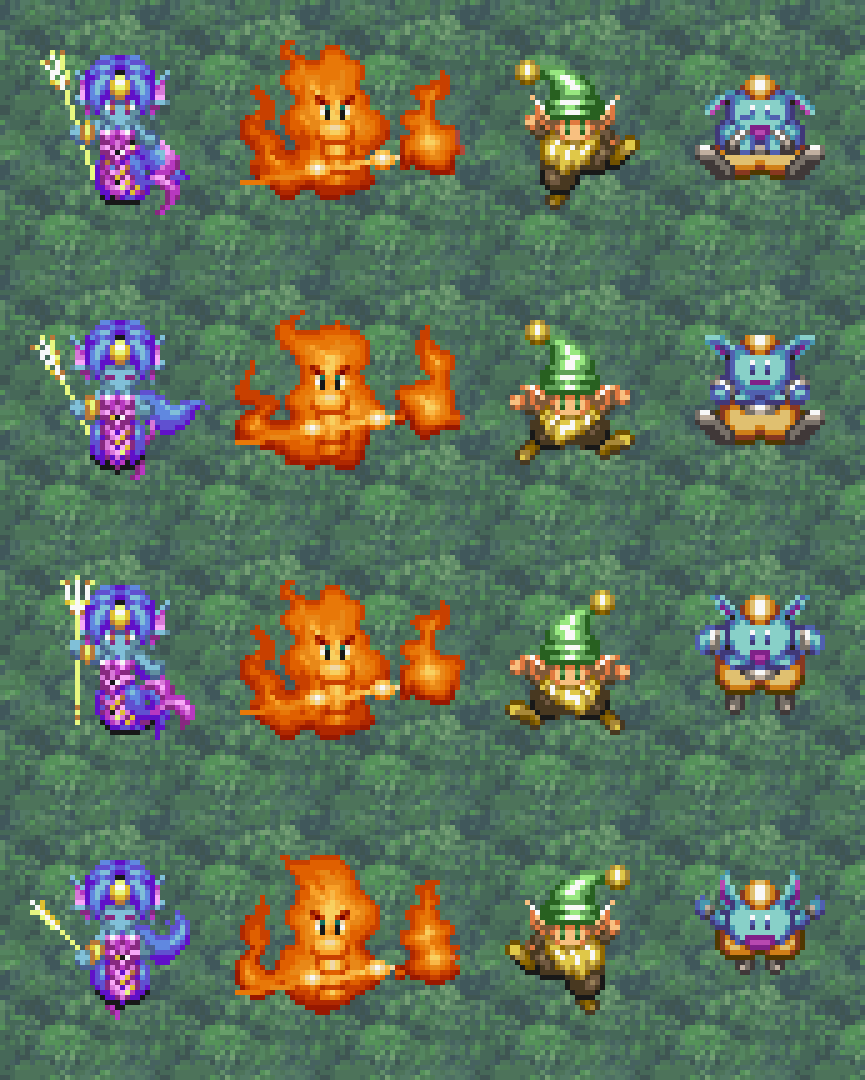
The game starts with the theories of Paracelsus. Undine represents water, Salamando represents fire, and Gnome represents earth. But then Secret of Mana makes the odd choice to have air be a blue, genie-looking creature — Sylphid in the original English localization but Jinn in every remake of Secret of Mana but also every sequel to it.
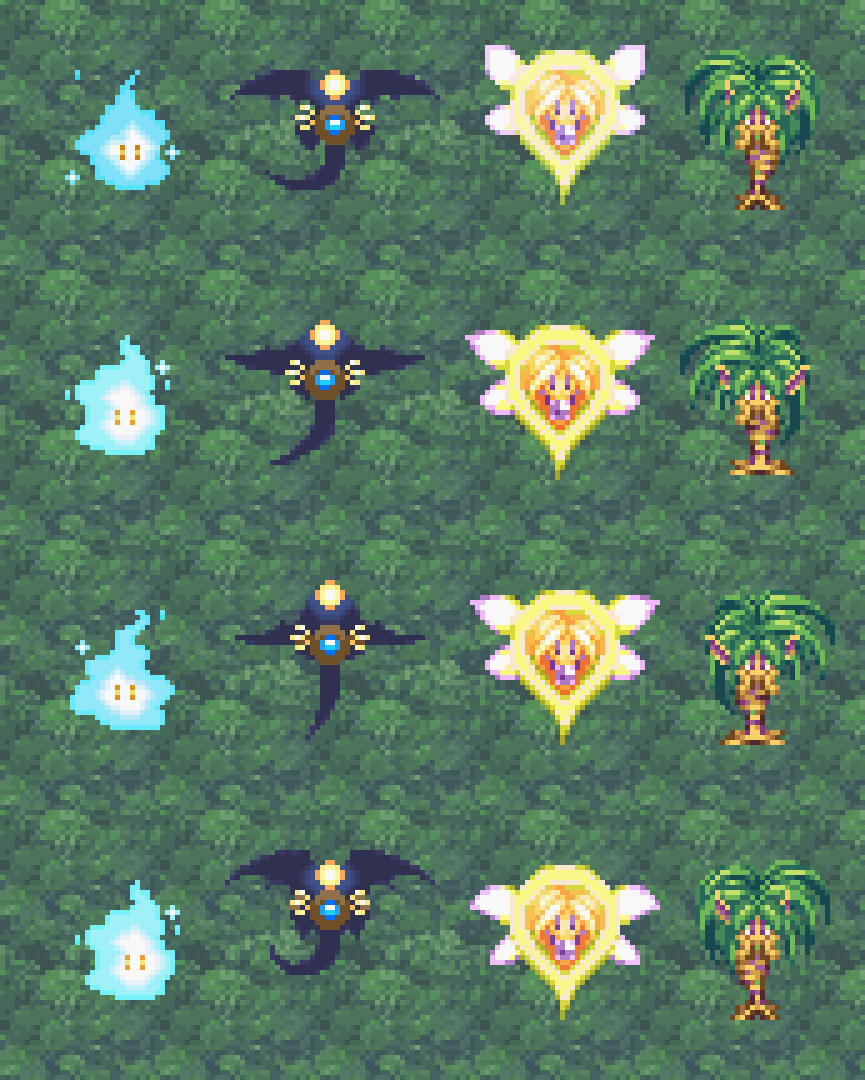
And then beyond that, there’s also Wisp representing light, Shade representing darkness, Luna representing the moon and Dryad representing wood. The final two are a little less consistent from game to game. In fact, Secret of Mana initially identifies Dryad as the mana spirit, but from Trials forward, she’s always been the embodiment of plants, trees and nature.
As in most RPG magic systems, natural opposites come into play here, with fire-affiliated characters being weak to water and vice-versa, as well as a similar thing going on here with air and earth affiliations. However, there’s some interrelation among these elementals that gets to the heart of the series battle system in a way that’s a little more subtle. In the second game to feature these elements, Trials of Mana, the amazon Reisz can upgrade her class to the light intermediate version, Valkyrie, in order to master a series of boosts for allies: raising defense, speed, magic power and attack power. But if she picks the dark intermediate class, Rune Maiden, she gets the power to reduce an enemy’s defense, speed, magic power or attack power. Each of these actions has an innate elemental nature that hints at something never explicitly said about their role in the lives of humans in this world and the various properties unrelated to the most literal interpretation of their element.
For example, it’s Gnome, the earth elemental, that grants increased defense and lower speed both; he can make you strong as a rock but also as fast as one, depending on who’s doing the spellcasting. Similarly, Salamando, the fire elemental, can raise someone’s attack power — figuratively making them burn for battle — but can also cloud their mind to make them less adept at casting magic. Jinn, the air spirit, can make you swift as the wind but can also leave your defenses thin. And Undine can clarify the mind in order to increase magic potential but can water down your attack power. To me, there’s a suggestion that the four main elemental spirits each govern an aspect of battle, and by extension there’s a way that what amounts to a battle mechanic also tells you something about the world these games take place in.
And it’s not just the four main elementals, either. Light and dark make for an obvious oppositional pair, but wood and moon moon are where this system gets really interesting. Dryad and Luna almost seem like two standalone spirits that don’t have as much to do with each other, but there is a parallel there even from the beginning, with wood representing terrestrial existence and Luna represents not just the moon but all celestial existence and the chaos of the cosmos. It’s notable that in Trials of Mana, Luna’s spells include ones that can decrease an enemy’s hit points by specific fractions, because these kinds of attacks exist in the Final Fantasy series as part of the gravity elemental. And because they’re often illustrated in Final Fantasy with pulsing orbs, I’ve always associated them with celestial bodies, gravitational pulls and black holes, all of which recall the various cultures’ pick for a fifth element — sky or void or some combination of both.
I think it’s the fact that Dryad and Luna are almost an oppositional pair but not quite that made Legend of Mana try something different. This game subs out Luna for a new elemental, Aura, representing gold. (The Latin word aurum literally means “gold,” and yes, earlier I identified metal as one of the five Chinese elements, but the character 金 can refer to all metals or gold specifically.) Aura is clearly meant to resemble Luna, but the fact that she’s been given a goblet-like stem and a crown-like headgear makes sense given the element she’s meant to represent. Luna, meanwhile… I’m not sure what she’s even supposed to be. A cherub? In the renaissance sense and not in the biblically accurate sense?
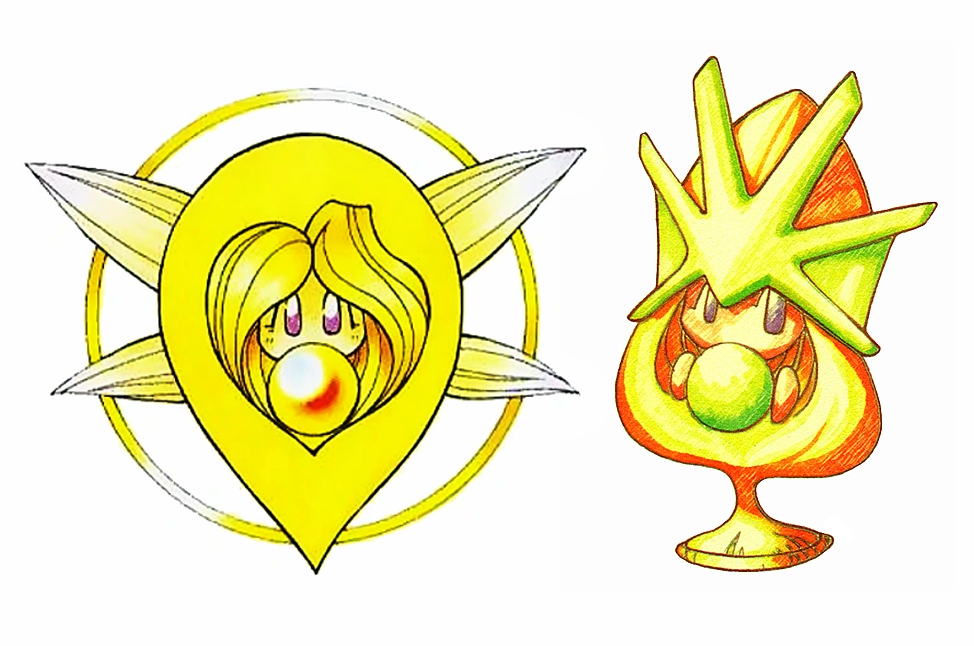
To me, this change perfects the magic system I had already loved for the two Mana games preceding, because it makes for a better oppositional pair. If Dryad represents wood, plants, and the essence of non-human life, then Aura represents human creation as it veers away from the natural world: metal and technology. What’s more, Aura’s domain could even include the celestial if you recall that a number of metals and minerals arrive on earth from meteorites. In that sense, Dryad and Aura represent the two different ways that a thing can be earthbound: the first bound to the earth and the other bound for the earth.
Aura did not last, however. The next game in the series, Sword of Mana, swapped Luna back in. Aura has not reappeared save for the nostalgia-bating mobile game Echoes of Mana, which I never played. If you can fill me in on how she figured into it, please let me know. I’d like to think she would wonder why she only got to appear in one game.
Even with the loss of Aura, Mana’s elemental system remains my favorite. It’s just extensive enough, and I like how each of the additions beyond the core four elements can each be traced to one real-world philosophy or another. As I see it, any more would clutter the game system and, perhaps even more importantly than that, the lore for the game’s fictional setting. Mana’s does a good job organizing magic but also providing a setting that’s rooted in nature and its precise balance.
Plus, you know, they’re really cute.
Miscellaneous Notes
In a sense, there is a ninth spirit in Trials of Mana in Faerie, who certainly looks like the sylph that didn’t get associated with wind in this series. She’s different from the rest, however, and she represents the power of mana as opposed to a specific element.
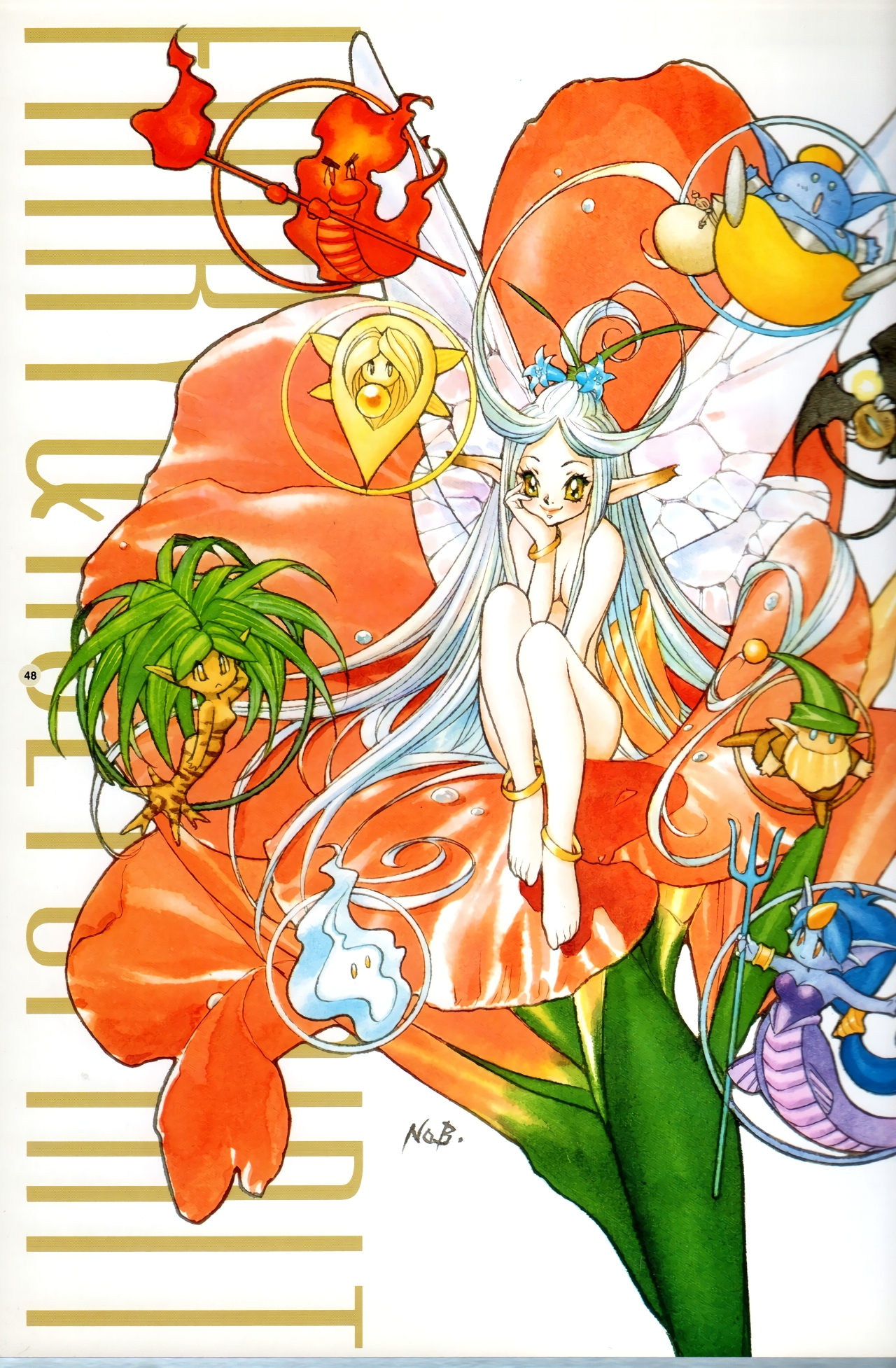
That said, Dryad’s elemental affiliation in Secret of Mana was mana, though for all I know that could just be how the text was localized. Whatever the case, Dryad was the wood spirit from Trials onward, and the Fairy character didn’t return in this capacity.
I suppose the idea of four additional elements beyond earth, air, fire and water was suggested before Secret of Mana in Final Fantasy IV. The game features four overworld crystals representing the four main elements and then four more in the underworld, but they’re never given an affiliation. They just might be the flipside to the overworld ones, representing the same elements, for all we know. As close I can think of any other Final Fantasy game doing eight elementals would be Final Fantasy Dimensions, which features a group of characters who kind of function like FFIV’s elemental fields and then four higher-ranking generals representing light, dark, lightning and ice. Has there ever been a character representing more Final Fantasy-specific elements like gravity or poison?
Ether exists in the modern world as a regular non-celestial thing, and I’m pretty sure it’s this, the chemical substance, that is being referenced in Final Fantasy with the MP-replenishing item, not the celestial sense of the term. Don’t yell at the guy who didn’t take chemistry in high school, but I’m actually not totally sure what real-world ether is. I mostly associated it with being the substance Mr. Burns huffs on The Simpsons, but whatever it is, it is, in fact, named for the aether that Aristotle named. According to Etymonline, this mundane ether got that name around 1730, though it had been known to chemists for centuries. I’m not sure how it was referred to before this. The etymology for aether goes back to a Greek word aithein, “to burn,” and this may also be the source of the place name Ethiopia, apparently because Greeks thought dark-skinned people were especially tanned. Aether is also the source of the English word quintessential, which has come to refer to the purest, most unrefined version of something. Etymologically, however, it breaks down to mean “fifth essence,” which seems obvious once it’s pointed out to you but may nonetheless sound surprising if you haven’t processed it before.
Finally, I have no way to prove this, but my theory for why Jinn ended up being the wind elemental in Secret of Mana has to do with the similarity between his name and din, the English word meaning “a loud noise,” which is not infrequently associated with thunder. I don’t think that’s likely how it came to be, however, and I’m all for suggestions that make more sense.