

How Samurai Shodown Turned a Catholic Radical Into a Gay Warlock
Virtually every fighting game in the 1990s brought together martial artists from around the world to engage in one-on-one combat. Samurai Shodown did this as well, but it stood apart as a result of two crucial differences. For one, it had each fighter bring a weapon into battle, and for another, it was the rare period piece fighting game, with the ten playable characters convening in Edo-era Japan over the course of the spring and summer of 1788.
In the background of the tournament, however, lurks a bigger story about an otherworldly phenomenon that threatens to topple the Tokugawa Shogunate ruling over Japan. As your chosen fighter advances through the game, you’re given glimpses of what awaits you in the final duel: a sinister presence that seems to emerge from an even older time period.
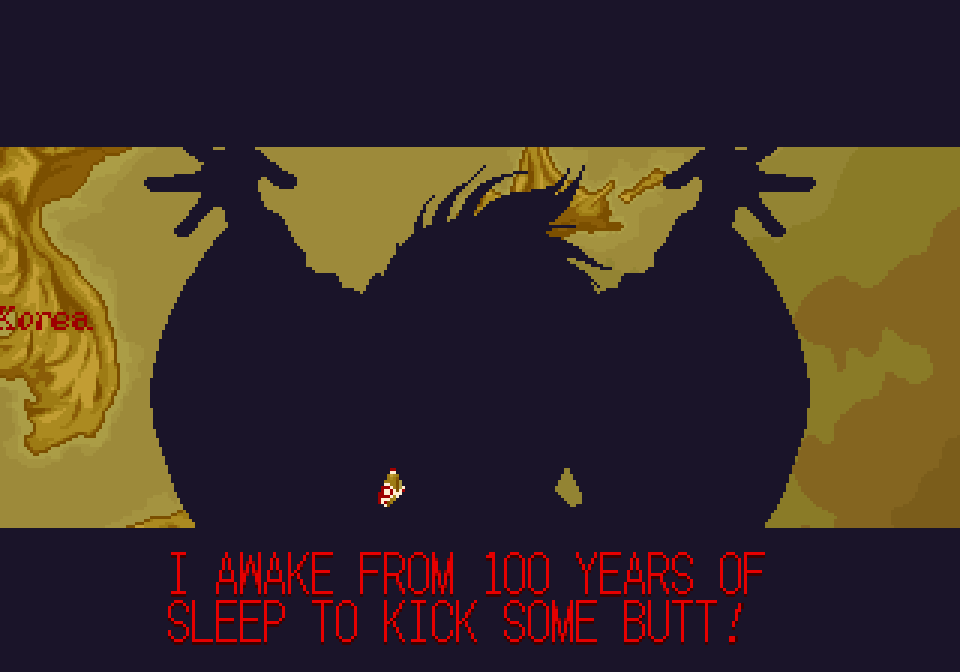
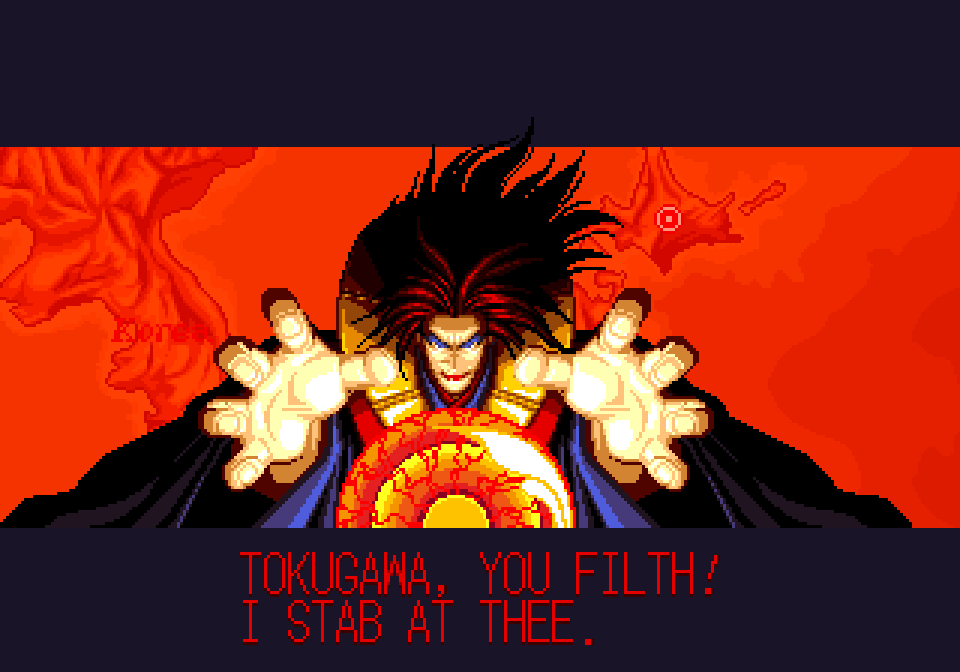
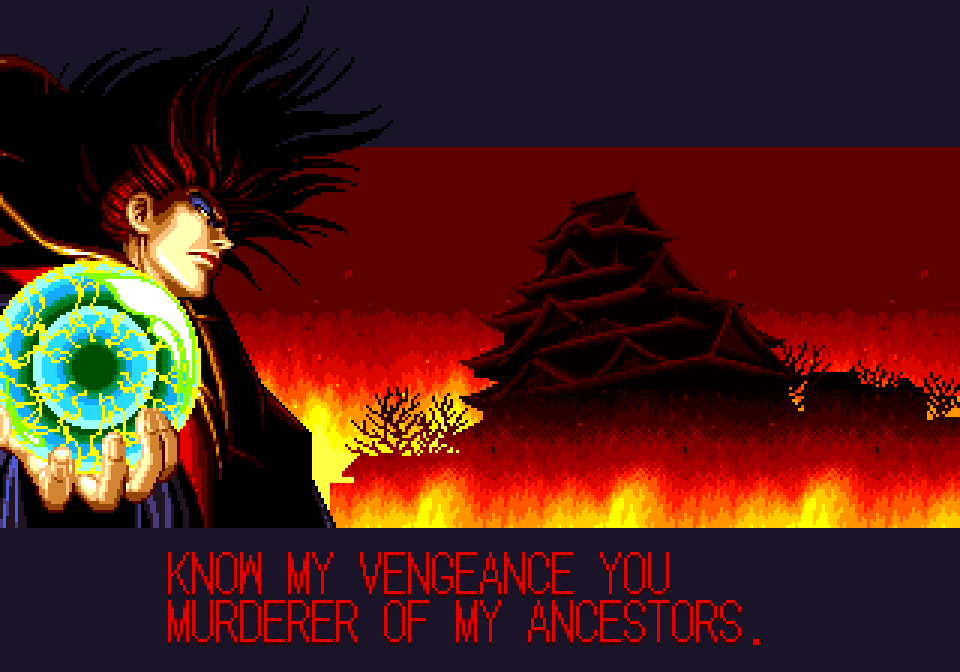
In the game’s finale, this figure steps out of the shadows and confronts you for one final duel. He’s Amakusa, you’re told, and although this name may not mean much to western players, it’s clear regardless that he fights differently than everyone you’ve beaten to get to him. He doesn’t wield any bladed weapon; instead, he channels his witchcraft through a glowing crystal orb. He doesn’t fight like a disciplined martial artist, especially; instead, his main physical attack is slapping. And he doesn’t speak with the kind of gravitas you might expect from a fighting game big bad; instead, his vocal performance consists of high-pitched whoops, breathy taunts and evil giggles. Yeah, you could say that Amakusa is a unique video game villain.
In fact, Amakusa presents as so atypically male that when the Samurai Shodown anime was dubbed in English the following year, the character was localized as female. Presumably, ADV Films decided it was easier to flip the character’s gender than deal with objections from viewers progressive and conservative alike.
Both the Japanese and English versions of the anime cast female actors as Amakusa — Yu Daiki in the original and Marcy Rae in the dub. It’s only in the English version that the character is given female pronouns, however.
It might seem strange in 2026 to think of the localization company changing a character’s gender to elide even the implication of homosexuality, but you have to keep in mind that this was around the time that the DiC dub of Sailor Moon reinvented Zoisite as a woman and Uranus and Neptune as cousins. Besides, the team at ADV Films probably wasn’t expecting most North American viewers to know enough about Japanese history to understand why this change wasn’t only a pivot from the game’s lore.
Starting with the first Samurai Shodown, the cast has included several characters drawn from history. Jubei Yagyu, for example, is clearly based on the real-life samurai by the same name. Hanzo Hattori also takes his name from a real-life samurai, but the game reinvents him as a ninja. Rival swordsmen Haohmaru and Ukyo Tachibana seem inspired by Miyamoto Musashi and Sasaki Kojirō, even if their names are different. One of the first posts on this blog was about how Charlotte de Colde, the French revolutionary fighter, is named for Charlotte Corday, a famous assassin, though her look and mannerisms seem more inspired by the cross-dressing character from the manga and anime Rose of Versailles. And even the Samurai Shodown II character Neinhalt Seiger, an apparent cyborg who fights with a steampunk-powered robot arm, is based on a real German soldier who lost his arm in battle and replaced it with a prosthetic — not a robotic one that fires artillery, but still.
Amakusa, whose full name in-game is Shirō Tokisasada Amakusa, is based on a figure from history as well, just one not likely to be known outside Japan. Given the way the Samurai Shodown version of Amakusa looks and acts, it might be surprising to learn that the real-life version was a seventeen-year-old boy who served as a leader — if not *the* leader — in the Shimabara Rebellion, an uprising against Japan’s long-lived military dictatorship. This Amakusa was a devout Catholic, and while the revolt is often described as being Catholic in nature as well, it’s debatable how many of the participants shared Amakusa’s religious devotion. Either way, it ultimately failed, Amakusa was executed and Christianity was driven underground in Japan. Portuguese expats present in the country — for the purpose of trade, religious conversion or both — were ordered to leave, and until 1854, Japan remained essentially isolationist, with the shogun controlling interactions with foreigners and foreign cultures.
So why would Samurai Shodown reinterpret a teenage Catholic revolutionary as a gay warlock?
While I do have an answer, I want to give some brief context for the historical events, just so you can appreciate the bizarreness of this transformation. Whole books have been written on the real-life Amakusa, though most focus on the events of the actual rebellion and not his subsequent treatment in popular culture. The two English-language ones I read in preparation for this post — Christ’s Samurai by Jonathan Clements and The Nobility of Failure by Ivan Morris — both ignore the latter in favor of the former, but I will be pulling from them for this quick explanation of how a seventeen-year-old came to play such a prominent role in Japanese history.
On December 17, 1637, inhabitants of the Shimabara Peninsula and Amakusa island chain, both in southern Japan, joined with masterless samurai to rise up against the shogun government. The movement succeeded initially, and the teenaged Shirō Amakusa emerged as its leader, either because he was a charismatic young man whose belief in the Judeo-Christian god inspired hope in the downtrodden populace or because he had magic powers. (Stories purport that he could perform miracles and was speculated to be a prophet, a messiah or semi-divine himself.) He was actually born Shirō Masuda, and after being baptized took the Christian name Geronimo (sometimes rendered as Jerome) and then apparently also Francisco. He’s got as many names as he has fantastic stories about him. All you need to know for the purposes of this post is that the uprising against the shogunate lasted longer than you might think, considering that they were fighting against armed and armored samurai. They holed up in the abandoned Hara Castle and fended off the shogun’s forces until April 15, 1638, at which point the government finally triumphed. All the rebels were executed. Amakusa’s severed head was displayed in the port city of Nagasaki to warn Japanese citizens of the dangers of Christianity and foreigners of the dangers of meddling with Japanese politics.
To state it more plainly, there’s not much in the actual events of the real Amakusa’s life to warrant reinvention as a gay warlock — at least on first glance with western eyes. Yet that’s exactly what happened, and in fact Samurai Shodown is not even the first pop cultural work to do so. For example, the 1981 live-action film Samurai Reincarnation features Kenji Sawada as a version of Amauksa who seduces the young warrior Kirimaru, played by Hiroyuki Sanada.
Yet another version is presented in the 1997 OVA Ninja Resurrection. I initially watched this years ago after being misled into thinking it was a follow-up to Ninja Scroll. It’s not. In fact, it is an adaptation of Makai Tenshō, a 1967 historical fantasy novel of which Samurai Reincarnation is also an adaptation. That said, this latter version spends more time with Amakusa before his transformation into a demonic entity, and in this form he is played as distinctly effeminate — self-assured, yes, but nothing at all like the model for rugged manhood that is the story’s protagonist.
The anime series Rurōni Kenshin — which, I should specify, is not based on Makai Tenshō — also features a character, Shōgo Amakusa, that is based on this historical figure. He’s neither especially effeminate nor gay-coded, even if his outfit does show off a lot more chest than I expect from a heterosexual. He is, however, twinned with a sister that essentially serves as his female half.
It’s as if the tendencies exhibited by Amakusa-inspired characters in other works all get channeled into the sister, but it’s also a literalization of an aspect in Ken Ishikawa’s 1987 manga retelling of Makai Tenshō, which has Amakusa being reincarnated through the body of a woman. He literally emerges from within her as a fully formed adult, in the style of Athena from the head of Zeus. And while it’s clear that his “birth” is unnatural, the visual language in this version suggests that he inherits the essence of the woman whose sacrifice has allowed him to exist again.
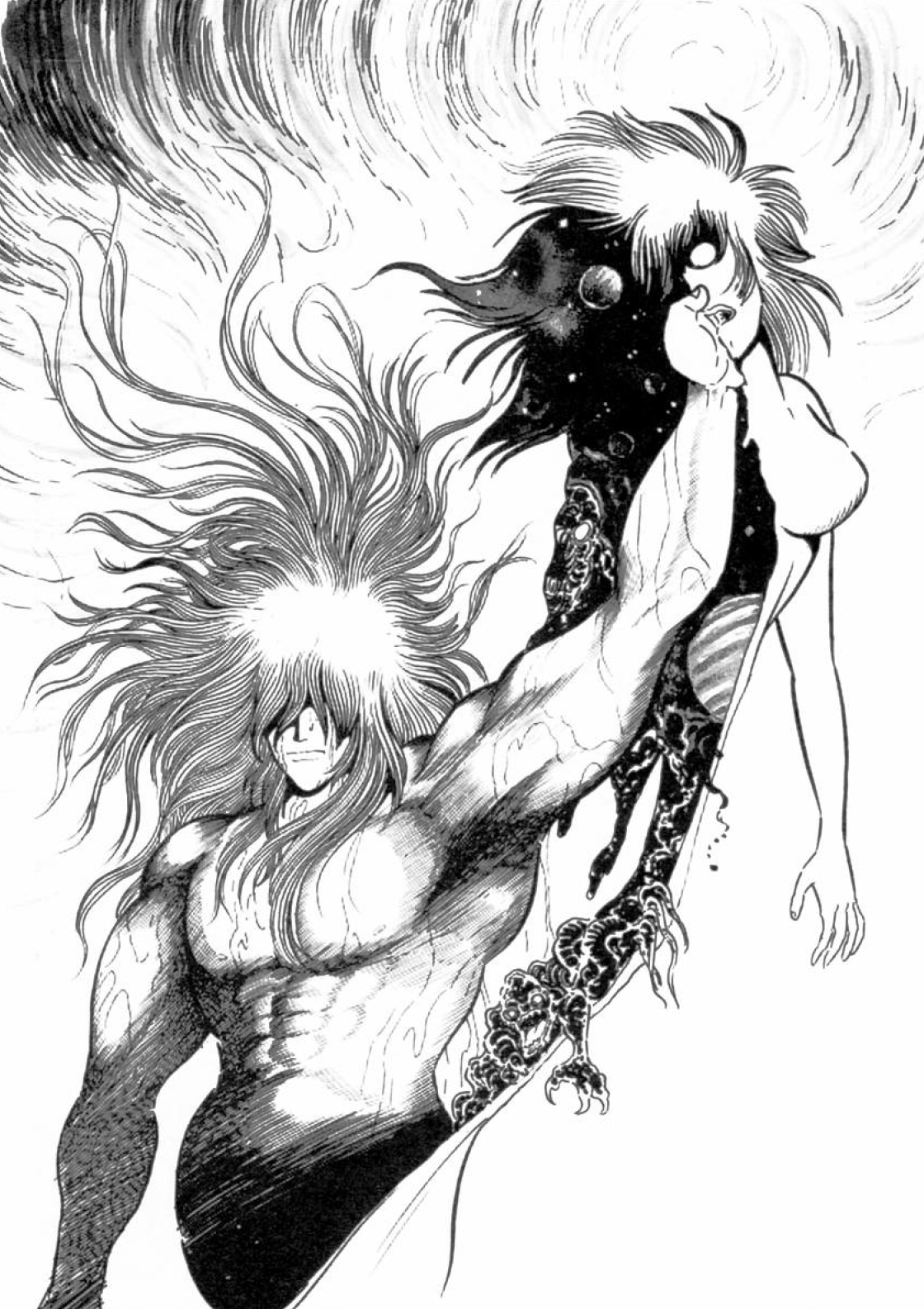
And yes, in the manga version, he does in fact dress like quite the fancy man once he’s emerged.
All of these manifestations of a dark, “othered” version of Amakusa would seem to trace back to a 1939 novel by Seishi Yokomizo that’s usually rendered in English as The Death’s Head Stranger (髑髏検校 or Dokuro-Kengyo). A loose adaptation of Bram Stroker’s Dracula, the story eventually reveals that Shiranui, its central vampire villain, is actually the undead version of Amakusa Shirō. And that makes sense in the grand tradition of vampire literature, which often uses this specific monster to represent the dangerous allure of exotic cultures. In Bram Stoker’s original, Dracula represents an eastern European “other” for the novel’s British leads. And in The Death’s Head Stranger, the Amakusa vampire represents a corruption of traditional Japanese culture as a result of contact with Europeans and their contagious Christianity.
It’s explained in “Vampire of the Rising Sun,” an article by Fintan Monaghan in a February 2011 issue of The Escapist, that Yokomizo’s novel found success in pre-World War II Japan because it played on the growing Japanese fears of foreign influence.
The vampire is generally considered to have arrived on Japanese shores in the 1930s with the country’s first boom in vampire literature. As Japanese militarism was hitting its peak, so too was xenophobia. This atmosphere of suspicion and paranoia was stoked by the most popular book of the ’30s boom, Seishi Yokomizo’s Dokuro-Kengyo (The Death’s-Head Stranger). … In the book, Amakusa is now a vampire, his deep immersion in Western culture having turned him into a kind of monster capable of spreading his corrupting influence to others. The vampire thus came to serve a function impossible for the homegrown Kappa or the Black Cat, embodying a generation’s fears of seditious foreign influence and the dangers of western ideas.
If The Death’s Head Stranger popularized the idea of Amakusa as a westernized vampire, then the original novel version of Makai Tenshō introduced Japan to the demonic Amakusa. Rebecca Suter’s 2015 book, Holy Ghosts: The Christian Century in Modern Japanese Fiction, describes how the circumstances of Amakusa’s resurrection position him as antichrist-adjacent if not fully an antichrist figure.
Yamada’s novel concentrates on the themes of incarnation and resurrection, emphasizing the physical and sexual elements of Christian mythology. The [reincarnation] ritual reads equally well as a parody of Jesus’s birth as God incarnate and of his resurrection after dying on the cross. While in the Bible the Christian God takes human form by making a woman give birth to a child who, through the mystery of the Trinity, is both the Son of God and God himself, as well as the Holy Ghost, in Makai Tenshō Amakusa Shirō is reborn from a woman’s womb as a demon that is “both himself and not himself,” a human that is consubstantial with his demon alter ego.
…
At the same time Shirō is, like Jesus, resurrected a few days after his death. The Kirishitan ritual is thus also a parody of resurrection, with a demonic twist, as Shirō does not come back to atone the sins of humanity but to take revenge against specific individuals who did him harm by destroying their government and their country.
Okay, so we’ve got a theory for how fictionalized versions of Amakusa came to be viewed as corrupted by western influence, as evidenced by The Death’s Head Stranger, and then literally demonized by a xenophobia that conflates Catholic ritual with witchcraft, as evidenced by Makai Tenshō. So why is he also gay?
Well, for one thing, vampires are never that far from being queer-coded because they’re both hypersexual and profane, with their lust for human bodies being both literal and figurative. This predates Dracula. Notably, Joseph Sheridan Le Fanu’s Carmilla, a vampire novel that was published twenty-five years before Dracula, has profound lesbian themes. (And yes, that is where the Castlevania character gets her name — and in the anime adaptation her sexuality as well.) And even Stoker’s more famous bloodsucker keeps Jonathan Harker captive for nearly two months despite Mina Murray being the ostensible target of his desires, which is just not necessarily something that a purely heterosexual villain would do.
Suter’s book, however, points toward the 1981 live-action adaptation of Makai Tenshō, the aforementioned Samurai Reincarnation, as the work that introduces homosexuality to Amakusa’s list of sins. As Suter sees it, this begins with Kenji Sawada being cast as the character. He’s not anything other than straight, at least publicly, but there’s something innately queer about his public persona that he brings to this role.
Essentially, by virtue of this performer playing the role, this version of Amakusa retains that vampiric ability to transcend conventional gender and sexuality; it just so happens that this particular one is not actually a vampire.
Again, from Holy Ghosts: The Christian Century in Modern Japanese Fiction:
In Fukasaku’s adaptation of Makai Tenshō, Sawada Kenji, better known by his stage name of “Julie” and famous for his gender-ambiguous performances, played the part of Shirō. Sawada gave a sensual rendering of the character, wearing a gaudy silver and red jinbaori, a large cross hanging on his chest, the classic adolescent samurai maegami (fringe) haircut, black lipstick and shimmering blue eye shadow.
And it’s worth nothing in this context that Sawada earned the nickname Julie as a result of his profound love for the work of Julie Andrews, and no, I am not joking. Again, I feel the need to point out that Sawada has been married to women for more or less the entirety of his public life.
Suter also notes that while the movie eliminates the notion of Amakusa being reborn through a human female vessel, the role of these sacrificial women is replaced in a sense by Amakusa himself, as he seduces various dead samurai into joining his zombie army. Those who consent are reborn through his body, in one way or another. For what it’s worth, it makes sense for this adaptation of the story. And it doesn’t seem unreasonable that Sawada’s performance could have informed subsequent versions of Amakusa in unrelated adaptations.
It’s possible that before his rise to fame, the real-life Amakusa might have engaged in the pederastic practice of shudo while squiring for a samurai. I’ll get into that in the miscellaneous notes section. I decided it’s not actually relevant to the main discussion because him doing so doesn’t necessarily explain the effeminacy of characters based on him, since Japanese society would not have viewed shudo that way. Ironically, it’s the Portuguese interlopers who would have been more likely to equate homosexual congress with effeminacy. But then again Amakusa, like all characters based on him, exists in a weird no man’s land between east and west, being quite literally the odd man out for mixing the traditions of two cultures in a way many would have thought unnatural and incompatible. That’s kind of his defining trait.
The closest the Samurai Shodown games get to conflating Amakusa’s gay warlock energy with any kind of same-sex desire is relegated to the backstory of the first game. In this telling of the story, Amakusa returns to life by possessing the body of Hanzo’s son, Shinzo. In this first game, therefore, it’s not technically Amakusa’s body flouncing about in the final battle but Shinzo’s made up to look like Amakusa’s. There are unsubtle sexual shadings to possession narratives, of course, what with the desiring and taking another’s body, but all of that is barely communicated in the game itself.
All I gather from Hanzo’s ending in Samurai Shodown is that defeating Amakusa seems to result in the death of Shinzo.
And even that doesn’t count, because Shinzo is playable in Samurai Shodown: Warrior’s Rage, disguised as his father.
Amakusa sits out Samurai Shodown II, where the new final boss is Mizuki, a Shinto priestess possessed by a demon in a way that very much parallels Amakusa being a holy man perverted by evil. (Mizuki wears less makeup than Amakusa does, it should be noted. I mean, well, I’m noting it, anyway.) But the third and fourth Samurai Shodown games have Amakusa returning as a playable character, and because these installments give the option to choose between a fighter’s honorable or treacherous forms, they tacitly acknowledge that regardless of his role as the original big bad, Amakusa has both a benevolent side as well. Not that he acts any less queeny.
He dresses the same as he always has. He has the same high-pitched yowls and yips as he had before. And he’s still declining a bladed weapon in favor of his sparkly crystal ball. I can’t say if it was always intended, but the implication is that Amakusa doesn’t necessarily conflate evil and queerness; they’re two separate things. He was an evil warlock, and then also, separately, he was an effeminate queerbo. How else to explain why the good version of him doesn’t butch up at all for the sequels? I mean, aside from the fact that you’re not left with a whole lot if you take away Amakusa’s flamboyant look and mannerisms.
While I would call this a happy ending, I’m not sure that the real-life Amakusa would agree. After all, we don’t know all that much about him other than that he was really, really Catholic, so there’s a good chance that he wouldn’t love one of his legacies being a gay warlock in a video game series. I don’t mean to put aside the feelings of a long-dead seventeen-year-old — because let’s be honest, that’s probably something the adults did when they elected him the symbolic leader of their doomed rebellion — but I can’t get over how dramatically this historical figure’s legacy was warped by the passage of time and the human compulsion to force a story into a shape that complements one’s worldview. It’s telling that following the end of the Shimabara Rebellion, Amakusa became a cautionary tale against flirting with exotic cultures and then a boogeyman seeking to further pervert the nation he turned against.
That evolution probably sounds bad on paper, but in practice, I’m glad it happened. There are statues in Japan commemorating the real Amakusa’s short life and arguably honorable death, and while those have meaning for Catholics and lovers of history, I think these other versions of Amakusa have value too. As a gay man, I love that this effeminate villain ended up being popular enough with the Samurai Shodown fanbase that he returned to the games as a playable character — and that SNK did not feel the need to town down his look or mannerisms even when they were allowing a less evil version of the character to exist. I find something meaningful in Amakusa being able to step up with multicolor sparkle magic when everyone else is bringing a bladed weapon. He’s doing it like a queer person would — in a way that may not be conventional, but it makes sense for him.
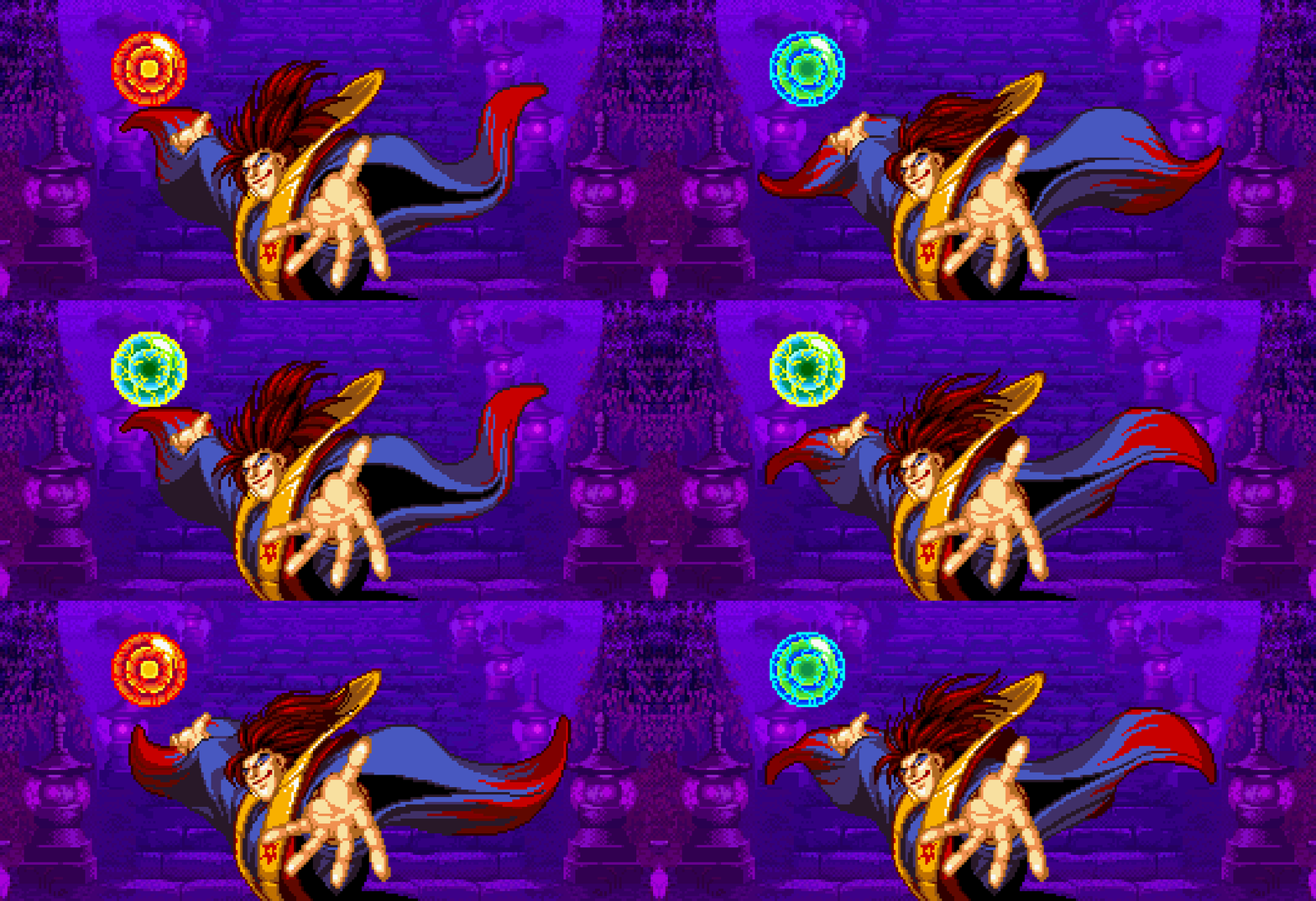
He’s managing his own way, and it works, you know?
Should we get another Samurai Shodown, I hope we get to see Amakusa again. For a certain audience, he stands for something. And that something might be drastically different from what his namesake stood for, but if one culture can make the real Amakusa a villain, I can make this video game version of him a hero.
This is, in fact, my annual pride month post, which I technically got out the door while it’s still June. Last year’s pride post was about how Eagle became Street Fighter’s first gay character, and the year before that I did the history of Birdo’s gender.
Miscellaneous Notes
It’s going to be a lengthy miscellaneous section this time, but first and foremost I need to thank Fatimah, who frequently helps me with Japanese translation but in this case did a lot of the footwork in piecing together Amakusa’s story. Hire Fatimah if you’re looking for assistance not just with the Japanese language but with the culture as well!
One of the connections Fatimah discovered in researching Amakusa is a link to the Go Nagai manga Devilman — and once it was pointed out to me, it seemed fairly obvious. Ken Ishikawa, the writer and illustrator of the 1987 manga adaptation of Makai Tenshō, was the protege of Go Nagai. Spoilers for Devilman, in case you haven’t gotten around to it yet, but its finale reveals that the protagonist’s friend, Ryo, is actually Satan — and, because Satan is a fallen angel and because angels are intersex in this fictional universe, Ryo is also intersex. There is a shimmer of reflection, perhaps, in the way this version of Makai Tenshō re-creates Amakusa as a man who inherits an aspect of the woman through which he is reincarnated.
Fatimah brought to my attention two more recent manga about female versions of Amakusa. One of them, Amakusa 1637 by Michiyo Akaishi, concerns Japanese high school students who time-travel back to the Shimabara Rebellion. One of them, a girl, ends up posing as Amakusa. It ran from 2000 to 2006. And then December 2024 saw the launch of a still-ongoing title, I Want to Save Amakusa Shirō. Written and illustrated by Risa Minato, it concerns Amakusa being reincarnated in modern-day Japan and becoming an influencer. (I swear I am not making this up.) As Fatimah points out, the covers for this manga “are depicting him quite girly pop.”
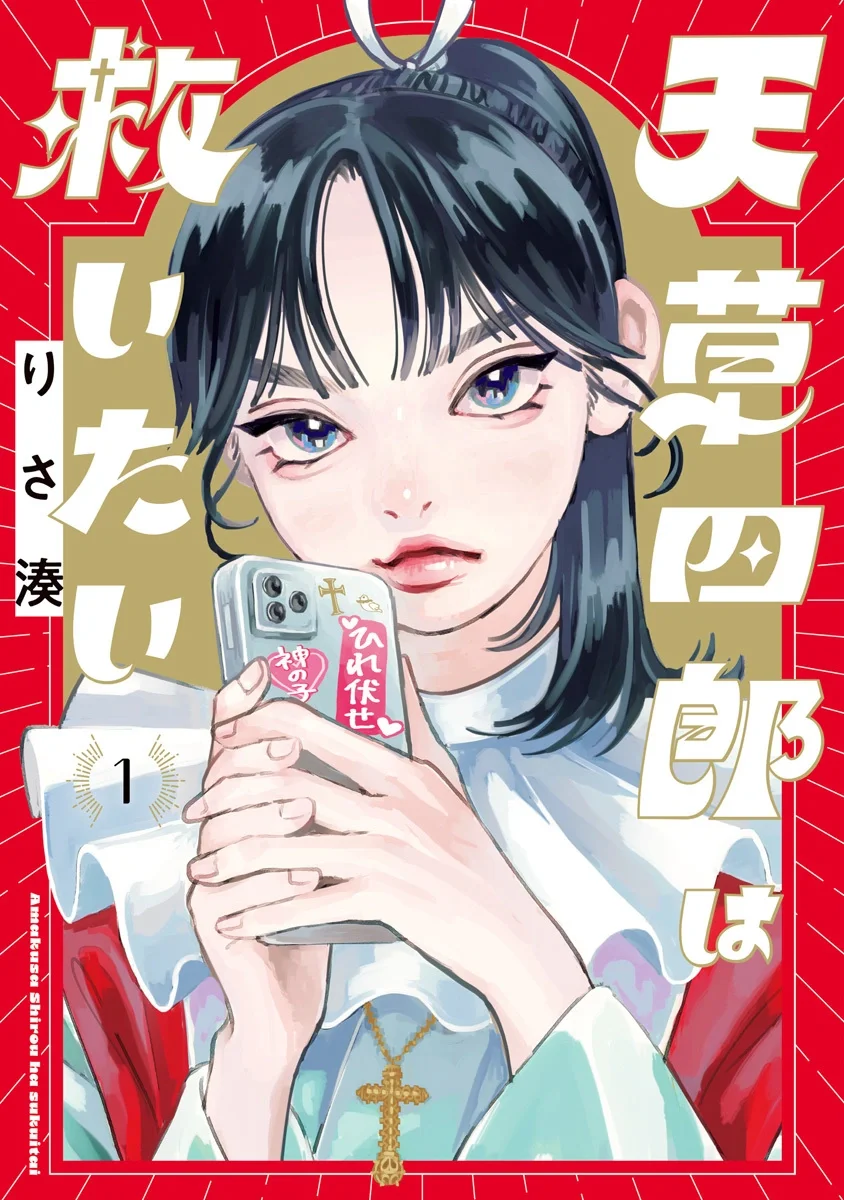
It’s noted in Holy Ghosts: The Christian Century in Modern Japanese Fiction, that to Japanese observers, Jesuit priests seemed like they were doing arcane rituals when they performed their Catholic rites. As someone who was raised Catholic and went to Catholic school partway through high school, I’d argue that this isn’t exactly inaccurate and is maybe even something Catholic services strive for in order to instill a sense of awe.
Religious artifacts were used for purification and healing and as lucky charms, for instance by warriors going to battle and by pregnant women. Initially the Jesuits encouraged this attitude, performing exorcisms on sick people who the missionaries claimed were possessed by the devil and providing the followers with sacred objects to use for these purposes.
This fostered a perception of Christianity as a form of magic, which persisted in the modern era, where it gave rise to creative interpretations in the realm of fantastical literature, as we will see. According to Higashibaba, it was Buddhist monks who spread the rumour that the European priests were devils and/or performed acts of witchcraft similar to those of yamabushi (mountain monks deemed to be endowed with supernatural powers). Further, the Jesuits, because of their lack of language proficiency, relied initially on Japanese converts to do the actual preaching in Japanese, while they performed symbolic and ritual functions that could be done without verbal interaction; this reinforced the image of the foreign priests as magicians in the collective imagination.
At least in the first game, the crystal ball Amakusa uses as a weapon is called the Palenke Stone in English and パレンケストーン or Parenke Sutōn in Japanese. Because it’s stolen from Tam Tam’s homeland in Green Hell, a wild and vaguely prehistoric region of South America, it seems like this object is likely named after the Mayan city of Palenque. In the sequel, Tam Tam’s sister Cham Cham is searching for this stone’s twin, the Tangiers Stone (タンジルストーン or Tanjiru Sutōn), which is stolen by Mizuki. Because this stone is also hidden away in Green Hell, however, I can’t figure out a reason why it should be named after a city in northern Africa.
I skipped over this earlier because I couldn’t make it make sense in the story I was telling, but in the book Christ’s Samurai, Clements briefly discusses the rumor that Amakusa may have engaged in shudo during his apprenticeship to a samurai.
According to his mother, Martha, Jerome [Amakusa] spent the early years of his childhood in a village on the Uto Peninsula that reached out from the mainland towards the Amakusa islands. House Hosokawa’s own annals noted that Jerome had once been a pageboy to a local samurai, Susami Hannoin, and also the chronicler’s belief that Jerome had been a kozōritori, or “sandal bearer.” The title originally referred to a page whose job it was to trail in a lord’s wake, carrying his shoes. However, at the time the chronicle was compiled, a kozōritori was also a euphemism for a catamite.
In a footnote attached to this passage, Clements also discusses the existence of fiction describing Amakusa in sexual relationships with men. In describing this type of literature, he quotes the 1990 book The Love of Samurai: A Thousand Years of Japanese Homosexuality by Tsuneo Watanabe and Jun'Ichi Iwata, comparing this kind of literature to Amakusa himself in the way it mixed two dissimilar things: “One of the symbols of the kirishitan movement which struggled against homosexuality is being absorbed into the Japanese homosexual tradition.” (I would have read this book before writing this piece, but I couldn’t find an affordable copy online.)
It’s notable that the 1939 novel The Death’s Head Stranger gives Amakusa the name Shiranui before revealing his real identity. Literally referring to the will-o’-the-wisp or some other phosphorescent light, the Japanese 不知火 breaks down etymologically to “unknown fire” or “mysterious flames” or the like. It’s of special relevance to SNK fighting games, however, because it’s the surname to both Mai Shiranui, the beautiful female lead of the Fatal Fury games, and Genan Shiranui, the decidedly non-beautiful Samurai Shodown character who amounts to a hunched green gremlin with a single Freddy Krueger claw. The two are not meant to be related, and I’ve never understood why they were given the same last name.
I’m curious if this discussion of Amakusa made anyone else think of Final Fantasy Tactics. (And Fatimah, don’t read this paragraph if you don’t want a major plot point spoiled.) As it turns out, one of the major plots in the game is the conspiracy to resurrect Saint Ajora, a male messianic figure who, like Amakusa, was executed by the government for heresy. At the very end of the game, Ajora is reincarnated using the body of the protagonist’s sister, Alma, so you also get a sense of blurring of gender lines around a figure that’s semi-divine — or at least pretending to be semi-divine. I wonder if the Final Fantasy Tactics plot might have been inspired by various versions of Makai Tenshō.
There’s a comment on my post about Charlotte that points out that if I want to discuss gender in Samurai Shodown, I should discuss Amakusa. This is how I replied four years ago:
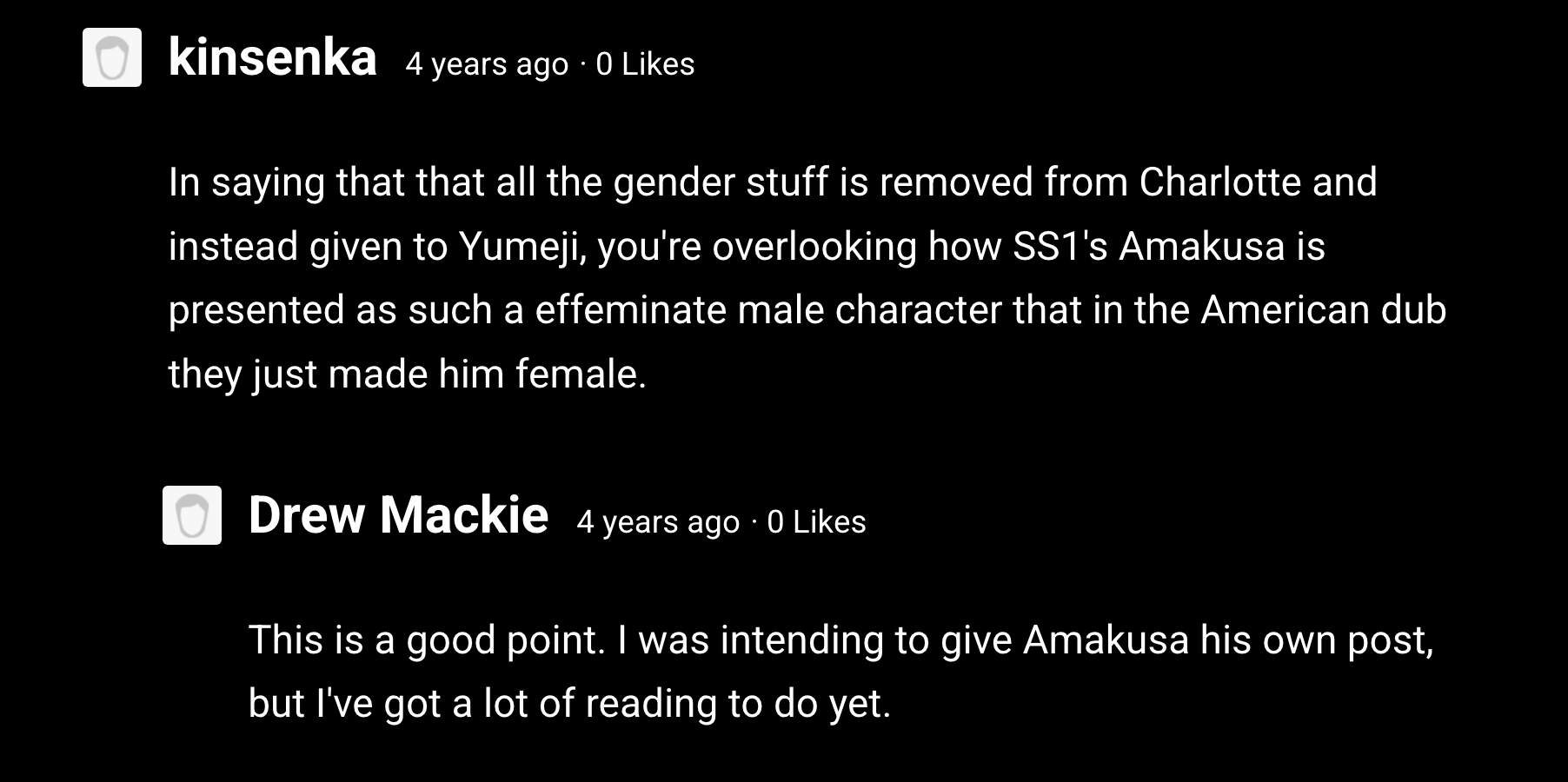
I wasn’t lying! There was a lot of reading! It’s just that Fatimah did a lot of it. (Thank you, Fatimah.)
And then finally there is enka singer Yukio Hashi’s 1965 song “Fair Youth of the South Seas.” Yes, it’s about Amakusa, and yes, it’s about as homoerotic as you might expect. The song was written by Takao Saeki, who apparently has involvement with other songs about bishonen that were also performed by Hashi, including “Pretty Boys of Tokyo” and “Pretty Boys Chushingura.” As a gay man, it’s really hard not to listen to these songs and think, “This is the gayest shit I’ve ever heard.” As an intellectual, however, I know it’s not fair to map western concepts of sexuality onto non-western cultures, but if you’re someone who knows anything about this kind of music, I would love to hear an explanation for why this is not, in fact, super duper gay.
Anyway, here are the lyrics to “Fair Youth of the South Seas,” as translated by Fatimah.
A silver cross adorns his chest
A martyr who does not fear fumi-e
Leading troops in the south
Is the fair youth Amakusa Shirō
Ah, even the Japanese rose weeps
Hearing the voice of the heavens
The site of Shimabara’s Hara Castle ruins
In God’s fortress, holding his ground
The fair youth shouts at the raging torrents
Ah, even the moon weeps at his forelocks
Burn, mysterious flames at sea, eternally
Holy and heroic in life and in death
Beyond the dawn-lit blue sky
Believe in the strong, fair youth
Ah, even the stars of the south sea weep
Fatimah explains that fumi-e (踏絵) “are tablets with Christian imagery that Edo religious authorities would force people suspected of being Christian to step on to prove they were not Christian.” And the “mysterious flames” mentioned in the eleventh line are the same shiranui (不知火) I mentioned earlier — “unknown fire.”