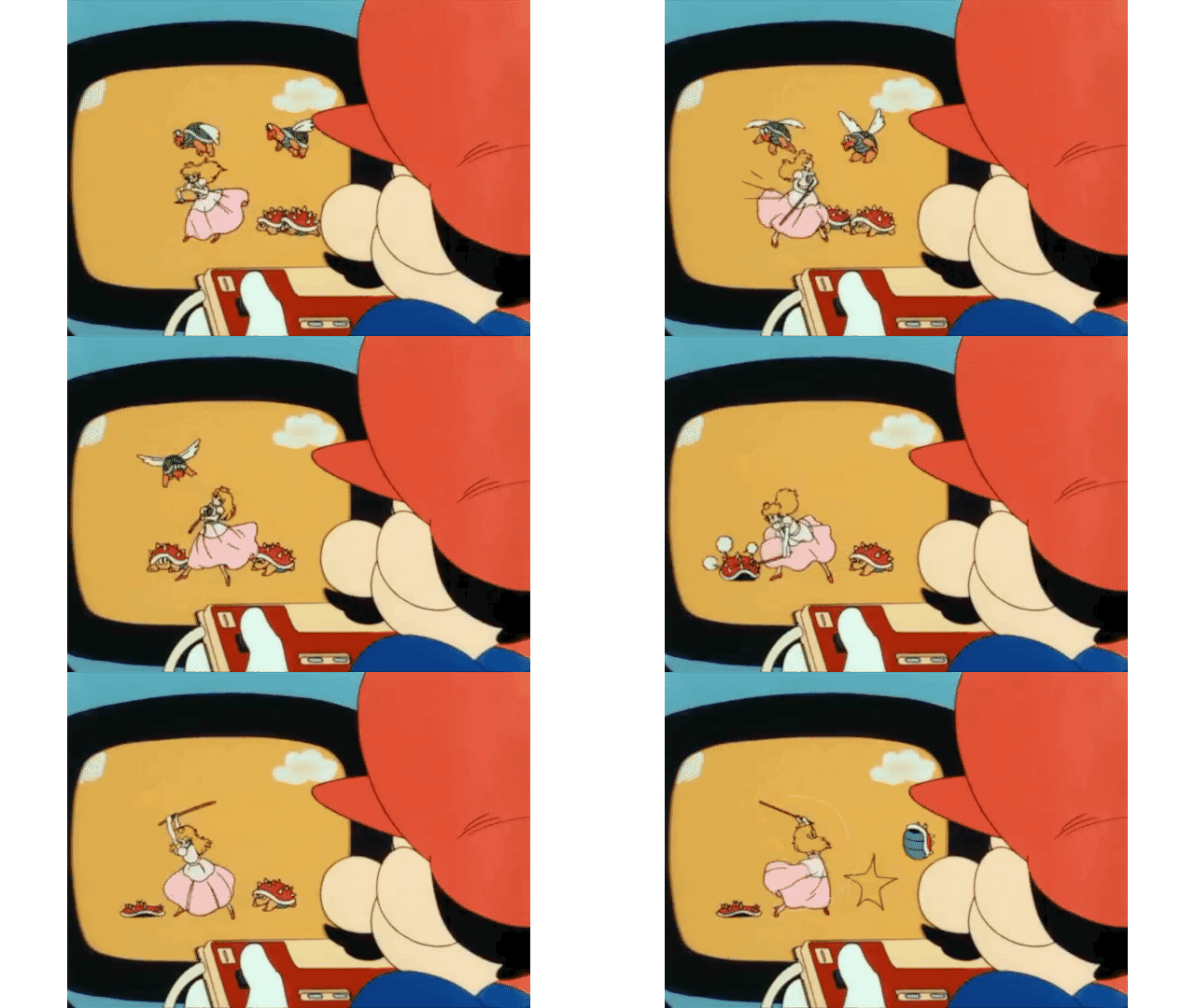
Why Did the Super Mario Anime Make Toad Female?
The new season of the Super Mario Moment podcast focuses on adaptations of the video game series, and the second episode examines Super Mario Bros.: The Great Mission to Rescue Princess Peach!, the 1986 anime that marked the first time these characters made it to the big screen — and, notably, the first time any video game was turned into a film.
Of course, one of the discussion points in the episode is how the movie suggests mechanics that would appear in later Super Mario games despite being made to coincide with the release of the Japanese Super Mario Bros. 2. For example, there is an airship segment that would seem to foreshadow airships being a central plot element in Super Mario Bros. 3.
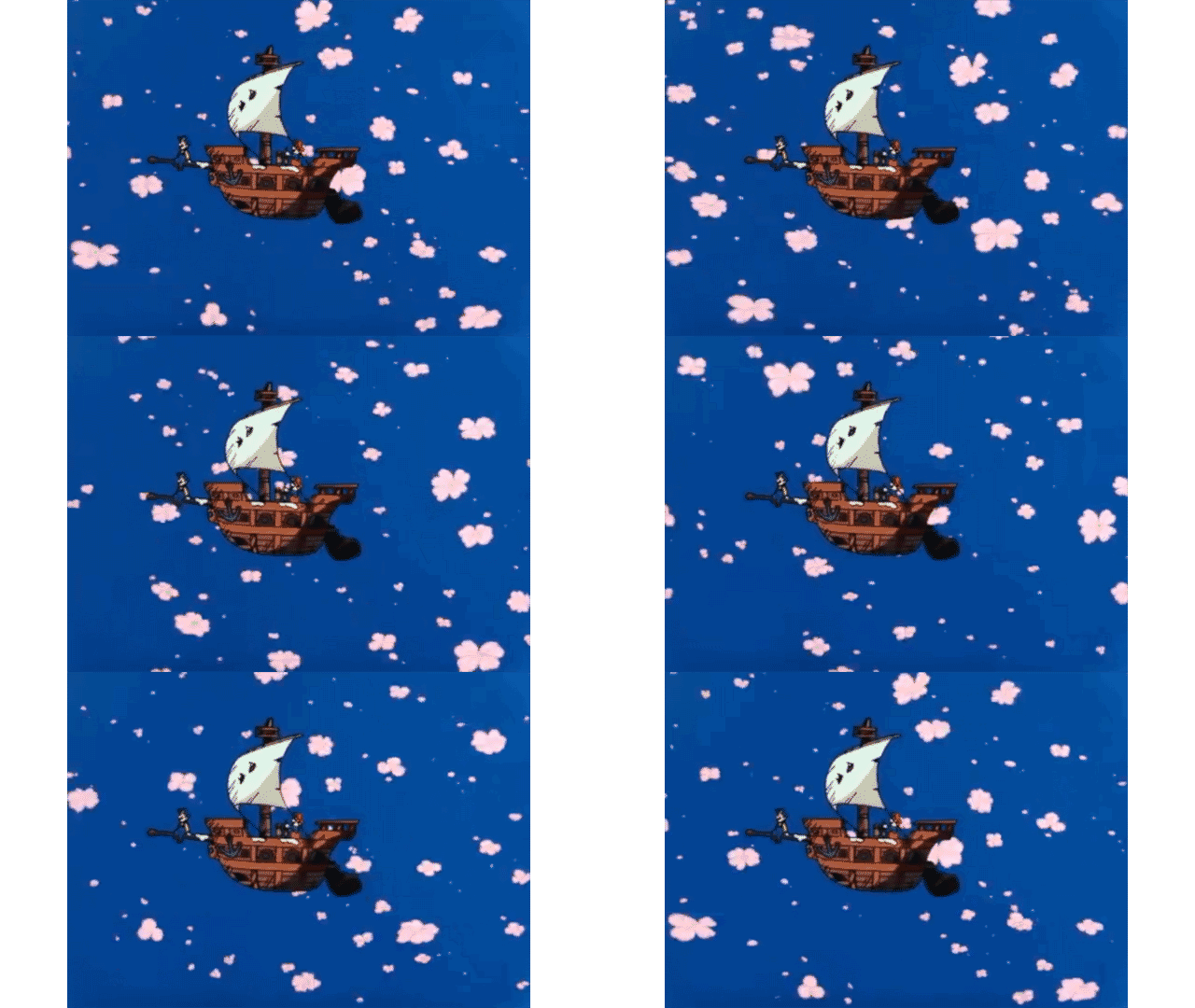
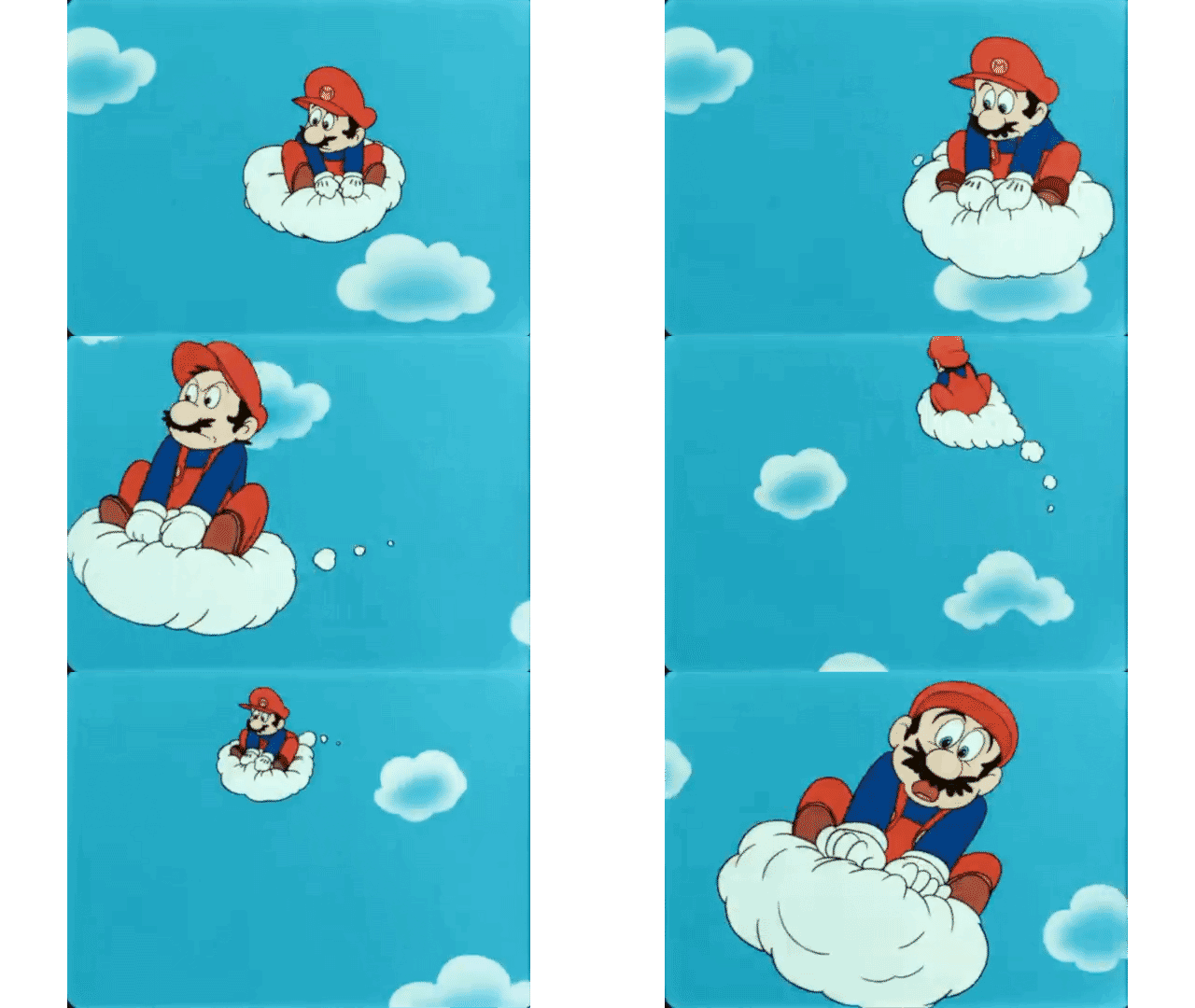
There’s a scene where Mario steals Lakitu’s cloud and rides around in it, which wouldn’t happen in a game in this specific way until Super Mario World.
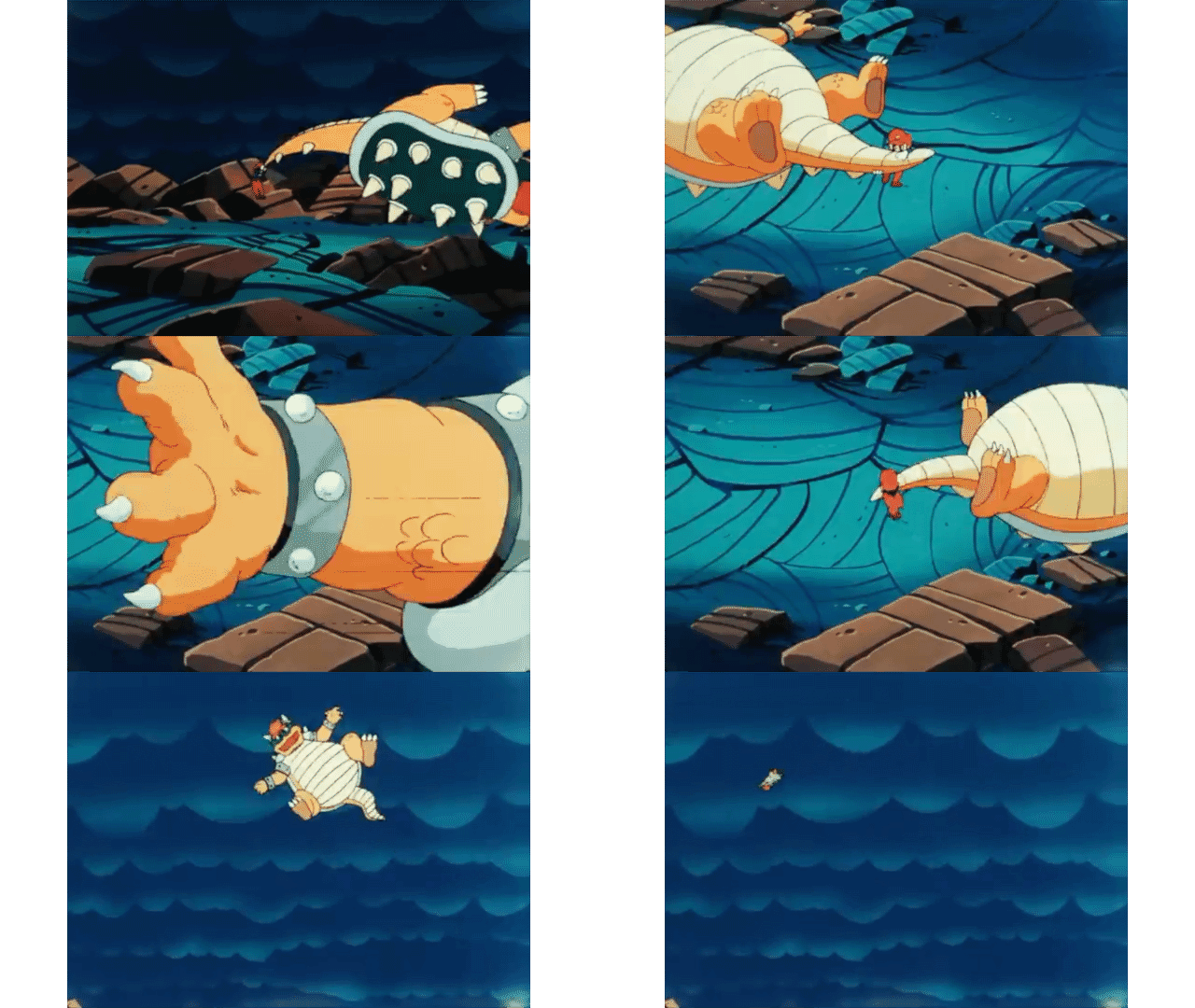
And most notably, the movie’s climactic fight ends with Mario grabbing Bowser by the tail and then spin-tossing him into the horizon in the style of an Olympic discus-thrower, which would famously become a central gameplay aspect of Super Mario 64.
Of course, none of this means that, like, the Super Mario anime was predicting what we would eventually see in the video game sequels, Da Vinci Code-style. I assume either people working on later Super Mario games arrived at the same ideas the people making the anime did or the people who made the games saw this movie and decided to implement various ideas way down the line.
To me, what’s notable to me about the Mario anime isn’t what it gets right so much as what it gets wrong. Little official literature about these games existed when this movie went into production, and for the most part it seems like every scrap of information ended up in the movie, rendered fairly accurately to how it’s depicted in the games or described in the instruction manuals. That’s what makes it so very odd that the movie presents not one but two female Toads. They’re very clearly meant to be the mushroom heads that we in the west call the Mushroom Retainers, the ones that wait at the end of every dungeon level to tell Mario that the princess is in another castle. And while they’re described in the Super Mario Moment as “femboy Toad,” I think they’re just meant to be female outright.
The first time Mario and Luigi encounter these characters, there’s one “spokesperson” Toad who identifies herself as Princess Peach’s maid, but she’s surrounded by a host of other Toads who are also clearly meant to be female.
Later, they meet a second, solo Toad who also appears to be female.
For the record, Toads that aren’t drawn to look feminine do show up in the movie, if only briefly. When Mario and Luigi are being briefed on how Bowser came to overthrow the Mushroom Kingdom, a flashback shows some Toads running in terror.
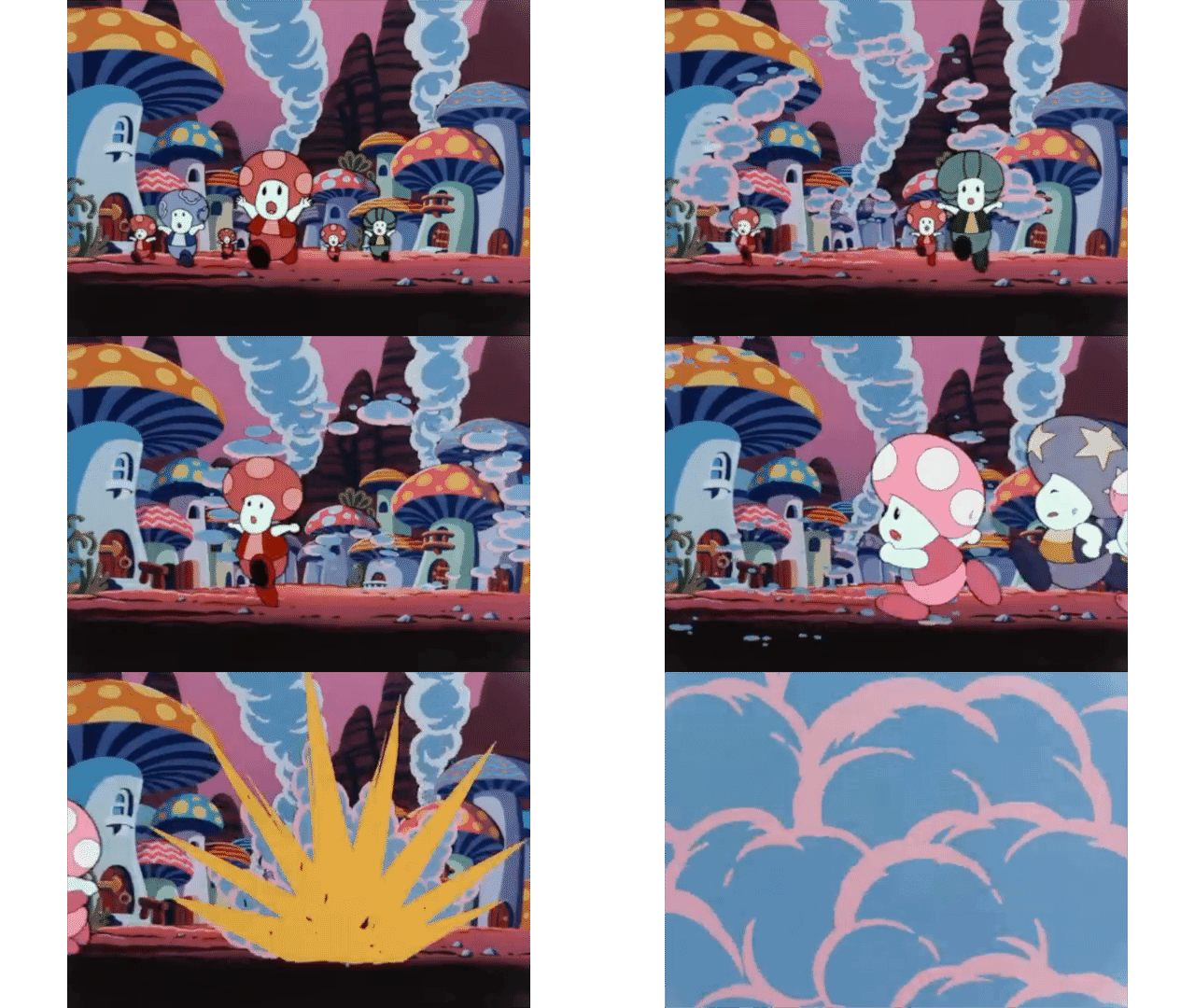
Lacking big eyelashes like the ones that Mario and Luigi rescue, these flashback Toads look a lot more like the ones that appear in the original Super Mario Bros. box art, which is to say that they look a lot more like the Toad we all know and love, just sporting more colors than we were used to back in the day.
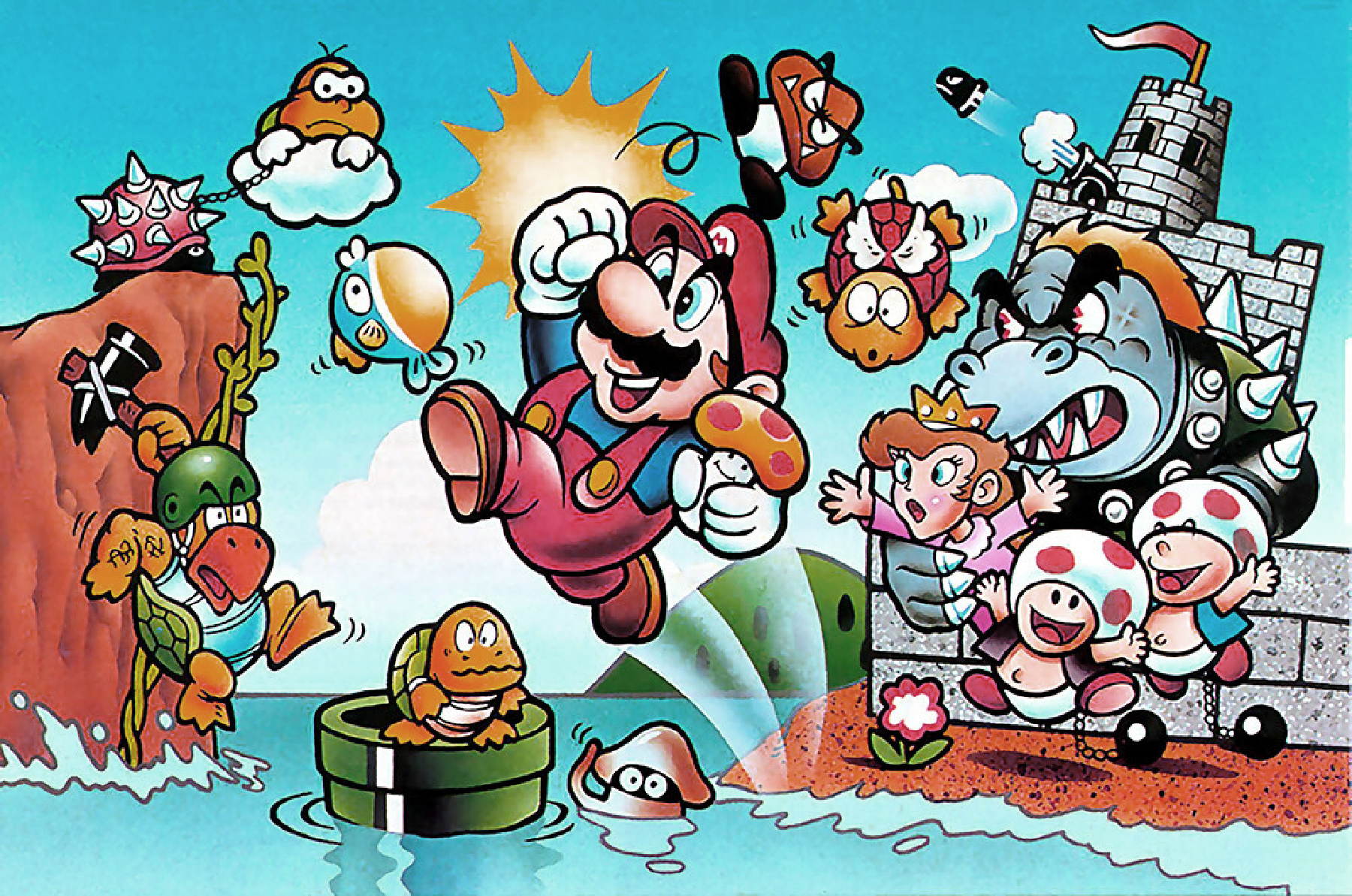
The major difference between these Toads and the anime ones is that the latter are wearing undershirts. These are showing off the goods, outie belly buttons and all.
So clearly the people who worked on the anime understood what a more typical Toad design should look like. But then why would they make the Mushroom Retainers female? I suppose the easy answer is that it just makes more sense to have male heroes rescue female captives, because that’s how these sorts of stories are usually told, but I think there’s another theory involving the difficulty in reading pixel art. Consider, if you will, how Mushroom Retainers appeared in the original Super Mario Bros. and then, beyond that, think about how they appear in the instruction manual, which would have been one of the few visual assets available to the people who did character designs for the anime.
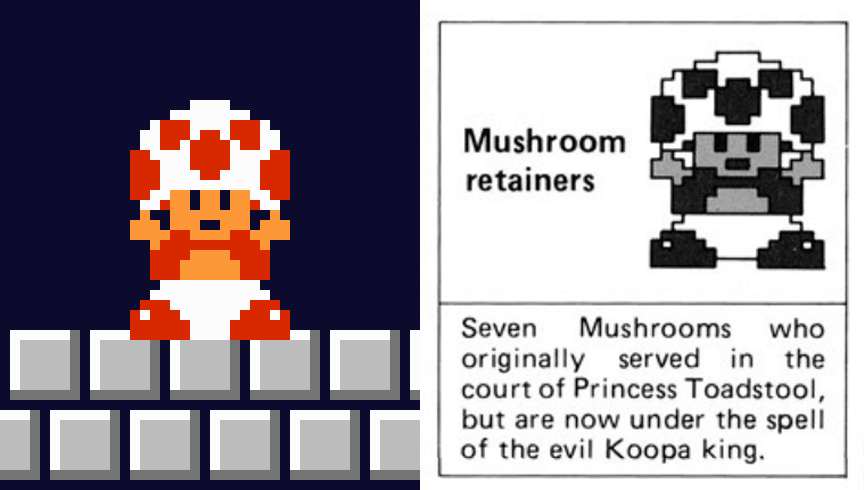
Yes, the Mushroom Retainer in the original Super Mario Bros. manual looks oddly squat. No, I don’t know why. You’d have to ask Nintendo, I guess.
If you put together that this particular mushroom head is supposed to be the same type of character as the ones seen in the box art, you can understand what’s being suggested with their pixelated clothes. The top is Toad’s vest and the bottom is the… diaper-like bottom that they all wear. If you’re just looking at the pixelated version on its own, however, I think you could also interpret the upper garment as a bikini-style top. Clearly, the four pixels connected the two sides of the vest are there to differentiate Toad’s head from his torso, but they could also suggest breasts — I’m guessing accidentally.
The English instruction manual doesn’t gender the Mushroom Retainers one way or another, except maybe if you, like me, associate the term retainer more with feudal Japan. Technically, a retainer is just a servant — of any gender, in any time period — but for whatever reason, I’ve encountered this sense of the word more in reference to samurai serving a shogun. If that’s the context, you could maybe assume that these Toads were male, but I’m pretty sure that’s not what the manual text was going for, however, as the original Japanese text only calls them キノピオ or Kinopio — “seven mushroom who serve the princess.” That said, some English materials went the other way and interpreted mushrooms serving in Peach’s court as ladies-in-waiting, basically. The Official Nintendo Player’s Guide, a 1987 publication from Nintendo offering general tips for the most popular NES titles of the time, specifically calls them maids. And I can’t really imagine why the writer of this text would make that assumption unless they looked at that upper garment and also decided that it was a red bikini top.

For what it’s worth, there’s a discussion about this subject that used to be live on the Legend of Localization website, although I can’t seem to find it now. (Luckily, it’s archived on the Wayback Machine.) Basically, Clyde Mandelin alludes to the idea that some Japanese players have it in their heads that the end-of-level captive Toads were originally supposed to be female (and specifically Peach’s handmaidens) but that later games changed this. However, Mandelin also notes that the game’s artwork would seem to imply that this isn’t the case, however, and that any lingering notion of these characters being female might just result from the anime overwriting people’s memory of the actual game. In fact, there is perhaps a parallel process that happened in the west, with the Super Mario Bros. Super Show! perhaps making its viewers more inclined to think of in-game versions of Toad as a single, specific character rather than a playable member of the larger mushroom head populace, if that makes sense.
Whatever the case, explicitly female Toads would eventually debut in Super Mario RPG, and then Mario Kart: Double Dash!! would mark the debut of Toadette, who’s been a regular part of the series ever since. In case you’re interested, I actually have a post that is a detailed history of how Toad has been gendered — in the original Japanese as well as in English localizations. What you’ve just read in this post is basically all from the first section of that longer post, but I decided to break it out into its own, because I’m always trying to figure out how to present information in a way that’s easy for people to find.
Also, ha ha — “femboy Toad.”
Miscellaneous Notes
The Japanese title to the Super Mario anime, スーパーマリオブラザーズ ピーチ姫救出大作戦! or Sūpā Mario Burazāzu Pīchi-hime Kyūshutsu Dai Sakusen!, literally translates as something like “Super Mario Bros. Princess Peach Rescue Operation!” I’m not sure who came up with the English title we know it as today, Super Mario Bros.: The Great Mission to Rescue Princess Peach!, but it clearly stuck despite the fact that its punctuation is awkward as hell.
It’s noted in the Super Mario Moment episode that technically, the Super Mario anime opened in Japanese theaters July 20, 1986 — the same day as Running Boy: Star Soldier’s Secret, which is technically an adaptation of the 1986 Hudson Soft shooter Star Soldier. However, based on the synopsis, I don’t think it should count. Not really. It’s a movie about the fictionalized account of how the game is created and not a movie starring the characters from the game Star Soldier. Go ahead and tell me I’m wrong, I dare you.
The podcast episode also notes the strangeness of Kibidango, a dog character in the Super Mario anime, looking a great deal like the two caterpillar characters in the video game series: Wiggler and Prince Florian. I do have a whole post about how it seems like Super Mario Bros. Wonder would might be riffing on ideas that originally appeared in the anime, but it also might be just a coincidence, with caterpillars in this series being drawn in a certain “house style” and Kibidango looking like a caterpillar because he’s supposed to look like a certain sort of ball-on-a-stick dumpling. Spoilers for the anime, I guess, but in the end, it’s revealed that Kibidando the dumpling dog is actually Prince Haru of nearby Flower Kingdom, having been transformed by Bowser’s magic. The fact that Florian is also prince of Flower Kingdom would seem like a dead giveaway that Super Mario Bros. Wonder is calling back to the anime, wouldn’t it? Maybe! Also probably not! It’s complicated, and I get into it in the earlier post. But whatever the case, I agree with Hamish and David that Prince Haru or a very Prince Haru-like character would give the Super Mario series the foppish dandy energy that it otherwise lacked, and we are poorer for not having it.
Finally, I have something that might not be anything in particular, but I suppose could be some kind of explanation for issues raised in this post. Below I have the image that was used for the soundtrack to Super Mario Bros.: The Great Mission to Rescue Princess Peach! I think it was also used for some home video versions as well. It’s weird because it seems to be showing off models for some characters that were altered before the final version of the film.
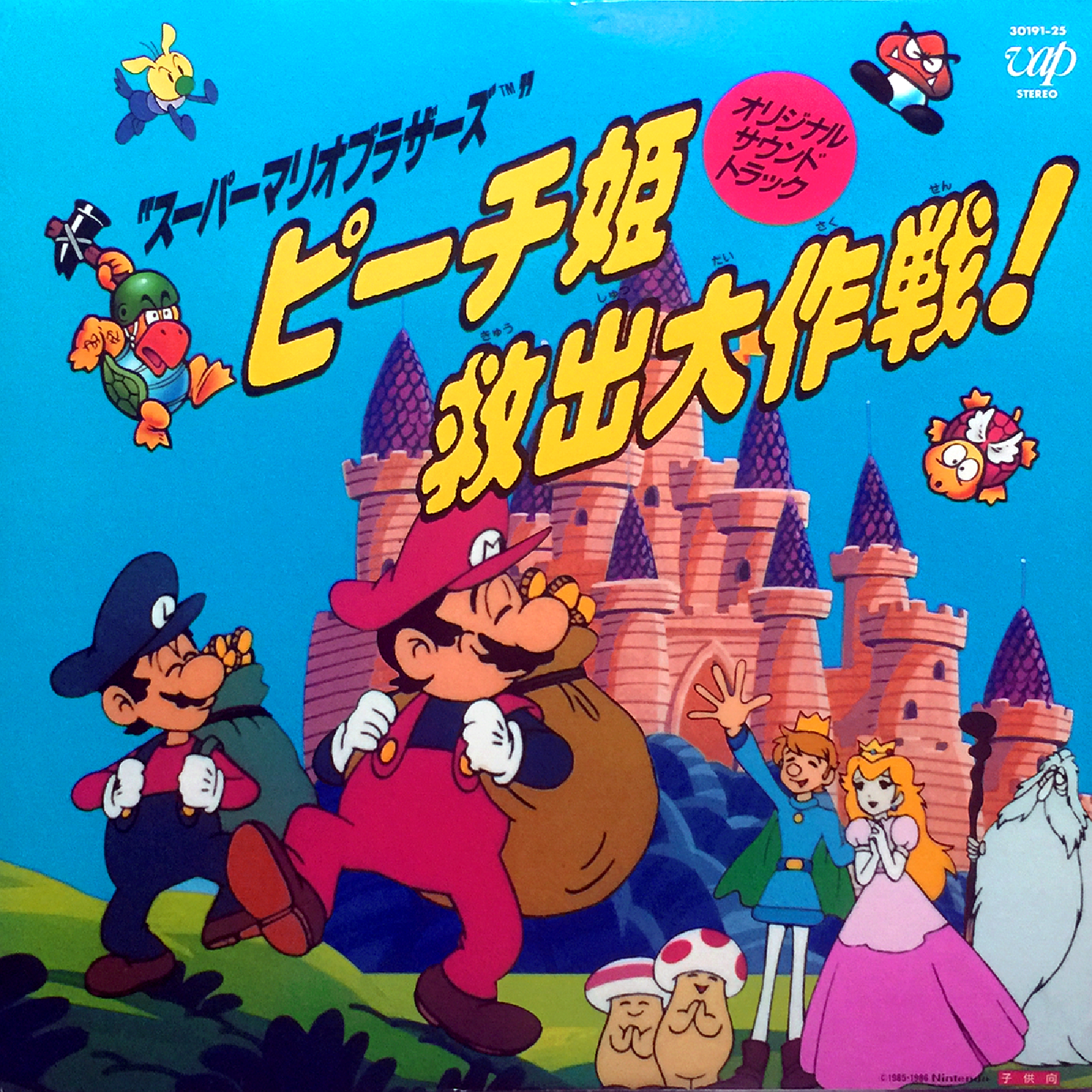
Note that except for Kibidango, the characters added to the upper portion of this image all come from the original Japanese Super Mario Bros. box art and not from the movie at all.
For one thing, Prince Haru was given a radically different look. The version seen here has a Mario-style potato nose, whereas the version in the film looks a lot more like a gender-swapped Princess Peach, with pink being swapped out for blue. And for another, while Mario looks more or less the same, Luigi was given Mario’s colors, just inverted. In the film, Luigi has blue overalls and a yellow undershirt, which is more or less unique to this adaptation and one of Luigi’s alternate color schemes in Smash Bros. But what really trips me up is the less-humanoid version of the Toads pictured next to Haru and Peach. I’m not sure if they’ve been denuded or devolved, but they definitely don’t show up in the movie at all. Was this maybe how the anime initially was going to depict the non-captive (non-female) Toads? If so, it’s possible the one flashback sequence depicting more on-model Toads was done after the fact, perhaps to push the anime even further in line with the games.
In closing, how cool is this gif of Peach kicking ass and taking names?