

The Mysterious Connection Between Lufia and Lunar
Although I have a tendency to ask questions in the titles of my posts, my goal is usually to go as far as I can to answer those questions. Today, however, I have come up short and am bringing this matter to you in hopes you can fill in some blanks.
Perhaps you can solve a mystery.
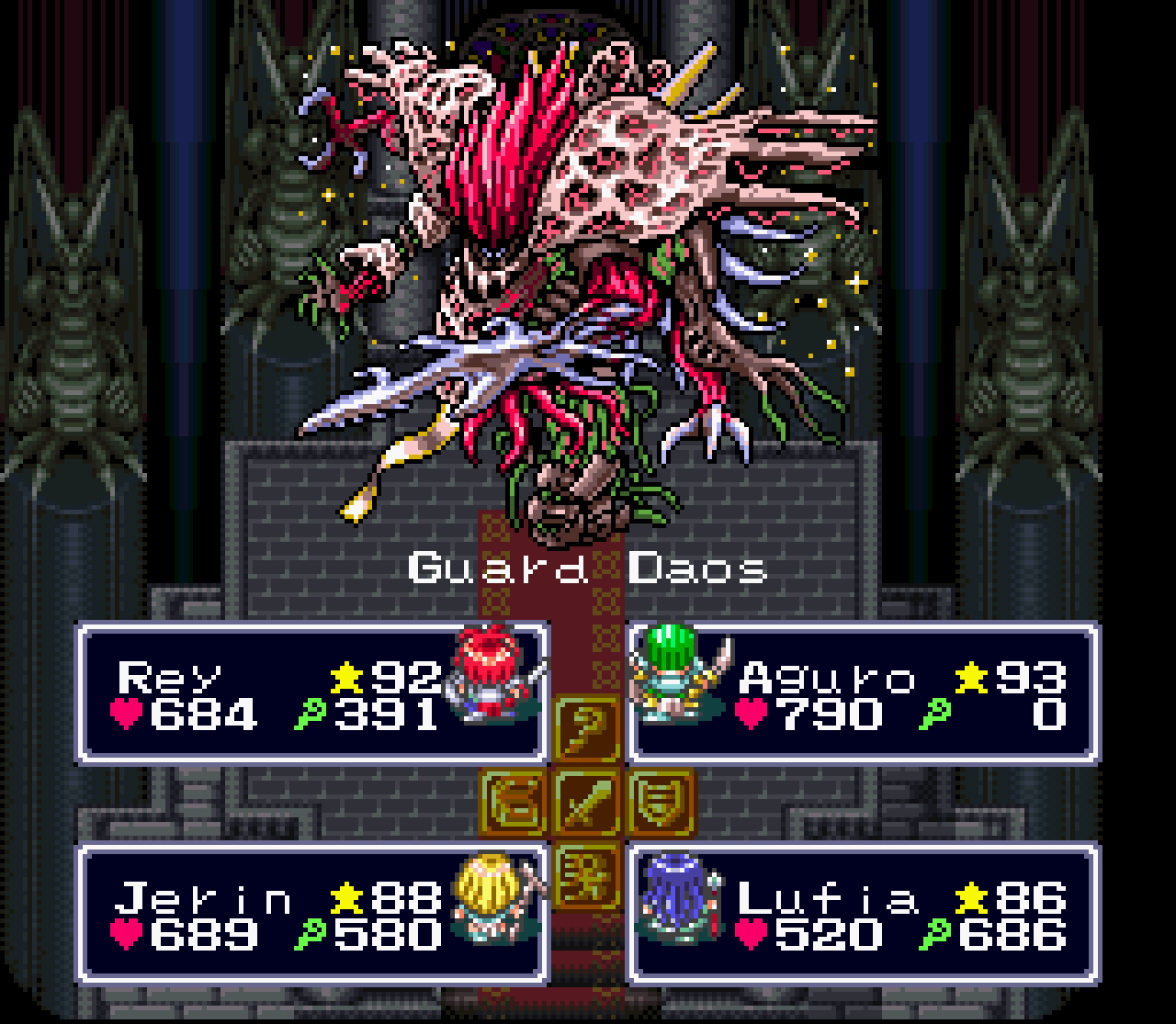
In the early 1990s, Squaresoft did such a good job selling me on RPGs that my attention soon drifted to efforts by other companies. This list included Breath of Fire, Soul Blazer, The 7th Saga, Arcana and, shortly after it came out in the U.S. in November 1993, Lufia and the Fortress of Doom. Despite its hokey-sounding title, I really dug Lufia. It used bright colors and cheerful-looking sprites to tell a story that was deeper and darker than I was expecting. Later, in college, I’d play the follow-up, Lufia II: Rise of the Sinistrals, and found it to be just as good. Though published by Taito, a company not associated with RPGs, Fortress of Doom was developed by Neverland, a now-defunct company that would go on to release the Rune Factory series in the early 2000s. I haven’t played those, but I’m told you can see glimmers of the Lufia series in those games, and I’m at least grateful for that.
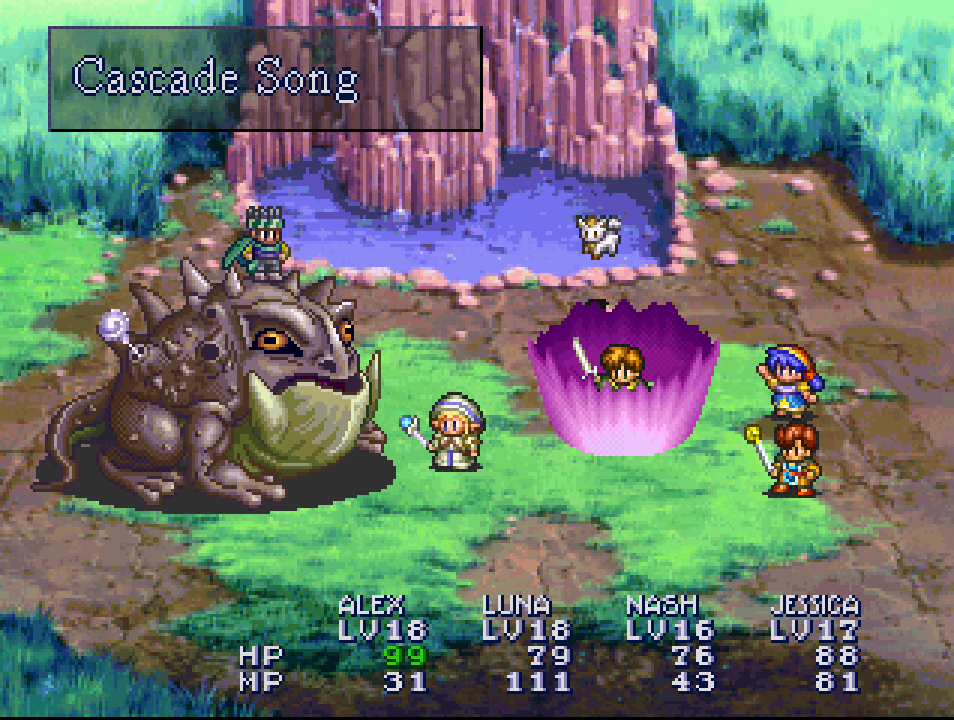
All the while I was playing these games, I was eagerly reading about all the RPGs released for non-Nintendo systems, which I did not have access to. Among the most enticing was Lunar: The Silver Star, first released for the Sega CD and first available to the North American market in December 1993, about the same time as the first Lufia game debuted in the west. Gaming magazines covered Lunar enthusiastically, and screenshots showed off not only Final Fantasy-eque battle sequences but also cut scenes done in the style of ’90s anime. Where I grew up, Japanese animation was still relatively hard to come by, and this collision of my favorite genre with this aesthetic I was craving made me regret that Lunar was not coming out for any Nintendo system. I actually only completed it this past year, and although it was the enhanced version released for Nintendo Switch in 2025, it still reminded me of the games I played back in my Super NES.
In finally playing Lunar, however, I was also surprised at how similar the two games are. I’m mostly speaking of the basic plot set-up, but I’ll mention a few other weird connections later in this post. Consider this your spoiler warning, however, for both Lufia and Lunar, if these thirty-year-old games happen to be something you’d like to experience fresh.
Here we go.
Lufia and the Fortress of Doom centers on the descendant of Maxim, the warrior who ninety years ago defeated the Sinistrals, a quartet of evil god-like beings. This descendant — he has no official name; the player chooses it — grows up in the small town of Alekia. One day, while he was a child, a blue-haired girl about his age showed up in town and was adopted by the local innkeeper. She gives her name as Lufia, and she and the hero grow up as friends. Once they hit their teens, they eventually become each other’s love interests. These two set out to investigate rumors of monsters showing up in nearby towns and eventually end up on a world-spanning quest to defeat the resurrected Sinistrals. However, towards the end of the game, it’s revealed that Lufia is actually Erim, the Sinistral associated with death. She goes into evil mode, but only temporarily, as Lufia’s personality eventually manifests again and she rejoins the party for the final battle against the other three Sinistrals. The heroes win, but Lufia apparently dies anyway. When the hero returns to Alekia at the end of the game, he’s surprised to find Lufia, apparently with no memory of him or anything else.
Lunar, meanwhile, focuses on Alex, a young man residing in the village of Burg, where he is raised alongside his adopted sister, Luna. Dyne, a dragonmaster and a great hero, showed up one night at the home of Alex’s parents with a blue-haired baby girl, and she and Alex instantly bonded. Alex grows up wanting to be a dragonmaster just like Dyne, and the early part of the quest involves him, with Luna in tow, traveling around the world to accomplish this. It’s eventually revealed that Luna is the avatar of the goddess Althena, and she’s kidnapped by the game’s main antagonist, Ghaleon, in an effort to control her powers and, by extension, the world. Alex and his friends eventually defeat Ghaleon. Luna, who has been transformed into a dark version of Althena, is restored and they return to Burg.
(Note: Lunar has been remade a few times, and the story has undergone tweaks here and there. Based on what I understand, everything I’ve stated in the above summary happens in all versions of the game… I think? Please correct me if I’ve got it wrong.)
While both of these games traffic in story beats that were common in Japanese RPGs back in the day, they also have more than a few plot similarities that many of those other games do not, especially regarding the portrayal of their female leads. What follows is a list of as many as I can think of.
Both stories focus on the relationship between a young male hero and a female companion of mysterious origins, who more or less shows up one day in the rustic village where the story begins. Her parentage is never really questioned, and for the most part the plots ignore this — until it becomes a major plot point.
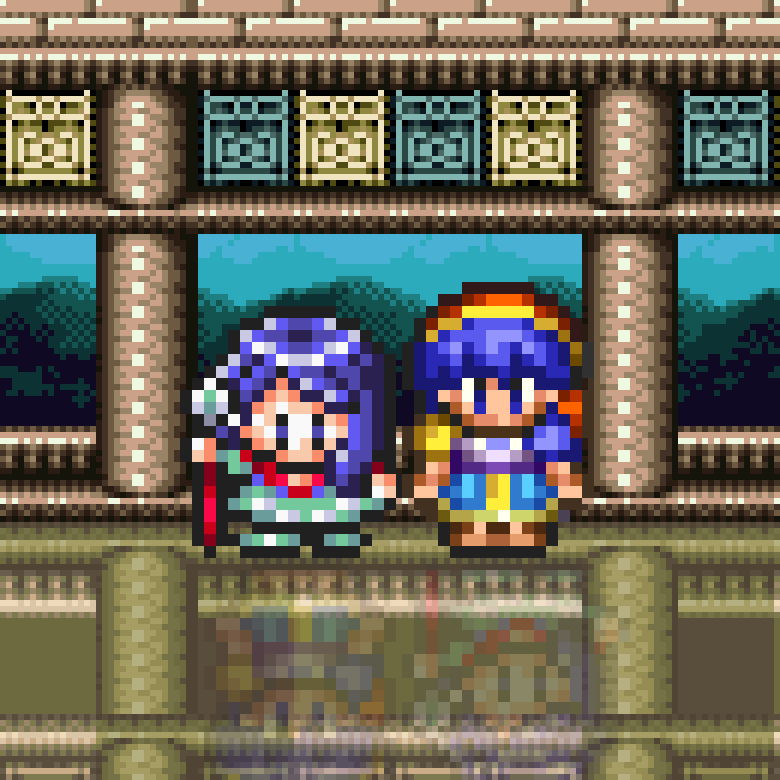
Both Lufia and Luna have blue hair, and I realize that may not sound like much, because this era of anime featured many characters with blue, purple, green or pink hair, but in both games, the hair color is a subtle hint that the female character is connected in some way to a goddess (or goddess-like being) who also has blue hair.
Both Lufia and Luna are raised alongside their respective heroes in a way that kind of blurs the lines between adoptive brother and potential boyfriend, Wuthering Heights-style.
I suppose both Lufia and Luna are magic-users and healers, but it’s par for the course in RPGs from this era that a female character would be the yin to the sword-wielding hero’s yang. In the case of Lufia, she turns out to be a very powerful magic-user, and this is probably another subtle tip-off that there’s something going on with her. Again, the game never says so explicitly, but the reason she has access to such powerful spells is that she is secretly Erim, who is the strongest magic user in the story.
Lufia and Luna’s names are also fairly similar. With the latter, it makes sense because the moon is a central image in the game, but with Lufia, it seems to be an entirely made-up name that could have been anything else. (I have a theory for where her name might have come from in the miscellaneous section, but it’s just a theory.)
Lufia and Luna both are eventually revealed to have some connection to a goddess, although their exact nature is somewhat murky. It’s never explained how Lufia is able to show up as a child in Alekia, and it’s not explained why she shows up again as an adult, sans memory, at the end of the game. The other Sinistrals, at least, claim Lufia is Erim, their sister and therefore some kind of god-like being, but when Lufia is Lufia, she’s not evil. Luna also seems to have no idea that she’s the goddess Althena. At the very least, it’s meant to be a surprise to the player.
Both Lufia and Luna have some connection to mortality. At least in some versions of Lunar, it’s explained that Althena sacrificed her immortality to become human, but I’m not sure if Luna is meant to be less immortal or less omnipotent when she becomes the dark goddess later on. Ghaleon, at least, doesn’t seem to think so. Lufia, meanwhile, is Erim, the Sinistral associated with death. Because she’s able to resurrect the other three, she’s arguably the most powerful of the group, even if she’s not the leader. While it’s never explained in-game, I think her mastery of mortality also explains how she’s able to resurrect as Lufia — and in later games as other characters.
Both Lufia and Luna show up in the follow-ups to their respective debut games, though as different characters. Lufia II: Rise of the Sinistrals is actually a prequel to the first game, wherein the story of Maxim and his friends is fleshed out far beyond the prologue seen in Fortress of Doom. Erim is still a Sinistral and therefore an antagonist, but she also shows up as Iris, a mysterious sage who encourages Maxim and sometimes even offers him information important to the story. It’s implied that, as Iris, she may have softened her stance on humans and perhaps this is why Lufia seems capable of human emotion. Luna and Althena, meanwhile, have some ambiguous relationship to Lucia, another mysterious blue-haired girl appearing in Lunar: Eternal Blue, where she seems to have inherited Althena’s powers — perhaps as a result of Althena becoming human? It may not be a coincidence that a similarly named character in a later sequel is explicitly revealed to be Althena.
Both Lufia and Luna have a connection to music. Luna’s is more explicit, I’ll admit. She sings a lot throughout the game and even gets a Disney-style “I wish” song. But music is also the form her magic takes in battle; all of her magic spells take the form of songs. Lufia does not sing, but she’s the only character who gets a theme song: “Priphea Flowers,” which becomes the love theme for the entire series. I realize that games such as Final Fantasy VI assign leitmotifs to every major character and even some minor ones, so this might seem like the weakest of connections, but in a game where characters don’t generally get individual theme songs, it seems notable that Lufia does, at least, have this one music association.
That’s everything I can think of, though it might be notable that both Lufia and Lunar make the aesthetic decision to have the party members walk in a single file row. Although some do, most RPGs don’t do that. Lunar only does it in towns or on the general map screen. It doesn’t do it in dungeons because battles are activated when a monster tags you, and having a line of up to seven characters (including Nall the baby dragon) would make your hit box way too big. Lufia, which has random enemy encounters, doesn’t need to worry about this, and you see everyone in your party machine in line at all times, even guest characters who don’t partake in battle.
It’s also worth noting that at some point, one of the remakes of Lunar seemed to take a note from Lufia, which famously opens with a prologue involving Maxim and his party taking on the Sinistrals before flashing forward ninety years later to Maxim’s descendant and Lufia as children. You literally play as the powered-up version of the four original heroes and you control the battle with the big bads. I think it’s the PSP remake of Lunar, Silver Star Harmony, that opens with a similar scene; Dyne, Lemia, Mel and future big bad Ghaleon are playable in their big climatic battle against the evil wizard Eiphel. Once they win, it’s revealed to be a story being read to young Alex and Luna.
So what’s going on here?
Lunar: The Silver Star was released in Japan on June 26, 1992, and Lufia was released June 25, 1993. I suppose it’s possible that the former influenced the latter, and indeed a page on the Neverland website states that development on Lufia lasted only six months. However, I think this refers to the specific development on the title that was eventually released for the Super Famicom. It began as a PC-98 title, Esteel (エステール). I’m guessing that the Japanese name for the series, Estpolis Denki (エストポリス伝記 or “Biography of Estpolis”) owes its etymology to that original title. Whatever the case, this Youtube series retrospective claims that Esteel might have actually been Maxim’s story and therefore the genesis for Rise of the Sinistrals. That could be the case, and that could explain why the second game is so well set up by the first despite the latter being a prequel; Neverland already knew the basic story — the original four heroes, the basic town map, the presence of the significance of the Shaia family of inventors — during the creation of Fortress of Doom. Meanwhile, this other Youtube retrospective goes as far to say that Esteel might have been both of the first two Lufia games: Maxim’s story and then his descendant’s.
I can’t find a solid date for when development on the first Lunar began, but I’m guessing around 1990, because that’s when Studio Alex was formed by former Falcom employee Kazunari Tomi. This studio co-developed the first three Lunar games with Game Arts, which published the titles. In fact, Studio Alex seems to have been founded specifically to make the first Lunar; I’m not sure if Studio Alex was named for the protagonist of Lunar or the other way around, but either way, the studio seems tied to the creation of this first game.
I lay out these timelines not to imply that Masahide Miyata, who wrote the story for the Lufia games, was inspired by Kei Shigema, who wrote Lunar, though I suppose Lunar might have influenced Lufia in subtle ways. It’s also entirely possible that all the similarities I listed above are just coincidences, and that no one was inspired by anyone else. Having written about the origins of video games for a while now, my gut feeling is telling me that there’s a different reason behind these parallel developments: They’re both riffing on the same pop culture precedent, and I just don’t know what it is. It could be a video game, a book or a movie, but to me, both Lufia and Lunar seem to be appropriating the same source material in slightly different ways, hence why some of the similarities don’t line up quite as neatly as others. There is precedence for this in video games. I’ll point to weird similarities to Cammy from Street fighter and Sarah from Virtua Fighter, which I wondered about for years before this post finally explained that no, this was not a coincidence.
So what’s the common ancestor, then? Again, I’ve got no idea, but I think the collective brain power of everyone who reads this blog might be able to find an answer.
I’m all ears.
Miscellaneous Notes
I don’t think the name Lufia means anything on its own. The katakana is ルフィア or Rufia, and considering that the term roofie was in use well before the 1990s, I guess the localizer had no choice but to call the heroine Lufia, loofah associations be damned. I do wonder if there is perhaps a connection with Lufia’s name and the fictional flower, Priphea, that’s associated with her. The katakana for the flower is a lot closer to Lufia’s name than the English transliteration would have you expect: プリフィア or Purifia. Like Lufia and her many incarnations, the flowers become symbols for the series itself, and they and their theme song show up in multiple games.
Oddly enough, the track also appears in the 1996 tactical RPG Energy Breaker, developed by Neverland and published by Taito, but only in Japan. Lufia also appears, and it’s possible that the game is meant to take place in the same world as the Lufia series.
I always found the name Erim to be strange. Apparently in Japanese it’s エリーヌ or Erīnu, which I also can’t make much of. I guess it’s close to Eris, the Greek goddess of discord, and the Erinyes, the goddesses of vengeance. I don’t know what to make of it.
I’m also curious about the provenance of the name Althena. Obviously, it’s extremely close to that of the Greek goddess Athena, and the katakana are even similar: アルテナ or Arutena versus アテーナー or Atēnā. But the name gets used again in Trials of Mana. It’s the magic kingdom from which the character Angela hails — アルテナ in the original Japanese version but rendered as Altena in the English localization. Does this mean something I’m just not getting?
Finally, I should admit that I have not played Lunar: Eternal Blue yet. I want to, and I will. But I’m curious about the the localization of the later remakes. I remember reading in video game magazines back in the day that the company behind the original English translation, Working Designs, tossed in a lot of jokes and pop culture references that were not part of the original Japanese version. For obvious reasons, the one that sticks out to me is the insinuation by Ruby the baby dragon that Leo, the too-cool captain of Althena’s guard, is gay.
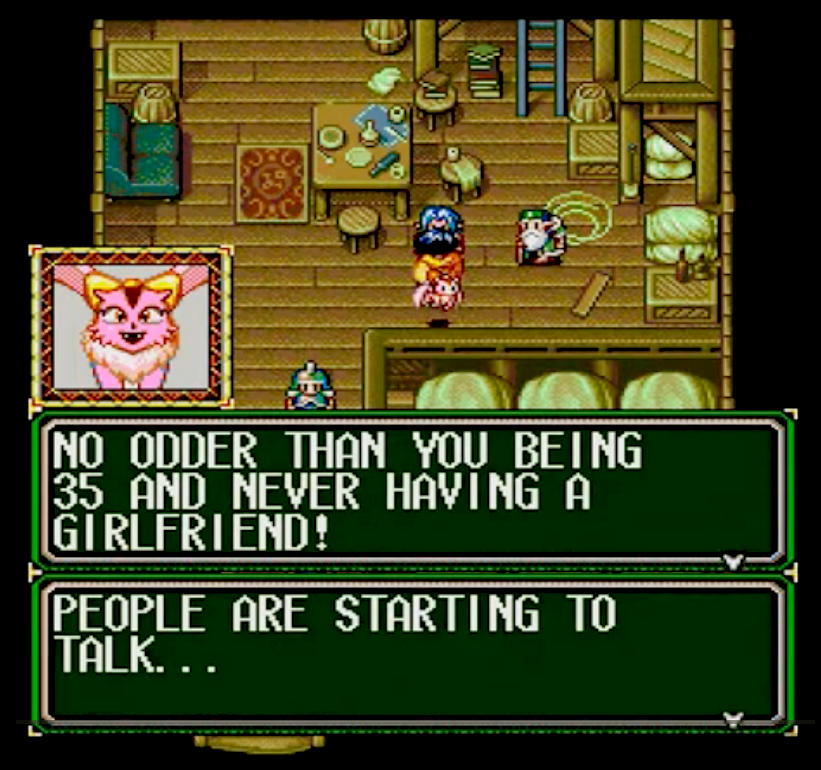
Just curious: Is this omitted from later remakes? Asking for a friend. (I am the friend.)