

Why Do We Think Mario and Luigi Are From Brooklyn?
I’m going to get to the point with this one and answer the question posed in the title of this post. We think of Mario and Luigi as being from Brooklyn because we keep getting told that they are. In fact, this has been an element of the Super Mario series in one form or another going back to the early days, even if it’s never been explicitly stated in any one game.
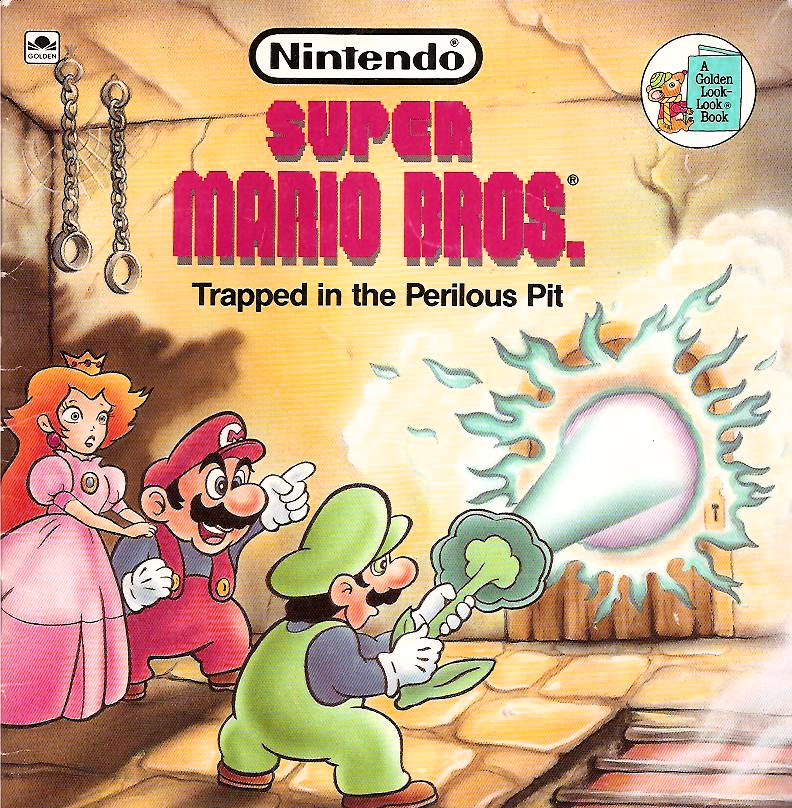
For me, I think I first became aware of this allegedly true thing with a Super Mario-themed book I picked up at my school book fair in second grade: Super Mario Bros.: Trapped in the Perilous Pit. Looking at the cover now, I see that this was published under the Golden Book umbrella, but as I kid, I just assumed the presence of the Nintendo logo as well as the Super Mario Bros. logo meant that this was an endorsed, verified depiction of the universe that Mario and Luigi lived in.
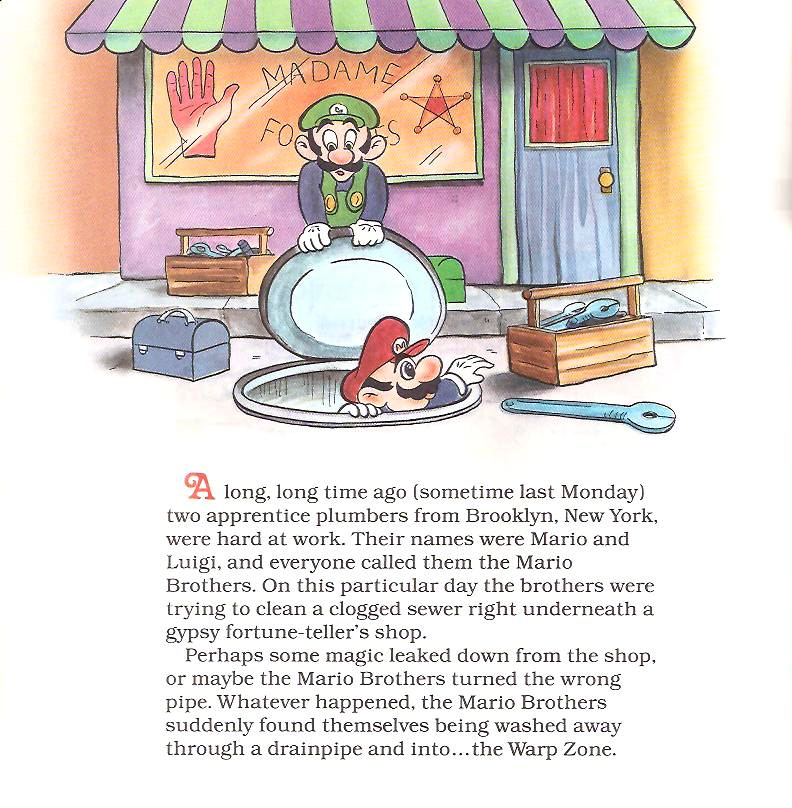
You can read the whole thing at the website Lemmy’s Land, which I am surprised and impressed still exists. Spoiler: Mario and Luigi learn a lesson about teamwork. The very first page, however, explains that the brothers arrived in the Mushroom Kingdom via the sewers of Brooklyn, New York, specifically.
This assertion would later be reinforced by other adaptations, including the Super Mario Bros. Super Show! and the 1993 live-action Super Mario Bros. movie. That shouldn’t mean much, since both play very loose with the game canon, but I didn’t question it back in the day. I just assumed Nintendo wouldn’t lie to me. Still, that’s perhaps an interesting position for me to take, seeing as how the instruction booklet that came with Super Mario Bros. did not mention Brooklyn once.
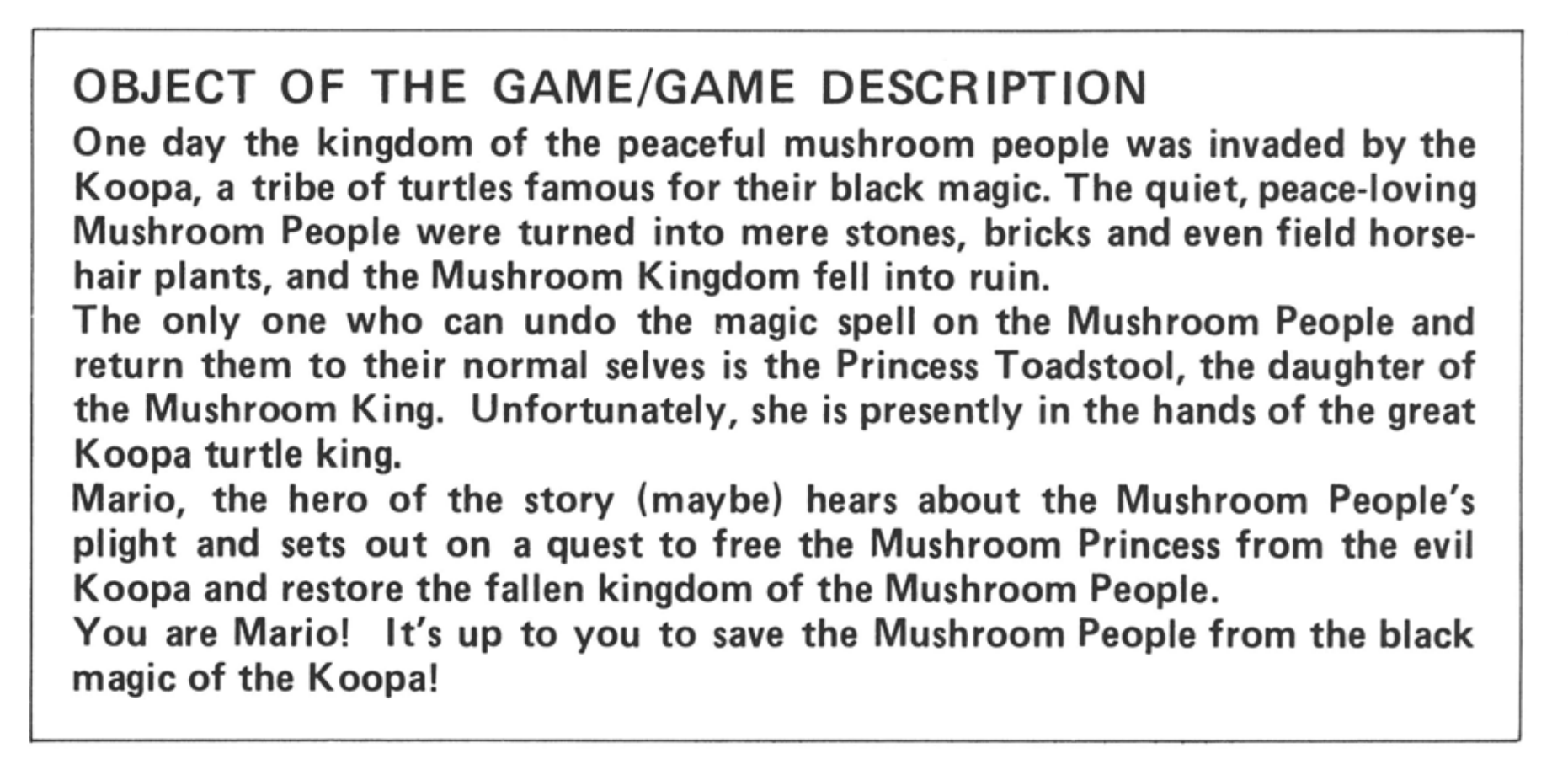
Notably, the backstory given doesn’t mention anything about Mario and Luigi being in any kind of isekai situation. They’re not noted as leaving our world or some kind of humdrum, non-magical world for the Mushroom Kingdom. They’re just going from somewhere else. For all we know, that took a bus from a few kingdoms over.
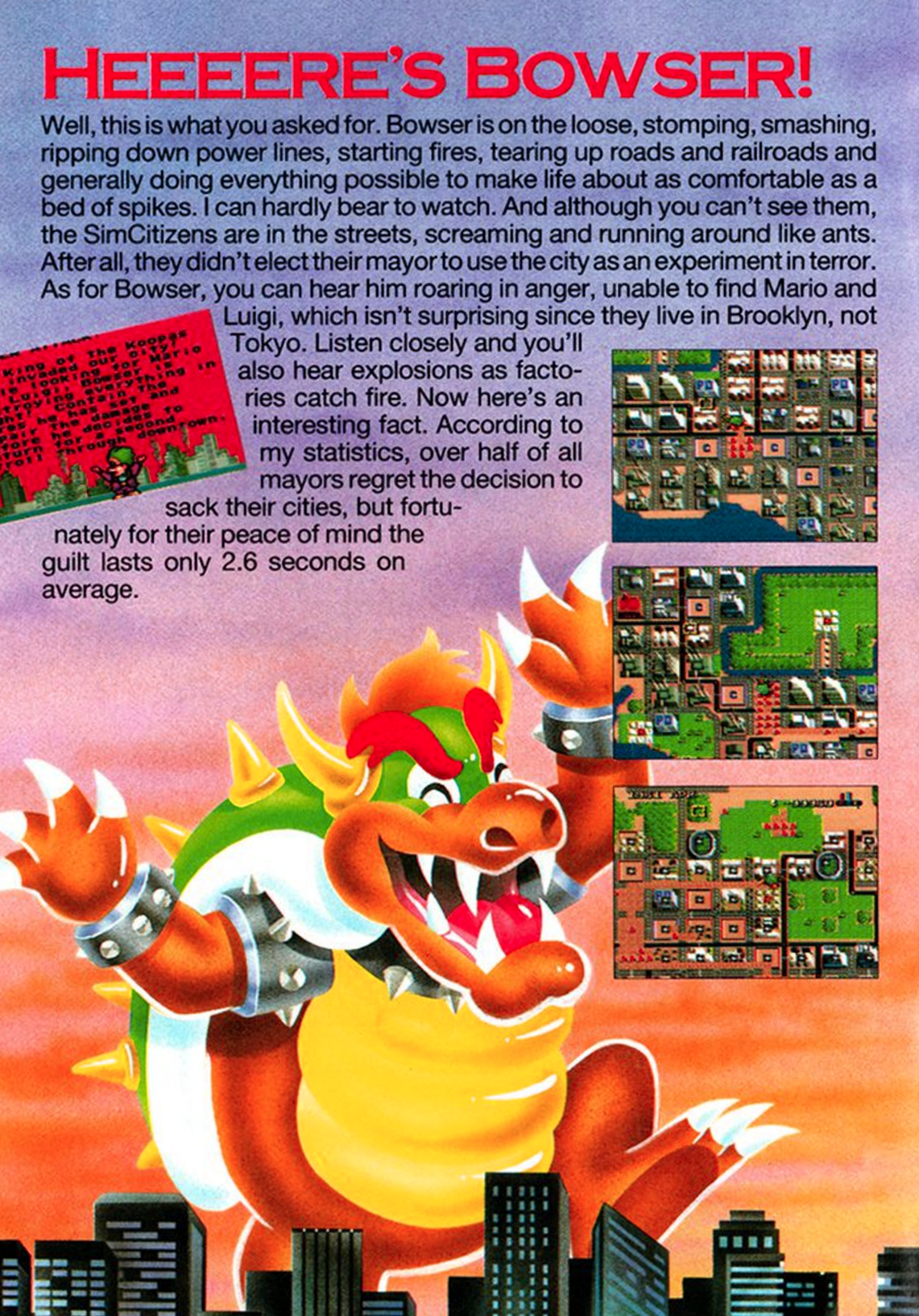
According to the Super Mario Wiki, it’s never stated in any game that Mario and Luigi are from Brooklyn, though the English version of the instruction booklets for the Super NES version of SimCity and either version of Mario Is Missing! do say this.
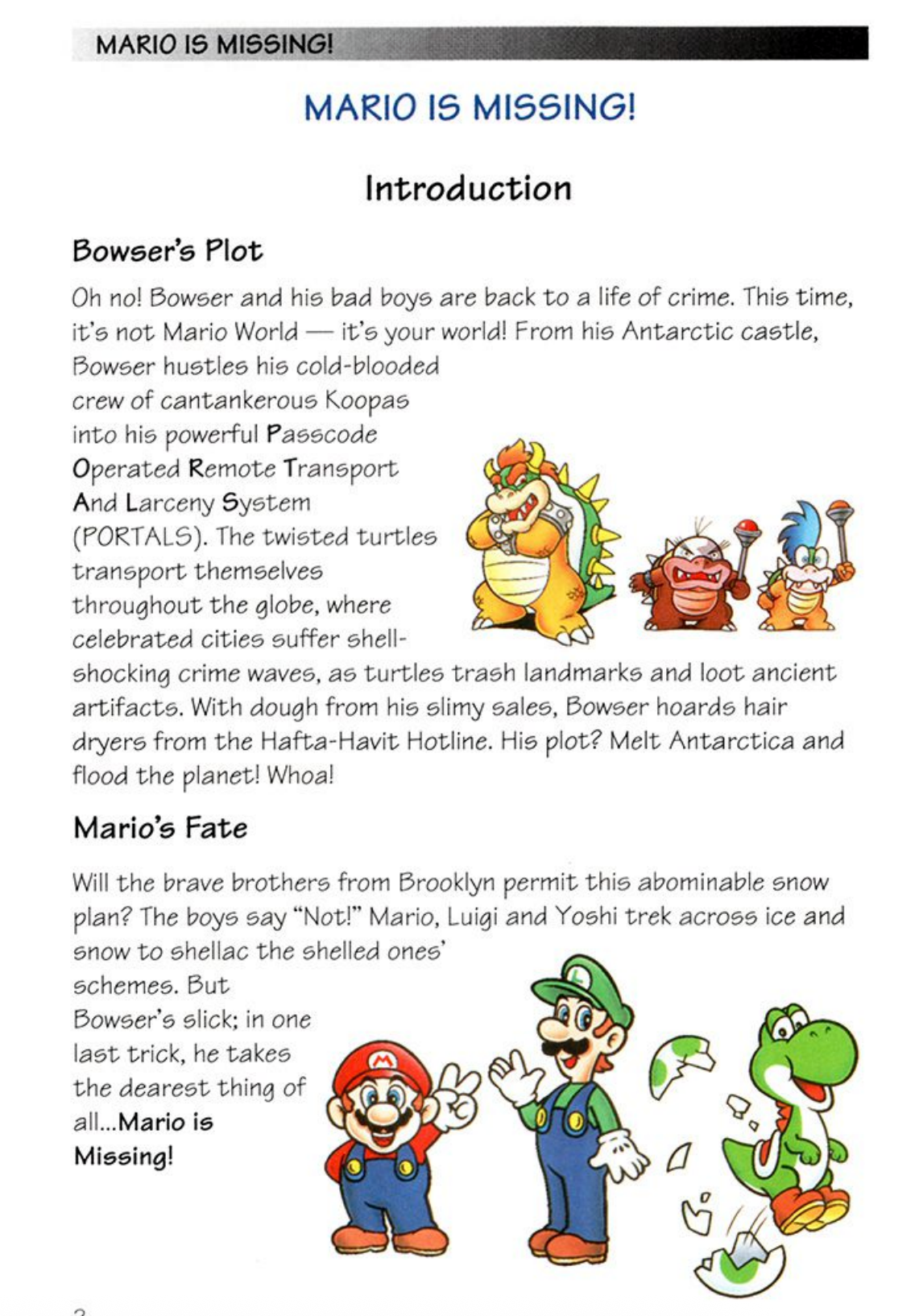
The wiki also points out that Shigeru Miyamoto himself has mentioned Brooklyn at least twice as being his personal headcanon for Mario’s pre-Mushroom Kingdom life. The first time happened in an interview that accompanied a 1996 Japanese-language guide to Super Mario 64 (translated by Shmuplations).
Interviewer: I noticed that Mario speaks with an Italian accent in this game.
Miyamoto: There’s no particularly detailed background or anything, but yeah, it’s a given that Mario is an Italian-American from Brooklyn, New York. That voice was actually done by a professional voice actor. He did Mario’s voice five or six years ago, at a video game event.
The second happens in a 2024 online interview that Nintendo Dream magazine did in promotion of The Super Mario Bros. Movie (translated by Fatimah).
Interviewer: You can’t say too much about the plot of the movie, but it depicts a story similar to the origins of Super Mario where there’s a plumber that goes to a mushroom kingdom. What was the intention behind that?
Miyamoto: It has nothing to do with the movie, rather something that was already decided on for the backstory. That's why the movies that were licensed in the past tended to have that kind of plot. This is generally understood by those involved. Originally in Mario Bros. we randomly decided to have two brothers who worked in the pipe-filled underground of New York — probably Brooklyn. And Donkey Kong takes place in New York, too. … Those pipes lead to the mysterious forest (Mushroom Kingdom) and is how Super Mario Bros. came to be.
Because Miyamoto is admitting on the record something to the effect of “Yeah it’s totally a thing, but it’s just not officially a thing,” you’re not wrong for assuming that Mario and Luigi are from Brooklyn even if that doesn’t get said outright in any one game. But I guess the better question to be asking at this point is this: Why New York City at all? And why Brooklyn as opposed to one of the five other boroughs?
The answers are fairly simple, but I’d guess a lot of people who play these games never asked the question.
Mario’s pre-Mushroom Kingdom antics tend to be associated with New York City because that’s where the finale of the movie King Kong takes place. I don’t know that anyone from Nintendo has ever said so on the record, but it makes so much sense that I can’t rationalize another reason for it. As I discuss in my piece “Who Put the ‘Kong’ in Donkey Kong?” Universal Studios sued Nintendo over alleged similarities between Donkey Kong and King Kong, and while Nintendo emerged victorious, I’d imagine the experience might have made Nintendo reps disinclined to discuss similarities between the two properties even years afterwards.
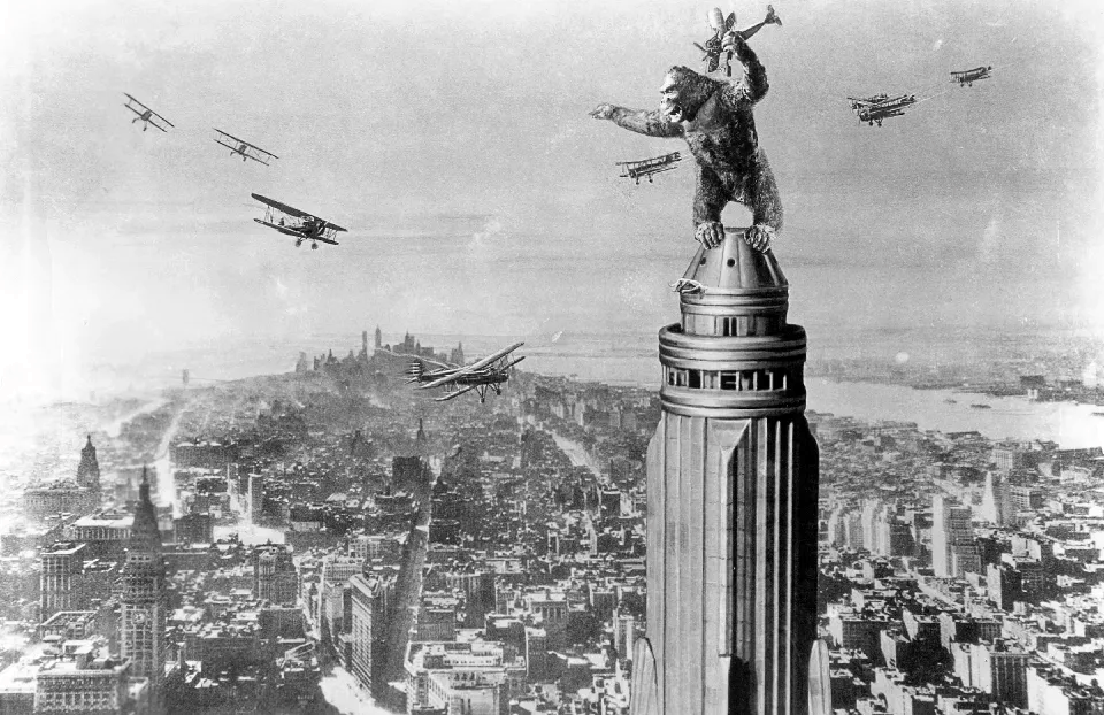
Pictured: short-term New York City resident King Kong.
That’s probably less the case now that Universal is distributing the new Super Mario movies, because everyone is making a ton of money and is presumably very stoked about it. Even in this era of more positive relations between the two companies, however, I don’t think that any Nintendo representatives have admitted on the record that without King Kong there wouldn’t have been a Donkey Kong and consequently there also wouldn’t have been a Super Mario series. Nonetheless, the King Kong connection to New York City explains why later games keep returning to very NYC-esque settings that manage to avoid returning to the “real” world: Big Ape City in Donkey Kong Land and New Donk City in Super Mario Odyssey.
There’s less of an official New York City tie to other games that pre-date Mario and Luigi arriving in the Mushroom Kingdom, but I’d argue the association is still there. The way Mario Bros. is set in an enemy-infested underground, for example, makes me think of the urban legend of alligators living in the sewers of New York. And the urban look of Wrecking Crew also makes me think it could take place in the city as well. I’m not the only one; I’m guessing this is why Foreman Spike shows up in the Brooklyn section of The Super Mario Bros. Movie.
So why Brooklyn?
Just looking at the history of Italian immigrants and Italian-Americans in New York City, all five boroughs have large populations of people who fit into one or both categories. In fact, NYC is home to the largest Italian-American population in all of North America. And while the city’s historic Little Italy is in lower Manhattan, Brooklyn saw the biggest influx of Italian immigrants to the city from the end of World War II up until the time Donkey Kong hit arcades. It’s even got its own Little Italy, in Bensonhurst, and it’s no coincidence that since 1949 the semi-pro soccer team based in this borough is the Brooklyn Italians. (If you want to read more about the history of Italian culture in New York City, read my piece on why the monkey enemies in Yoshi’s Island are called Grinders.)
Given all this, it’s no wonder that so many adaptations default to Brooklyn being Mario’s homebase. But whether he’s being played by Captain Lou Albano, Bob Hoskins or Chris Pratt, one thing all these three have in common is that they voice him more like a guy who lives in New York and not a guy who either lives in Italy or literally just relocated from there. That’s how Charles Martinet voiced him and that’s basically how Kevin Afghani voices him now, but that was not always the case.
The first instance of Mario talking anywhere in western media, as far as I know, is in the TV commercial advertising the various home console ports of the Donkey Kong arcade game. The first was the ColecoVision port, which went on sale in August 1982. The spot features a live action Mario, played by actor Harris Shore. And while he sports a killer mustache, he’s very much talking like a New Yorker.
Shore reprises the role for the Donkey Kong Jr. ports.
The first instance of Mario being voiced to have an Italian accent, however, is the 1983 novelty album Donkey Kong Goes Home. It’s kind of a prog rock opera that tells the story of the original Donkey Kong, only in a way that is wrong and weird. I actually didn’t know about this until recently, until someone mentioned it in a comment on this site, and I still don’t know whether to thank or yell at this person. It’s a fascinating piece of Super Mario memorabilia from before a time when Nintendo attempted any creative control over adaptations. In short, it’s bad — but it’s interesting if you’re a nerd for Super Mario history like I am.
In spoken interludes between songs, Mario is voiced by actor Pat McBride in a way that sounds like an Italian character but by way of the worst Ricky Ricardo impression you’ve ever heard.
Clipped from this YouTube because most posted tracks cut out the spoken word interstitials. But do listen to the full thing, because it is... certainly something that humans decided to create.
The 1984 TV spots for Donkey Kong cereal feature something a lot closer to Charles Martinet — which is to say an Italian stereotype but at least a happy one. Super Mario Wiki identifies this actor as Tony Moran, who Behind the Voice further identifies as the voice of the talking Parkay butter tub. If you know, you know.
But when Peter Cullen assumed the role of Mario in the Donkey Kong segments on Saturday Supercade, which began its run in 1983, he does it more like the first guy, with a hint of New York in there but nothing that actually sounds like Italy.
So what gives? I mean, obviously, any actor taking on a part is going to have their own approach for how a character should sound within the limits of what the director approves. I have no idea if anyone doing the commercial for the Donkey Kong cereal realized that Mario was supposedly from Brooklyn, but it’s entirely possible that they just saw that he looked like the winking chef on a pizza box and whipped up the most over-the-top, macaroni-tastic Italian accent they could muster. That is, after all, what The Simpsons did with its Italian stereotype character, Luigi the chef.
Just looking at Luigi on The Simpsons and hearing Hank Azaria’s broad accent, you might assume that he’s meant to be a parody of Mario. And he might be, but keep in mind that he was introduced to the show in April 1994, about two years before the mainstream debut of Charles Martinet in Super Mario 64. It’s more likely that the Simpsons character is inspired by the Italian chef mascot from the pizza boxes, if not the chef character from Lady and the Tramp. Luigi is, after all, a traditional Italian name in addition to being the name of a famous video game character, as recent events have reminded us.
For what it’s worth, when Mario and Luigi actually appear on the show in Bart’s fantasy in “Marge Be Not Proud,” Dan Castellaneta voices Mario while Azaria voices Luigi.
Martinet’s first gig voicing Mario was for the 1991 debut of Mario in Real Time, a sort of interactive display used for promotional events. He next voiced the character in the CD-ROM version of Mario Teaches Typing, released in 1994. (The original 1992 version had Mario being voiced by actor Ronald B. Ruben.) But all of Martinet’s work as the character has him sounding the way he does in Super Mario 64: exuberantly Italian to the point in a way that makes me think some actual Italian-Americans might be offended. As far as I’ve been able to tell, that is not the case. No, really — years ago I reached out to the Italian-American Civil Rights League to ask if anyone had ever complained about Mario’s accent. The person I spoke to said no. I suppose there are more harmful stereotypes out there than a heroic plumber who makes friends wherever he goes.
I do realize that there are Italian-Americans who have recently emigrated and who therefore sound something like Mario. There are probably also Italian-Americans who emigrated years ago and who still have an accent as thick as a hearty marinara. If we want to get really picky about it, the way Mario talks doesn’t necessarily make sense if he’s supposed to be a guy born in Brooklyn. But then again that doesn’t really need to make sense, because the games have never actually said this. In fact, the ending to Yoshi’s Island explicitly says that Mario and Luigi were delivered to parents living in the Mushroom Kingdom.
It’s one of the more beautiful moments in the series, I say, even if it breaks canon, which I’m not even sure it does.
Now, I am loath to give Chris Pratt much credit, but he did astutely point out the problem with Mario’s in-game accent in his press tour for The Super Mario Galaxy Movie. The long and short of it is that he toned down Mario’s signature exclamation for the new movie as compared to the original one.
From a Screen Rant interview did with Pratt:
There’s one sound... I don’t necessarily know if it would be an effort sound, but it’s a line, which is — I’m not going to say it right now because I haven’t done all my vocal warmups. I don’t want to do it, but it’s “mamma mia.” It’s “mamma mia.” And when you hear that original version of the character, it’s in Italian. It’s like, [high-pitched] “mamma mia!” And I'm like, “Why does it make sense for a guy who’s from Brooklyn who doesn’t have that accent to use that so much?” So it was always tough. They’re like, “It’s written as ‘mamma mia.’” But I'm like — if I’m expressing some reverence or some sense of, “oh wow, mamma mia.” But that’s not something necessarily a person says unless they’re doing the Italian accent. So it’s always really hard to find how “mamma mia” works. … I’ve always tried to vary. I think that’s maybe why they slowed it down to take some of the stink off it because I’m not sure I ever fully got it right.
Essentially, Pratt is explaining how he struggled to give nuance to a character that began sounding like a broad Italian stereotype even though that’s not how he should actually sound. And because the movies make it explicit that Mario is in fact from Brooklyn, it actually poses a problem for the logic of the film if he’s occasionally slipping into a stereotypical Italian accent different from his regular speaking voice.
Pratt is not the only one aware of this problem. The first movie hung a lantern on the matter with the character Giuseppe, who was voiced by Charles Martinet. His existence is the movie’s way of acknowledging that Mario’s traditional in-game voice doesn’t really make sense in this context. It’s outdated and weird for a twentysomething from Brooklyn.
Now that Kevin Afghani has replaced Martinet as Nintendo’s official voice of Mario, it will be interesting to see how the games grapple with this same disconnect. Mario may just continue sounding like the guy on the pizza box, I guess, but I wouldn’t be surprised if Afghani slightly reduces the stereotypical mannerisms. If he does, he just might make Mario sound a little more like he’s from Brooklyn… which is officially isn’t, even if still kinda-sorta is.
Miscellaneous Notes
This is the second of two posts I got to the idea to do while recording an episode of Retronauts about the 1986 Super Mario anime. Yes, I will continue hassling you to support Retronauts financially.
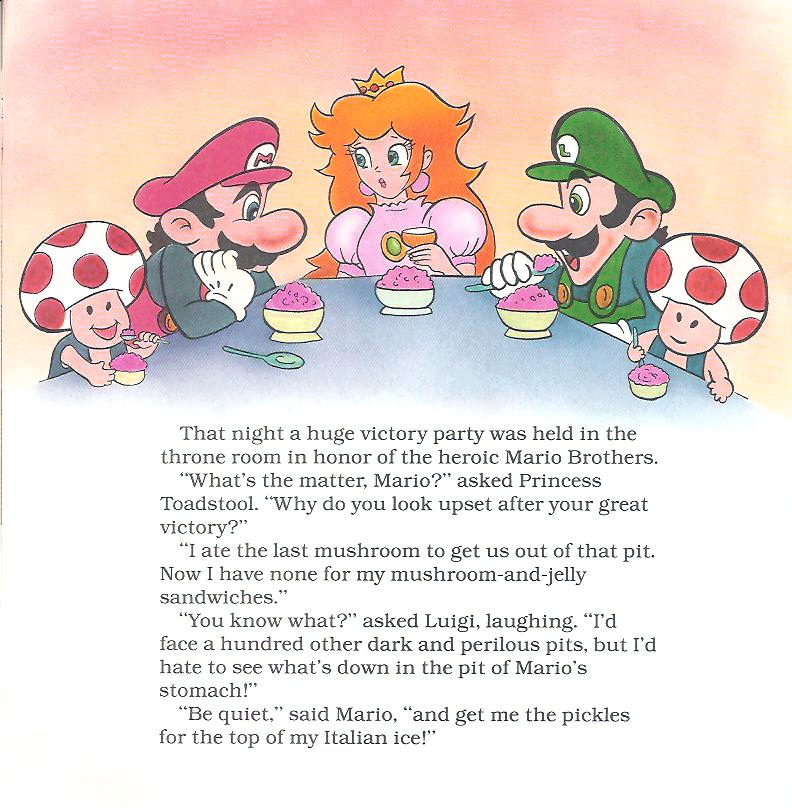
I don’t know if this is proof that I lacked critical reading skills as a kid or if the Super Mario book was not to be trusted, but the last page of the book also misled me into thinking that people actually put pickles on Italian ice. (This is not a thing, it turns out.)
Here is a question I cannot answer but perhaps someone who reads this blog can: In any of the adaptations where Mario speaks Japanese, does he ever speak Japanese with an Italian accent? Is that even possible? It literally did not occur to me until right now that people probably speak every language with foreign accents, and I’m kind of bummed that I am not fluent enough in any foreign language to hear it.