

Despite what this post’s title might make you think, I don’t come here to injure the reputation of Hyrule’s most famous sentient tree. No, if anything, I will attempt to injure my own reputation, because I will be admitting that I may have gotten something wrong. In my big post on the invented words in the Legend of Zelda, I think I misstated what one of them might mean: deku.
This little piece of Hylian vocab probably came to the attention of most English-speaking players with the original release of Ocarina of Time. The Great Deku Tree is the first character you encounter upon leaving Link’s little forest village, and he’s a memorable character at that, because he’s also the game’s first dungeon, meaning even the most untalented player can count on getting at least this far. The way it’s stated in English, it sounds like Hyrule might have more than one Deku tree growing here and there, but this guy is the main one, hence why he’s so great. But that may not be the case.
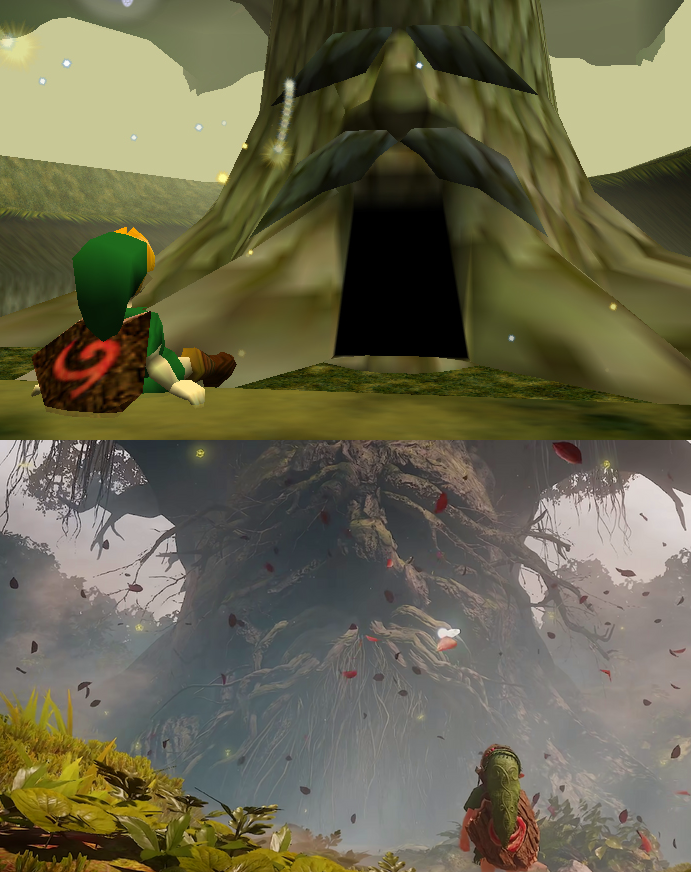
Top: The Deku Tree in the original, Nintendo 64 Ocarina of Time. Bottom: The glow up it got for the Switch 2 remake.
In short, this video game name is complicated in the way that many are.
Ocarina of Time has a few enemy characters whose names point to some kind of relationship with the Great Deku Tree. For example, Deku Scrubs are smaller sentient plants that function kind of like Octoroks, spitting rocks at Link when he draws near. There’s also the Deku Baba, and while I’m not sure what baba is supposed to mean, they’re Piranha Plant-like carnivorous flowers, so at the very least we’re still in the plant family. In my original piece on recurring Hylian terms, I guessed that deku meant “plant” even though that made it somewhat redundant with boko, which seems to mean “forest” and which shows up in the names of monsters such as the Bokoblins. Part of my reasoning in this was the similarity in this Zelda term deku (デク) and the Japanese word 木偶 or deku, meaning “puppet” or “wooden doll,” because wood = plants = forest, or at least that chain of association would seem to make sense.
I’m not sure I was right, however. Just this week, Liz Bushouse, who works as a translator of Japanese video games, shared my piece on Zelda language but did so as part of a thread about various linguistic tidbits in the Ocarina of Time remake and beyond. In fact, in the post immediately before she shared my piece, she pointed out that deku (デク) might just mean “big,” and it might appear more frequently in Zelda names as degu (デグ).
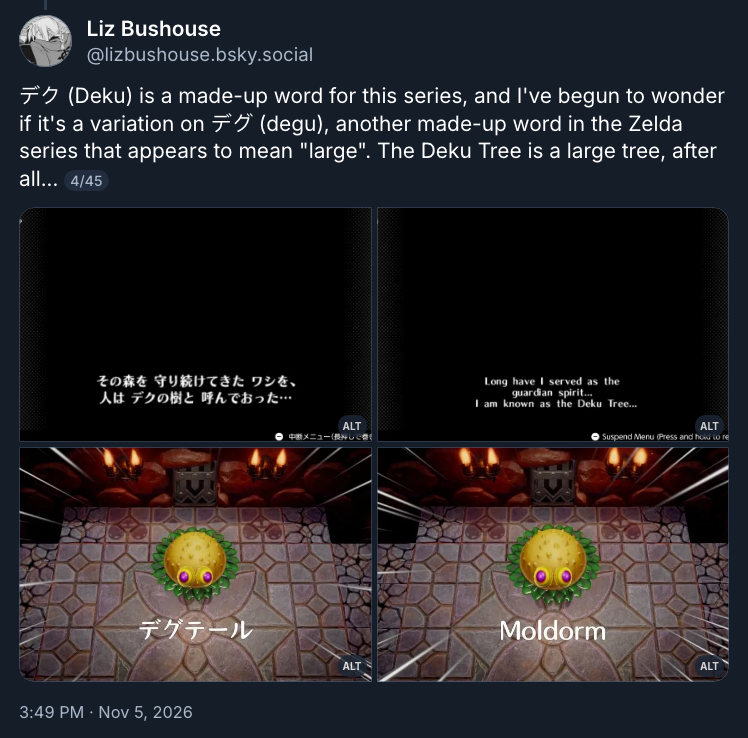
That degu- word part shows up a lot in the names of enemies that are bigger-than-normal versions of regular ones. As Bushouse points out, the caterpillar-like boss enemy that westerners known as the Moldorm is known in Japan as デグテール or Degu Tēru, meaning “big tail” and implying that it’s the larger version of the regular version of the enemy westerners call the Mini-Moldorm, which is known in Japanese as just テール or Tēru. Essentially, English flipsflops which version is the “normal” version and which one is the unusually sized variant. For us, it’s the big guy. For Japanese players, it’s the little guy. A comment from Zero-ELEC on my Zelda Language piece listed a few more of these. For example, the six large Armos bosses fought at the end of the Eastern Palace in A Link to the Past are known in Japan as デグアモス or Degu Amosu — basically Big Ol’ Armos. And the Japanese name for the Big Dodongo in Four Swords Adventures is デグドドンゴ or Degu Dodongo. Zero-ELEC even postulates that deku- might come from a combination of the Japanese でかい or dekai, “huge, severe, intense,” and the English word big, which would be transliterated into katakana as ビッグ or biggu.
The degu- trend would seem to go all the way back to the original Legend of Zelda, where the fifth dungeon boss is an oversized version of a Clu Clu Land enemy. It’s called Digdogger, which is a real headscratcher of a name, but that is how it’s written out in the Japanese instruction manual.
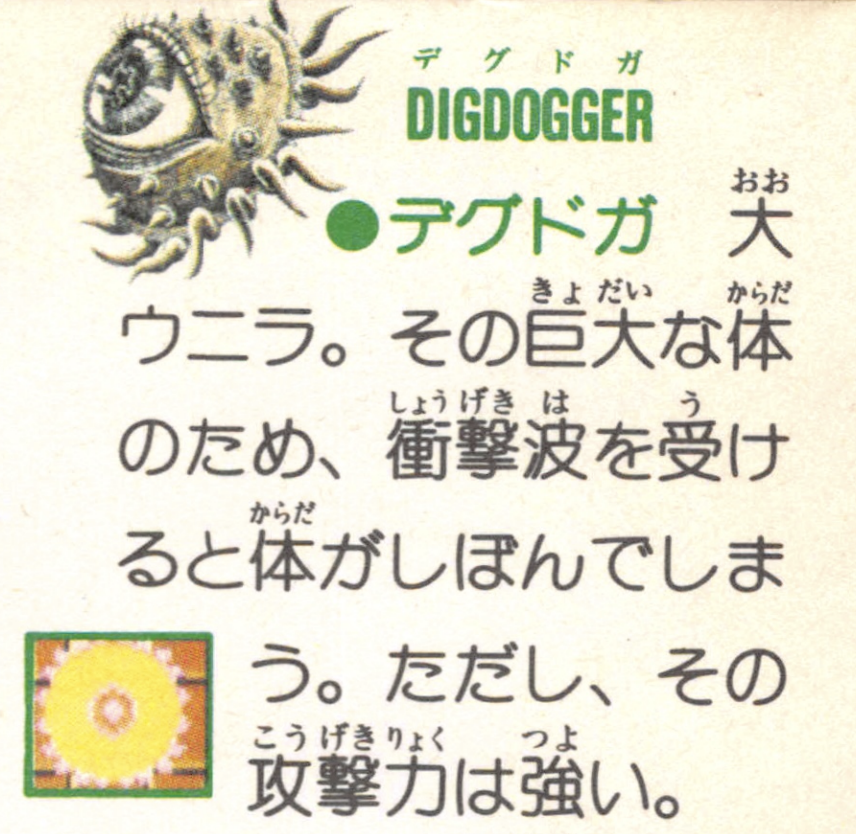
However, the katakana for its name, デグドガ, might also be written out as Degudoga. And that -doga part shows up again in A Link to the Past: Vitreous, the boss of the Misery Mire dungeon, is known in Japanese as ゲルドーガ or Gerudōga. This boss is essentially a slime-covered eyeball, so if you assume the geru- part of its name is a reference to Gel, a recurring slime blob enemy in this series, then you could read its name as essentially “slime eye.” By extension, you could then read Degudoga as something like “big eye.” And it is, in fact, a big ol’ eye.
So what does this have to do with the Deku Tree? Well, if Digdogger is just a big eye, then is the Deku Tree just a big tree? I mean, it is a big tree, but is that what its name means? You know, in case it weren’t obvious that he’s a big tree? And would its name therefore be redundant, in a sense, since degu and deku might imply a large size on their own? Like, is the Deku Tree the Big Big Tree? Or is it the Great Great Tree?
To find out, I first checked out the tree’s name in Japanese. In Ocarina of Time, it’s usually written out at デクの樹さま or Deku no Ki-sama, with 樹 or ki meaning “tree” and さま or -sama being the honorific suffix. That suffix gets dropped sometimes, and in Wind Waker and Echoes of Wisdom, it’s just デクの樹 or Deku no Ki — “Deku Tree.”
Next, I asked Fatimah, who pointed out that the English version of the game might call it the Great Deku Tree for reasons that might have nothing to do with the meaning of deku in the series and instead be based on the choice of an advanced kanji over a simple one:
The most basic kanji for tree is 木, but the deku tree uses 樹, which comes with a grander connotation. Even the way it looks feels fancier. It contains the 木 tree radical on the left-hand side of the character, but is made up of multiple kanji radicals. So even visually, it looks more complex than the simplicity of the 木 kanji.
Fatimah also cautioned that 木 can also mean “wood” in the many senses that humans might discuss it, and therefore it’s both broader and more common. (And yeah, in fact, it’s that kanji that appears in 木偶 or deku, the word meaning “puppet” or “wooden doll.”) However, 樹, the kanji used the in Deku Tree’s Japanese name, means something more specific: “a standing tree.” And it lends itself to special connotations, Fatimah explained; the Japanese name for the Etrian Odyssey series, for example, is 世界樹の迷宮 or Sekaiju no Meikyū — literally Labyrinth of the World Tree, the world tree being another name of Yggdrasil.
So we have a kanji that tells you this tree is special, we have an honorific suffix at least part of the time, and we’ve got a name that is used throughout the Legend of Zelda series, however subtly, to convey greatness of size if not greatness of stature as well. If we’re debating what deku means in this fictional universe, then I think it’s pretty clear that we’re talking about immensity and grandeur and not, you know, being made of wood. Because all trees are made of wood and that’s not usually a facet of their character that you need to impart to someone. Is the important thing about the Great Deku Tree that it’s huge and is also the genus loci of Hyrule forest? Or is it that it’s made of wood like every other goddamn tree in the kingdom?
(I am assuming you pick the right answer here.)
The only part that confuses this matter somewhat is that Ocarina of Time and later games also refer to various items with the Deku name — Deku Sticks, Deku Seeds, Deku Nuts — in addition to the Deku Scrub and Deku Baba enemies I mentioned earlier. None of these are especially large, and they’re all woody enough that I think people assume the “wooden puppet” sense is what’s being alluded to in the name. That is probably part of it, and that’s probably why calling them this sounded right to the game’s Japanese creators, even if it muddied up the way the series used deku- and degu- in every other context. But yeah, I think someone goofed and didn’t get the message that in Hyrule, these words aren’t meant to convey “wood” as much as “big.” Maybe they didn’t fully understand what the Deku Tree’s name was supposed to mean.
Do we want an in-universe explanation for this as well? Fine, sure. Let’s say the Deku Tree’s name used to specify that it was the biggest and most-talkingest tree in the land, but over the years the meaning of the name got lost and ended up taking on generic senses for things that were products of trees or tree-adjacent. Or maybe all of these things with the Deku branding — the nuts, the seeds, the little Fry Guy-looking bush dudes — actually retain some essence of Big Granddaddy Tree and that’s why they’re more special than ordinary plants. Or hell, for all I know, the tree is so famous that Hyrule merchants named ordinary sticks and nuts for the Deku Tree just to help sell them.
Any of these could work, I guess, but I’m more interested in the IRL explanation — and I feel like this one makes a lot of sense. Yes, I think I just managed to prove that the Great Deku Tree is, in fact, great.
Miscellaneous Notes
I’ve got a few Ocarina of Time posts planned. I have not played the game since the Nintendo 64 was the newest console in my house, and I’m looking forward to putting an analytical eye on some of the stuff I just accepted when I first played through.
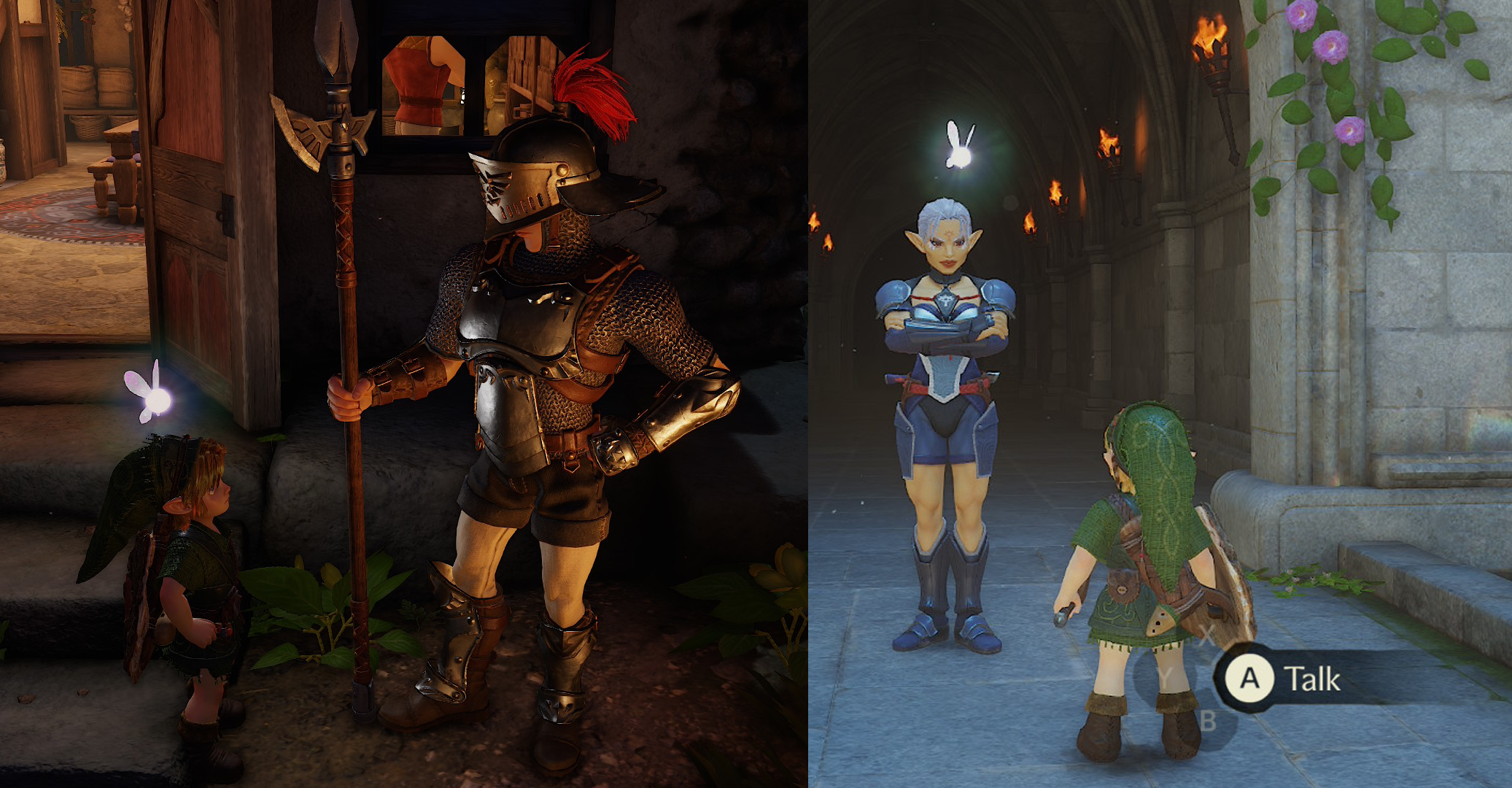
For example, can I commend whoever saw fit to restyle Impa and the Hyrule guards just enough to make it clear that they’re wearing uniforms of the same design? I never noticed this before — and always thought Impa’s Ocarina of Time design looked a little off until now. In this remake, I think Impa looks great and I kind of want a version of the Hyrule soldier outfit for my Halloween costume next year.
While researching this post last night, I realized my understanding of the Japanese particle の or no was lacking and I didn’t understand exactly what it was doing in the Deku Tree’s Japanese name. It’s a lot, this character, and although English-speakers often shorthand it as an equivalent of the English word of, it’s not strictly a possessive case word so much as it is genitive case, which I’m not sure is something that gets really taught when you’re learning English. Ironically, the person who ended up offering the best explanation ended up being Liz Bushouse, who had no idea that I was already writing a post that she’d essentially kickstarted. In my head, at least, the best way I can think to understand what the の is doing in デクの樹 is something like “Tree of Deku,” which sounds weird until you remember that this is a construction we use for foreign, fanciful or otherwise important names, in both English and Japanese. Examples: Tower of Druaga (which could have easily been Druaga Tower, but just wasn’t), the City of New York, the Land of Nod, and the Japanese way of writing out the name of its most famous mountain, 富士の山 or Fuji no Yama.
Confusingly, the Japanese name for the Deku Scrub is デクナッツ or Deku Nattsu — literally “Deku Nut.” So what does Japan call the Deku Nut item? デクの実 or Deku no Mi, with 実 or mi meaning “fruit.” I would call this a good localization change. It reduces confusion, but also scrub works as a pretty good pun in English, referring to both a shrub and a someone who’s not on the starting line-up — and these guys definitely aren’t.
The confusing thing about Vitreous’ Japanese name more or less meaning “slime eye,” at least by Hylian standards, is that there very much is a boss character whose English name is that already: Slime Eye, which debuted in Link’s Awakening, and whose Japanese name is デグゾル or Degu Zoru, meaning it’s meant to be a big version of a different recurring slime enemy in this series, the Zol. Go figure.
I assume Degudoga and Gerudōga aren’t the only eyeball monsters in the Zelda series to have the -doga word part, but I can’t think of any.