
The problem with writing about old media is that any time you think you’ve discovered something new, you’re putting yourself at risk of being the Christopher Columbus of retro and getting all excited about something that everyone else already figured out decades ago. This post is probably that, but I’m going forward with it anyway because I was just so stoked when I figured this out… even after it was brought to my attention that I am not the first to do so.
But here we go: There is a logic underpinning the Robot Master weakness system in the first Mega Man.
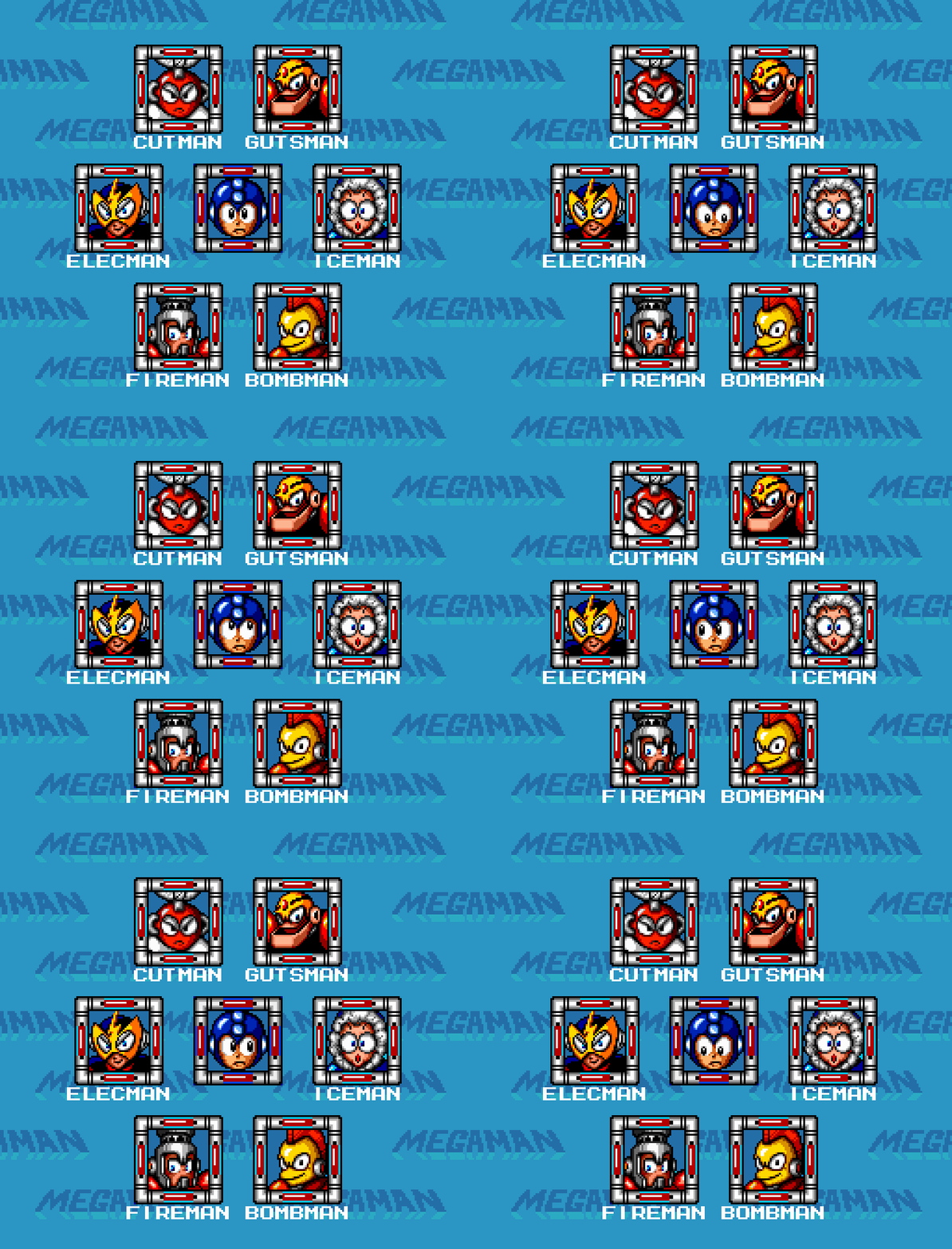
I can’t imagine you’d be reading this blog without knowing the system I’m referring to, but just in case this is somehow the first Mega Man-related post you’ve ever read, the way the game works is that beating one boss gets you his special weapon, which you can then use against another boss to beat him more easily. The logic dictating which weapon is effective against which boss is fairly obvious once you realize it, but I’ve been aware of this system since I was in the first grade, and it only occurred to me this morning that Elec Man is weak against Cut Man’s weapon, the Rolling Cutter, because it’s a reference to cord-cutting — you shut off the power to a machine when you snip the electrical cord. And from there, everything else more or less fell into place.
Elec Man’s weapon, the Thunder Beam, is effective against Ice Man, and I guess that sort of makes sense if you think about water being a conductor of electricity… even if ice is solid water and doesn’t conduct electricity nearly as well as when it’s in its liquid form, but whatever. Ice Man’s Ice Slasher works well against Fire Man, and that makes sense since something cold and wet can put out fire. Fire Man’s Fire Storm is the weapon that takes out Bomb Man because fire can detonate anything explosive. From Bomb Man, Mega Man gets the Hyper Bomb, and Guts Man is weak against that because he’s associated with rocks and boulders, which you use explosives to get rid of. Guts Man grants the Super Arm, which allows Mega Man to throw heavy rocks and which is most effective against Cut Man because — and this one is the one that really got me — as everyone knows, rock beats scissors.
Ta-fucking-da.
To me, this is notable for two reasons. For one, I’m surprised I never put this together before now because I’ve known for some time that the original Robot Master weakness system was explicitly modeled on Rock Paper Scissors, in which each option is weak against one thing and strong against another. I’m not sure when I learned this, but at the very least it’s been in the public consciousness since a 2003 interview that G4 did with Mega Man co-creator Keiji Inafune. I would guess it was known even before that, however.
Around the 3:54 mark, Inafune explains the parallel: “Basically, when you think about it, there’s nothing in the world that is just stronger than everything else. Almost everything has something that it’s stronger than and something that it’s weaker [than]. It’s sort of like in [Rock Paper Scissors]. Scissors will beat paper, but it loses to the rock. Paper will beat the rock but it loses to scissors, so that’s how the Mega Man weapons work.”
But even knowing that Rock Paper Scissors was the model for the first Mega Man, I didn’t realize that it extended to the reasoning why one Robot Master’s weapon would be effective in taking down another. I guess I just assumed it was random what weapon worked well against whatever boss, but this brings me to the second reason I think this “discovery” is notable: It helped new players by rewarding basic critical thinking.
While there was a segment of the video game-playing population that had access to Nintendo Power or other publications that helped you suck less at video games, a lot of people were on their own, just renting random titles off the shelf and hoping they could get past the first level. A well-designed game helps new players out a little, however, and there being a logic as to which weapon works on which Robot Master speaks to the thoughtfulness of the team that created Mega Man. Unlike most platformers, which push players down a linear path, Mega Man allowed players to choose which stages they take on and in which order — and that level of freedom might be daunting to people not used to forging their own paths. But if someone took a second and wondered if some sort of organization might suggest the proper stage order, they might have an easier time moving through this game. Even if they only figured out which Robot Master was weak to which weapon as a result of a lot of trial and error, it would still be gratifying to realize that the game was giving clues from the get-go. It’s sort of like the difference in a the solution to a whodunit being something completely random versus something that makes sense and was in front of your face the entire time, even if you didn’t figure it out on your own.
So yeah, I thought I was all smart when I posted this to Bluesky this morning, but then someone pointed out that the YouTuber FlamingMercury5 not only figured this out but actually did an explainer for all logic dictating Robot Master weaknesses all the way through Mega Man 11.
Are some of them a stretch? Yes! But I’m just happy someone else did the work and you can watch her talk through it all so I don’t have to. None of the sequels works out as cleanly as the first one does, in my opinion. That said, her reasoning that Metal Man’s Metal Blade works well against Flash Man, the time-controlling Robot Master, because it’s a reference to cutting through the fabric of time makes sense to me.